Key takeaways
- AI adoption in Bangladesh is no longer a big-company story. Founders, professionals, students, and small business owners are all moving at once.
- The businesses that gain from AI are the ones that weave it into daily work, not the ones that buy a tool and leave it idle.
- B2B and service businesses in Bangladesh have a clear opening right now in lead generation, email, content, and reporting.
AI Summit Rajshahi 2026 made one thing clear: AI adoption in Bangladesh is no longer driven from the top down by large corporations. Founders, professionals, and students are all moving at the same time. The businesses that treat AI as core infrastructure today, not a tool to bolt on, will hold a hard-to-close advantage by 2027.
Bangladesh is not waiting for AI to arrive. That was the clearest signal at AI Summit Rajshahi 2026, an event that brought together founders, working professionals, students, and business owners from Dhaka, Rajshahi, and the surrounding region. Accord Tech Solutions was a proud sponsor, and what we saw in that room told us a lot about where AI in Bangladesh actually stands.
This was not a room watching AI from a comfortable distance. It was a room of people who had already decided to move. And the range of people who showed up, from seasoned founders to fresh graduates, made it plain: AI adoption in Bangladesh is no longer a conversation happening only inside tech companies. It is starting to shape how ordinary businesses plan their next year, including the AI-powered B2B marketing work we do every day.
Who actually showed up at AI Summit Rajshahi 2026?
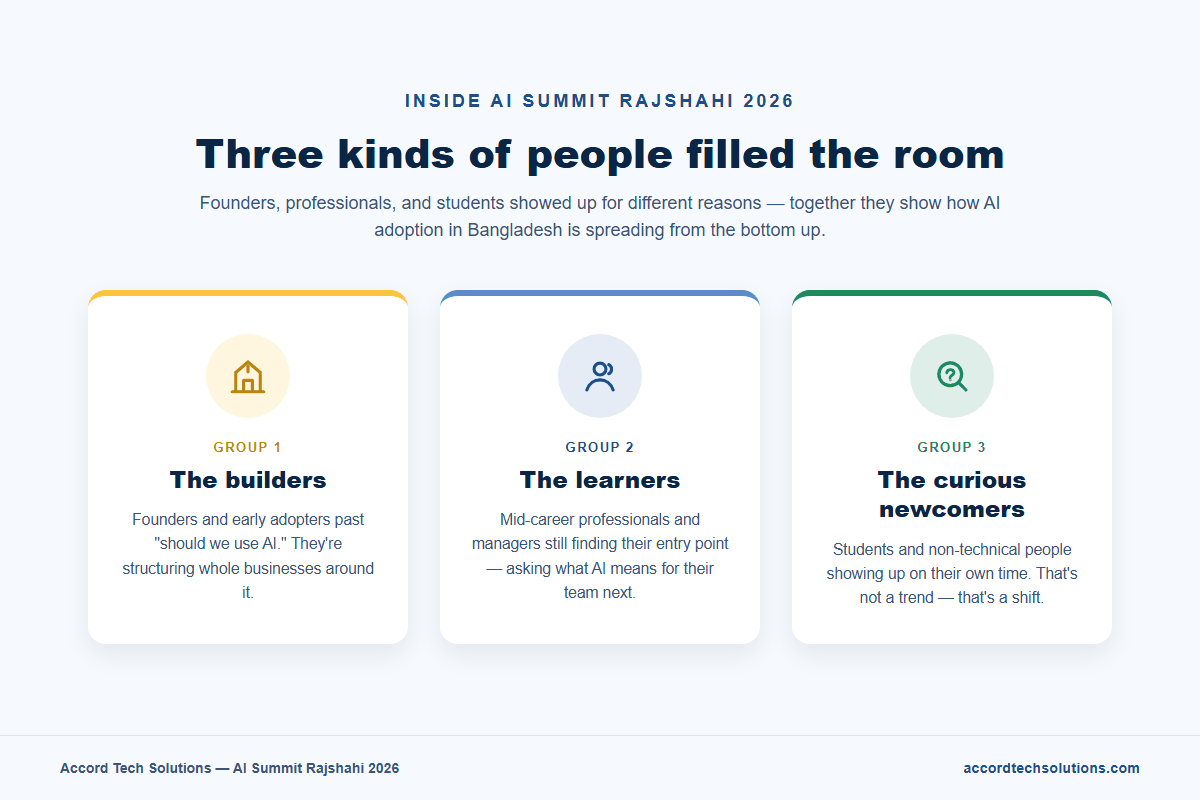
Three distinct groups filled the room, and together they painted an honest picture of where AI adoption in Bangladesh stands in 2026.
The first group is already building. These are the founders and early adopters who have moved past "should we use AI" and are now asking "how do we structure a whole business around it." They were a minority, but they spoke with the quiet confidence of people who had already tried things and learned from them.
The second group is still learning. Mid-career professionals, managers, and executives who know AI is changing their industry but have not yet found their entry point. They came to understand, not just to observe. Their questions were specific and practical: not "what is AI," but "what does this mean for my team next year."
The third group, and the most important signal in the room, was students and people from non-technical backgrounds. Their curiosity showed that AI awareness in Bangladesh has moved well beyond the tech sector. When people with no prior interest in software start showing up to AI events on their own time, that is not a trend. That is a shift.
All three groups in the same room, in Rajshahi, in 2026, tells you something important: this adoption is bottom-up. People are not waiting for permission.
Why does this mindset shift matter more than any single tool?
It matters because the gap between "early adopter" and "mainstream" is shorter than it has ever been. In most emerging markets, technology arrives, large enterprises test it, and awareness spreads outward over years. In Bangladesh in 2026, that sequence is collapsing into a single moment.
Small businesses in Rajshahi are digitizing and spotting opportunities at the same time, without waiting for large organizations to show them how. Professionals across industries are asking how to stay relevant. Learners are not waiting for the curriculum to catch up. Adoption is happening on several levels at once, not one after another.
The scale is real, not anecdotal. A December 2025 Telenor Asia study reported that 96% of Bangladeshi internet users say they regularly use AI. The demand side is clearly ready; the question is whether businesses move to meet it.
The founders who impressed us most were not the ones naming the most advanced tools. They were the ones who had picked one specific problem, tested a solution properly, and built a repeatable process around it. That is the approach that produces results.
What should Bangladeshi businesses actually do now?
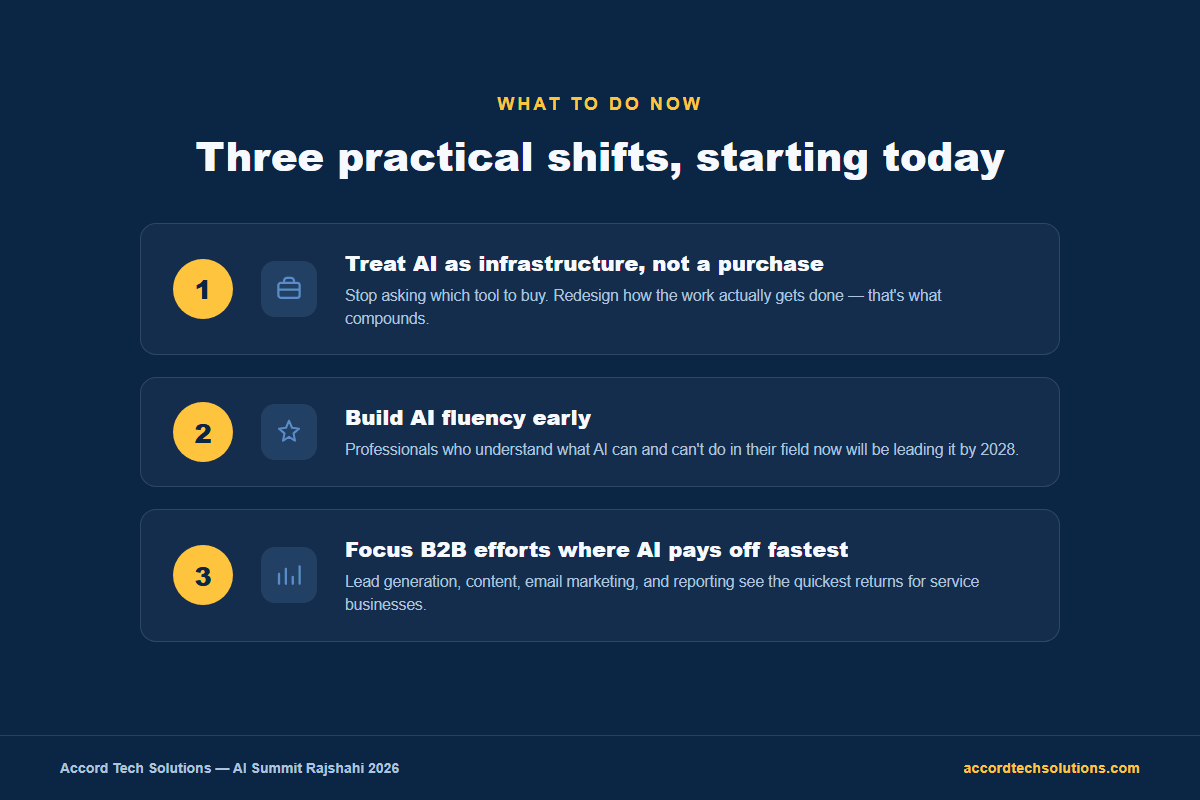
The conversations at AI Summit Rajshahi 2026 pointed to three practical shifts businesses can make right now, not in some distant future.
1. Stop treating AI as a software purchase
The founders in that room were not asking "which AI tool should I buy." They were asking "how do I redesign my operations around what AI makes possible." That is the right framing.
AI-powered marketing, AI-powered sales, and AI-powered operations are not features you switch on. They are a different way of thinking about how work gets done. Approach AI as a one-time purchase and you get one-time results. Approach it as ongoing infrastructure and the gains keep compounding.
The practical test is not "do we have an AI tool." It is "have we changed how we work because of it."
2. The professionals who adapt earliest will lead
The professionals asking "how do I stay relevant" were asking exactly the right question. The answer is not to learn every tool on the market. It is to become genuinely fluent in what AI can and cannot do in your specific field, then build your daily work around that understanding.
The people who do this in 2026 will be the managers and senior leaders of 2028. Not because AI replaces everyone else, but because the people who understand it make better decisions, move faster, and become far more useful to the organizations they work in. The professional who builds that fluency now is two years ahead of the one who waits for a company training course.
3. AI for small businesses in Bangladesh pays off fastest in B2B
Consumer AI gets most of the global attention. But the most immediate opportunity in Bangladesh sits in B2B and professional services. AI for small businesses in Bangladesh can stretch the resources a company already has across lead generation, content production, email marketing, digital advertising, and client reporting.
The math is simple. Suppose AI cuts the time to deliver a piece of work by half. The agency or service that adopts it first can take on more clients at no extra cost, or lower its prices while protecting margin. Either advantage compounds. This is exactly why we build AI into lead generation and outreach for B2B clients, rather than treating it as a side experiment.
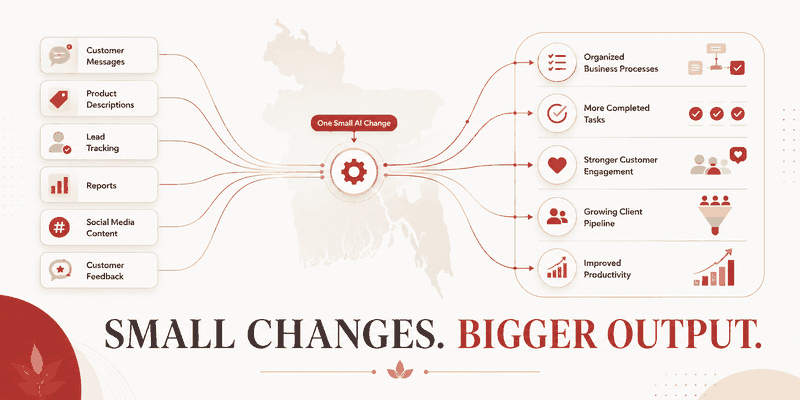
What AI adoption means for small businesses specifically
For a small business in Bangladesh, AI is not really about cutting-edge technology. It is about getting practical things done a little better, with the team you already have.
A small business rarely needs an elaborate system. It usually needs a better way to handle one recurring job: responding to customer messages, writing product descriptions, putting together social posts, tracking leads, or making sense of customer feedback. Start with one clear area:
- A local service company can use AI to build templates for common customer responses.
- A small agency can use it to turn around client reports faster.
- An ecommerce business can use it to write sharper product descriptions.
- A training center can use it to assemble learning materials.
- A B2B company can use it to support email outreach and prospect research.
The aim is not to roll AI out everywhere at once. Pick one real problem, build something simple around it, see whether it works, then improve it. For a small business, that is far more sensible than trying to overhaul everything in one go.
Why is AI different from every upgrade that came before it?
Because earlier business technology made existing tasks more efficient; AI changes what gets done, who does it, and what still needs a human decision. That distinction matters.
For decades, CRMs, digital marketing platforms, and cloud tools sped up work people were already doing. AI is a different kind of shift. Marketing teams can now run at a scale that used to require a much bigger budget. Decisions that once waited for a monthly review cycle can be made in days. Client communication can become personalized without taking longer to produce.
These are not concepts. Businesses at the summit were already doing them, and they were not describing complicated setups. They were describing simple processes built around tools we all have access to today. The only difference was that they had already started.
There is a catch. AI only delivers when it is used with clear goals, proper checking, and some discipline about how it is applied. Use it haphazardly and you get haphazard results. Build it into your process and you get something worth having.
Where Accord Tech Solutions fits into this
As a sponsor of AI Summit Rajshahi 2026, Accord Tech Solutions sees Bangladesh's digital marketing market at a genuine turning point. We work at the intersection of AI and B2B growth: building reliable sales pipelines, improving organic visibility, and making sure buyers can find a brand whether they search on Google, ChatGPT, or another AI engine.
That last point has a name. Answer engine optimization (AEO) is the practice of structuring content so AI engines understand it, trust it, and cite it in their answers. It sits alongside traditional SEO, and for businesses that adopt it early, it is one of the clearest ways to stay visible as search behavior changes.
The shifts we watched at the summit, founders rethinking business models, professionals upgrading skills, and AI being treated as infrastructure rather than an experiment, mirror what we see inside our clients' operations.
Final thoughts
AI Summit Rajshahi 2026 showed something worth showing: Bangladesh's AI conversation has grown up. Founders are not just curious anymore, they are building. Professionals are not just watching, they are preparing. Students are not waiting to see how things settle, they are working out where they fit.
The businesses that come out ahead will not be the ones that chased every new platform. They will be the ones that picked a real problem, built something practical around it, brought their team along, and kept getting better at it.
If you left the summit asking "how do we get started," that is the exact question our team is built to answer. Tell us where your team loses the most time, and we will help you build the first AI-driven workflow that earns it back.
Frequently asked questions
What was AI Summit Rajshahi 2026?
AI Summit Rajshahi 2026 was a Bangladesh-based event that brought together founders, entrepreneurs, professionals, and students from Dhaka, Rajshahi, and the surrounding region to focus on AI adoption, business-model innovation, and the future of work. Accord Tech Solutions was a proud sponsor of the event.
Why is AI Summit Rajshahi 2026 worth paying attention to?
Because the crowd it drew reached well beyond the capital and beyond the tech sector. When a serious AI audience turns out in Rajshahi rather than Dhaka, and includes students and non-technical professionals, it signals that AI interest in Bangladesh is no longer concentrated in one city or one industry.
Is AI relevant for small businesses in Bangladesh?
Yes, for the right tasks. AI is most useful to a small business when it takes over a repetitive weekly job, such as answering common customer questions, writing product descriptions, or chasing leads. The barrier to entry is lower than most expect; the trick is starting with one task rather than overhauling everything at once.
How should Bangladeshi businesses start with AI?
Start with the problem, not the tool. Identify the single task your team wastes the most time on, build one simple AI-assisted workflow for it, and confirm it works before expanding. Proving a return on one narrow use case is far more sustainable than rolling AI out across the whole company at once.
What is AI-powered B2B marketing?
AI-powered B2B marketing uses machine learning and large language models to attract, engage, and convert business buyers. In practice it means AI-assisted SEO and answer engine optimization, personalized email marketing, prospect research, and predictive lead scoring, with the thinking and final decisions still owned by your team.
How does AI help with B2B lead generation?
AI lead generation for B2B speeds up the three steps that eat the most time: finding prospects, researching them, and drafting outreach. It builds targeted lead lists, enriches them with useful data, and personalizes the first message at scale, which lifts reply rates without adding headcount. It will not close deals, but it frees the people who do.
What is answer engine optimization?
Answer engine optimization (AEO) is the practice of structuring your content so AI answer systems, such as Google's AI summaries, ChatGPT, and Perplexity, can read, understand, and cite it. It sits alongside traditional SEO rather than replacing it, and it is becoming essential as more people get their answers directly from AI.
What is the biggest mistake businesses make with AI?
The biggest mistake is treating AI as a one-off purchase: buying a tool, using it twice, then returning to the old way. AI pays off as an ongoing habit, not a single experiment. The advantage goes to teams that keep building processes around it, testing, refining, and expanding what works.