
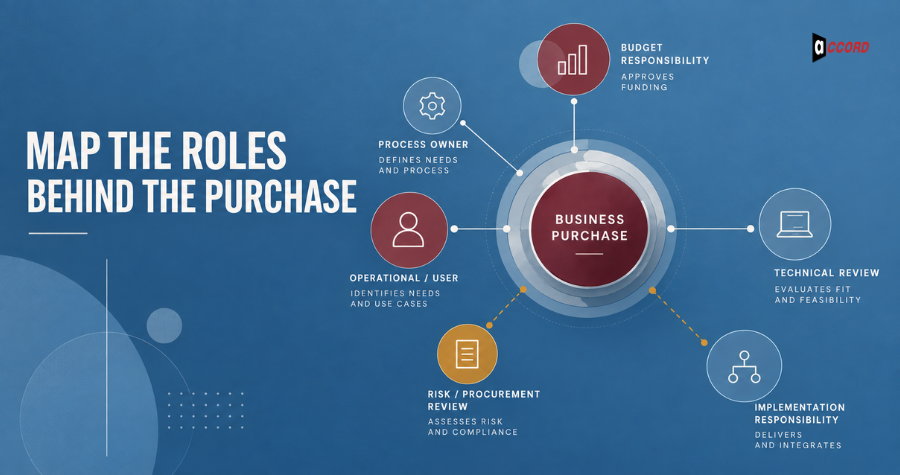
B2B buying committee mapping identifies the responsibilities, concerns, and decision roles involved in a purchase. Begin with the business problem, map the functions affected, and distinguish confirmed involvement from assumptions. Use the map to plan relevant conversations and shared evidence, then update it as buyers explain how their organization actually decides.
An account can contain several people with impressive titles and still leave the buying process unclear. The person who answers your email may use the service, recommend a supplier, coordinate evaluation, or simply forward the request. None of those roles automatically includes budget authority.
A buying committee map helps a team understand those differences. It is a working explanation of a purchase, not a list of people to contact simultaneously. Good mapping reduces repeated questions and helps sales bring the right material into each conversation.
For teams using account and contact research, the map also gives researchers a more useful brief than "find decision-makers." It defines what involvement means for the particular offer.
Define the decision before researching names
Start by describing the proposed purchase in operational terms. What will change, who will use the output, and which systems or processes could be affected? A website content engagement has a different decision structure from replacing a customer database, even inside the same company.
List the decisions required to proceed. These might include approving the business case, validating technical compatibility, agreeing on implementation capacity, and completing procurement. Some purchases combine several decisions in one person; others distribute them.
Keep scope narrow enough to investigate. "Digital transformation" can involve almost every department. "Rebuilding the service-page publishing workflow" points toward a clearer set of responsibilities and dependencies.
Write down what the research cannot establish. Public information may reveal department structure or role descriptions, but usually cannot prove a private approval process. The map should reserve those questions for direct confirmation.
This preparation prevents a common mistake: collecting senior names first and inventing a buying role for each afterward.
Map functions before job titles
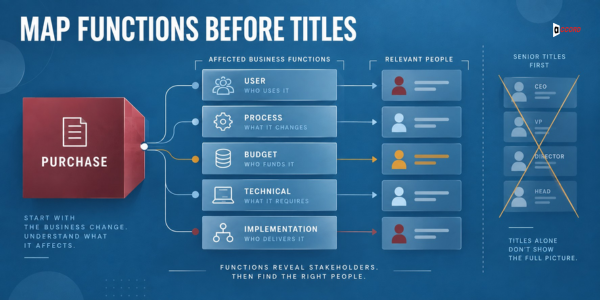
Identify the functions that experience the problem or control the proposed change. Consider users, process owners, budget owners, technical reviewers, risk reviewers, and implementation teams. These are functional roles, not a universal committee template.
A marketing operations manager may own campaign workflows but rely on IT for integration approval. A finance leader may approve spending without participating in day-to-day evaluation. Procurement may manage the contract after a business sponsor has already agreed on the need.
Use titles as research clues. Read the responsibilities attached to a role instead of assuming that a title carries the same authority across companies. Organization size and business model can change the meaning substantially.
An outsourced service can also affect people who will not sign the agreement. If internal specialists must provide information or review deliverables, their workload matters. Ignoring them may create implementation resistance even when a senior sponsor supports the project.
Map these dependencies before deciding which contacts are necessary.
Distinguish role, person, and relationship
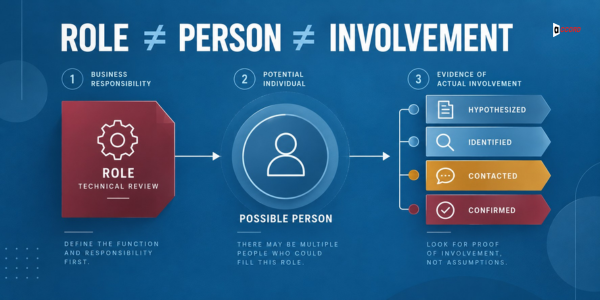
Keep three separate concepts in the record. The role describes the buying responsibility. The person is the individual who may hold it. The relationship describes what your team currently knows about their involvement.
For example, "technical reviewer" is a role. A named systems manager is a possible person. "Confirmed by the project sponsor during a discovery call" describes the relationship evidence. A public profile alone would justify a weaker status.
Useful involvement statuses include hypothesized, identified, contacted, and confirmed. Define them clearly. A person can be identified without being contacted, and contacted without being involved in the purchase.
Allow one person to hold several roles. Small organizations often combine budget ownership, evaluation, and implementation. Forcing a separate contact into every box creates unnecessary research and can misrepresent the business.
Also allow an unfilled role. An honest gap makes the next question visible. An invented decision-maker creates false confidence that spreads into outreach, planning, and forecast discussions.
Build a practical B2B buying committee map
For each relevant role, record the affected function, likely concern, evidence needed, involvement status, source, observation date, and next confirmation question. Add the person only when you have a defensible match.
The map should answer practical questions. Who understands the operational problem? Who will evaluate the proposed method? Who must provide access or approve changes? Who could explain the approval sequence?
Avoid turning the map into an encyclopedia. Details should change the conversation or the preparation. A long biography rarely helps more than a clear statement about responsibilities and unresolved dependencies.
A compact role entry might say: "Website operations owner; concerned about publishing effort and maintenance; involvement hypothesized from role description; confirm who approves CMS workflow changes." That is more useful than labeling someone a champion before they have expressed support.
Keep source facts and sales interpretation in separate fields. This makes it easier for another teammate to challenge an assumption without disputing the underlying observation.
Match evidence to each stakeholder's concern
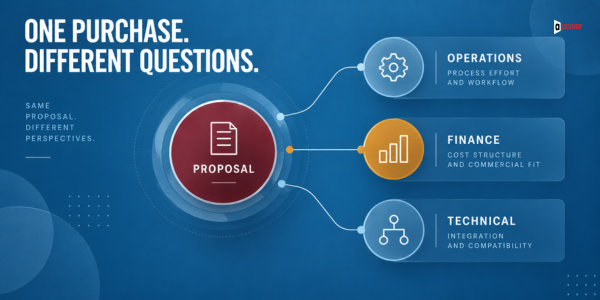
Different stakeholders may need different explanations of the same proposal. The operating team may need a process demonstration. Finance may need a transparent cost structure. Technical reviewers may need integration requirements, access boundaries, and maintenance responsibilities.
These are common possibilities, not fixed personality categories. Ask the buyer which questions matter instead of relying on stereotypes about departments.
Build a shared core explanation so the materials remain consistent. The business problem, scope, assumptions, and promised deliverables should not change between stakeholder versions. Adapt the depth and emphasis, not the underlying offer.
For example, a proposed website engagement might use one scope document with separate sections covering editorial ownership, implementation dependencies, and acceptance testing. Stakeholders can review their concerns without receiving contradictory presentations.
This connects naturally to website development planning. Technical and commercial clarity are part of the buying process, even when the first conversation starts with design.
Ask for process clarity respectfully
A direct conversation is usually the best way to confirm the map. Explain why the question matters: you want to prepare useful information and avoid leaving affected colleagues out of the discussion.
Ask who will use the output, who needs to review the approach, and what must be agreed before the project can start. Questions about the decision process often produce more useful answers than asking for "the real decision-maker."
Avoid bypassing the person helping you. A contact who coordinates evaluation may hold substantial influence even without final signing authority. Treat their guidance as valuable and ask how they prefer to involve colleagues.
When someone names another stakeholder, clarify whether an introduction is appropriate. A referral is context, not permission to imply a relationship that does not exist.
Record the buyer's wording carefully. "Finance reviews proposals above a threshold" does not mean finance has approved the current proposal. The map should preserve that distinction.
Coordinate outreach at the account level
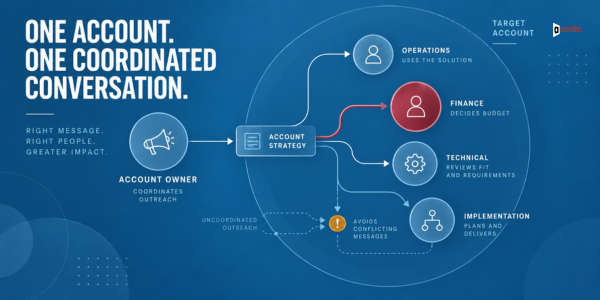
A committee map can help prevent multiple teammates from contacting the same organization with conflicting messages. Assign an account owner and make active conversations visible before launching additional outreach.
Decide which contact is appropriate for the first question. Often, one relevant conversation can clarify the process more effectively than contacting every plausible stakeholder at once.
When parallel conversations are justified, coordinate the purpose. One discussion might resolve technical feasibility while another clarifies operational requirements. Each recipient should understand the context without receiving a false impression of internal agreement.
Pause scheduled messages when a human conversation begins if those messages would conflict with the exchange. A prospect who has already referred you to a colleague should not receive an automated note asking whether anyone owns the topic.
Treat silence as uncertainty. It does not prove that a person lacks authority or that another stakeholder will welcome escalation.
Work through a hypothetical website purchase
Imagine a business services company considering a new website publishing workflow. The initial contact is a marketing manager who describes slow content approvals. The seller could assume that marketing owns the entire purchase, but the map suggests several questions.
Who maintains the current CMS? Who approves changes to customer-facing claims? Who will train new editors? Who signs the service agreement? The answers may reveal a web administrator, a subject expert, and an operations leader alongside marketing.
The manager confirms that the web administrator must review integrations and that operations approves the project budget. The map now distinguishes confirmed roles from the still-unknown legal review process.
The next meeting can focus on publishing requirements and technical constraints. A separate commercial review can follow once the scope is clear. There is no need to bring every stakeholder into every discussion.
This is an illustrative scenario. Its value is the sequence of clarification, not a claim about a typical committee size or an Accord client result.
Handle disagreement and changing participation
Stakeholders may disagree about the problem itself. Marketing may want faster publishing while technical staff want fewer unsupported integrations. Treat that disagreement as a requirement to resolve, not an objection to overcome with more persuasive copy.
Write the competing needs in neutral terms. Identify which tradeoff belongs in the project scope and which decision needs an accountable owner. A shared acceptance criterion can sometimes resolve what appears to be a personality conflict.
Update the map when participation changes. Someone may delegate evaluation, a new project lead may join, or a department may become relevant after scope expands.
Preserve important history without leaving outdated roles marked active. Note when and why the responsibility changed. That history helps new sales or delivery colleagues understand prior decisions.
If the buyer cannot clarify ownership, recommend a smaller next step that establishes it. A requirements workshop may be more appropriate than preparing a full proposal around an unconfirmed process.
Hand the map from sales to delivery
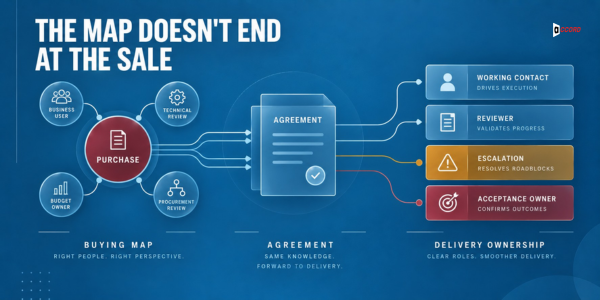
The buying committee map remains useful after agreement. Delivery needs to know who approves work, supplies information, resolves blockers, and accepts the final output. These responsibilities may differ from the roles that selected the supplier.
Translate the sales map into a delivery ownership plan. Confirm the primary working contact, escalation route, subject reviewers, and acceptance owner at kickoff rather than treating the signed agreement as the final source.
Keep the handoff factual. Include decisions already made, unresolved questions, promised follow-ups, and any constraints that affected the scope. Exclude subjective labels that do not help the team work with the client.
Check access to the record. Contact information and private buying discussions should remain within the people who need them. A public case study or marketing asset should never inherit internal stakeholder notes accidentally.
The handoff succeeds when delivery can explain how decisions will be made without asking the buyer to repeat every earlier conversation.
Review the map for usefulness
Review whether the map helped the team prepare relevant material, identify missing responsibilities, and avoid contradictory outreach. Counting contacts alone rewards a larger list rather than a clearer understanding.
Look for recurring gaps. If technical requirements repeatedly appear late, the initial discovery questions may need revision. If budget discussions stall because scope is unclear, adding more executive contacts may not solve the actual problem.
Ask salespeople which fields they use and which they ignore. Remove fields that invite speculation or duplicate another system. Keep the evidence and next-question fields because they support learning.
A useful map is small enough to maintain and explicit enough to challenge. It should guide the next conversation while remaining open to correction by the buyer.
Frequently asked questions
How many people belong in a buying committee map?
Include the roles needed for the actual purchase rather than aiming for a standard number. A small engagement may involve one or two people with several responsibilities. A more complex project may need additional reviewers. Public research should generate hypotheses that conversations then confirm.
Is the most senior contact always the best starting point?
No. Start with the person whose responsibilities make the question relevant and who can help explain the problem or process. A senior executive may sponsor the project, but an operational owner can often provide the detail needed to determine whether there is a useful fit.
What is the difference between a sponsor and a champion?
Use those terms carefully and define them internally. A sponsor may support the business objective or allocate resources. A champion may actively help colleagues evaluate the proposal. Neither label should be assigned merely because a contact replied positively or attended a meeting.
Can public profiles confirm purchase authority?
Usually they can suggest responsibility, not confirm private approval authority for a particular purchase. Record the profile as evidence of a role and mark the buying responsibility as a hypothesis. Ask the organization to explain its process before relying on that assumption in a proposal.
Should the map be shared with the prospect?
A neutral responsibility summary can be useful for confirming who reviews what. Internal notes about relationship strength or sales strategy may be inappropriate to share. Prepare a buyer-facing version containing responsibilities, open questions, and agreed next steps, and check it for accuracy.
Make the next conversation easier to prepare
Start with the purchase and its consequences, then map responsibilities with evidence. The goal is a coordinated discussion in which the right people can evaluate the right questions.
Contact Accord Tech Solutions to discuss a research brief that connects target accounts, relevant functions, and stakeholder questions. Bring the offer and the uncertainties your current contact list cannot explain.
Methodology and sources
An original editorial framework for role-based research and discovery. The website example is hypothetical. No universal committee-size statistic, private contact data, or claimed client result is used. Accord service references were checked against current public service pages.