
B2B email A/B testing compares two deliberately different versions to answer one defined question. With small lists, focus on meaningful changes, comparable groups, an agreed measurement window, and honest uncertainty. Choose the decision rule before sending, inspect the actual response counts, and keep an inconclusive result separate from a demonstrated winner.
A campaign report can make a tiny difference look decisive. One version receives several clicks and another receives slightly fewer. The platform highlights a percentage, and the team rewrites its entire email program around the apparent winner.
Small B2B audiences make this temptation especially strong. Each response changes the reported rate substantially, while differences in account fit or timing can influence the result.
A useful test does not need to produce a winner every time. It needs to reduce uncertainty about a question that matters enough to change future communication.
Start with a decision, not a tool feature
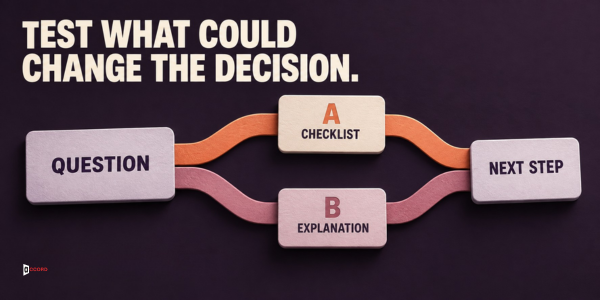
Write the decision the test will inform. For example, you might compare an email that offers a practical checklist with one that offers a short process explanation. The decision is which approach better supports the next step for that audience.
Avoid testing a variable merely because the platform exposes it. Button color may be easy to change, but it may be less consequential than an unclear offer or an irrelevant audience.
Choose one primary question. If the subject, offer, body structure, and destination all change, the test may compare two complete approaches, but it cannot isolate the effect of one component.
Describe the expected mechanism. “A more specific resource may help readers assess relevance” is a hypothesis. “This subject line will increase leads” is an unsupported prediction.
Email campaign planning should establish these questions before the team configures an experiment.
Choose an outcome that matches the email's job
The primary outcome should reflect the action the email is meant to support. A resource email might use a verified resource request. A consultation invitation might use a relevant human reply or completed booking.
Define the event precisely. A click, a submitted form, and a qualified conversation are different outcomes. Do not rename the easiest event to measure as the business result you hoped to achieve.
Use a denominator that is appropriate and consistent across versions. Document whether the rate uses assigned recipients, delivered messages, or another population, and explain any exclusions.
Keep secondary measures for diagnosis. Delivery issues, unsubscribes, and qualitative replies can help interpret the result, but avoid switching the primary measure afterward because another number looks more favorable.
Where the tracking path is uncertain, fix it first or use a simpler outcome that can be verified reliably.
Understand what the platform is comparing
Review the sending platform's test behavior. Check how it assigns recipients, whether it sends to a sample or the whole audience, and how it selects or sends a winning version.
Mailchimp's A/B test guidance describes testing variables and winner-selection options within its product. Those settings are implementation details, not a substitute for choosing a sensible business question.
Confirm whether a declared winner is based on a user-selected metric, a fixed window, or another platform rule. Do not assume that a highlighted version represents strong statistical evidence.
Understand what happens to recipients outside the initial test. If a winner is sent to the remainder, a small early fluctuation can influence the larger campaign.
Record the chosen settings in the test brief so the team can interpret the report later without reconstructing the configuration from memory.
Keep the groups comparable
Use a genuine random assignment when the platform supports it and the test design calls for it. Splitting the first half of a spreadsheet from the second can create differences in source, geography, or acquisition date.
For B2B work, consider account-level effects. Several contacts at the same organization may influence one another or receive related communication. Treating them as completely independent can overstate how much separate evidence the test contains.
If account-level assignment is necessary, plan it before the send. The exact design depends on list structure and the question, so involve someone with experimental-design expertise when the decision is costly.
Keep eligibility and exclusions consistent between versions. A test that sends one version to customers and the other to new subscribers is comparing audiences as well as content.
Document unavoidable imbalances. Transparency about the design is more useful than presenting a neat percentage without its limitations.
Make one meaningful change
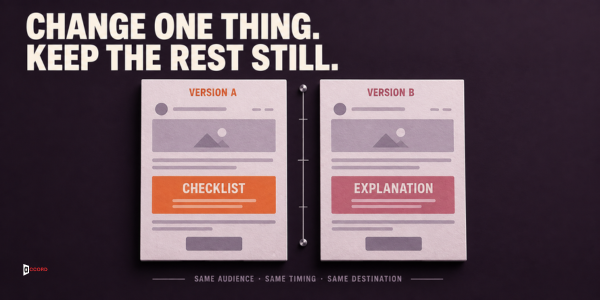
Choose a difference large enough to matter to the reader. Compare a concrete resource with a vague request, a clearer explanation with a dense one, or two distinct ways of framing the same relevant problem.
Keep unrelated elements stable when trying to isolate one factor. Use the same destination, sender context, and eligibility rules unless they are part of the stated comparison.
Avoid tiny cosmetic tests on very small lists when the expected effect is unlikely to be distinguishable from ordinary variation. The team may learn more from reviewing the offer and talking to readers.
If you compare complete creative approaches, label the conclusion accordingly. You can say one approach performed differently in that test; you cannot attribute the difference solely to its subject line.
Save both final versions and their destinations. A report without the actual creative is difficult to turn into useful editorial learning.
Plan for limited evidence
Small lists produce limited information, especially when the meaningful outcome is uncommon. A test can be operationally well executed and still lack enough evidence to support a confident decision.
Discuss the smallest difference that would change your behavior. If only a substantial improvement would justify a new workflow, do not celebrate a trivial observed difference as a strategic breakthrough.
When a formal sample-size calculation is needed, base it on the chosen outcome, plausible baseline, meaningful effect, and design assumptions. Avoid borrowing a sample threshold from an unrelated campaign.
Do not manufacture confidence by adding unrelated campaigns together. Combining results requires comparable audiences, treatments, outcomes, and timing assumptions.
An inconclusive result can lead to another test, a larger observation period, qualitative research, or a practical editorial choice explicitly described as judgment rather than proof.

Set the observation window before sending
Choose a window that gives the intended audience a reasonable opportunity to act. The appropriate duration depends on the communication rhythm and outcome, not a universal rule.
Avoid stopping the test the moment one version moves ahead. Repeatedly checking and declaring a winner at a convenient moment can distort the interpretation.
Decide how late responses will be recorded. A campaign may continue generating useful conversations after the formal test window, but those should not silently change the original comparison.
Keep send timing comparable unless timing itself is the variable. A version sent during a different business period may face different conditions.
Document interruptions such as a broken destination or an unexpected service outage. Those events may make the comparison invalid or require a qualified conclusion.
Work through a small-count example
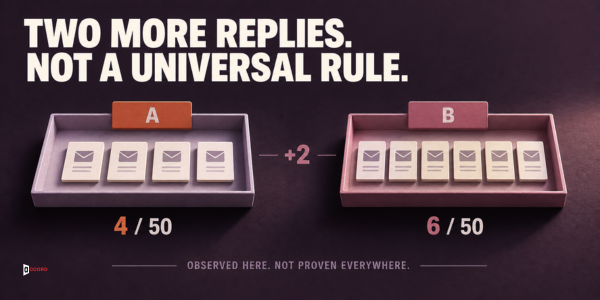
Consider a hypothetical test with fifty eligible recipients assigned to each version. Version A produces four relevant replies and version B produces six. The observed reply rates are eight percent and twelve percent.
The arithmetic is straightforward: divide relevant replies by the fifty assigned recipients in each group. The difference is four percentage points, representing two additional replies in this illustrative sample.
That observation does not, by itself, establish a dependable advantage. The sample is small, and the underlying uncertainty may be substantial. No significance claim is being made here.
Read the replies as well. If one version produces requests unrelated to the offer, its higher response count may not serve the original decision.
The useful report states the counts, definitions, design, and uncertainty. It does not turn two extra replies into a forecast of future revenue or a universal copywriting rule.
Read qualitative responses alongside counts
Human replies can explain confusion that a rate cannot. Readers may misunderstand the offer, ask for a different resource, or point out that the message reached the wrong function.
Classify this feedback consistently. Keep examples anonymized and distinguish direct reader statements from the team's interpretation.
Do not cherry-pick a favorable comment to override an unfavorable quantitative result. Qualitative evidence can suggest a new hypothesis, but it does not rewrite the original test.
Review the destination and follow-up experience. A clear email may still lead to an unclear form, and a useful resource may be delivered too slowly to support the intended action.
When account fit appears to be the problem, revisit lead research and validation rather than testing more subject lines against the same unsuitable audience.
Decide what to do with the result
Use the decision rule established in the brief. Possible outcomes include adopt the better-supported version, continue with the current approach, repeat with a clearer design, or record that the evidence is inconclusive.
A practical choice is still possible when evidence is limited. The team may prefer a clearer version because it is easier to understand and maintain. Label that as editorial judgment supported by the test context, not as a proven performance improvement.
Keep the conclusion proportional to the design. One test in one audience does not establish a permanent rule for every market or lifecycle stage.
Record what should be tested next and why. The next question should follow from uncertainty or observed feedback, not simply produce another campaign activity.
Make the result accessible to future writers so the same weak hypothesis is not tested repeatedly without learning from prior work.
Before adopting a version, check the cost of acting on a mistaken conclusion. A minor wording change may be easy to reverse. Rebuilding a campaign sequence, changing an offer, or reallocating a substantial budget requires stronger evidence. The same observed difference can justify different actions depending on that consequence.
Also consider whether the treatment can be maintained. A highly personalized resource may require research time that the comparison did not measure. Include those operating costs in the decision so the team does not select a version whose apparent benefit disappears when production effort is considered.

Maintain a compact test register
For each test, retain the question, audience, assignment method, versions, primary outcome, denominator, window, result counts, limitations, and decision. This is enough to make the finding interpretable without creating an elaborate reporting system.
Record changes to tracking or qualification definitions. Results measured under different definitions should not be compared casually.
Review the register periodically for repeated inconclusive tests. That pattern may indicate an audience too small for the chosen questions or a tendency to test differences that are not meaningful.
Balance experiments with direct improvements. Fixing a broken link, correcting an inaccurate claim, or honoring a preference should not require an A/B test.
The testing program should help the team make better decisions, not delay obvious corrections or create a stream of weak winner announcements.
Frequently asked questions
What is the minimum list size for an email A/B test?
There is no universal minimum that guarantees a useful result. Required evidence depends on the outcome rate, meaningful difference, assignment design, and confidence needed for the decision. Small lists can support exploratory learning, but the team should report uncertainty and avoid overstating a winner.
Should we use open rate as the main outcome?
Use an outcome that matches the email's job and can be interpreted reliably. Platform open data may have measurement limitations, so review the current documentation. A relevant reply, verified request, or completed action may be more decision-useful when that is the intended result.
Can we test two subject lines and two offers together?
You can compare two complete approaches, but then the result does not isolate the effect of the subject line or offer. For a simple test, change one meaningful factor. More complex experimental designs require enough data and a clear plan for interpreting interactions.
What should we do when the result is inconclusive?
Record that result honestly. Consider a clearer treatment difference, better measurement, more comparable observations, or qualitative feedback. You may still choose a version for practical reasons, but describe the choice as judgment rather than claiming the experiment demonstrated an improvement.
How long should we keep test records?
Retain them long enough to inform the team's planning and explain decisions under your normal data-retention policy. Preserve the creative, definitions, and limitations, not just a winning label. Remove unnecessary recipient-level information from shared learning documents while keeping approved operational records appropriately.
Test questions that can change the work
Choose a meaningful question, verify the measurement path, and decide how much evidence the decision needs. A careful inconclusive result is more useful than an attractive number the team cannot defend.
Discuss an email testing plan with Accord Tech Solutions using your audience size, campaign purpose, and current response definitions. Those details determine which experiments can produce useful learning.
Methodology and sources
Original editorial testing guidance. Mailchimp documentation was consulted for product-level test settings, not statistical guarantees. The fifty-recipient example is hypothetical; rates are simple arithmetic and no significance or causal claim is made. No external benchmark dataset was used.