
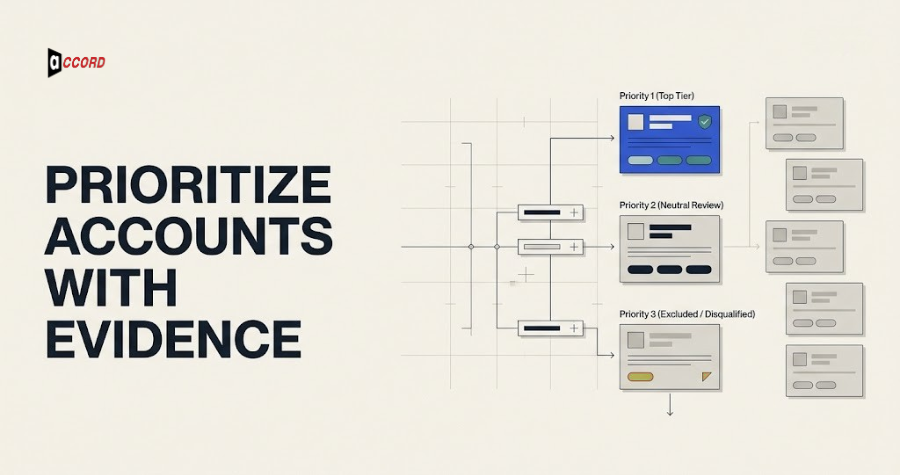
A B2B ICP scorecard turns your ideal customer profile into researchable criteria for deciding which accounts deserve attention. Start with business fit, separate disqualifiers from preferences, and record evidence beside every judgment. Use the result to allocate research and sales effort, then revise the criteria when real conversations expose weak assumptions.
A promising company can look excellent in a database and still be a poor prospect. It may operate in the right industry but sell through a business model your service cannot support. It may be large enough to buy but require capabilities your team does not provide. A familiar logo does not settle either question.
An ideal customer profile, or ICP, describes the kinds of organizations you can help. A scorecard makes that description usable by different people. Its value is consistency: a researcher and a sales manager should be able to look at the same evidence and explain why an account belongs in the same priority group.
This guide focuses on account selection before contact research. It complements Accord's lead generation services by defining the acceptance rules that a research brief needs.
Start with the buying problem
Write one sentence describing the problem your offer addresses. Include the business situation, the team affected, and the change your service can deliver. Avoid beginning with company size or a broad industry label, because those characteristics can be weak substitutes for a real need.
For example, a hypothetical operations consultancy might help distributors standardize inconsistent branch reporting. Its target is not simply every distributor with many employees. The useful situation includes multiple reporting locations, a central operations function, and an identifiable coordination problem.
Next, describe the boundary of your delivery. If your team supports reporting processes but not financial-system replacement, an account seeking a new accounting platform may be outside scope. Making that distinction early prevents sales from discovering a mismatch after several calls.
Ask sales and delivery colleagues for recent examples of fit and misfit. Capture the reasons, not confidential customer details. A scorecard based only on the founder's favorite customer can reflect personal familiarity rather than a repeatable market.
Separate exclusions from preferences
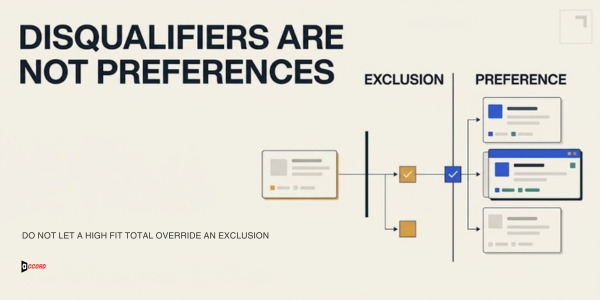
A disqualifier is a condition that makes an account unsuitable regardless of its other strengths. A preference makes an otherwise suitable account more attractive. Combining both in one numerical total can hide critical problems.
Unsupported geography, an incompatible delivery requirement, or a conflict with an existing commercial relationship may be exclusion rules. A relevant department, a suitable operating model, or a useful technology environment may be preferences. Define these for your actual offer rather than borrowing another company's list.
Give exclusions a separate decision field with three possible outcomes: clear, excluded, or unresolved. An unresolved exclusion needs review. It should not quietly become clear because the rest of the record looks promising.
Consider a company with the desired industry, size, and recent expansion. If the expansion is into a market you cannot serve, a high fit total should not override the delivery limit. The scorecard should make that conflict obvious enough that a new researcher catches it.
Keep the exclusion list short and defensible. Overly broad rules can remove viable accounts before anyone understands their circumstances.
Choose evidence that researchers can actually find
A useful criterion can be checked through an identifiable source. "Innovative company" is too subjective. "Offers a subscription product to business customers" is observable through product and pricing information, although unclear cases may still require review.
For each criterion, write the question, accepted evidence, and limits of interpretation. An official careers page may establish that a company advertises a particular role. It does not establish approved purchasing budget or dissatisfaction with the current supplier.
Use primary company sources where possible: service pages, official announcements, operating-location pages, product documentation, and public filings when relevant. Record the URL and observation date alongside the conclusion. A link without an explanation forces the reviewer to repeat the research.
Distinguish "not found" from "not present." If a company does not publish its technology stack, the field is unknown. Treating missing disclosure as a confirmed absence introduces a systematic bias toward businesses with more public documentation.
Restrict the data collected to what the decision needs. An account scorecard rarely benefits from personal details about employees. Company-level operational evidence usually provides a more appropriate foundation.
Build a simple B2B ICP scorecard
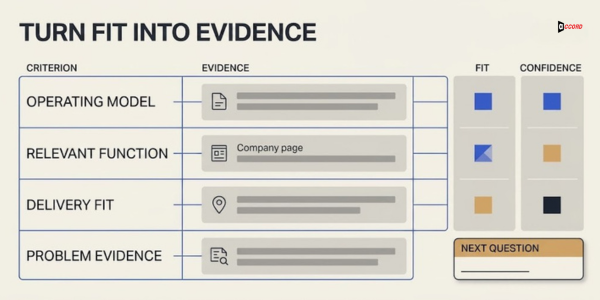
Start with a small set of dimensions such as operating model, relevant function, delivery fit, and problem evidence. Use a descriptive scale before introducing weights. "Supported," "uncertain," and "unsupported" can be easier to apply consistently than a finely divided numerical system.
If prioritization requires numbers, attach them to written anchors. In an illustrative scale, zero might mean contrary evidence, one might mean partial evidence, and two might mean direct support. These values are an editorial example, not a validated prediction model.
Keep evidence confidence separate from account attractiveness. A company can be highly attractive on incomplete information. Another can be a moderate fit supported by reliable sources. Those accounts need different next actions even when a combined score would make them look identical.
Add a review field for the next question that would change the decision. "Confirm whether branch reporting is centrally owned" is useful. "Research more" is not.
Avoid starting with a complex formula. A transparent scorecard that researchers can explain is easier to improve than a weighted model whose inputs nobody trusts.
Keep fit, timing, and access distinct
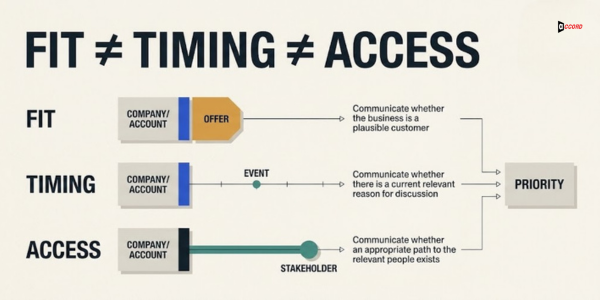
Fit asks whether the business is a plausible customer. Timing asks whether there is a current reason to discuss the problem. Access asks whether you have an appropriate route to the relevant people. These questions influence prioritization, but they should remain visible separately.
A relevant expansion announcement may improve timing without improving delivery fit. A warm introduction may improve access without creating a business need. A perfect account may remain worth researching even when no current trigger is visible.
Use a priority decision that considers all three dimensions explicitly. An account with strong fit and unclear timing might enter a research queue. An account with strong fit and a relevant current event might receive a reviewed outreach brief.
This distinction also helps email campaign planning. The message should explain a relevant business reason; it should not pretend that an internal account score proves purchase intent.
When a signal is old or ambiguous, lower confidence rather than inventing urgency. "Published a new operating-location page" is an observation. "Needs our service immediately" is a separate inference that requires support.
Calibrate with a mixed account sample
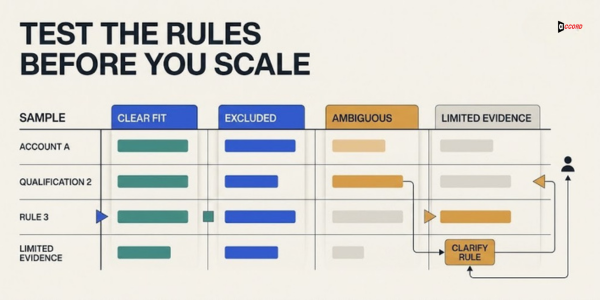
Before assigning a large research batch, test the scorecard on a small, varied sample. Include obvious fits, obvious exclusions, ambiguous organizations, and companies with limited public information. The purpose is to find unclear rules before they affect the whole list.
Have two people assess some of the same accounts independently. Compare their reasoning before comparing totals. If both give the same score for different reasons, agreement may be superficial.
A disagreement about "enterprise readiness," for instance, often means the term needs observable criteria. Does it refer to procurement requirements, service coverage, integration complexity, or something else? Rewrite the definition around the actual buying constraint.
Document the resolution in the rulebook. A short positive example and a short counterexample can save repeated explanations. Keep these examples anonymized when they involve private commercial information.
Do not keep adjusting the criteria until every favorite account receives a high score. Calibration should improve consistency and usefulness, not manufacture approval for a predetermined list.
Work through an illustrative decision
Suppose a fictional reporting consultancy evaluates three distributors. Account A publishes a branch directory and identifies a central operations team. Account B has a large workforce but operates from one location. Account C has several locations but no public evidence about reporting ownership.
Under a branch-coordination offer, A may justify deeper contact research. B may remain a lower priority because size alone does not establish the relevant operating complexity. C belongs in a clarification queue rather than an automatic rejection.
Now add timing. A recently announced another branch, but the announcement does not mention reporting changes. The researcher records the event and a cautious interpretation: expansion may create coordination work. Sales can test that hypothesis in a conversation.
The output is three different actions, not three decorative scores. Research the relevant function at A, check whether another service fits B, and resolve the ownership question at C.
This example is hypothetical. It demonstrates the decision method and does not describe an Accord client outcome or a measured conversion relationship.
Translate the scorecard into a handoff
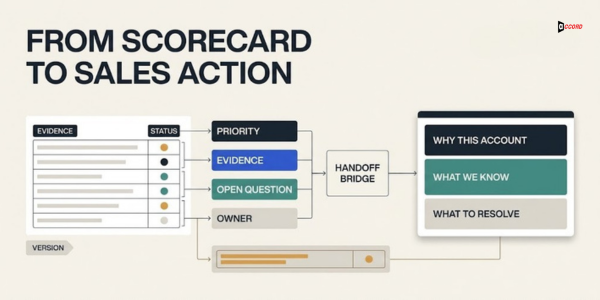
The handoff record should contain the account identifier, priority group, exclusion status, evidence summary, source links, observation dates, unresolved questions, and assigned owner. Include the scorecard version so later reviewers know which rules were applied.
Keep the explanation brief enough for sales to read. A concise account rationale should connect the company's situation to the offer. It should also state the uncertainty that a first conversation needs to resolve.
Define what happens when a required field is missing. A record might return to research, move to manual review, or remain on hold. The choice should depend on the importance of the missing evidence, not on pressure to fill a delivery quota.
Avoid transferring a priority label without its supporting rationale. Salespeople may otherwise treat a research hypothesis as a verified buying requirement. That can produce confident but inaccurate outreach.
A useful handoff also permits rejection with a reason. Delivery is part of the feedback cycle; it is not the end of learning.
Review outcomes without confusing correlation with proof
Track whether researched accounts were accepted, whether sales found the rationale useful, and which criteria repeatedly failed in conversations. These observations help refine the scorecard even before there is enough closed business to assess commercial outcomes.
Do not conclude that a criterion predicts revenue because a few successful accounts share it. Sales coverage, relationships, offer changes, and market conditions can influence the same results.
Review rejected accounts as well as accepted ones. If a group is never contacted, its lack of opportunities says little about its underlying potential. A small, deliberate exploration group can reveal whether the selection rules are too narrow.
Use reason codes that lead to action: unsupported operating model, wrong function, stale evidence, unclear need, or delivery mismatch. Avoid a catch-all "bad lead" label that hides the source of the problem.
Set a regular review rhythm and change one major rule at a time when practical. Record why it changed and what evidence would justify keeping the revision.
Maintain the scorecard as the offer changes
A scorecard should change when delivery capability, target market, pricing structure, or buyer requirements change. Waiting for a periodic cleanup can leave researchers applying an outdated definition to a new offer.
Assign one accountable owner and invite input from research, sales, and delivery. The owner maintains definitions and versions; the wider team supplies evidence about how the rules work.
Archive previous versions for interpretation of past lists. Do not overwrite a historic record's meaning by silently relabeling every old score under new criteria.
Before the next batch, check that the brief, spreadsheet fields, CRM properties, and reviewer examples describe the same rules. Misalignment between those surfaces can cause more inconsistency than the scoring formula itself.
The practical standard is straightforward: another qualified person should be able to reproduce the decision from the evidence you retained.
Frequently asked questions
Should we score contacts or companies first?
Start with companies when the offer depends on an organization's operating situation. Contact research becomes more useful after you know why the account belongs in the market. Later, assess whether a person's responsibilities connect to the buying problem. Seniority alone does not establish influence over your particular purchase.
How many criteria should a first scorecard contain?
Use the smallest set that changes your decisions. A handful of clearly defined criteria is usually easier to calibrate than a long inventory of weak signals. Add a field only when the team can explain how its answer affects priority, the research task, or the next conversation.
What should happen when information is missing?
Record uncertainty explicitly and identify the source or question that could resolve it. Missing public information is not evidence that a company lacks a capability or need. Where the unknown concerns a critical exclusion, hold the record for review before activation.
Can a spreadsheet support this process?
Yes. A spreadsheet can support a first version when it has controlled fields, clear definitions, evidence links, version information, and an accountable reviewer. Move to a more integrated system when access control, volume, ownership, or repeated updates become difficult to manage reliably.
Does a high score mean the company is ready to buy?
No. A high fit score indicates alignment with your selected criteria. Buying readiness depends on circumstances that research may not reveal, including priorities, resources, timing, and stakeholder agreement. Use the score to decide where to investigate, then test the business hypothesis respectfully.
Put the decision rules into the next research brief
Choose one service, define its buying problem, and build a scorecard against a mixed sample before expanding the list. The first useful result is a set of decisions that research and sales can explain consistently.
For support turning an account-selection brief into a research workflow, discuss the criteria with Accord Tech Solutions. Bring the current offer, a few fit and misfit examples, and the questions that still produce disagreement.
Methodology and sources
This guide presents an original editorial operating framework. The scoring example is hypothetical, not a statistical model or an Accord client result. Current Accord service pages were checked to align the service references; no search-volume or performance dataset was used.