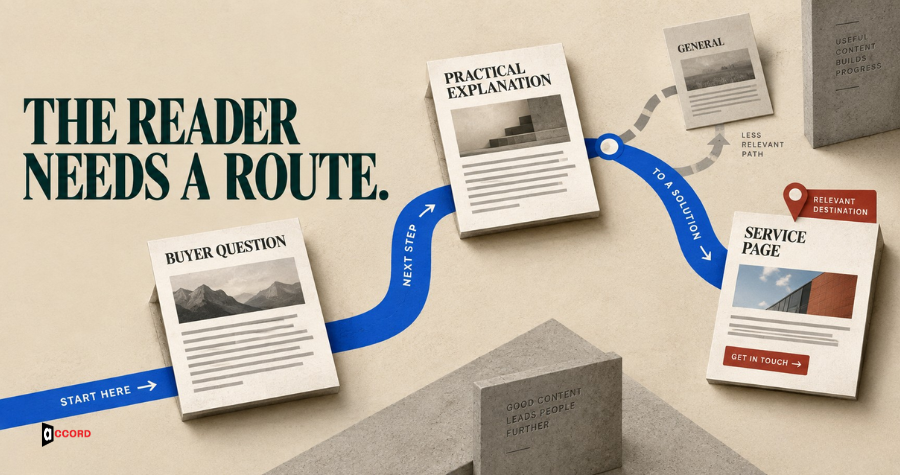
B2B internal linking connects related buyer questions, practical explanations, and service information through useful navigation. Give each important page a clear role, link where the next resource answers a natural follow-up question, and use descriptive anchors. Review the destination and surrounding context instead of adding links simply to meet a numerical target.
A website can contain strong articles and still make readers work too hard to understand the business. A guide explains a problem but offers no route to the relevant service. A service page makes a promise but does not point to the material that explains the method.
Internal linking helps connect those pieces. It supports the reader's journey and gives search systems relationships they can follow, but it does not replace useful pages or resolve unclear positioning by itself.
This guide focuses on a manageable linking workflow for B2B sites. It covers page roles, editorial choices, technical checks, and maintenance without assuming that every topic needs a large content cluster.
Assign a job to each page
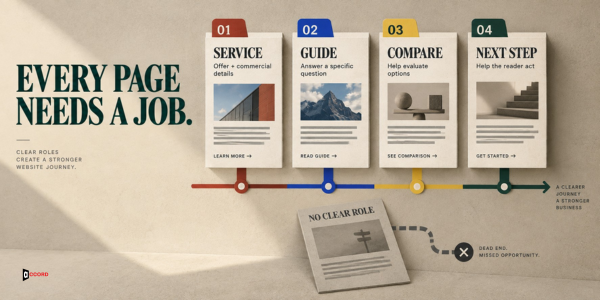
Begin with the pages that matter to the business. Identify which explain a service, answer a specific question, compare options, demonstrate a process, or help a reader take the next step.
A service page should describe the offer and relevant commercial details. A supporting article should complete an informational task. If both pages attempt to own the same broad intent with nearly identical content, adding links between them will not resolve the overlap.
Write the page role in a short inventory. Include the current URL, main reader question, useful next destination, and owner. This makes linking decisions easier to review.
For example, a CRM cleanup guide might lead to an explanation of lead research and data validation services when the reader needs help implementing the work.
The link is useful because it follows the reader's decision, not because the service keyword appears somewhere in the paragraph.
Map the next question a reader will ask
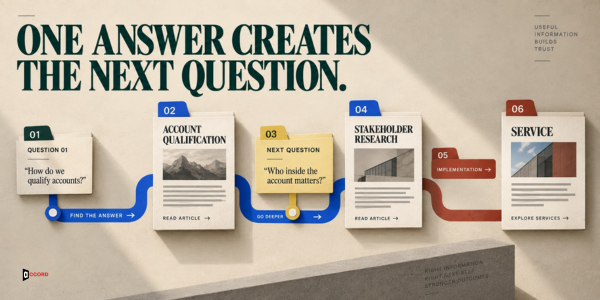
Read each page as someone trying to complete a task. After a section explains a problem, ask what the reader needs to understand next.
A discussion of account qualification may lead naturally to stakeholder research. A website migration article may need a separate explanation of redirect testing. A buyer comparison may lead to a scope checklist.
Do not assume that the next step is always a sales inquiry. Many readers need another piece of information before they can evaluate a service.
Choose the destination that best answers the specific follow-up. A broad blog index can be useful for exploration, but it is often less helpful than a focused article when the question is already clear.
Keep the link context honest. If the destination is a service page, the anchor should not imply that it is a downloadable template or independent research report.
Build a small B2B internal linking map
Start with one service area and its supporting pages. Mark the main relationships: explanations that support the service, related questions that support each other, and pages that complete a practical journey.
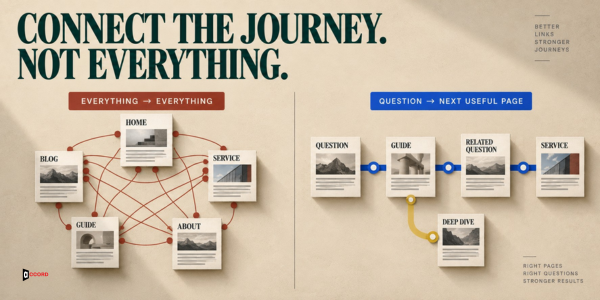
Use the map to identify gaps, not to force every page to link to every other page. A dense web of weak relationships can make the content harder to read.
Separate current destinations from proposed articles. A draft URL should not appear as a live link before the page exists and has been verified.
Prioritize important pages with no meaningful incoming links. Google explains in its link best practices that links help it discover pages and understand context, and recommends linking important pages from elsewhere on the site.
That does not establish an ideal number of links. The editorial test remains whether the relationship helps a person understand or continue the task.
Choose descriptive, natural anchor text
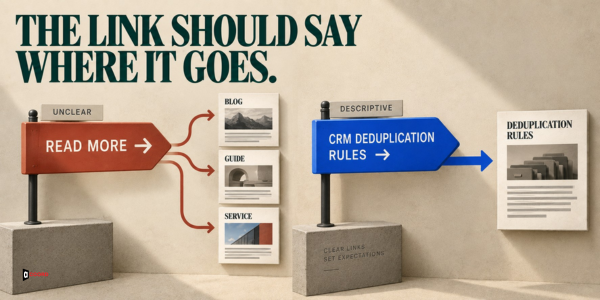
The anchor should set an accurate expectation for the destination. “CRM deduplication rules” tells the reader more than “read more” when the linked page actually explains those rules.
Avoid repeating an exact keyword phrase in every link. Use the wording that fits the sentence and describes the destination clearly.
Keep anchors concise enough to scan while retaining meaning. Linking an entire paragraph can obscure the specific resource being offered.
Read the sentence without the link styling. It should still sound natural. If the sentence exists only to carry a keyword, rewrite it around the reader's question.
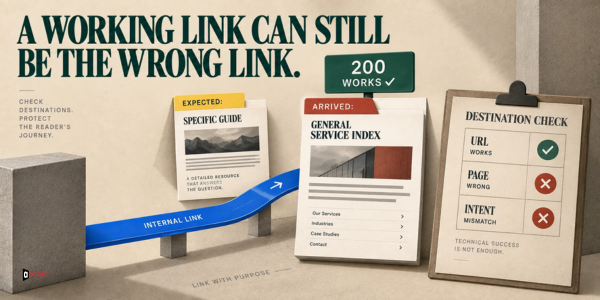
Check that the destination fulfills the anchor's promise. A link labeled as a checklist should not lead to a generic agency page with no checklist.
Place links where they help interpretation
A contextual link works best when the surrounding passage explains why the destination matters. Add it near the concept that creates the follow-up question.
Avoid inserting several links into a short sentence. The reader needs enough context to distinguish them, and a crowded passage can interrupt comprehension.
Use navigation and related-content modules for broader discovery. Use body links for specific conceptual relationships. Both can be useful, but they serve different reading behaviors.
Do not place the only important service link in an unrelated closing paragraph. Connect it where the article's practical work meets the service's scope.
For a technical issue affecting several page types, a link to Accord's SEO service should explain the relevant task rather than rely on a generic promotional sentence.
Check the destination before editing at scale
Open every proposed destination and confirm that it is the intended page. Review the title, main content, canonical route, and current purpose.
A URL can return a successful response while redirecting to a broad service index or an unrelated page. Status alone does not prove editorial relevance.
Check for outdated or duplicated destinations. If two pages answer the same question, decide which should own the intent before adding new incoming links.
Use the final canonical URL where appropriate, rather than copying a temporary tracking link or a route with unnecessary account parameters.
Record unresolved destinations in the working plan. Do not place a guessed slug into publishable content and assume that someone else will repair it later.
Verify that links are technically usable
A link should work for readers and be represented in a form search systems can follow. Google documents ordinary anchor elements with an href as the normal crawlable pattern in its link guidance.
For sites using JavaScript, inspect the rendered page and confirm that the intended destination remains available through proper link markup. A clickable visual alone does not establish that the underlying implementation is suitable.
Check keyboard access and visible focus behavior as part of the website's normal usability review. Readers should not need a mouse to move through important resources.
Verify mobile behavior. A related-content block that looks orderly on desktop may become cramped or difficult to select on a narrow screen.
When a platform change affects navigation or components, retest representative links across page types instead of assuming the old behavior remains intact.
Work through an illustrative service cluster
Imagine a B2B site offering research and data services. It contains a service page, an account-scorecard guide, a buying-role article, and a deduplication policy guide.
The account-scorecard guide links to buying-role research after explaining why company fit comes first. The buying-role article links to the service page when discussing the research deliverable. The deduplication guide links to the service where verified identity research becomes relevant.
The service page links back to the most useful explanations near the corresponding deliverables. It does not list every article simply because the articles share a category.
A reader can now move from problem definition to method and then to implementation support. Each link has a specific reason.
This is a hypothetical architecture. It illustrates editorial relationships and does not claim a ranking improvement or describe a measured client result.
Audit existing links without rewriting everything
Begin with high-value pages and common problems: broken destinations, misleading anchors, irrelevant links, and important pages with weak incoming context.
Review the sentence around each link. A destination may still be live while the surrounding claim has become outdated.
Make changes in small groups and retain a record of the source page, destination, anchor, and reason. This helps reviewers understand the intent without comparing entire articles manually.
Avoid broad automated insertion based solely on keyword matching. The same phrase can appear in contexts that need different resources, and some occurrences do not need a link at all.
When a page needs a substantial content revision, handle that as an editorial task. Link cleanup should not become an unreviewed rewrite of unrelated sections.
Connect new publishing to the existing library
Before publishing a new article, identify the existing pages that would naturally benefit from linking to it. This prevents new content from relying only on the blog listing for discovery.
Check whether the new article replaces a missing explanation or duplicates an existing one. A linking plan can expose overlap before the team creates another page.
After publication, verify the actual URL and add the agreed contextual links. Do not use the proposed slug until the destination has been confirmed.
Assign ownership for the backward links. Writers often add outgoing links in the new article while nobody updates the older pages that should introduce it.
Keep the process proportionate. A focused article may need only a few well-chosen relationships rather than a large library-wide update.
Review usefulness without claiming causation too quickly
Observe whether readers can reach the intended resources and whether important journeys contain confusing steps. Direct usability review can reveal problems that a link count misses.
Use available site data carefully when assessing changes. Traffic and business outcomes can be affected by content revisions, demand, campaigns, and many other factors at the same time.
Do not attribute a ranking movement to one new internal link without a defensible basis. Report the change and its context instead of turning correlation into a universal rule.
For editorial maintenance, track practical outputs: corrected destinations, clarified anchors, connected new pages, and removed irrelevant links. These are verifiable changes even when their wider effect is uncertain.
The goal is a website whose relationships make sense to a reader, with technical implementation that preserves those relationships.
Keep ownership and retirement rules clear
Assign an owner for the page inventory and define when links are reviewed. Product changes, service changes, migrations, and major content revisions are natural triggers.
When retiring a page, inspect its incoming links. Update them to an appropriate current destination or remove them when no relevant replacement exists.
Do not redirect every retired article to a service page simply to keep a working URL. The replacement needs to serve the old reader's intent closely enough to be useful.
Preserve a change record for important routes. Future editors should be able to understand why a destination changed and which relationships were affected.
A maintainable linking system depends more on clear ownership and page purpose than on an elaborate diagram that nobody updates.
Frequently asked questions
How many internal links should a B2B article contain?
There is no universal ideal. Add links that answer natural follow-up questions or connect the article to relevant service information. A short, focused guide may need fewer than a broad comparison. Review relevance and readability rather than treating a fixed count as a ranking formula.
Should every article link directly to a service page?
A service link is useful when it fits the reader's next decision and the article's topic. Some articles may first need a supporting explanation. Do not force a commercial link into unrelated content, and make the anchor clear about what the destination provides.
Can we use the same anchor text repeatedly?
Repeated wording can be natural when it accurately names the same resource, but do not force exact-match phrases into every context. Choose descriptive language that fits the sentence. Consistency of meaning matters more than mechanical variation or repetition.
Are related-post modules enough?
They can support exploration, but they do not always explain a specific relationship within the article. Contextual body links help when a nearby concept creates a clear follow-up question. Use modules and editorial links for their respective purposes rather than expecting one to replace the other.
What should we do when a destination is not published yet?
Keep it in the editorial plan and add the live link only after publication and verification. A proposed canonical is useful metadata, not a working destination. Check the final route, content, and relevance before updating existing pages to point to it.
Connect one useful journey first
Choose a service, identify the questions readers ask before evaluating it, and connect the strongest existing explanations. Verify the destinations and make each anchor earn its place.
Discuss a content architecture review with Accord Tech Solutions using your service pages and current article inventory. A small, coherent set of relationships is a practical starting point for a more useful B2B website.
Methodology and sources
Original editorial linking workflow. Google Search Central's current link guidance supports the limited technical statements on discovery, context, and crawlable anchors. The service cluster is hypothetical. No ranking gain is promised and no site analytics were analyzed for this draft.