
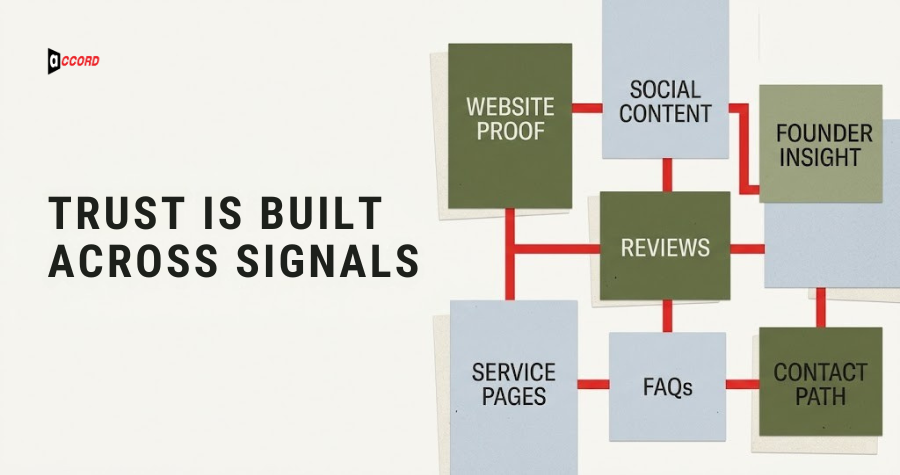
Quick answer: A B2B social proof system is a coordinated set of trust signals across the website, search content, reviews, LinkedIn, case-style stories, and sales assets. It helps buyers verify that a company is credible before they reply, book a call, or share the brand internally. For B2B growth, social proof should support outreach, SEO, AEO, GEO, website conversion, and founder-led visibility.
Social proof works best when it is specific, findable, and connected to the buyer's problem.
Why social proof matters in B2B
B2B buyers are careful because the cost of a bad vendor decision is high. They may not respond to a cold email immediately, but they often check the company website, LinkedIn profiles, reviews, posts, service pages, and examples of work.
If those trust signals are weak or inconsistent, the campaign has to work harder. A good message may still be ignored because the buyer cannot confirm whether the company is credible.
Social proof reduces uncertainty. It does not replace a strong offer, clean data, or relevant outreach. It supports them.
What counts as social proof
Social proof can include client testimonials, reviews, case studies, case-style examples, before-and-after explanations, screenshots where approved, founder posts, team expertise, process documentation, service pages, awards, certifications, media mentions, partner logos, and helpful educational content.
For many growing B2B companies, the strongest proof may be practical process proof. If public case studies are limited, show how the work is done. A clean lead list workflow, CRM enrichment checklist, cold email QA process, SEO/AEO/GEO content map, or website conversion audit can build trust without exposing private client details.
Website proof
The website is the trust base. It should make the company identity, services, audience, process, and next step clear.
A social proof system on the website should include:
- Specific testimonials or review snippets.
- Service pages that explain the process.
- Examples or anonymized scenarios where allowed.
- Clear author or company context on blog posts.
- FAQ sections that answer buyer objections.
- Internal links from proof to relevant services.
- Contact paths that feel simple and low-friction.
For Accord Tech Solutions, website proof should connect lead generation, CRM enrichment, cold email, SEO/AEO/GEO, website design, social media marketing, and product listing SEO under one B2B growth story.
Founder visibility
Founder-led visibility can make a B2B company feel more real. Buyers often trust people before they trust brands. LinkedIn posts, short videos, comments, and practical opinions can help the market understand the founder's thinking.
Founder content should not only announce wins. It should explain lessons, frameworks, client problems in anonymized form, service decisions, buyer mistakes, and useful checklists. This creates familiarity before a sales conversation.
A founder's content can also support SEO and AEO indirectly. Questions that perform well on LinkedIn can become blog sections, FAQs, landing page copy, and sales email angles.
Reviews and testimonials
Reviews should be specific. "Great service" is useful, but "helped clean our lead list before a cold email campaign" is more useful. Specific proof helps buyers connect the review to their own problem.
When collecting reviews, ask about the situation before working together, the process, what changed, and what part of the work felt most useful. Avoid pushing clients into exaggerated claims. Accurate reviews are more trustworthy than inflated ones.
Content as proof
Educational content can act as proof because it shows how the company thinks. A blog about CRM enrichment, technical SEO for AEO/GEO, cold email personalization, or landing page decisions can demonstrate expertise before the buyer contacts sales.
The content should be useful even if the reader does not buy immediately. That is how trust compounds.
How social proof supports SEO, AEO, and GEO
Social proof supports SEO when review language, service examples, and buyer questions inform keyword-rich pages and internal links.
It supports AEO when FAQs, direct answers, and comparison sections address objections clearly.
It supports GEO when the site consistently explains who Accord Tech Solutions is, what services it provides, who it serves, and what evidence supports the claims. AI systems need clear entity context and factual relationships. Social proof adds credibility signals, but it should be presented honestly.
How social proof supports cold outreach
Cold email works better when the prospect can verify the sender quickly. If an email mentions CRM enrichment, the website should have a page or article that explains CRM enrichment. If outreach references SEO/AEO/GEO, the site should clearly define those services. If the founder is active on LinkedIn, the profile should support the same positioning.
This creates message continuity. The prospect sees the same business logic across email, website, search, and social.
A practical social proof workflow
First, list the proof assets the company already has: testimonials, reviews, client comments, project screenshots, process docs, founder posts, blog posts, and service pages.
Second, map each proof asset to a service. A review about lead quality should support lead generation. A process checklist about data cleanup should support CRM enrichment. Founder posts about AI visibility should support SEO/AEO/GEO.
Third, fill the gaps. If a service has no proof, create process proof, educational content, or anonymized examples.
Fourth, distribute proof across the website, LinkedIn, landing pages, outreach sequences, and sales materials.
Fifth, keep it current. Old proof can still matter, but fresh content signals that the company is active.
Where Accord Tech Solutions fits
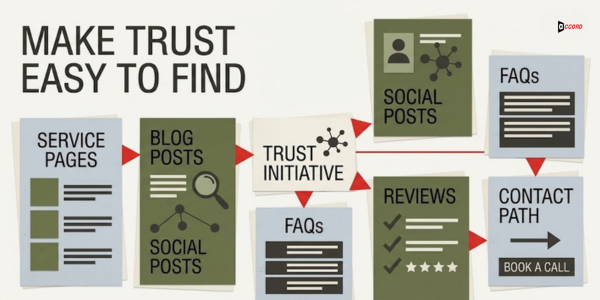
Accord Tech Solutions can help B2B companies build and connect trust assets across website, SEO/AEO/GEO content, LinkedIn, social media, landing pages, cold email, and lead generation campaigns.
The goal is to make the buyer's verification path easier. When someone checks the brand after seeing a message, the proof should be ready.
Proof approval rules before publishing
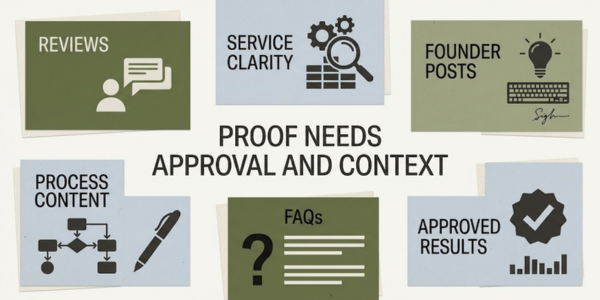
Social proof is powerful only when it is real and approved. Do not publish client names, logos, testimonials, screenshots, metrics, awards, certifications, or case results unless the business has permission and the source is documented. If approval is missing, use process proof instead.
Process proof can still be strong. It can show how Accord Tech Solutions audits a lead list, checks CRM data, reviews a landing page, structures SEO/AEO/GEO content, repurposes a blog into social assets, or prepares product listing improvements. This kind of proof does not claim a client result. It shows working standards.
Use this proof ladder:
- Approved client proof: testimonials, reviews, named case studies, or public client comments.
- Approved anonymized proof: situation, work type, and process without identifying details.
- Process proof: checklists, workflows, QA steps, templates, and decision frameworks.
- Educational proof: useful content that shows expertise.
- Founder or team point of view: clear thinking, service standards, and lessons.
Proof quality matters more than proof volume. One specific, approved testimonial can be more useful than a page full of vague praise.
How to place proof across the buyer journey
Different proof belongs in different places. Early-stage buyers may need educational proof: blog posts, LinkedIn posts, and FAQs. Evaluation-stage buyers may need service proof: process, examples, review snippets, and comparison content. High-intent buyers may need contact reassurance: clear next steps, expected response time, and what happens after the form is submitted.
A practical placement map:
- Homepage: company clarity and broad trust signals.
- Service pages: proof tied to the specific service.
- Blog posts: educational proof and internal links.
- Landing pages: campaign-specific proof near the CTA.
- LinkedIn: founder visibility and repeated expertise signals.
- Email follow-up: one useful proof asset matched to the buyer question.
This prevents proof from becoming decoration. Every proof element should reduce a specific doubt.
External source and schema notes
Google's helpful content guidance asks whether content demonstrates expertise and gives readers enough information to achieve their goal. That supports the approach here: social proof should help buyers evaluate a company, not manipulate them.
Structured data should also be used carefully. Google's structured data guidance says markup should represent visible content and avoid misleading information. Review schema should only be considered when review content is visible and compliant with the relevant guidelines. Do not mark up fake reviews, hidden proof, or broad claims as if they were verified evidence.
Social proof and content distribution
After publication, this article can support platform-native content:
- LinkedIn post: "Social proof is not one testimonial. It is a verification path."
- Carousel: proof ladder for B2B companies.
- Short video: what to use when you do not have public case studies.
- Sales asset: proof placement map for landing pages and outreach.
Each version should adapt the hook and CTA for the platform instead of copying the same text.
FAQ
What is B2B social proof?
B2B social proof is evidence that helps business buyers trust a company, such as reviews, testimonials, case-style examples, founder content, service pages, and educational content.
Does social proof improve lead generation?
It can support lead generation by reducing uncertainty after a prospect sees an email, ad, LinkedIn post, or search result. It does not guarantee leads.
What if a company has no public case studies?
Use process proof, anonymized examples, educational content, founder posts, and specific service explanations while collecting approved testimonials over time.
How does founder visibility help B2B trust?
Founder visibility gives buyers a person to evaluate. It shows thinking, experience, and consistency before a sales conversation.
How does social proof connect to GEO?
Social proof helps clarify the brand entity, services, audience, and credibility signals that AI search systems may use when interpreting company context.