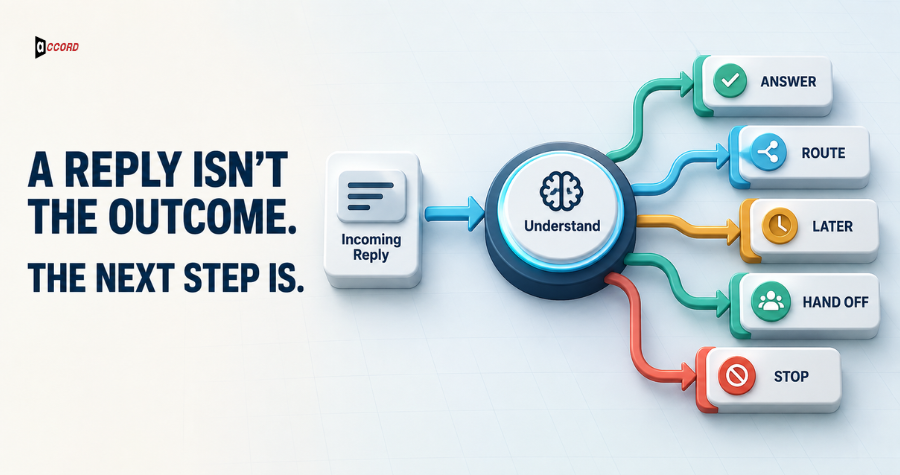
Cold email reply handling is the process of reading responses, identifying what the sender actually means, assigning an owner, and taking the appropriate next step. Separate interest, questions, referrals, timing requests, objections, and opt-outs. Stop conflicting automation, preserve context, and measure meaningful conversation progress rather than treating every reply as a lead.
An outreach campaign can generate replies while the sales team still misses useful conversations. One response sits in an unattended inbox. Another receives a generic meeting request that ignores the question. A third asks to stop contact but continues receiving scheduled messages.
The reply workflow determines what happens after outreach earns attention. It connects campaign operations with sales judgment and gives the recipient a coherent experience.
This article focuses on that handoff. It assumes the outreach itself has an appropriate basis and relevant targeting. It does not treat a response as permission to expand contact beyond what the person requested.
Define response categories around actions
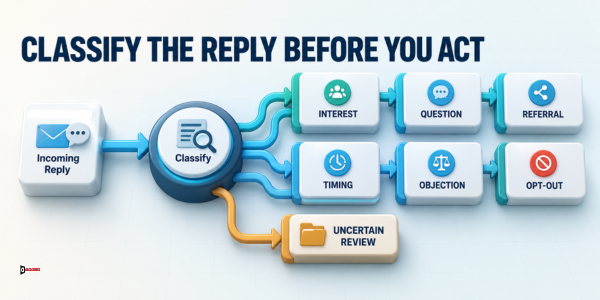
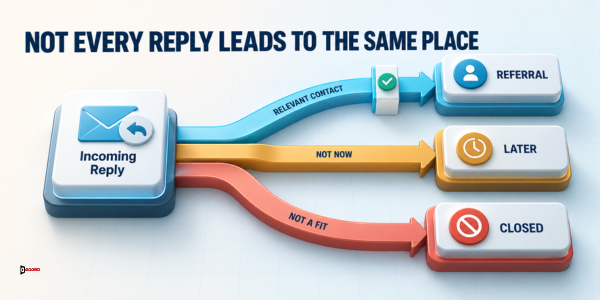
Create categories that change what the team does next. Useful starting groups include interested, information request, referral, timing request, objection, not relevant, opt-out, automatic response, and unclear.
Write a short definition and example for each category. "Interested" should mean more than polite wording. "Please send details" may be an information request, not agreement to a meeting.
Allow a primary category and an important secondary flag when necessary. A person can ask a question while also saying they are not responsible for the purchase. Forcing that response into one simplistic label can lose context.
Use an uncertainty queue for ambiguous messages. It is better to ask a human reviewer than to let an automatic classification trigger an inappropriate follow-up.
For teams building email marketing and outreach workflows, the category list should be agreed before the campaign starts.
Put opt-outs and restrictions first
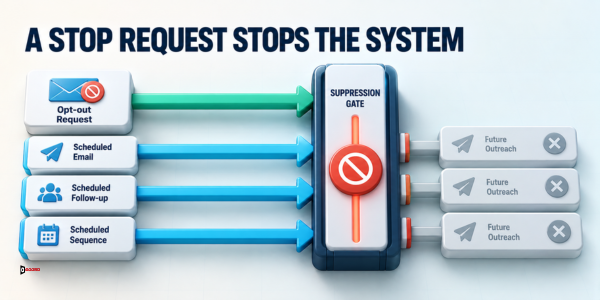
A request to stop contact should receive an immediate operational treatment. Route it to the appropriate suppression process and stop scheduled messages that would contradict the request.
The US Federal Trade Commission's CAN-SPAM compliance guide explains that the law covers commercial email, including business-to-business messages, and sets requirements for opt-out handling. Its guidance specifies honoring opt-out requests within ten business days. An internal workflow can act sooner.
That source describes US requirements; it is not a complete rulebook for every recipient or jurisdiction. Apply the rules relevant to the campaign and the restrictions imposed by the sending platform.
Do not ask a person to explain why they want to stop before processing the request. Do not move the address to another campaign or send from another identity to continue the same unwanted outreach.
Check suppression across the systems that participate in sending. A change in one inbox is ineffective if another connected tool can reactivate the contact.
Assign ownership before promising response times
Decide who monitors replies, who answers commercial questions, and who covers absences. A shared inbox without clear ownership can produce both missed messages and duplicate responses.
Set an internal service target that reflects actual staffing. A small team should not promise immediate human responses around the clock if no one is available to deliver them.
Use assignment states such as unreviewed, assigned, waiting for internal input, waiting for prospect, and closed. Keep the states focused on work, not decorative pipeline labels.
Define what happens when the assigned person is unavailable. A backup owner should be able to see the conversation, original outreach, account rationale, and relevant restrictions.
Review the queue at predictable intervals. The goal is reliable handling, not frantic checking that interrupts every other task without improving the recipient's experience.
Read the thread before choosing a response
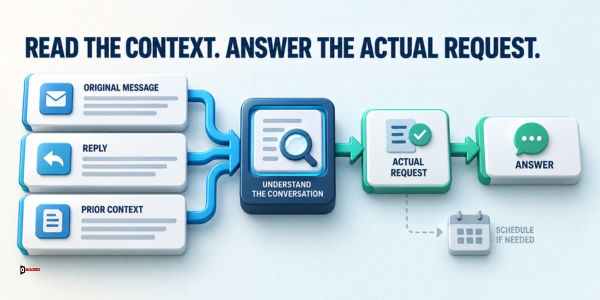
The original message matters. A reply saying "yes" has different meanings depending on whether the email offered a checklist, asked about responsibility, or proposed a meeting.
Read the full exchange and any earlier contact history. Check whether a colleague has already replied or whether the person has made a previous restriction clear.
Identify the actual request in one sentence. "They want a short explanation of the data-validation process" is more useful than "positive reply." That sentence should guide the answer.
Avoid interpreting courtesy as intent. "Thanks for sharing" may acknowledge receipt without inviting a sales discussion. A useful response respects the level of interest expressed.
If the original outreach contained an error, correct it directly. Do not build the next message around a claim that the person has already disputed.
Answer the question before asking for a meeting
When a prospect asks a concrete question, answer it at an appropriate level of detail. A meeting request that replaces the answer can make a straightforward evaluation feel unnecessarily difficult.
For example, if someone asks what a lead research deliverable contains, describe the account criteria, fields, evidence, and review process. Link to a relevant resource only when it helps answer the question.
Keep claims within approved service scope. If pricing or a capability depends on requirements, explain the dependency rather than inventing a package to maintain momentum.
After answering, offer a next step proportionate to the exchange. A short clarification question may be more useful than a calendar link.
This approach also improves internal learning. Repeated questions reveal missing information in the offer, landing page, or service explanation.
Handle referrals without overstating the relationship
When someone identifies a more relevant colleague, record the referral accurately. Note whether they offered an introduction, named a role, or simply suggested another department.
Do not imply that the colleague has requested contact unless that happened. A respectful message can explain that the original person suggested the function might be relevant, without claiming endorsement.
Check whether another teammate is already speaking with the referred person or account. Account-level coordination prevents parallel outreach from appearing careless.
Thank the original contact when appropriate, and stop asking them questions that belong with the new owner. Preserve their request if they also asked to be removed from future outreach.
Use the referral to improve the role map. It may indicate that the research brief identified the wrong responsibility, which is a useful correction for later campaigns.
Treat timing requests as specific instructions
A reply such as "contact me after our planning cycle" should become a dated task or a clearly defined follow-up condition. It should not remain in a generic nurture sequence that sends messages before the requested time.
Clarify timing only when the wording is too ambiguous to act on. Avoid turning a simple request into an unnecessary qualification exchange.
Record what the person agreed to revisit. A request to discuss one service later does not automatically justify unrelated campaign enrollment.
When the time arrives, reference the earlier context and check whether the situation still applies. Business priorities can change between the original reply and the follow-up.
If the person does not respond, follow the campaign's appropriate contact limits. A past timing request is not an indefinite invitation to keep escalating frequency.
Distinguish objections from poor fit
An objection can reveal a concern that deserves an answer. It can also reveal that the offer is not suitable. The reply handler should diagnose the difference before trying to persuade.
A question about implementation effort may justify a clear explanation of responsibilities. A statement that the company does not operate in the relevant market may indicate a targeting error.
Record the specific reason rather than using one broad negative category. Pricing structure, internal capability, timing, competing priorities, and unsupported requirements point to different improvements.
Avoid arguing with a prospect's description of their own circumstances. You can ask a respectful clarification question, but the objective is to determine whether a useful next step exists.
Close the conversation cleanly when there is no fit. A concise acknowledgment can be more professional than another attempt to force a meeting.
Separate automatic replies from human intent
Out-of-office notices, delivery notices, and automated acknowledgments should not be counted as interested prospects. They may still require operational action.
An out-of-office response can indicate a return date or an alternate contact, but treat that information carefully. An automated alternate contact is not necessarily a referral for a sales conversation.
Check for loops. A sequence that replies to every automatic message can create repeated exchanges between systems without any human involvement.
Keep automatic-response categories distinct in reporting. Otherwise, a campaign with many absence notices may appear to generate stronger engagement than it actually does.
Use human review when automation is uncertain about whether a response was written by a person. The cost of one review can be lower than the reputational cost of an obviously inappropriate reply.
Build a concise sales handoff
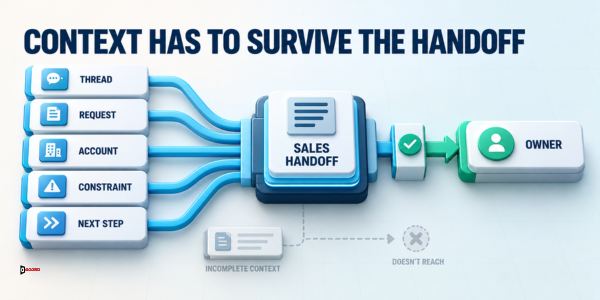
When a conversation merits sales involvement, provide the thread, account rationale, exact request, relevant constraints, and agreed next step. Do not hand over only an email address and a positive label.
Define acceptance. Sales should be able to confirm ownership or return the handoff with a reason. A silent transfer into the CRM leaves the original handler unsure whether the prospect will receive a response.
Avoid exaggerating the state. "Requested a service outline" and "booked discovery" are different outcomes. A scheduled meeting is also different from an attended meeting or qualified opportunity.
Keep promises visible. If the reply handler committed to sending a sample or answering a technical question, that obligation should travel with the record.
The handoff should help the next person continue the conversation naturally, without asking the prospect to repeat what they already explained.
Test the workflow with realistic examples
Before launch, run sample replies through the system. Include an opt-out, a referral, a short ambiguous answer, an out-of-office message, a question about scope, and a reply from an existing customer.
Check classification, assignment, sequence stopping, suppression, CRM updates, and the response draft. Verify the full path rather than testing each tool in isolation.
A hypothetical test might use "Please send the field list, but I do not manage purchasing." The correct treatment should preserve both the information request and the role limitation. Marking it as a meeting-ready lead would lose important context.
Have the person responsible for customer conversations review the test responses. Technical correctness does not ensure that the wording answers the actual question.
Retest after changes to integrations, categories, or ownership rules. A small workflow edit can affect messages that enter through a different inbox or campaign.
Measure conversation quality and operating reliability
Track human replies separately from automatic messages. Within human replies, distinguish information requests, relevant interest, referrals, restrictions, and clear misfit.
Measure whether assigned replies receive the promised action and whether suppression works. These are direct operating outcomes that the team can improve.
Use commercial measures carefully. Reply count is not qualified-lead count, and booked meetings are not revenue. Report the actual stage reached and retain definitions across campaigns.
Review a sample of closed conversations for learning. Repeated confusion about the service may suggest a messaging change; repeated wrong-role referrals may suggest a research change.
Do not optimize a category definition simply to make the campaign look better. The reporting system should help the team understand what happened and what to change.
Frequently asked questions
Should every positive reply receive a calendar link?
No. Match the next step to the request. Someone asking for a document should receive the relevant information first. A calendar link becomes useful when a discussion is appropriate and the person has enough context to decide whether that discussion is worth their time.
Can automation write all responses?
Automation can assist with routing and draft preparation, but ambiguous intent, commercial commitments, complaints, and restrictions need dependable review. The team should know which actions can occur automatically and test them against realistic examples. Responsibility for the response remains with the business.
Is a referral a qualified lead?
A referral identifies a possible route to a relevant person or function. It does not establish need, interest, budget, or agreement to a conversation. Preserve the referral's exact context and confirm relevance before moving the record into a more advanced sales stage.
What if two team members answer the same reply?
Use a visible owner and a check-before-send process in the shared workflow. If duplicate responses occur, acknowledge the confusion briefly and establish one contact for the conversation. Investigate whether assignment, inbox visibility, or integration timing caused the overlap.
How should a polite rejection be recorded?
Capture the specific reason when the person provides one, honor any contact restriction, and close the exchange respectfully. Do not force every rejection into an objection sequence. Clear misfit is useful information for improving targeting and reducing future irrelevant contact.
Prepare the reply workflow before the next send
Define categories, ownership, stopping rules, and sales acceptance before launch. Then test the process with the kinds of replies your team actually receives.
Discuss an email workflow review with Accord Tech Solutions using anonymized response examples and the current handoff process. The goal is to give each reply a sensible next action and preserve the context that makes a conversation useful.
Methodology and sources
Original editorial workflow guidance, with the US opt-out statements grounded in the FTC's CAN-SPAM compliance guide. The example response is fictional. Platform capabilities and legal requirements beyond the cited US source are not assumed; no response-rate benchmark is claimed.