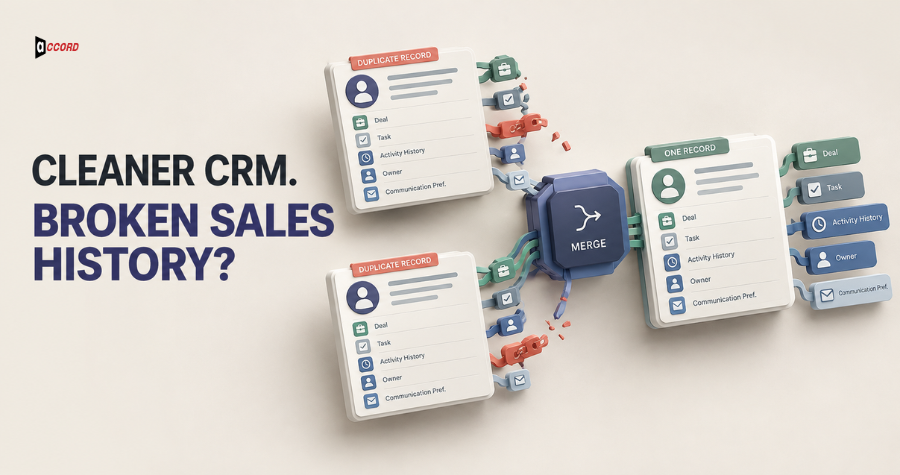
CRM deduplication rules define when records represent the same entity, which values should survive, and how related activities remain connected. Separate duplicate detection from merge approval, protect ownership and communication preferences, and test representative records before bulk changes. A successful cleanup produces a usable customer history, not merely a lower record count.
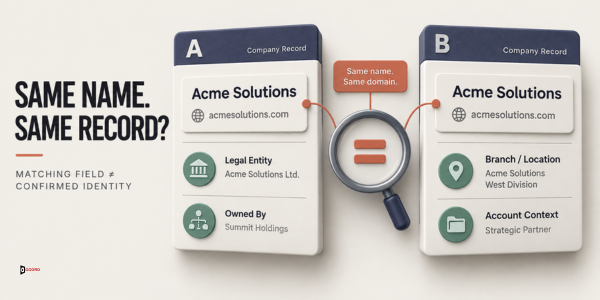
Two records can share a company name without representing the same business. Two contacts can share an email address because it belongs to a team. A familiar domain can belong to several subsidiaries. These details make deduplication an identity problem rather than a simple spreadsheet cleanup.
Customer relationship management systems, or CRMs, store relationships as well as fields. A merge can affect deals, tasks, consent history, reporting, and integrations. Removing a duplicate-looking row without understanding those relationships can create more confusion than it resolves.
This guide describes an operating policy for a cleanup project. Platform behavior varies, so use the actual CRM documentation and a controlled test before applying the policy to production records.
Define what counts as one entity
Begin with the objects in your system: contacts, companies, opportunities, locations, and any custom records. Write a plain definition of each. A company record might represent a legal entity, an operating brand, or a sales account, depending on your workflow.
Those choices matter. If the CRM uses one account per branch, identical corporate domains may be expected. If it uses one account per legal entity, branch records may need a different relationship rather than a merge.
For contacts, define how job changes should be represented. The same person moving to a new company does not necessarily justify combining all company associations into one current relationship.
Record the boundaries before choosing matching fields. Otherwise, the team may use whichever identifier is easiest to compare and discover later that it does not reflect the sales model.
Accord's CRM data research and validation services are relevant where identity rules require verified company and contact context.
Normalize fields without destroying evidence
Normalization makes values comparable. It may include trimming accidental spaces, standardizing country names, separating a website domain from its full URL, or mapping known company-name abbreviations.
Retain original values or an audit record when normalization changes something meaningful. A cleaned value helps matching; the original can help explain how the record entered the system.
Avoid aggressive transformations. Removing every suffix from a company name can collapse legally distinct entities. Lowercasing an identifier may be appropriate for one field but inappropriate for a case-sensitive external system.
Write field-specific rules and test examples from your data. A phone number should not be normalized using the same approach as an account code. Preserve leading zeros in identifiers when they carry meaning.
Normalization should improve detection. It should not silently decide which record is correct, change communication preferences, or overwrite customer information without review.
Separate candidate detection from merge decisions
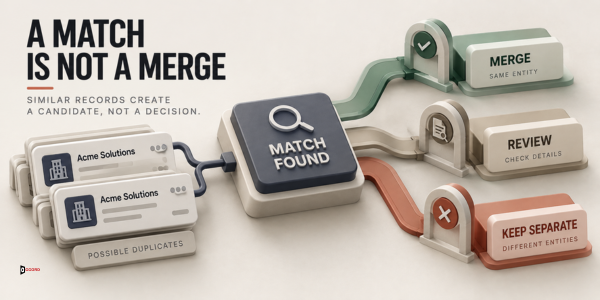
Candidate detection identifies records worth comparing. Merge decisions determine whether they truly represent the same entity. Keep these stages separate so a broad search can find possible duplicates without authorizing every match.
An exact stable identifier may support a high-confidence candidate. Similar names, shared domains, or matching phone numbers may support review but not automatic merging. The confidence depends on your record model and source quality.
Create decision groups such as eligible for controlled automatic processing, manual review required, and do not merge. Define the evidence for each group rather than relying on a vague similarity score.
HubSpot, for example, documents different deduplication behavior for contacts, companies, imports, and record identifiers. Review its record deduplication guidance if that is your platform. Do not assume the same behavior applies to another CRM or every ingestion route.
Keep rejected candidates in a decision log when they are likely to recur. Otherwise, reviewers may investigate the same valid pair each month.
Write CRM deduplication rules around risk
The consequence of a wrong merge should determine the review standard. Combining two empty prospect records is different from combining active accounts with contracts, opportunities, and multiple owners.
Define critical conditions that block automatic processing. These could include conflicting customer identifiers, distinct legal entities, incompatible suppression states, or active deals assigned to different business units.
Use a small decision matrix in the working policy. For each candidate type, specify the evidence required, reviewer, action, and exception path. Keep the production implementation aligned with that matrix.
A matching email address can still require context. Shared inboxes, role-based addresses, and recycled business addresses may not identify a single enduring person. The record history should influence the decision.
Do not frame a high match rate as the project's success measure. A conservative policy that retains uncertain candidates for review may preserve more business value than an aggressive merge that removes ambiguity by deleting it.
Define field survivorship explicitly
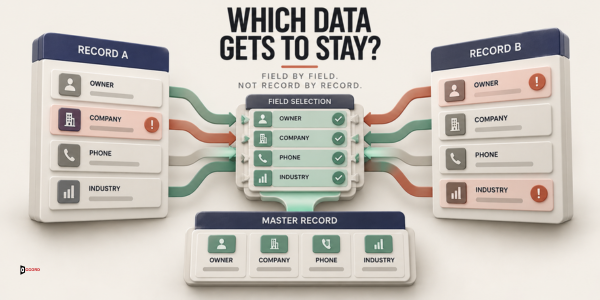
Survivorship determines which field value remains after a merge. "Keep the newest record" is rarely sufficient because different fields may have different authoritative sources.
A sales owner might be controlled by an active account assignment. A legal company name might come from an approved customer record. An industry classification might require a current research check. Each needs its own rule.
Distinguish a blank value from a deliberate empty value. A missing phone number should not overwrite a verified number, but a field intentionally cleared after a correction should not always be repopulated from an old record.
Protect source and date information alongside the surviving value. Knowing that a field was checked recently can be more useful than knowing which record happened to be created last.
Make conflicting values visible in the review queue. The reviewer should resolve the business question, not simply choose the longest text or the record with the most populated fields.
Preserve relationships and activity history
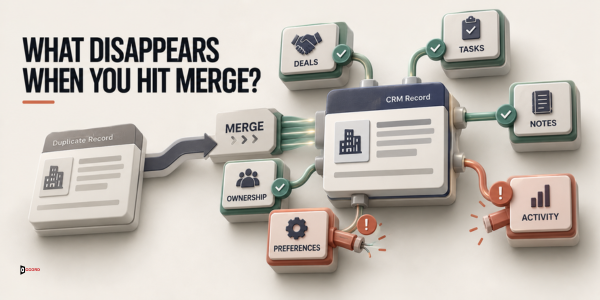
Before merging, inventory the associations that matter: deals, tasks, notes, email activities, tickets, lists, custom objects, and external system references. Check how the platform handles each one.
Some associations may move automatically; others may need explicit remapping. Read-only activity history can also behave differently from editable fields. Test the actual operation instead of assuming that everything visible in the interface survives unchanged.
Pay special attention to ownership. A merge can accidentally change who receives tasks or which team sees an account. Define whether ownership follows the active opportunity, territory policy, or a manual decision.
Preserve suppression and communication-preference history conservatively. A merge should not make a person eligible for marketing simply because the surviving record was missing a restriction. Have the responsible team define the appropriate rule for your system and obligations.
Coordinate this part of the cleanup with email marketing operations. Database identity and campaign eligibility need consistent treatment.
Test a representative sample before bulk work
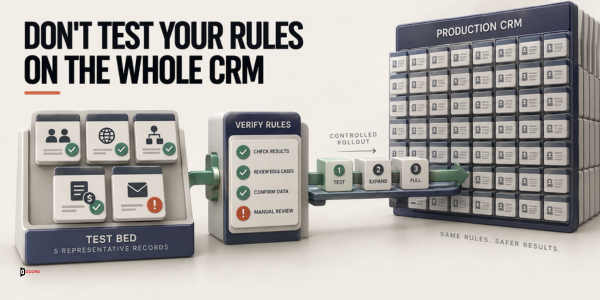
Create a test set containing the difficult cases as well as the easy ones. Include a shared domain, a contact with a job change, an active opportunity, conflicting ownership, and a communication restriction where such cases exist.
Use a sandbox or another controlled environment when available. If testing must occur in production, use explicitly approved records and a documented recovery approach appropriate to the platform.
Record the before state: relevant fields, associations, activity counts, owner, and external identifiers. After the test, check those same items. A successful tool response does not prove that the business context remains usable.
Have a sales or operations reviewer inspect the result. Technical validation can confirm field values while missing that a relationship now appears under the wrong account.
Document what cannot be reversed automatically. Some platforms restrict unmerging or restore only part of the original state. That limitation should shape the rollout size and review process.
Work through an illustrative conflict
Consider two hypothetical company records called North District Supply. One contains an active opportunity and a verified customer identifier. The other contains a more recent website URL and an old marketing restriction inherited through an integration.
A name match alone is not enough. The reviewer first confirms whether both records represent the same legal or operating account under the CRM policy. If they do, the customer identifier and opportunity association need protection.
The website value may survive if its evidence is current and appropriate. Ownership follows the agreed sales rule. The communication restriction requires explicit reconciliation rather than disappearing because it sits on the secondary record.
The test then checks the opportunity, tasks, source references, and downstream sync. The correct output is a coherent account, not simply the newer record with extra fields.
This example is hypothetical and intentionally avoids claiming a platform-specific merge result.
Roll out in small, reviewable groups
Group the production work by risk and matching rule. Process a well-understood group first, verify it, and then consider the next group. Mixing several rules in one large run makes unexpected behavior harder to isolate.
Assign a run identifier and record the candidate list, decision policy version, execution time, operator, and resulting record identifiers. Store this log in the approved project location.
Define stop conditions before starting. Unexpected association loss, ownership changes, sync failures, or a rising rate of identity disagreement should pause the rollout for investigation.
Avoid launching cleanup immediately before a major campaign or reporting deadline. The team needs time to check downstream systems and correct issues before the data is used.
Do not interpret a completed batch as permission to process newly discovered candidates under different conditions. New risk patterns require review of the rules that govern them.
Prevent duplicates at the point of entry
Cleanup becomes repetitive when forms, imports, integrations, and manual entry keep creating the same conflicts. Map each entry route and identify which identifiers it supplies.
Improve the import template and required fields where possible. Provide clear instructions for updating an existing record versus creating a new one. Test how the system behaves when an identifier is missing.
Review integrations for retries and inconsistent matching. A repeated request should not create a new customer every time a network response is lost. The technical solution depends on the system, but the business expectation should be explicit.
Give staff a fast way to report suspected duplicates without merging them casually. A review queue can reduce both uncontrolled edits and the temptation to ignore the problem.
Keep prevention rules compatible with legitimate exceptions. Shared domains, multi-location accounts, and several contacts using one departmental address may be valid parts of the business model.
Measure retained usability, not only removed rows
Track candidate volume, reviewed decisions, confirmed duplicates, unresolved exceptions, and post-merge issues. Include the reasons that drive manual review so the team can improve detection.
Measure whether sales can find the correct account and understand its history. Ask whether campaign lists respect restrictions and whether integrations still refer to the intended records.
A reduction in duplicate count is useful context, but it does not prove better data quality. Removing valid records can produce a pleasing number while damaging the system.
Review a sample after subsequent imports or sync cycles. Some errors emerge only when an external system recreates an old record or overwrites a carefully chosen survivor value.
Maintain the rules as an operating document with an owner and version history. Deduplication is easier to trust when each decision can be explained from a stable policy and a preserved evidence trail.
Frequently asked questions
Can we merge every record with the same email address?
Do not make that a universal rule. Email addresses can be shared, reassigned, or attached to different record contexts. Use the CRM's documented behavior and your identity policy, then review exceptions involving shared inboxes, job changes, conflicting preferences, or important customer relationships.
Should the oldest or newest record survive?
Choose survivorship by field and relationship rather than creation date alone. An older record may own the authoritative customer identifier or active deal. A newer record may contain better contact details. The surviving record should preserve the business meaning, with evidence for conflicts.
Is an export enough to undo a merge?
Not necessarily. A flat export may omit associations, activity history, permissions, or integration state. Check the platform's recovery capabilities and test what can actually be restored. Record any irreversible effects before the cleanup and use smaller rollout groups where recovery is limited.
How often should we run deduplication?
Base the review rhythm on entry volume, error patterns, and operational impact. A system with frequent imports may need regular candidate review. A smaller database may need less frequent work. Fixing the sources of repeated duplicates is usually more useful than scheduling increasingly large cleanups.
Who should approve uncertain matches?
Use a reviewer who understands both the CRM record model and the commercial relationship. Operations may own the policy, while sales or customer teams resolve account-specific uncertainty. Escalate unresolved identity conflicts instead of asking a researcher to make an irreversible guess.
Establish the policy before the cleanup
Define identity, matching, survivorship, associations, and recovery before removing records. Then prove the rules on a representative sample and maintain a clear decision log.
To scope a research and validation project around those rules, speak with Accord Tech Solutions. Bring sample duplicate patterns and the fields or relationships your sales team cannot afford to lose.
Methodology and sources
The policy is an original editorial synthesis. HubSpot's current documentation was consulted only for the point that duplicate behavior depends on object and ingestion route. The example is fictional; implementation must be validated against the actual CRM. No platform recovery capability is assumed.