
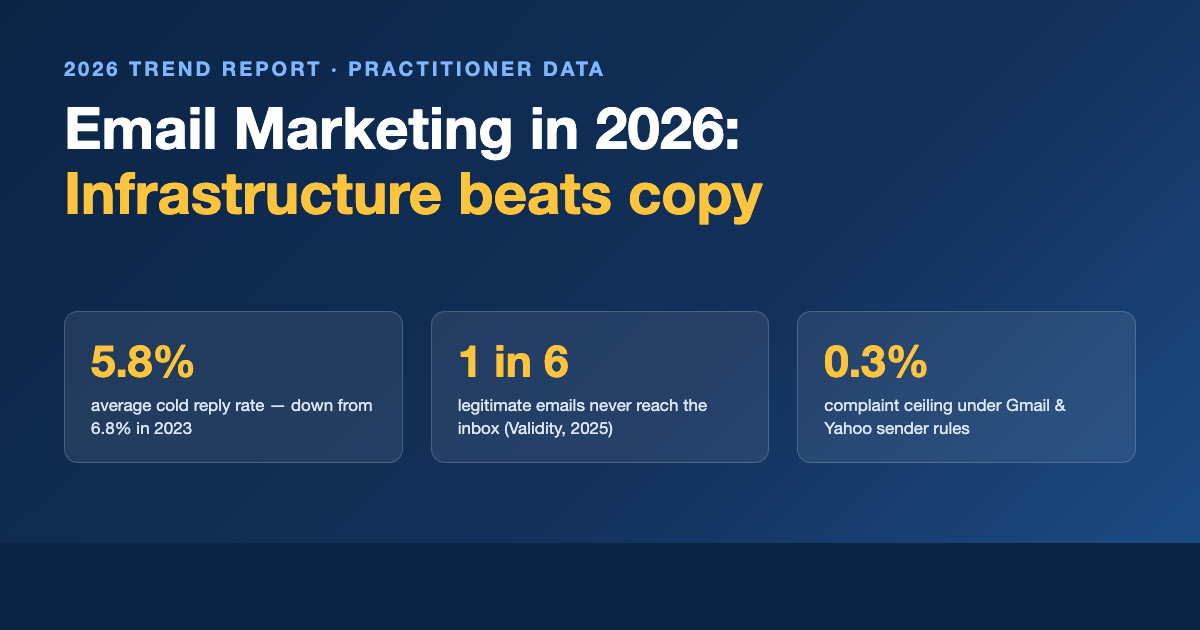
The biggest email marketing trend of 2026 is a shift from copy to infrastructure. Reply rates have fallen to 5.8% on average, open rates are no longer trustworthy, and Gmail, Yahoo, and Microsoft now enforce strict sender rules. The programs still winning are small, targeted, technically clean — and automated where it counts.
Most “email trends” articles are written by people who haven’t sent a campaign in years. This one is different. We spent July digging through what practitioners actually report in communities like r/Emailmarketing, r/coldemail, and r/sales — thousands of senders comparing notes in public — and cross-checked their claims against 2025-2026 industry benchmarks. Where Reddit anecdotes and benchmark data agree, you can trust the trend. Where they disagree, we say so.
Here is what the data says changed, what stopped working, and what to do about each one. If you’d rather have a team handle this end to end, our email marketing services cover everything below — from DNS records to revenue reporting.
What changed in email marketing in 2026?
Three things reshaped email between 2024 and 2026: mailbox providers began enforcing authentication and complaint thresholds, AI flooded inboxes with lookalike messages, and engagement tracking became unreliable. Together they ended the era when a clever subject line could compensate for a sloppy sending setup.
The numbers behind that summary:
- Average cold reply rate: 5.8%, down from 6.8% in 2023 (Prospeo analysis of 16.5 million cold emails, 2026).
- Global inbox placement: roughly 84% — about one in six legitimate emails never arrives (Validity Email Deliverability Benchmark, 2025).
- B2B decision-makers now report receiving 50-100+ cold emails per week.
Every trend below is a consequence of those three shifts. Notice what’s not on the list: subject-line hacks, emoji tests, “best time to send” tricks. The 2026 battles are won lower in the stack.
Why can’t you trust open rates anymore?
Open rates stopped being a reliable metric because Apple Mail Privacy Protection pre-loads tracking pixels and platforms now filter bot-triggered opens. Newsletters that reported 35% opens saw 18% overnight without losing a single reader. In 2026, the metrics that matter are clicks, replies, and revenue per recipient.
This is the loudest complaint in practitioner communities this year. One newsletter operator with a 6,000-subscriber list watched opens fall from ~35% to ~18% with clean authentication and no list change. HubSpot users reported drops from 30%+ to under 9% after the platform started filtering out opens triggered by Apple and Google’s automated scanning rather than humans.
Neither case was an audience problem. The measurement changed, not the readers.
What to do instead:
- Judge campaigns on clicks and replies.
- Track revenue per recipient monthly.
- Treat opens as directional, never absolute.
- Compare trends, not single sends.
If an agency or a tool still reports open rate as its headline success metric, that tells you how current their playbook is.
What do Gmail, Yahoo, and Microsoft now require from senders?
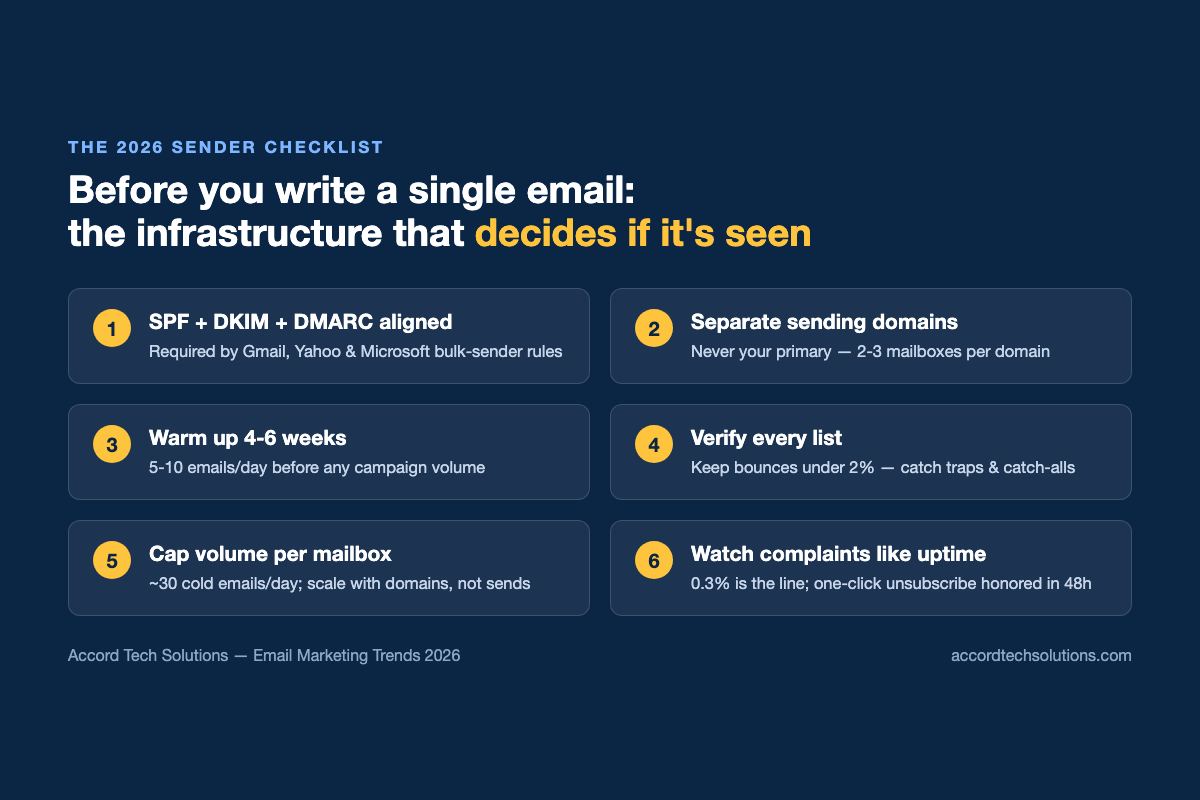
Since Google and Yahoo’s bulk-sender rules took effect (Microsoft followed with equivalent requirements), anyone sending at volume must pass SPF and DKIM with DMARC alignment, offer one-click unsubscribe honored within two days, and keep spam complaints under 0.3%. Miss any of these and your mail silently disappears.
The practical checklist, in plain English:
- SPF and DKIM: cryptographic proof you own the domain.
- DMARC record: minimum
p=none, aligned to your From-domain. - One-click unsubscribe: honored within 48 hours.
- Complaint rate below 0.3%: measured by the providers.
- Valid forward and reverse DNS.
Here’s the part most articles skip: practitioners report these rules punished legitimate senders with lazy setups far more than actual spammers, who simply rotate domains. The upside is real, though — senders who fixed authentication and cut complaint-heavy segments consistently report placement recovering within four to six weeks.
This is also the clearest illustration of 2026’s core theme. Copy-focused threads rarely mention SPF, DKIM, or DMARC at all — and infrastructure is exactly where most programs are quietly bleeding. Most agencies will write good emails; far fewer will fix the DNS records that decide whether those emails get seen. (That gap is, frankly, why our engineering-led B2B email marketing agency team leads engagements with a deliverability audit, not a copy deck.)
Is cold email dead in 2026?
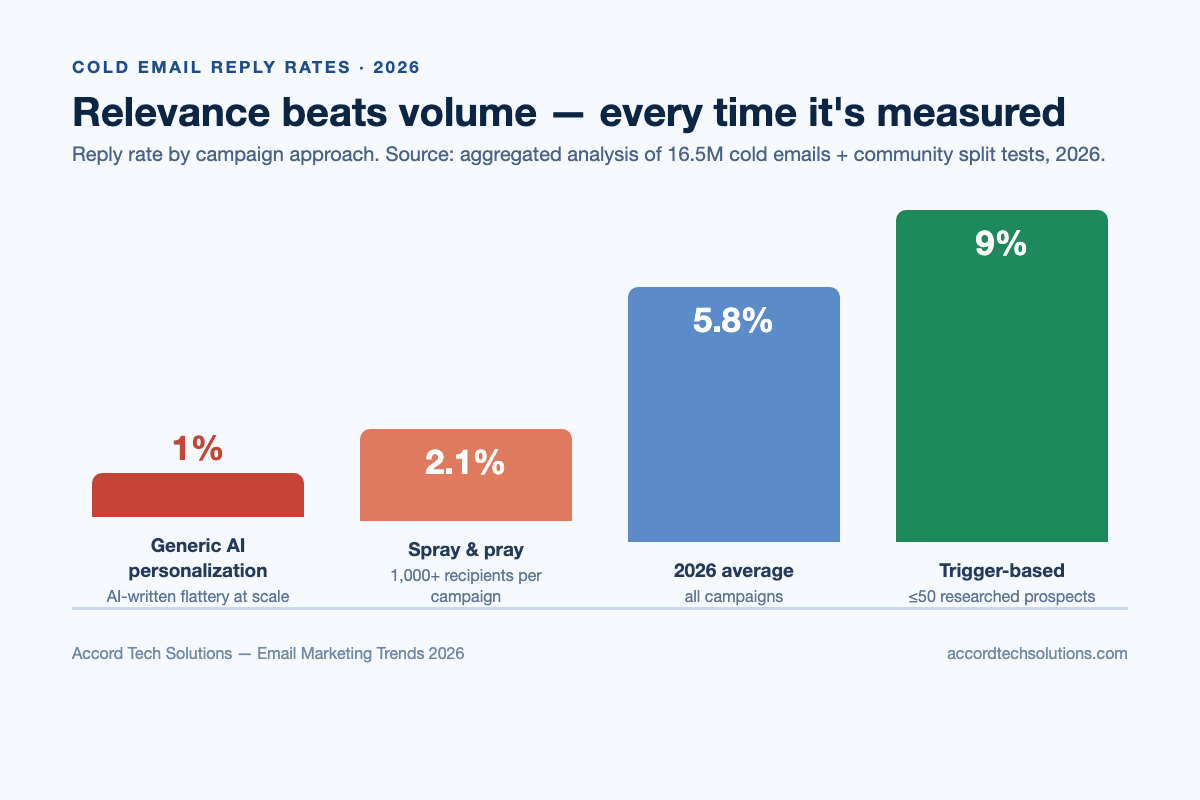
Cold email is not dead — untargeted cold email is. Campaigns sprayed at 1,000+ recipients now pull a 2.1% reply rate, while tightly targeted sends to under 50 well-researched prospects still achieve 5.8% or better. The channel works, but only when run like infrastructure: warmed domains, verified lists, capped volume.
This section covers cold outbound — prospecting email to people who haven’t heard from you. Lifecycle email for existing audiences is covered two sections down; the two disciplines share almost nothing.
The 2026 economics of cold outbound, straight from the aggregated data:
- Targeted ≤50-recipient campaigns: 5.8%+ replies.
- Spray-and-pray 1,000+ campaigns: 2.1% replies.
- One to two contacts per company: 7.8%.
- Ten or more contacts per company: 3.8%.
- First follow-up: lifts total replies ~49%.
- Fourth email: complaint rates triple. Stop at three.
And the infrastructure math nobody puts in the sales deck: separate sending domains (never your primary), two to three mailboxes per domain, roughly 30 cold emails per mailbox per day, and a four-to-six week warmup at low volume before any campaign. Sending 1,000 emails a day means owning and warming around 14 domains at a running cost of $200-300 per month — before you’ve written a word. Platforms built for this (Instantly, Lemlist, Smartlead) manage the rotation; none of them can skip the warmup physics.
Two details that consistently surprise people. Plain-text emails outperform designed HTML in cold outbound, every time it’s tested. And turning off open tracking correlates with about +3% replies — the tracking pixel itself is a spam signal.
Does AI actually work for email personalization?
AI personalization works when it’s used for research and fails when it’s used for prose. In a widely shared 2026 split test, generic AI-personalized emails pulled a 1% reply rate while trigger-based emails — referencing a real event like a competitor launch or a new hire — pulled 9%. Buyers have learned to smell generated flattery instantly.
This is the sharpest finding in this year’s research, and it cuts against most of what’s being sold right now. The “AI email marketing trends 2026” everyone is promoting — fully generated sequences, AI-written compliments about a prospect’s LinkedIn post — are precisely what recipients now filter out on sight. When every inbox contains twenty messages saying “loved your recent post about scaling,” the twenty-first is deleted unread.
Where AI genuinely earns its keep in 2026:
- Trigger detection: monitoring funding rounds, hires, launches.
- List research: qualifying accounts before they enter a sequence.
- Verification and hygiene: catching invalid addresses and spam traps.
- Reply triage: routing interested responses to humans fast.
The pattern: AI on the inputs (who to email, when, about what), humans on the message. Practitioners who do the research-heavy version report it takes 10-15 minutes per lead — which only makes sense because a 9% reply rate on 50 researched prospects beats a 1% rate on 5,000 blasted ones, on every metric including the sender reputation you keep.
What’s working in lifecycle email in 2026?
Lifecycle email — automated flows to people already in your audience — remains the highest-ROI work in the channel. Programs at maturity attribute 25-35% of digital revenue to email, with most of it coming from a handful of automated flows: welcome, abandonment, post-purchase, and win-back. The 2026 trend is fewer campaigns, better automation.
This is the other half of email — Klaviyo, HubSpot, and Mailchimp territory, not Instantly territory. Different platforms, different rules, different metrics.
The benefits of email marketing in 2025-2026 haven’t changed on paper — the Data & Marketing Association’s long-running benchmark still puts returns around $36 per $1 spent (DMA, 2024), and it remains the only major channel you own outright. What changed is where the return concentrates. Practitioner consensus and platform data agree: automated flows generate the large majority of email revenue while one-off campaign blasts decline, yet most businesses still spend 80% of their email hours on the blasts.
Email marketing automation best practices for 2026, condensed:
- Welcome flow within minutes of signup — in Klaviyo or HubSpot, a three-message series triggered on list join outperforms any newsletter you’ll send that quarter.
- Abandonment flows (cart, browse, quote) — highest revenue per recipient of any automation.
- Sunset flow: automatically stop mailing non-engagers after 90-120 days. This is now a deliverability requirement, not housekeeping — complaint thresholds punish you for mailing the indifferent.
- Zero-party data capture: ask preferences at signup; segment on answers, not guesses.
- One metric: revenue per recipient, monthly, per flow.
Automation in email marketing is also the honest answer to shrinking teams: a five-flow setup built once outsells a year of manual campaigns, and it doesn’t take PTO.
How does AI search change email’s role in your marketing?
AI search makes email more valuable, not less. With AI Overviews now appearing on roughly half of Google searches and most searches ending without a click, the traffic websites used to rely on is thinning. Email is the one channel where an algorithm doesn’t sit between you and your audience — which is why capturing addresses from every remaining visit became 2026’s quiet priority.
The numbers driving this: AI Overviews appeared on 48% of queries by March 2026, up from 34.5% in December 2025 (industry SERP tracking, 2026), and 58% of searches now end with no click at all. Informational content — the “what is” and “how to” posts that fed newsletter signups for a decade — is exactly the category AI answers absorb first.
The strategic consequence is simple: every website visit is now scarcer and more expensive, so converting visits into owned contacts matters more than ever. The businesses adapting fastest treat search (classic and AI) as the acquisition layer and email as the relationship layer — get cited or ranked, capture the visit, then let the flows above do the compounding. Email list growth is, in 2026, an insurance policy against algorithms you don’t control.
What does email marketing cost in 2026?
Expect $200-300 per month in infrastructure for a serious cold outbound setup before any labor, $100-600 per month for a lifecycle platform at typical B2B list sizes, and $2,000-$10,000 per month for a full-service agency retainer. The real cost variable in 2026 is not tooling — it’s whether the work is done right the first time.
Breaking that down by route:
Do it yourself. Cold outbound: domains, mailboxes, and a sending platform (Instantly, Smartlead) land around $200-300 per month at the roughly 1,000-emails-a-day scale described above — a small two-domain starter setup runs closer to $40-80 — plus verification credits. Lifecycle: Klaviyo and Mailchimp pricing scales with list size — at 10,000 contacts they run about $150 and $100 per month respectively (2026 published tiers), with typical 5,000-25,000 contact B2B lists landing in the $100-600 band. HubSpot is the exception: its Marketing Hub Professional tier starts around $800 per month, well above that band. The hidden cost is time: the warmup, authentication, and flow-building work in this article is 40-60 hours done properly, and mistakes are expensive — a burned domain takes months to recover, and a mailed-out unengaged segment can push complaints over the 0.3% line in one send.
Hire an agency. US retainers cluster between $2,000 and $10,000 per month depending on whether it covers one discipline or both, with project work (audits, migrations, flow builds) at $3,000-$20,000. The 2026 buying tip that practitioner threads repeat constantly: ask any agency you’re evaluating to walk you through their own SPF/DKIM/DMARC setup and their warmup schedule before you sign. The ones who light up at the question do infrastructure; the ones who redirect to a portfolio of pretty templates don’t. It is the single fastest way to sort the field.
Hybrid. An increasingly common 2026 pattern: agency builds the infrastructure and flows (one-time project), in-house team runs campaigns on top. It front-loads the expertise where errors are costly and keeps the recurring cost internal.
Which email KPIs should you actually track in 2026?
Track deliverability first (inbox placement, bounce rate, complaint rate), then response (clicks and replies), then money (revenue per recipient, pipeline from email). Opens are a footnote. If you only watch five numbers: complaints under 0.3%, bounces under 2%, cold replies above 5%, click trend, and revenue per recipient by flow.
The 2026 benchmark card to pin above your dashboard:
- Complaint rate: under 0.3% — survival threshold.
- Bounce rate: under 2% — verify or suffer.
- Inbox placement: 84% is average; aim higher.
- Cold reply rate: 5.8% average; 8%+ excellent.
- Follow-ups: three maximum, first one essential.
- Revenue per recipient: trend monthly, per flow.
Two habits separate teams that improve from teams that report. First, measure per flow and per segment, never just per account — a healthy welcome flow can hide a dying newsletter in blended numbers. Second, when a metric moves, check the measurement before the message: as the open-rate section above shows, half of 2026’s “performance changes” are actually tracking changes.
Which email marketing trends should you ignore in 2026?
Ignore any trend that adds volume or polish instead of relevance: fully AI-written sequences, heavier HTML design, longer follow-up chains, purchased lists, and open-rate optimization. Every one of them now actively damages either your reply rate or your sender reputation.
The anti-trends, with the receipts:
- “Send more follow-ups” — complaints rise from 0.5% on email one to 1.6% by email four. Three is the ceiling.
- “Beautiful HTML templates” — plain text wins cold outbound; even lifecycle mail is trending simpler.
- “AI writes everything” — the 1% vs 9% split test above.
- “Buy intent lists” — unverified lists mean bounces; bounces over 2% mean the spam folder.
- “Optimize send-time to the minute” — Thursday beats Monday by ~1.5 points; everything finer is noise.
- “More mailboxes, more volume” — volume without targeting is how you end up rebuilding domains from scratch.
Do these trends apply differently to B2B and B2C?
Yes. B2B email in 2026 is dominated by the cold-outbound rules — sender reputation, trigger-based targeting, three-touch limits — because the buyer is a person you can research. B2C is dominated by the lifecycle rules — flows, segmentation, sunset policies — because revenue comes from behavior, not persuasion. Most of the damage happens when a business runs one playbook for both.
The quick translation table:
- B2B: fewer, researched, plain-text; replies are the KPI.
- B2C: automated flows on Klaviyo-class platforms; revenue per recipient is the KPI.
- Both: authentication, verification, complaint discipline — no exemptions.
One B2B-specific note from this year’s threads: the same buyers drowning in 50-100 cold emails a week still respond to relevance — reply rates on researched, trigger-based sends held steady even as average rates fell. Scarcity of attention punished lazy senders and quietly rewarded careful ones. And one B2C-specific note: SMS and email are converging into single lifecycle platforms, but the deliverability rules of each channel stay separate — an email complaint threshold won’t warn you before a carrier filters your texts.
How do you build a 2026-proof email program?
A 2026-proof email program has five layers: authenticated infrastructure, verified and segmented lists, trigger-based targeting, automated lifecycle flows, and measurement built on replies and revenue rather than opens. Build them in that order — each layer is worthless without the one below it.
The 30-day build order we use:
- Week 1 — infrastructure: SPF, DKIM, DMARC aligned; secondary domains bought and warming; tracking domains configured.
- Week 2 — list: verify everything (target <2% bounce); segment by engagement; sunset the dead weight.
- Week 3 — flows: welcome, abandonment, and one win-back flow live in your platform; cold sequences capped at three touches.
- Week 4 — measurement: replies, clicks, and revenue per recipient on a dashboard; opens demoted to a footnote.
- Ongoing: one trigger-based cold campaign at a time, under 50 prospects, researched properly.
That’s the whole trend report, honestly: the winners in 2026 are running smaller, cleaner, more automated programs while everyone else buys AI tools to send more of what already wasn’t working. If you’d rather compress those 30 days into a done-for-you engagement, our outbound and lifecycle email program starts with the deliverability audit and ends with the revenue dashboard — typical outbound engagements move reply rates from the 1-2% range to 5-10% within 60-90 days, and retainers run $2,000-$10,000 per month depending on scope.
How we researched this
We reviewed top threads from July 2026 and the preceding months in r/Emailmarketing, r/coldemail, r/sales, r/SaaS, and r/LeadGeneration, alongside aggregated analyses of those communities, and cross-checked practitioner claims against published benchmarks: Prospeo’s 16.5-million-email cold outreach dataset (2026), Validity’s Email Deliverability Benchmark (2025), the DMA email ROI study (2024), and Google/Yahoo/Microsoft sender documentation. Where a claim appeared only as anecdote without benchmark support, we either flagged it or left it out. No statistic in this post comes from a vendor’s sales page.
Last reviewed: 10 July 2026. We re-check the numbers quarterly.
Frequently asked questions
Is email marketing still worth it in 2026?
Yes — email remains the highest-ROI owned channel, returning roughly $36 per $1 spent (DMA, 2024), and it’s insulated from the AI-search shifts cutting website traffic. But the return now concentrates in automated lifecycle flows and tightly targeted outbound, not in bigger sends or prettier templates.
What is a good cold email reply rate in 2026?
The overall average is 5.8%. Targeted campaigns to fewer than 50 researched prospects regularly beat that; anything above 8-9% is excellent. If you’re below 2%, the cause is almost always list quality or deliverability infrastructure — not your copy.
Why did my open rates suddenly drop?
Most likely nothing changed with your audience. Apple Mail Privacy Protection inflates and distorts opens, and platforms like HubSpot now filter bot-triggered opens out of reporting, which cut some accounts from 30%+ to under 9%. Judge your program on clicks, replies, and revenue per recipient instead.
How many cold emails can I send per day in 2026?
Around 30 per mailbox per day, with two to three mailboxes per sending domain — always on separate domains from your main one, warmed for four to six weeks first. High volume means more domains, not more sends per mailbox: about 14 domains for 1,000 emails a day.
Does AI email personalization work?
Only when AI does the research instead of the writing. Trigger-based emails referencing a real event (funding, hires, a competitor launch) pulled 9% replies in 2026 testing, while generic AI-personalized messages pulled 1%. Use AI to find the trigger; write the sentence yourself.
What are the most important email marketing automation best practices?
Five, in order: authenticate your sending domains (SPF, DKIM, DMARC); verify lists to under 2% bounce; launch welcome and abandonment flows before any campaign work; sunset subscribers who haven’t engaged in 90-120 days; and measure revenue per recipient monthly per flow.