
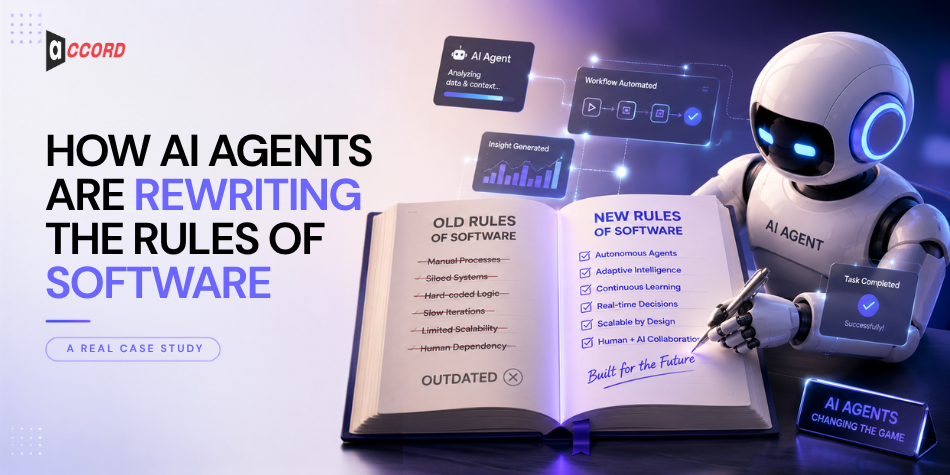
The 4-Hour Task That Took 14 Minutes
There are moments in technology when something shifts — not gradually, but suddenly and irreversibly. We had one of those moments at Accord Tech Solutions, and it changed how we think about software, productivity, and the role of artificial intelligence in modern business operations.
A project that once took 4 hours and 41 minutes — even with AI assistance as a co-pilot — was completed by a custom-built AI agent in just 14 minutes.
That is a 95% reduction in time on a real, production-level task. Not a sandbox demo. Not a controlled experiment. A real deliverable, completed at a fraction of the cost and effort — and repeatable on every similar project from this point forward.
What Is an AI Agent — And Why Is It Different From Regular AI?
Before diving into the case study details, it is worth clarifying something that a lot of businesses get wrong about AI.
When most organizations talk about "using AI," they mean AI assistance — tools like ChatGPT, Claude, or Gemini that answer questions, draft content, write code snippets, or suggest strategies. This is genuinely valuable, but it still requires a human in the loop to read the output, decide what to do with it, and take the next action.
An AI agent is fundamentally different.
AI Assistance
Like hiring a brilliant consultant who gives you the best possible advice. You still have to read it, decide what to do, and execute every step yourself. The human remains in the loop for every action.
AI Agent
Like hiring a specialist who actually does the work — start to finish — while you focus on higher priorities. The agent plans, executes, validates, and delivers without hand-holding at each step.
An AI agent is an autonomous system designed to plan, execute, verify, and deliver on its own. It does not wait for human prompting between steps. It handles entire workflows from start to finish, makes decisions along the way, recovers from errors, and produces production-ready results.
This distinction is why AI agents represent a genuine structural shift in how software and business operations work — not just an incremental improvement on existing tools.
How We Built the Agent: The Full Story
The Problem We Were Solving
Our team was working on a project that involved repetitive, multi-step data processing — the kind of task that requires careful sequential decision-making, consistent formatting, structured output, and quality checks at every stage. Even when using AI tools to assist, the work still required significant human time and attention: reviewing, adjusting, running commands, validating results, and repeating.
The bottleneck was not intelligence. The bottleneck was repetition. And repetition is exactly where AI agents thrive.
The Decision: Build AI as a Worker, Not a Helper
Rather than continuing to use AI as a helper tool, we made a deliberate decision: build AI as a worker. We designed and developed a custom AI agent tailored specifically for this workflow, architected to handle the following autonomously:
- Understand the complete scope of the task without step-by-step human prompting
- Execute each step in sequence, chaining outputs into subsequent inputs automatically
- Validate its own output before advancing to the next step
- Handle edge cases and recover from errors intelligently
- Deliver a final, production-ready result without human review of intermediate steps
The Honest Part Everyone Skips
Did we build the agent entirely from scratch without any AI support? No — and we will not pretend otherwise. We used AI to help architect and refine the agent itself. But here is the critical insight that most people overlook:
"The time invested in building the agent was a one-time cost. Every similar project from this point forward costs 14 minutes, not 4 hours and 41 minutes."
The first time we ran the agent on a real production project, it completed the task in 14 minutes. The output was clean, accurate, and ready to use. A task that once occupied most of a workday now runs in the background while the team moves on to higher-value work. The ROI began on Day 1 and compounds with every project that follows.
Why This Matters Beyond Our Team
You might be reading this and wondering: "That is impressive, but what does it mean for my business?" The answer is that the economics of software work are changing — and they are changing faster than most organizations are prepared for.
The Shift From Doing to Designing
For decades, the measure of a skilled software or marketing professional was how quickly they could do the work — how fast they could write the code, produce the analysis, build the campaign, or deliver the report. That measure is rapidly becoming less relevant.
The professionals and organizations that will lead in the next five years are the ones who excel at designing systems that do the work for them. They will spend their time architecting agents, defining quality standards, and solving problems that machines genuinely cannot handle yet. The repetitive, sequential, rule-based work? Agents will own that.
AI Agents Are Compounding Assets
One of the most underappreciated truths about AI agent development is that the value compounds over time. When you pay a human worker to execute a repetitive task, you pay for every hour of that task, indefinitely. When you build an AI agent to do the same task, you pay a build cost once, and then the cost per execution drops dramatically — as our case study demonstrates, often by 80–95% or more.
Moreover, once an agent is built, it can be improved, extended, and deployed across similar workflows. A single well-designed agent is not just a solution to one problem. It is a foundation for solving an entire category of problems — and that is where the real competitive advantage accumulates.
What AI Agents Mean for Digital Marketing and Business Growth
At Accord Tech Solutions, we are an AI digital marketing agency that has been helping businesses grow for over 13 years. We see the intersection of AI automation and business growth every single day. The implications of AI agents for these functions are significant and immediate.
Traditional lead generation requires human researchers to identify prospects, validate contact information, enrich CRM records, and qualify leads against ideal customer profiles. Each step is time-consuming and prone to inconsistency.
AI agents can handle large portions of this workflow autonomously — executing research, validating data, enriching records, and flagging the highest-quality leads for human review — in a fraction of the time. The result is a pipeline that grows faster with significantly less manual overhead.
Email marketing has always been labor-intensive at scale. Writing personalized sequences for different buyer personas, adjusting messaging based on funnel stage, and testing variations all require significant human production time.
AI agents change the calculus entirely. With the right system in place, agents can generate, test, and refine personalized email campaigns across multiple segments simultaneously — delivering the personalization that converts without hours of manual production per campaign.
For PE/VC portfolios and B2B companies managing large datasets, the cost of inaccurate or outdated CRM data is enormous. Decisions made on bad data lead to wasted sales effort, missed pipeline opportunities, and flawed strategy.
AI agents can monitor, validate, enrich, and update data records continuously — maintaining a level of data accuracy that was previously impossible to sustain without large operations teams. This is the infrastructure that allows businesses to make better decisions faster and generate more revenue from their existing assets.
Lessons Learned Building Our First AI Agent
For organizations thinking about exploring AI agent development, here are the honest lessons from our experience:
Start with a painful, repetitive process you already understand deeply
The worst candidates for automation are vague, judgment-heavy processes. The best are ones where steps are clear, inputs are defined, and quality criteria are measurable.
Understand the workflow before you automate it
If you cannot describe every step clearly enough for a junior employee to execute it, you cannot build an agent to do it either. Clarity precedes automation — always.
Expect an upfront build investment
Building a well-designed agent takes time and expertise. The payoff comes after the agent is running. Abandoning early because the build takes effort is a short-term decision with long-term costs.
AI agents are structured logic, not magic
The most effective agents are well-designed systems with clear decision trees, defined outputs, error handling protocols, and quality validation. The AI handles nuance; the structure handles reliability.
The Future of Software: Less Execution, More Architecture
We are entering a period where the most valuable skill in software and business operations is not executing tasks — it is designing the systems that execute tasks. This is a profound shift, and like all profound shifts, it creates enormous opportunity for organizations that move early and significant risk for those that do not.
The companies that will dominate their markets in the next three to five years will not necessarily be the ones with the largest teams or the biggest budgets. They will be the ones with the most efficient, well-designed AI-powered operations — systems that scale without proportional increases in cost or headcount.
At Accord Tech Solutions, we are not watching this shift from the sidelines. We are building these systems — for our own operations and for the clients we partner with. From AI-powered lead generation to intelligent email marketing automation to CRM enrichment at scale, we are integrating AI agents into the work we do every day.
The 14-minute project was not an endpoint. It was proof of concept. The real work — and the real opportunity — is just beginning.
Ready to Transform Your Operations?
Stop Doing the 4-Hour Version of Your Work
Whether you are scaling a B2B pipeline, running a PE/VC portfolio, or looking to cut operational overhead — AI agent-driven automation is not something you can afford to wait on.
Talk to Our AI TeamFrequently Asked Questions
Everything you need to know about AI agents, workflow automation, and what they mean for your business.
An AI agent is an autonomous software system designed to independently plan, execute, and complete multi-step tasks from start to finish — without requiring a human to direct each step. This is fundamentally different from AI assistants like ChatGPT, which respond to prompts but still require a human to take the output and decide what to do next.
An AI agent chains actions together automatically. Instead of asking an AI to write a script and then manually running it and asking the AI to process the output, an AI agent does all of this in sequence on its own — checking its own work along the way and delivering a final, usable result.
The time savings depend heavily on the type of task being automated. In our own case study at Accord Tech Solutions, a task that previously took 4 hours and 41 minutes was reduced to 14 minutes by a custom AI agent — a 95% reduction in time.
In general, AI agents perform best on repetitive, rule-based, multi-step tasks with clearly defined inputs and outputs. For those types of workflows, time savings of 70 to 95 percent are realistic. Tasks that require complex human judgment, creative strategy, or relationship management are better suited to AI assistance rather than full agent automation.
For off-the-shelf AI agent tools, some technical background is helpful but not always required. For custom AI agents built to handle specific business workflows — like the agent we built at Accord Tech Solutions — a development team with experience in AI systems, APIs, and workflow architecture is strongly recommended.
The good news is that you do not need to build agents entirely in-house. Working with an experienced AI digital marketing and automation agency can dramatically reduce the time and expertise required to get a production-ready agent deployed for your specific needs.
AI agents work best when tasks have clearly defined inputs and outputs, sequential steps that can be executed in a predictable order, and objective quality criteria that can be evaluated programmatically.
Strong candidates include lead generation and CRM data enrichment, email campaign generation and management, web scraping and data processing, content production workflows, product listing creation and optimization, SEO auditing, report generation, and customer onboarding sequences. Tasks that involve nuanced human judgment, live negotiation, or open-ended creative direction are less suited to full agent automation.
AI agents are not replacing software developers or digital marketers — they are replacing the exhausting, repetitive portions of their work. The demand for professionals who can design, build, monitor, and improve AI agent systems is actually growing rapidly, not shrinking.
The shift is from execution to architecture. Developers who can design agent workflows, and marketers who can define automation strategies and quality standards, are becoming significantly more valuable.
Accord Tech Solutions is an AI digital marketing agency with over 13 years of experience helping B2B companies, PE/VC portfolios, and growth-stage businesses build scalable data infrastructure, generate qualified leads, and accelerate pipeline growth using AI-powered operations.
We help businesses identify which workflows are the best candidates for AI agent automation, design and build custom agent systems tailored to their specific needs, and integrate those systems into existing CRM and marketing infrastructure. Get in touch with our team to start the conversation.