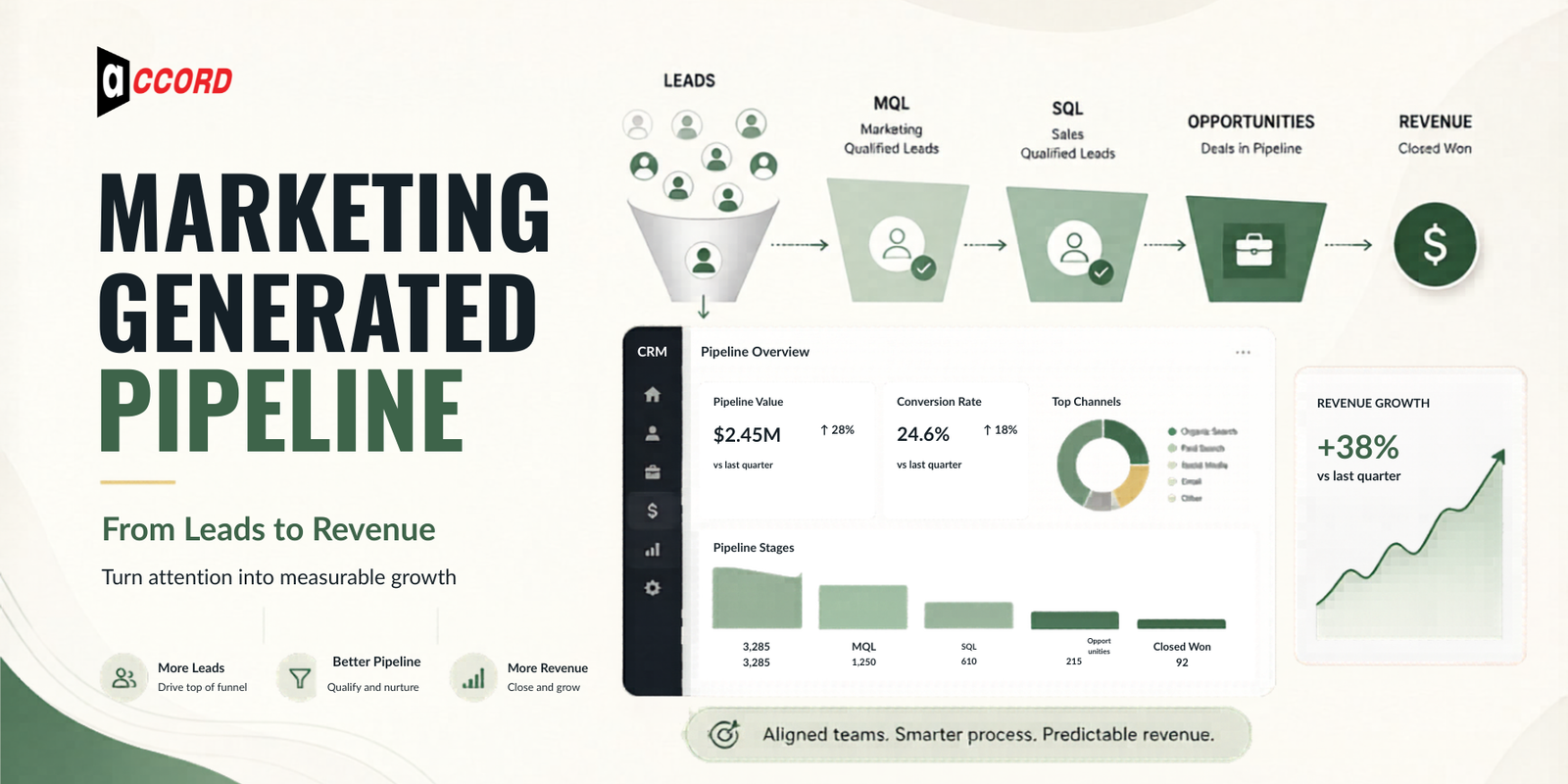
Are you tired of presenting high lead counts to your executive team only to be met with blank stares because those leads aren't turning into actual contracts? This is the age-old friction point between departments tat many modern organizations still struggle to solve. On February, 2026, the demand for transparency in digital spend is higher than ever, according to recent industry benchmarks from Gartner.
The real question is: How can marketers move from being a "cost center" to a "profit center" by showing a clear revenue pipeline? It is not just about catching interest; it is about proving that your specific campaigns are the direct catalyst for closed-won deals. In this guide, we will break down the mechanics of the lead to the revenue process explained so you can finally align your efforts with the company’s bottom line.
Understanding the Concept of Marketing Generated Pipeline

When we talk about a marketing pipeline, we are referring to the total dollar value of qualified opportunities in the sales funnel that originated directly from marketing activities. This is the ultimate proof of health for any growth team. In the past, marketers were judged on "vanity metrics" like clicks or impressions. However, in a revenue driven marketing environment, those metrics take a backseat to actual opportunity value.
This shift exists because the B2B buying journey has become incredibly complex. A prospect might read three blog posts, attend a webinar, and download a whitepaper before ever talking to a salesperson. Without a way to track this, marketing looks like an expensive hobby. By focusing on the pipeline, you provide a forward-looking indicator of company health rather than just looking at the past month's spend.
Accord Tech Solutions, we often see teams that have plenty of traffic but zero visibility into where that traffic goes. This is where a scalable lead generation engine becomes necessary. It isn't just about getting more people in the door; it is about ensuring those people are the right fit and are moving toward a purchase.
The Mechanics of the Marketing Attribution Model

To prove your worth, you need a reliable marketing attribution model. This is the framework that decides which touchpoints get credit for a sale. Is it the first ad they clicked?
The last email they opened? Or a mix of everything in between? Without a solid model, your data is just a collection of guesses.
Most successful B2B organizations use a multi-touch attribution approach. This recognizes that a single "lead" is rarely the result of just one interaction. Technical tracking involves using UTM parameters, cookies, and CRM pipeline reporting to stitch together a person's journey. For example, if a user first finds you through an organic search and later converts via a LinkedIn ad, a "Linear" model would give equal credit to both.
However, the technical architecture goes deeper. You need to ensure your marketing automation platform "talks" to your CRM. This sales and marketing alignment is the glue that holds the data together. If Sales marks a lead as "Qualified," that data must flow back to Marketing so they can see which campaign produced that high-quality prospect.
From Leads to Revenue: Bridging the Conversion Gap

The transition from leads to revenue is often where the most friction occurs. A lead is just a person who showed interest. Revenue is the actual money in the bank. The space between those two points is a funnel that requires constant maintenance and B2B funnel optimization.
Think of your funnel like a leaky bucket. You can pour as much "water" (leads) into the top as you want, but if there are holes in the middle, you will never fill the bucket. This is why MQL to SQL tracking is so vital.
A Marketing Qualified Lead (MQL) only becomes a Sales Qualified Lead (SQL) when they meet specific criteria, such as budget, authority, and need. If your MQLs aren't becoming SQLs, your marketing generated pipeline is essentially an illusion.
I remember working with a client who was frustrated that their "hot leads" were being ignored by sales. When we looked at the data, we realized the leads were actually students looking for information, not decision-makers.
By implementing a performance marketing framework, we tightened the targeting. We shifted from quantity to quality, and suddenly, the lead to revenue conversion rates skyrocketed because the leads were actually relevant to the sales team's goals.
How to Connect Marketing to Revenue and Prove ROI

If you want to know how to connect marketing to revenue, you have to start with the data. You cannot manage what you cannot measure. Proving B2B marketing ROI requires a direct line of sight from the initial dollar spent to the final contract signed. This usually involves marketing revenue attribution, which assigns a specific dollar value to marketing's contribution.
Here is a simple way to look at it:
-
Step 1: Track every touchpoint using a pipeline building system.
-
Step 2: Integrate your ad platforms with your CRM for data driven growth marketing.
-
Step 3: Calculate the "Customer Acquisition Cost" (CAC) and compare it to the "Lifetime Value" (LTV).
When you can show that for every $1 spent, the company generates $5 in the pipeline, you are no longer asking for a budget; you are presenting a business case. This is exactly what marketing KPIs for executives should look like. They don't want to hear about "engagement rates"; they want to hear about "pipeline velocity" and "win rates."
Why Pipeline Tracking for Marketers is a Non-Negotiable
The modern threat landscape for marketers isn't just about competitors; it's about bad data. Relying on "gut feelings" is a risk that can lead to wasted budgets and missed targets. Pipeline tracking for marketers acts as a GPS for your strategy. It tells you when you are off track and which "roads" are leading to dead ends.
In the real world, companies that ignore this often see a massive disconnect between their departments. Marketing thinks they are winning because lead volume is up, while Sales is struggling because those leads are poor. This is why a lead generation Services Agency often focuses first on the infrastructure. You need a scalable lead generation engine that works while you sleep, filtering out the noise and highlighting the gold.
Using Accord Tech Solutions as an example of an expert perspective, we believe that a truly revenue focused lead generation strategy must be holistic. It’s not just a "marketing thing" or a "sales thing." It is a business-wide commitment to understanding how a stranger becomes a loyal customer.
Common Misconceptions About Marketing ROI
One of the biggest myths is that marketing's job ends once the lead is handed over to sales. This couldn't be further from the truth. In a high-performing revenue driven marketing setup, marketing continues to nurture the prospect throughout the entire sales cycle.
Another misconception is that you need incredibly expensive software to start. While a sophisticated CRM pipeline reporting tool helps, the logic is more important than the tool. You can start how to track marketing pipeline with simple spreadsheets and clear definitions of what constitutes a "qualified" lead.
The goal is clarity, not just complexity. People often confuse "attribution" with "contribution." Attribution is about credit; contribution is about value. Focus on the latter.
Expert Recommendation:
To truly master your growth pipeline, don't just look at the last click. Implement a "U-Shaped" or "W-Shaped" marketing attribution model. This ensures you give credit to the first touchpoint that introduced the brand and the middle touchpoints that actually convinced the user to sign up. This provides a much more honest view of your B2B marketing ROI.
The Future of Revenue-Driven Strategies
As we look toward the future, the reliance on data driven growth marketing will only intensify. Artificial Intelligence is already starting to predict which leads are most likely to close based on historical patterns. This means your pipeline building system will become even more predictive rather than just reactive.
However, technology will never replace the need for human-centric sales and marketing alignment. At the end of the day, B2B sales are about relationships. Your job as a marketer is to facilitate those relationships at scale. By mastering how to prove marketing ROI, you secure your place as a vital driver of your company’s growth.
Frequently Asked Questions
Once the definitions are set, use your CRM to tag the "Lead Source" for every new contact. This is the foundation of pipeline tracking for marketers.
Send useful, relevant information and follow up with emails that answer common questions and ease concerns before they speak to sales. This is the core of B2B funnel optimization.
Ready to turn your marketing into a revenue-generating machine? Contact Accord Tech Solutions today to see how our data-driven strategies can transform your business.