
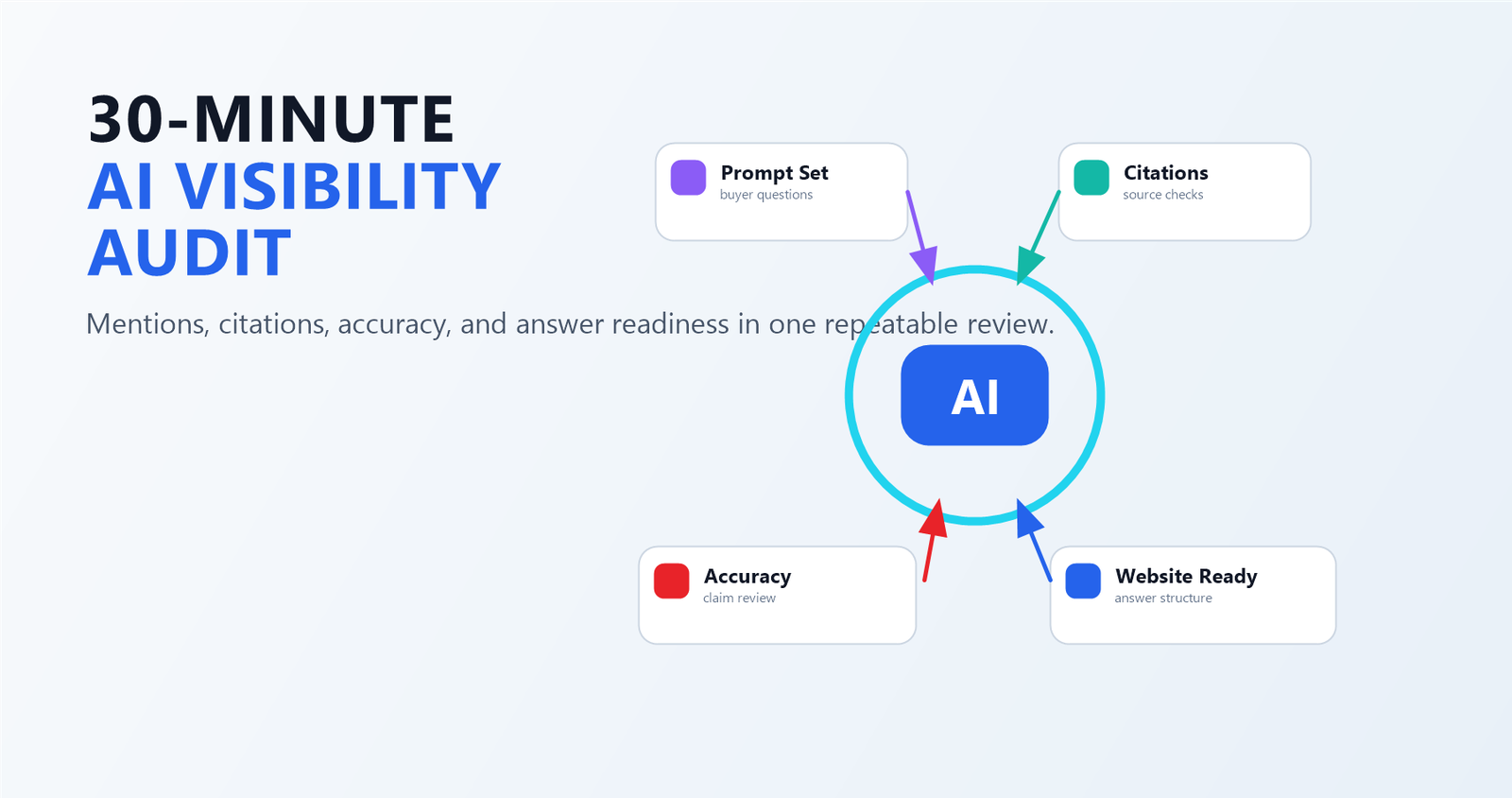
Quick answer: A 30-minute AI visibility audit uses a fixed set of buyer prompts to record whether a platform mentions your brand, cites your pages, describes the company accurately, and represents competitors or sources instead. It then checks the website’s technical access, answer clarity, entity consistency, and evidence. The audit is a snapshot—not a complete or guaranteed visibility score.
A prospect asks an AI assistant for the best provider in your category. Does your company appear? If it appears, is the description correct? Does the answer cite your website, a third-party source, a competitor, or nothing at all?
Those questions matter, but they are easy to test badly.
A team enters one flattering prompt, receives one brand mention, takes a screenshot, and declares success. Another team receives no mention, assumes the website is invisible everywhere, and immediately creates dozens of AI-targeted pages. Neither conclusion is reliable.
Generative outputs can vary by platform, model, user context, location, browsing mode, date, prompt wording, and source availability. A short audit cannot reveal every answer a buyer may see. It can establish a repeatable baseline, identify obvious accuracy or coverage problems, and create a prioritized research backlog.
This 30-minute process is designed for a focused B2B review. Use it to decide where deeper technical, content, entity, and authority work is justified.
What is an AI visibility audit?
An AI visibility audit evaluates how a brand, service, expertise, and web content appear across generative search and answer experiences. It examines mentions, citations, accuracy, context, competitor presence, source patterns, and the website signals that may help systems retrieve and understand trustworthy information.
An audit is broader than asking whether the company ranks for a keyword. It asks:
- Is the brand mentioned for relevant buyer questions?
- Is the mention accurate and appropriately qualified?
- Which pages or third-party sources support the answer?
- Does the brand appear in discovery, comparison, and evaluation prompts?
- Which competitors or publishers appear consistently?
- Can systems access and interpret the most important site content?
- Does the web contain enough consistent evidence to validate the company’s claims?
Because systems are dynamic, the audit should record conditions and use trends—not isolated outputs—as evidence.
Before the timer starts: create a simple audit sheet
A useful audit needs a consistent recording structure before prompts are tested. Create one row per prompt-platform combination and record the date, platform or product, model or mode where visible, location or account context if relevant, exact prompt, brand mention, citation, accuracy, competitors, notes, and screenshot or archive reference.
Use columns such as:
- Audit date.
- Platform and mode.
- Exact prompt.
- Buyer-stage category.
- Brand mentioned: yes, no, or unclear.
- Position or prominence: descriptive, not a universal rank.
- Your domain cited: yes or no.
- Other sources cited.
- Description accurate: yes, partly, or no.
- Competitors mentioned.
- Recommended follow-up.
Do not create a percentage from a tiny prompt set and call it “AI market share.” A simple count can help compare the same methodology over time, but the label must describe the sample accurately.
Minutes 0-5: choose ten buyer prompts
The prompt set should represent real questions across problem discovery, approach comparison, provider evaluation, and implementation. Avoid prompts designed only to force your brand into the answer. You want to observe natural category visibility and factual brand understanding.
Select two prompts from each group:
- Problem: “Why is our B2B lead list producing low-quality meetings?”
- Approach: “How should a company verify B2B contact data before outreach?”
- Comparison: “Cold email or email marketing for a new B2B service?”
- Provider evaluation: “What should I look for in a B2B lead generation agency serving US companies?”
- Brand validation: “What services does Accord Tech Solutions provide?”
Adapt the language to your actual audience. Include non-branded prompts for discovery and branded prompts for accuracy. Keep them stable across audit periods. If you change a prompt, label it as a new series.
Minutes 5-15: test prompts across selected platforms
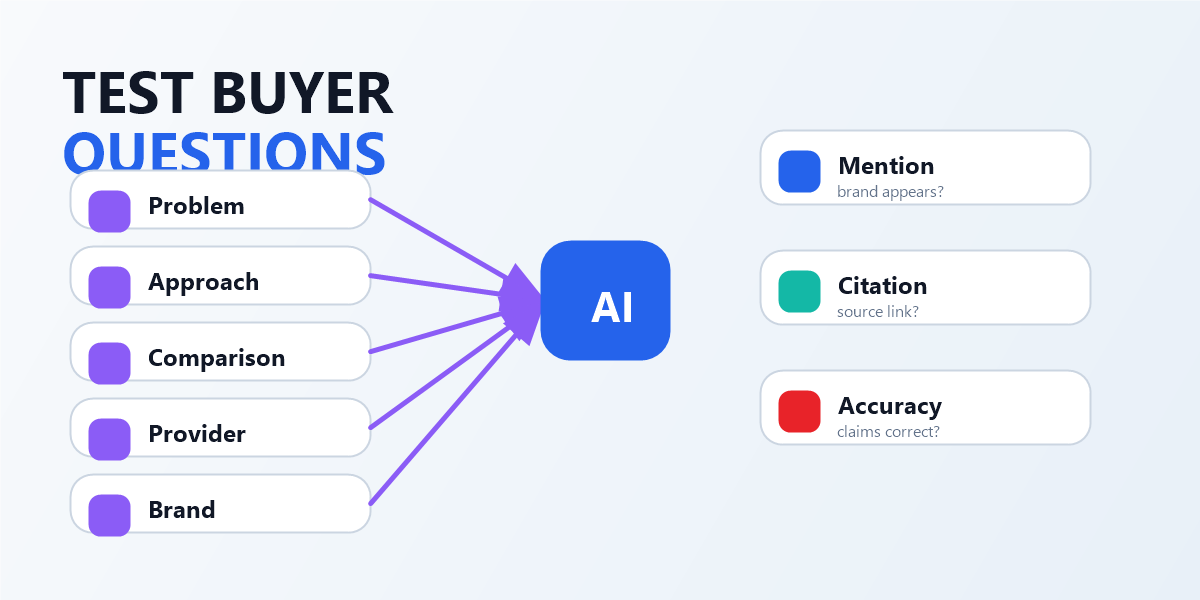
Run the exact same prompt set in each platform you can access and record the output conditions. ChatGPT, Perplexity, and Google’s AI search experiences do not work identically, and availability or features may differ by account, region, query, or date.
For a strict 30-minute audit, you may need to sample rather than run every prompt everywhere. One practical approach is:
- Run the two highest-priority discovery prompts on all three surfaces.
- Run the remaining prompts on the two surfaces most important to your buyers.
- Save exact prompts and citation URLs.
- Note when an AI answer is not shown.
Use a clean, repeatable environment where practical, but do not claim it removes personalization completely. If a platform offers browsing, deep research, or multiple modes, record which mode was used. Those modes may use different sources and produce different answers.
Do not repeatedly regenerate until the brand appears. That would measure persistence, not typical visibility. If you run variants, preserve every result and state the sampling method.
What to record for every answer
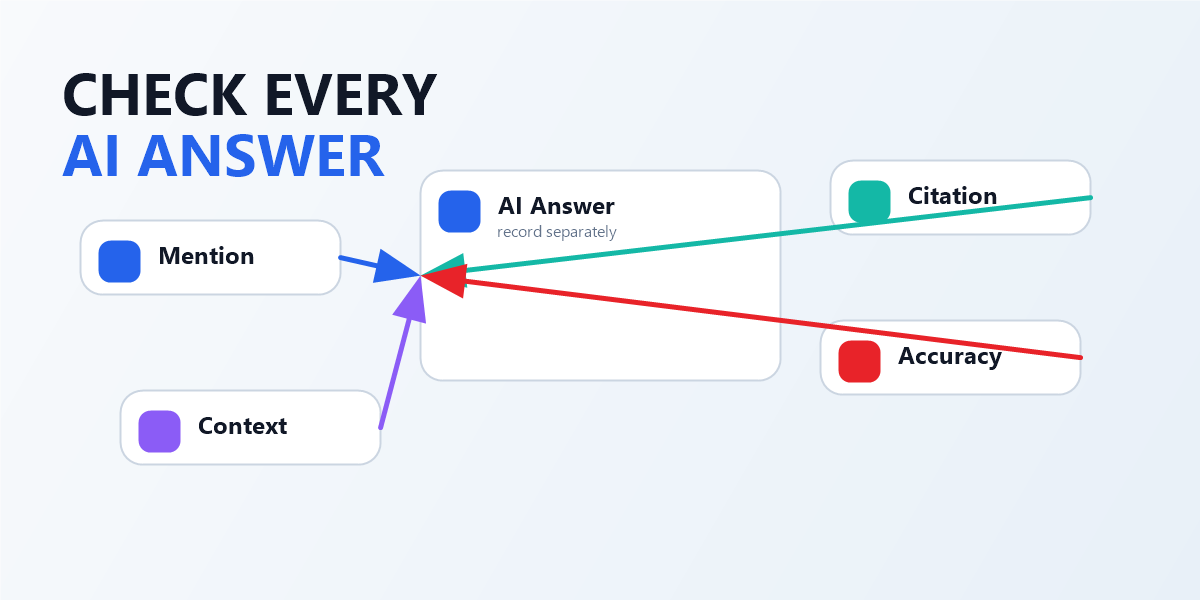
Record presence, prominence, citation, accuracy, and context as separate observations. A brand mention without a citation is different from a cited service page. A citation is not valuable if the answer misrepresents the service. A correct branded answer does not prove category discovery.
Use five checks:
1. Mention
Was the company named? Was it central to the answer, included among several options, or mentioned only after the prompt supplied the name?
2. Citation
Did the output link to the company’s own page? Did it cite a directory, article, profile, customer source, or competitor? Open the source and confirm that it supports the claim.
3. Accuracy
Are services, location, experience, audience, and differentiators described correctly? Flag outdated offerings, exaggerated claims, wrong company identity, and unsupported numbers.
4. Context
Does the brand appear for the right problem and buyer? A mention in an irrelevant list can be less valuable than no mention because it creates confusion.
5. Competitive pattern
Which companies and publishers appear repeatedly? What evidence, page types, or external sources seem to support them? This is a research clue, not proof of a single ranking factor.
Minutes 15-20: inspect your website's answer readiness
Answer-ready pages state the main question and response clearly, support claims, and provide enough context for accurate extraction. Review the pages that should have supported the audit prompts: homepage, service pages, relevant articles, about page, contact page, and any evidence or case-study pages.
Check whether each priority page has:
- One clear topic and search intent.
- A descriptive H1 and logical H2 structure.
- A concise answer near each important question.
- Definitions for specialized terms.
- Examples, process details, limitations, or comparisons.
- Claims supported by visible evidence or appropriate sources.
- Current publication or review information where useful.
- A relevant next step and descriptive internal links.
If the homepage calls the company one thing, a service page uses another description, and external profiles list outdated services, the entity becomes harder to interpret. Fix contradictions before adding more AI-focused copy.
Minutes 20-25: check technical and entity signals
AI visibility still depends on discoverable web content and consistent information about the organization. Review basic search accessibility, canonical pages, internal links, structured data, authorship, company details, and crawler policies using current official documentation.
In a short audit, confirm:
- Priority URLs return the intended status and can be indexed where desired.
- Titles, canonical tags, and headings identify the preferred page.
- Key content is present in accessible page output.
- Important service pages are linked from logical navigation and related articles.
- Organization details are consistent across the site.
- Organization, Article, Breadcrumb, Service, or FAQ schema is used only where accurate and visible.
- Authors, publication dates, and update dates are genuine.
- robots controls match the company’s current search and AI access policy.
This is a screening check, not a complete technical audit. A developer or technical SEO specialist should investigate rendering, log data, templates, and large-scale indexing issues when the quick review reveals risk.
Minutes 25-30: turn observations into priorities
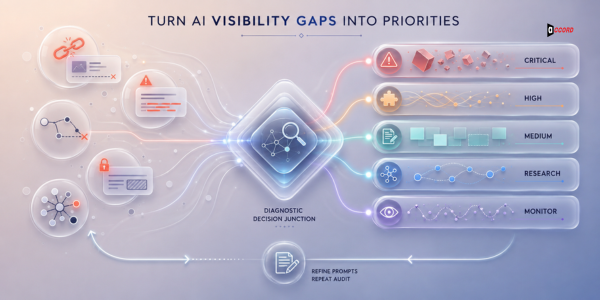
Prioritize the smallest change that addresses the clearest evidence gap. Group findings into accuracy, coverage, accessibility, evidence, authority, and measurement rather than producing a long unranked list.
Use these priority levels:
- Critical: The brand is confused with another entity, key service information is wrong, or important pages are blocked or broken.
- High: Core services lack clear pages, claims conflict, important buyer questions have no credible answer, or citations point to outdated information.
- Medium: Pages need clearer answer passages, authorship, source support, internal links, or appropriate structured data.
- Research: A competitor or publisher appears frequently and deserves source-pattern analysis.
- Monitor: Output differences are interesting but not yet consistent enough to justify a major change.
Assign an owner, next action, and review date. The audit becomes useful only when it produces a manageable backlog.
How to interpret four common audit outcomes
Different combinations of mentions and citations point to different problems, so avoid treating all “no visibility” results alike. Use the output as a hypothesis generator.
Your brand is mentioned and accurately cited
Preserve the useful source, keep facts current, and expand related coverage where it helps buyers. Do not rewrite a successful page merely to chase wording from one output.
Your brand is mentioned but described incorrectly
Identify where the wrong claim may originate. Correct conflicting owned pages and important profiles, make entity information explicit, and seek corrections from third-party sources where appropriate. Do not add more repetition of the wrong term.
Your content is cited but the brand is not prominent
The page may be useful while the company entity or service relationship remains unclear. Review authorship, publisher information, contextual service links, and organization consistency. Keep the informational value intact.
Competitors appear and your brand does not
Compare their source footprint, content specificity, evidence, external mentions, and topic coverage. Do not copy their pages. Identify what buyer question they answer or evidence they provide that your information system currently lacks.
Improve AI visibility without publishing filler
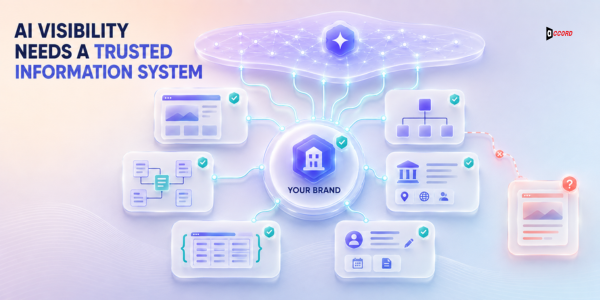
The most durable response to weak AI visibility is clearer, better-supported information—not a large volume of pages written for imagined model preferences. Strengthen content where a real buyer question and evidence gap exist.
High-value improvements may include:
- Rewrite vague service pages around audience, problem, process, deliverables, limitations, and next steps.
- Add concise answers to genuine evaluation questions.
- Publish original frameworks, definitions, comparisons, and documented examples.
- Consolidate overlapping pages that compete or contradict one another.
- Build internal topic paths from educational content to commercial pages.
- Add accurate authorship, methodology, sources, and review dates.
- Correct inconsistent organization information across owned profiles.
- Earn relevant coverage and references through useful expertise and digital PR.
Avoid fabricated studies, artificial quotes, fake authors, unsupported statistics, and mass-generated location or question pages. They create trust risk for readers and machines alike.
Repeat the audit without turning it into theater
A repeatable audit uses the same prompt set, recording method, and interpretation rules at a sensible interval. Monthly or quarterly review may be appropriate depending on market activity and resources. Major site changes, rebrands, launches, or misinformation may justify an additional check.
Keep a change log. When visibility shifts, note what else changed: content, citations, technical access, platform model, prompt, season, or external coverage. Do not attribute every change to the most recent edit.
Report three categories:
- What was observed.
- What is inferred and with what confidence.
- What action is recommended.
That separation protects stakeholders from treating volatile outputs as deterministic rankings.
How Accord Tech Solutions approaches AI visibility audits
Accord Tech Solutions combines AI visibility sampling with technical SEO, answer structure, entity review, content quality, internal linking, and business measurement. The aim is to find actionable gaps in how a company is discovered and understood across search—not to sell a guaranteed citation.
Our SEO and AEO services can support technical audits, keyword and intent research, content planning, on-page optimization, answer-first structures, schema review, and performance reporting. Web development and social distribution can address technical and authority gaps that content edits alone cannot solve.
An initial 30-minute review is useful for orientation. A full engagement should examine more prompts, competitors, pages, sources, regions, technical evidence, and conversion data.
Frequently asked questions
Can I check my company's ChatGPT ranking?
There is no single stable, universal ChatGPT ranking equivalent to a traditional keyword position. Outputs can vary by model, mode, context, date, and user. Track a documented prompt sample over time and report mentions, citations, accuracy, and context rather than claiming a complete rank.
Does Perplexity always cite the best source?
No system should be assumed to select the objectively best source every time. Open citations and verify whether they support the answer, are current, and represent the subject accurately. Citation patterns are useful evidence for research, not an endorsement of every source selected.
How do Google AI features affect SEO?
Google states that established SEO fundamentals remain relevant to its AI search experiences. Websites still need accessible, indexable, useful content that follows Search policies. Appearance is not guaranteed, and site owners should use current Search Central guidance because features and documentation can change.
Do we need separate pages for SEO, AEO, and GEO?
Only when distinct buyer intent and useful content justify them. Creating near-duplicate pages for each acronym can cause confusion and cannibalization. Often, one authoritative page can explain the relationship while focused supporting articles answer genuinely different questions.
How can we correct inaccurate AI information about our brand?
First identify the cited or likely source. Correct inconsistent owned content and important profiles, publish explicit verifiable information, and request third-party corrections where possible. Re-test over time. There is usually no single edit that can force every generative system to update immediately.
Use the audit to improve the information system
A 30-minute AI visibility audit will not reveal a final score. It will show how a small, documented set of buyer questions is answered today, where your brand appears, which sources carry the story, and what obvious gaps deserve investigation.
That is enough to make a better next decision. Fix incorrect company information. Strengthen missing buyer answers. Improve technical access and internal paths. Publish evidence worth citing. Then repeat the same test and interpret changes cautiously.
If you want to move from a quick snapshot to a prioritized search and AI visibility roadmap, contact Accord Tech Solutions to discuss the prompts, competitors, technical checks, and business outcomes that matter to your market.
Methodology and sources
This article uses a transparent sampling approach and does not claim that prompt tests represent all users or guarantee visibility. References include Google Search Central guidance for AI features, Google’s structured data policies, OpenAI’s guidance for publishers and developers, and the Accord Tech Solutions SEO service.
Last reviewed: August 13, 2026.