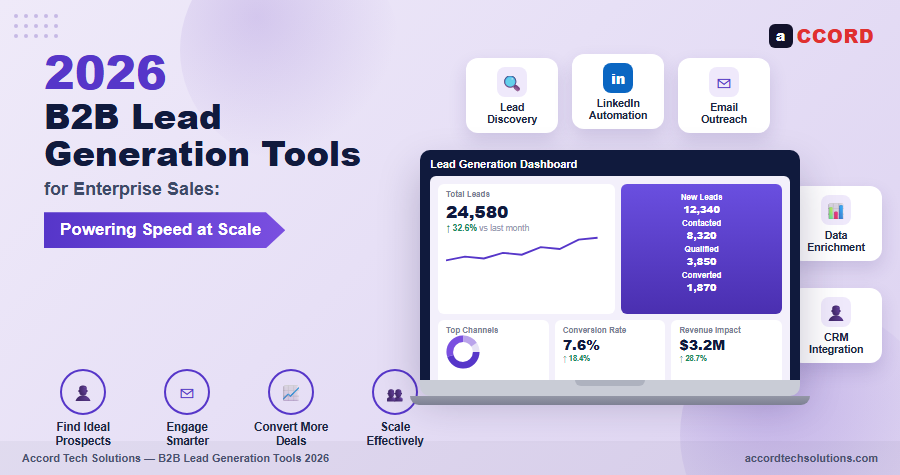
B2B lead generation tools for enterprise sales combine prospecting databases, contact enrichment, and intent data to find and verify decision-makers faster than manual research allows. In 2026, the enterprise teams winning pipeline pair these tools with human verification — automation alone creates volume, not qualified opportunities. The right stack shortens prospecting from days to hours.
Enterprise sales has never been a game for the slow or the careless. In 2026, the gap between teams that generate pipeline efficiently and those still chasing cold, unverified contact lists has become a canyon.
The reason: B2B lead generation tools have matured well beyond basic CRM plug-ins or contact databases scraped from LinkedIn. Today's tools layer buying-intent signals, real-time enrichment, and behavioral data into a single, coherent prospecting workflow. The enterprise sales teams that combine these layers close deals faster and more predictably than their competition.
But here is the catch: more tools do not automatically mean better results. The companies winning in enterprise sales right now are the ones pairing smart lead generation tools 2026 with experienced human oversight. That combination, not either one alone, is what creates a reliable and scalable pipeline. Here is how it works.
Enterprise Sales in 2026: Why Speed and Accuracy Matter More Than Ever
Speed and accuracy matter more in 2026 because buying committees have grown larger and manual prospecting cannot keep pace with them. Enterprise deals now involve six to ten stakeholders on average (Gartner), and reps spend most of their week on tasks other than selling (Salesforce, 2024). By the time manual research finishes, the buying window has often closed.
Why Manual Prospecting Slows Down Enterprise Growth
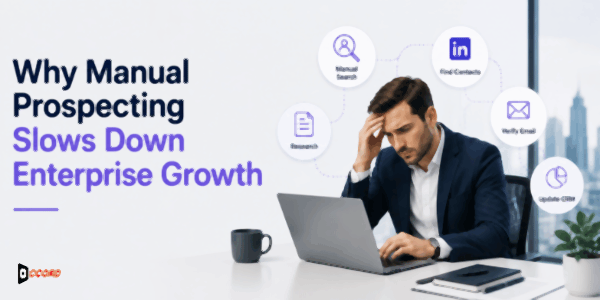
Ask any enterprise sales rep how much of their week goes toward actually selling — the conversations, the demos, the negotiations — versus finding and qualifying leads. The answer is almost always discouraging. Salesforce's 2024 State of Sales report found reps spend just 29% of their week on selling activity; the other 71% goes to admin, data entry, and prospecting (Salesforce, 2024).
This problem multiplies fast at the enterprise level. Decision-maker contact details change constantly. Buying committees have grown larger over time, and the average complex B2B deal now involves six to ten stakeholders (Gartner). With longer sales cycles, hitting the right person at the right moment of intent is not just helpful — it is decisive.
Manual prospecting simply cannot keep pace. By the time a rep has researched a target account, found the right contacts, verified emails, and crafted personalized outreach, the window of opportunity has often closed. In enterprise sales, timing is not just important. It is everything.
How B2B Lead Generation Tools Improve Sales Velocity
Enterprise-focused sales technology changes what a rep's week looks like, freeing up time to develop quality leads instead of chasing them. A process that once took days can take hours with a well-configured lead generation tool.
Some examples of this process:
- Automated account discovery — flags new prospects that match your ideal customer profile as they emerge.
- Contact enrichment — adds verified emails, direct phone numbers, and company data to each prospect.
- Intent data — flags accounts actively researching solutions like yours right now.
- Outreach sequencing — runs multi-touch outreach to each prospect without manual entry.
The result: the sales team spends most of its time in genuine conversations with prospects, not on data entry and guesswork.
The 2026 B2B Toolset: Scaling Lead Generation Without Losing Quality
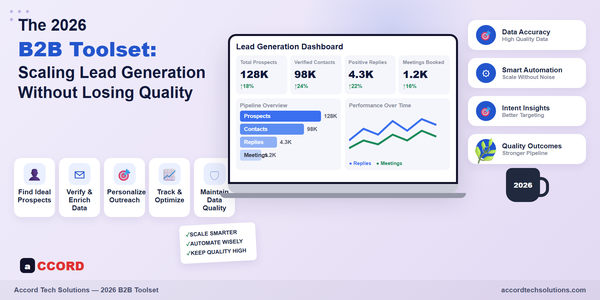
The 2026 B2B toolset layers four categories: prospecting platforms like Apollo.io and ZoomInfo to find decision-makers, enrichment tools like Clearbit and Cognism to keep contact data current, and intent platforms like Bombora and 6sense to flag accounts actively buying. Layering these categories, instead of relying on one, is what lets teams scale outreach without losing lead quality.
Prospecting Tools for Finding Decision-Makers
The first challenge in enterprise sales is finding the right person — not just the right company, but the decision-maker who holds authority, controls budget, and has a problem your solution genuinely solves.
Modern sales prospecting tools like Apollo.io, ZoomInfo, and Lusha have evolved well beyond basic contact databases. They now filter by job function, seniority level, department size, company technology stack, growth signals such as recent funding rounds or executive hires, and precise geographic and industry combinations.
The practical benefit is real. Instead of building prospect lists by hand, a sales development representative can define their ideal customer profile parameters once and pull a fresh, accurately targeted list within minutes. Quality prospecting is a matter of strategy now, not just effort.
Lead Enrichment Tools for Better Contact Accuracy
Finding a name is only the beginning. A verified email address, a direct phone number, recent LinkedIn activity, and a company's revenue range — that is a contact record you can actually act on.
Lead enrichment tools such as Clearbit, Cognism, and People Data Labs add layers of company and technology data to raw lead records. This matters enormously for enterprise sales, where a single bad email address can derail a carefully structured outreach sequence and damage your sender reputation.
The most effective teams treat enrichment as a continuous process, not a one-time data import. B2B contact data goes stale at roughly 20 to 30 percent a year (Dun & Bradstreet; ZeroBounce Email List Decay Report, 2026), which means a list that was accurate six months ago could already be meaningfully out of date. Keeping data current protects your outreach investment and keeps your CRM genuinely useful.
Intent Data Tools for Finding Ready-to-Talk Buyers
This is arguably the most significant shift in B2B lead generation over the past few years. Intent data tools — platforms such as Bombora, G2 Buyer Intent, and 6sense — track behavioral signals across the web to identify which companies are actively inside a buying cycle right now.
When a target account begins consuming large volumes of content around topics like "enterprise sales automation" or "B2B data compliance," that pattern is a buying signal. Intent platforms capture those signals and surface them to your sales team before your competitors know the prospect is even looking.
The use case is simple. When intent data shows a target account surging on topics relevant to your solution, that account rises immediately to the top of your outreach list. You stop guessing who is ready to talk. The data tells you.
How Intelligent Prospecting Tools Are Changing Enterprise Lead Generation
Intelligent prospecting tools use predictive models, built on your own historical win data, to rank accounts by how closely they match your best customers. Platforms like 6sense and Demandbase turn weeks of manual account research into hours of scored output. Lead scoring then tells reps which accounts deserve attention first, based on engagement, fit, and intent signals — not guesswork.
Using Data Science to Identify High-Value Accounts
AI lead generation tools now analyze thousands of data points simultaneously — company size, industry, technology usage, funding history, and behavioral signals — to predict which accounts are most likely to convert and at what deal size.
Platforms like 6sense and Demandbase use predictive models that continuously improve based on your historical win data. The more deals you close, the sharper the model gets at identifying accounts that match your best customers. For enterprise teams in complex verticals, this precision cuts wasted outreach cycles significantly.
What used to take a senior sales strategist several weeks to produce — a refined, prioritized target account list — these platforms can generate in hours. That is not replacing human judgment. It is amplifying it. For a broader look at where this technology is heading, see our take on the best AI lead generation tools in 2026.
How Smart Scoring Helps Sales Teams Prioritize Better Leads
Not every lead in your pipeline deserves equal attention. A rep's time is finite, and intelligent lead scoring helps make sure that time flows toward the highest-value opportunities rather than spreading thin across everything equally.
Lead scoring models weigh engagement behavior such as email opens, link clicks, and website visits; fit against your ideal customer profile; third-party intent signals; and historical conversion patterns by deal stage and velocity.
The practical result: a sales rep opens their CRM first thing in the morning and immediately knows which three accounts deserve attention that day. No guesswork, no wasted hours on prospects that were never going to convert. The technology does not replace the rep. It makes the rep dramatically more effective.
Why Automation Alone Is Not Enough for Enterprise Sales
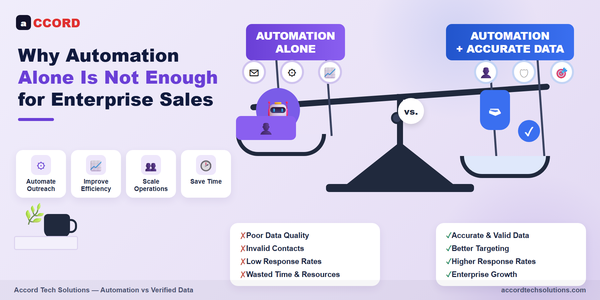
Automation alone is not enough because it multiplies whatever data quality you feed it — cheap bulk lists produce fast, high-volume failure, not pipeline. Low-quality data damages email deliverability and sender reputation, which can set outreach back by months. A structured human verification layer, checking each contact before outreach fires, is what turns automated volume into qualified opportunities.
The Risk of Low-Quality Bulk Lead Lists
There is a tempting shortcut too many enterprise teams fall for. They buy cheap, high-volume lead lists and blast them with automated outreach sequences. On paper, the math looks appealing: ten thousand contacts for a few hundred dollars feels like scale. In practice, it is a pipeline disaster waiting to happen.
Low-quality bulk lists are filled with outdated email addresses, incorrect job titles, duplicate records, and contacts nowhere near the target profile. The consequences go beyond wasted outreach budget. Sending to invalid addresses damages your email domain's deliverability score, so even well-crafted outreach to genuine prospects starts landing in spam folders. In enterprise sales, a damaged sender reputation can push your pipeline back by months.
Automation amplifies whatever data you put into it. Feed it poor data, and you get poor results — only faster and at greater scale.
How Human Review Improves Lead Quality
The fix for low-quality automation is a structured human verification layer inserted before outreach goes out at scale. Experienced analysts reviewing leads should check whether each contact matches the defined target profile, whether company data including revenue and headcount is current, whether the contact's role and seniority align with the actual purchasing decision, and whether the company shows signs of budget and urgency.
This process is not slow. A well-organized verification workflow adds hours to a campaign, not weeks. And the return is substantial: outreach that reaches real, qualified people converts at meaningfully higher rates. Your sales reps spend their time on conversations that actually lead somewhere.
How Accord Tech Solutions Supports Enterprise Lead Generation in the USA
Accord Tech Solutions is a B2B Lead Generation Company in USA that pairs account-discovery technology with a multi-layer manual verification process before any contact reaches a client's outreach sequence. Every record is checked for email deliverability, job title accuracy, and fit against the target customer profile. That combination is what separates a structured partnership from a plug-and-play data vendor.
When enterprise sales teams across the United States need to scale their pipeline without sacrificing quality, Accord Tech Solutions sits at precisely that intersection. As a dedicated B2B Lead Generation Company in USA, Accord Tech Solutions has built its service model around bridging the gap between data-driven prospecting technology and rigorous human verification.
This is not a plug-and-play data vendor. It is a structured lead generation partnership, and that distinction shows up clearly in the quality of the pipeline it delivers.
Data Collection, Verification, and Segmentation
Accord Tech Solutions begins where most lead generation vendors stop — after the raw data has been collected. Its process combines account discovery technology with multi-layer manual verification. Every contact record that exits the pipeline has been checked for email deliverability, job title accuracy, company size, and alignment with the client's target customer profile.
The segmentation layer ensures client sales teams receive leads organized by industry vertical, seniority level, buying stage, and geography — not a flat, undifferentiated list that needs hours of internal cleanup. For enterprise sales teams scaling their B2B Lead Generation Services in USA, this means fewer bounced emails, more relevant first conversations, and a CRM database that reps actually trust and use.
Outreach Support, Reporting, and Pipeline Tracking
Beyond data delivery, Accord Tech Solutions supports the full prospecting cycle: outreach sequencing, detailed performance reporting, and pipeline tracking that connects lead quality directly to revenue outcomes.
Rather than delivering a list and moving on, the team monitors what is working — reply rates, meeting conversion rates, stage progression — and uses those signals to continuously sharpen targeting criteria and messaging. That feedback loop is what makes each campaign cycle more effective than the last. For enterprise teams that need a reliable, scalable lead generation engine in the United States, this full-service model removes the prospecting burden from the sales team and lets them focus on closing.
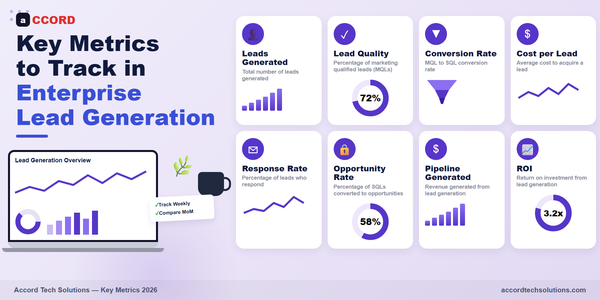
Key Metrics to Track in Enterprise Lead Generation
The four metrics enterprise teams should track are lead accuracy rate, positive reply rate, qualified meeting rate, and cost per qualified lead. Together they show whether your pipeline problem is data quality, messaging, or volume. A healthy benchmark is 90%+ lead accuracy and a 5-10% positive reply rate (Instantly Benchmark Report, 2026) — track them to know where to invest.
Lead Accuracy Rate
Lead accuracy rate measures what percentage of your contact records contain verified, deliverable information. A healthy benchmark for enterprise outreach is 90 percent or higher. Anything below that means your team is burning time and domain reputation on bad data, which compounds quickly across a large sequence.
Positive Reply Rate
This metric goes beyond open rate. It tracks actual replies from qualified prospects who engage with your message. For enterprise cold outreach, a positive reply rate of 5 to 10 percent is a solid benchmark for 2026 (Instantly Cold Email Benchmark Report, 2026). If you are consistently landing below 2 percent, the problem is almost always data or messaging, not volume.
Qualified Meeting Rate
Of all the meetings your outreach generates, what percentage convert into legitimate pipeline opportunities? This metric reveals whether your lead generation is delivering prospects with genuine interest and budget, or simply filling your calendar with conversations that go nowhere after the first call.
Cost Per Qualified Lead
This number is the final figure defining your lead generation ROI. It includes all costs associated with your tool, analyst time spent working the leads that required outreach, and the overhead of converting a lead from initial outreach into a qualified opportunity — an accurate representation of the cost of each lead worth pursuing. Track it consistently across campaigns, and you will always know where to invest more and where to pull back.
Methodology and Sources
This guide draws on named, dated industry benchmarks — Gartner's B2B buying-committee research, Salesforce's 2024 State of Sales report, Dun & Bradstreet and ZeroBounce's 2026 data-decay findings, and the Instantly Cold Email Benchmark Report 2026 — cross-checked against how Accord Tech Solutions' own analysts score and verify enterprise leads day to day. Tool names are included as category examples, not paid endorsements or an exhaustive list.
Last reviewed: August 2, 2026.
FAQ: Enterprise Growth and Scaling
What are the best B2B lead generation tools for 2026?
The strongest 2026 stacks combine four categories: a contact and account database (Apollo.io, ZoomInfo, or Cognism), an intent data platform (Bombora or 6sense), a lead enrichment layer (Clearbit or People Data Labs), and a sequencing platform (Outreach or Salesloft). The right mix depends on your industry, deal size, and sales motion, but every enterprise team needs all four categories covered.
How do enterprise sales teams scale lead generation?
The most effective approach layers four capabilities together: account discovery to find target companies at scale, enrichment tools to build accurate contact records, intent data to time outreach around real buying behavior, and human verification before sequences go live. Teams that rely on a single layer, automation alone or manual effort alone, consistently fall short of their pipeline targets.
Why is speed important in enterprise sales?
Enterprise buying cycles run long, but the window to get into the initial evaluation is short. When a company starts an active buying process, it typically shortlists vendors within a few weeks. Intent data and fast, relevant outreach give you a real chance of making that shortlist. Slow prospecting means arriving after the evaluation has narrowed — a real disadvantage.
How can intelligent prospecting tools improve lead generation quality?
Intelligent prospecting tools replace guesswork with predictive modeling built on your company's own historical win data. Instead of reps building lists from intuition, the tools rank accounts by statistical fit with your best past customers and current behavioral signals. The result is a shorter, more targeted account list that converts at a higher rate than mass outreach to unqualified contacts.
What is the return on combining automation with verified lead data?
Teams that pair structured automation with verified, enriched data consistently land inside the 5-10% positive reply rate range that counts as healthy for B2B cold outreach in 2026, instead of the sub-2% results common with unverified bulk lists. Automation multiplies whatever data quality you feed it. Verified, accurately targeted data is the single best investment in your outreach operation.
Final Thought
The 2026 B2B lead generation tools that matter most are not the ones with the longest feature lists. They are the ones that pair prospecting, enrichment, and intent data with a human verification layer that catches what automation alone misses. Compare your current cost per qualified lead against these benchmarks, then see how Accord Tech Solutions structures its lead generation programs for enterprise sales teams scaling in the U.S. market.