
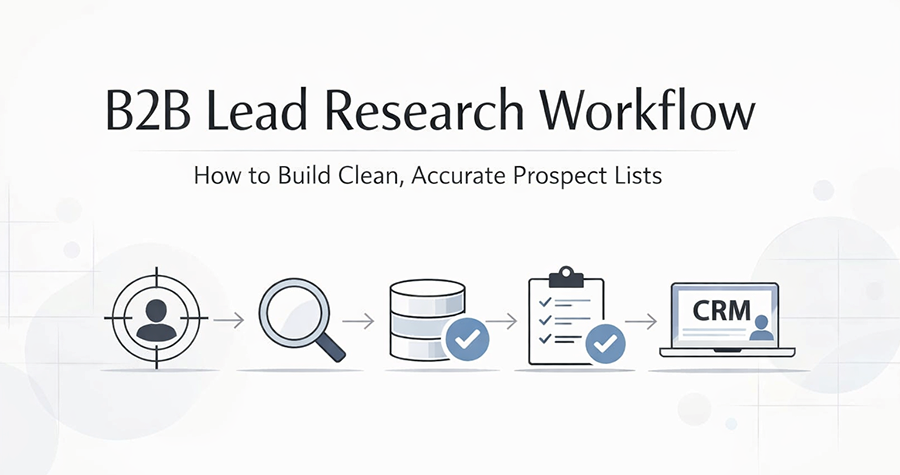
Modern B2B lead research is not about collecting the biggest list. What matters now is accuracy, not size. Studies show that 20–30% of B2B contact data goes out of date each year because people change jobs, companies grow or merge, and roles shift. This means most prospect lists start to lose value in just a few months.
Many teams still focus on speed when lead list building. They grab large lists from tools without checking if the contacts are correct. This leads to wrong emails, the wrong people, and wasted time.
A clear workflow can fix this. When B2B lead research follows a step-by-step process, the data stays clean and accurate. This guide explains how a workflow-based approach to lead list building helps teams create clean, accurate prospect lists that perform in today’s B2B environment.
Why Most B2B Lead Lists Fail Today

Most lead list building fails because teams focus on collecting a lot of contacts instead of the right ones. Most of the list is filled with old emails, wrong roles, or missing information. The other issue is poor targeting. Without a clear idea of the right customers, emails go to the wrong people or companies.
Lists also fail if they are not updated. People change jobs, companies grow or merge, and emails stop being valid.
What Clean and Accurate Data Really Means in B2B Lead Research

In B2B lead research, clean and accurate data plays a key role. Thousands of wrong, old, incomplete data do not get a real result. Data hygiene means your contacts are correct, up-to-date, and ready for outreach.
Clean data has three essential parts. Accuracy makes sure the emails and job titles are correct. Freshness means the data is still active. Completeness means full details. For Completeness, you have to collect the company name, size, industry, and role, valid contacts.
Data Hygiene as an Ongoing Process
Think of data hygiene like cleaning your desk. You do it regularly, not just once. About 20–30% of B2B contacts change each year. People switch jobs, companies merge, or businesses close. If you do not update your list, it quickly becomes unreliable.
You should check your contacts often. Remove old or wrong entries and update new information. Regular maintenance keeps your emails reaching the right people.
Accuracy Benchmarks That Matter for Outbound Campaigns
To get the best results, your lists need clear standards.
-
Keep email bounce rates under 3–5%.
-
Make sure you reach the right decision-makers. Wrong roles lower responses.
-
Target companies that fit your ideal customer profile. Wrong industries or sizes reduce engagement.
Following these rules makes your lead list building reliable. Your sales and marketing teams can trust the data and focus on talking to the right people.
The Complete B2B Lead Research Workflow

Good B2B lead research is not a one-time task. You cannot just grab a list and start emailing. You need a simple, repeatable process. This will help you target the right audience and build a loyal and honest customer base. A good strategy saves time, reduces risk, and helps your emails reach the inbox. This turns building a customer base from scratch into a 24-hour process.
Defining Your ICP Targeting Framework
The first step is to define the goals of your ICP. ICP is known for its high level of customer satisfaction. It shows who your customers are most likely to buy from.
Start with the basics, such as business size, revenue, efficiency, and growth. Then look for signs of revenue or growth to attract employees who are ready to engage.
A clean ICP protects your team from being focused. It also makes your messages more relevant. When you know exactly who you are targeting, your chances of getting a reply go up.
Qualitative Industry Research
Also, use industry-based filters to refine your list. Not every company is a good fit for your needs. Segmenting by role allows you to focus on the roles that need what you offer.
For example, if your product is perfect for a SaaS company, sending an email to a sales or technology company is a waste of time. Filtering ensures that you reach the right accounts and improves your results.
Business filters will help you write better emails. Once you know the framework, you can describe the real problem your idea solves. This will make your pitch more effective and increase your chances of success.
Role-Based Targeting and Persona Alignment
After choosing the right companies and industries, the next step is to set your goals in role-based targeting. You want to reach people who can make decisions and influence purchases. A job title is not enough. A “Manager” in one company may have decision-making power, while in another, they do not.
Start by mapping personas. Find decision-makers, influencers, and end-users who matter for your solution. Look at their responsibilities and position in the team. Confirm your emails are sent to the targeted audience. It saves time and increases the chances of getting replies. When you target the correct people, your B2B lead research becomes much more effective.
Multi-Source Lead Collection Strategy

Relying on just one source for leads is risky. No single tool has all the data you need. Using only one source can leave gaps and miss opportunities.
A multi-source strategy fixes this. Combine data from LinkedIn, company websites, directories, and trusted databases. Cross-check the information to make it accurate and complete.
Using multiple sources is not just about more contacts. It helps you build better, reliable lists. Each new source adds verification and reduces errors. This makes your B2B lead research stronger and your campaigns more likely to succeed.
Data Enrichment Workflow for Complete Contact Records

Even the best lists are rarely complete. This is why the data enrichment workflow is so important. Enrichment will fill in the missing data and prepare your document for publication.
Start by adding business information like size, location, and industry. Then enter your contact information, such as email, phone, and LinkedIn profile. Make sure all of your CRM data is up to date.
Check that the email is correct. Clear and up-to-date content will help your company reach the right audience. It increases reply rates and makes every campaign more effective.
Contact Validation Process and Email Verification
After building your lead list, the next step is the contact validation process. This makes sure every contact is real and up-to-date. Without validation, your emails may bounce, and your campaigns can fail.
Start by checking emails and job roles. Make sure the contact is current and belongs to the right person. Then use email verification to confirm the email works. Verified emails protect your deliverability and keep your messages out of spam folders.
A proper validation process saves time and helps your team focus on leads that can actually respond. Clean, verified contacts make your outreach more effective and improve results.
How to remove duplicate data for data security
Duplicate content can hurt your customer base. It breaks your CRM, confuses your team, and gives you inaccurate reports. When you use double encryption, you keep your data safe and easy to access.
Check for repeated emails, names, or companies. Keep the most complete record and remove the rest. You can use tools, but a quick manual check helps catch anything important.
Removing duplicates saves time and makes targeting easier. Your team can focus on opportunities without having to chase the same person twice. A clear, unique theme increases the effectiveness of any project.
Lead Segmentation Framework for Smarter Outreach
After preparing your content, the next step is to create a distribution plan. Segmentation refers to dividing your audience into smaller groups. You can sort them by industry, company size, or country. This helps you send messages that are relevant and personal.
For example, separate decision-makers from influencers. Send messages that match their responsibilities. Filter by industry so you don’t send SaaS emails to manufacturing companies. Segment by company size or region to make your outreach more targeted.
Segmenting your leads saves time and gets better results. Emails are more personalized, response rates are higher, and ads are more effective. There is no easy way to segment leads to increase your ad reach.
Preparing a CRM-Ready Lead Format
Once your contacts are segmented, you need to have a CRM-ready contact list. This makes it easy to save leads in your CRM and start working with leads immediately.
Include all the necessary information: name, company name, email address, phone number, and LinkedIn profile. Include business information such as size, industry, and location. Track where each lead came from. Keep formatting consistent, like emails, phone numbers, and dates.
A CRM-ready format saves time and reduces mistakes. Your team can focus on talking to the right leads instead of fixing errors. When your list is ready and organized, campaigns run smoothly, and results improve.
Quality Control Metrics for Reliable Lead List Building

Building a lead list is just the start. You also need to keep it accurate and reliable. Quality control helps you check, improve, and maintain your lists over time. This keeps your data hygiene strong and ensures your outreach works.
Key Metrics to Track
|
Metric |
What It Checks |
Target |
Why It Matters |
|
Email Accuracy |
Are emails valid and active? |
Bounce rate < 3–5% |
Makes sure emails reach inboxes |
|
Role Match |
Are contacts the right decision-makers? |
90%+ |
Ensures you reach the right person |
|
Company Accuracy |
Are company details correct? |
95%+ |
Helps target the right businesses |
|
Data Freshness |
Is the information up-to-date? |
Review every 3–6 months |
Keeps lists relevant and useful |
|
Duplicate Rate |
Are there repeated contacts? |
<2% |
Keeps your CRM clean and accurate |
This table shows the main things to check and why they matter.
Lead List Quality Workflow
Here’s a simple workflow to keep your lists clean:
Lead List → Accuracy Check → Duplicate Removal → Data Enrichment → Refresh Cycle → CRM-Ready List → Ongoing Monitoring → Campaign Ready
-
Check emails: If bounce rate > 5%, clean and verify
-
Check roles: If less than 90% accurate, update titles and personas
-
Check duplicates: Remove extra contacts to keep CRM clean
This shows that quality control is a continuous process. Every step keeps your lead list building accurate and ready for outreach.
By tracking these metrics and following this workflow, your lists stay clean, up-to-date, and useful. Data hygiene increases participation, responsiveness, and effectiveness of the electoral process. It also saves your team time and prevents losing customers.
Compliance and Risk Control in Modern B2B Lead Research
When doing B2B lead generation, there are a few rules to follow. Ignoring them can disrupt your email efforts and put your business at risk.
Key Rules to Know
-
GDPR Basics: You must have permission to contact people. Use their data carefully. Allow your people to edit or withdraw their information when asked.
-
CAN-SPAM Rules: Enter your filtering unsubscribe name. Always use honest sender information. Make sure subject lines are accurate. Breaking these rules can lead to problems and may result in damage to your email account.
Problems can arise
Using or rejecting opt-outs can lead to serious problems. Emails bounce. People mark you as spam. Mistakes like these reduce engagement and can hurt your brand.
How to Stay Safe
-
Check emails before sending campaigns.
-
Keep track of who opted in or out.
-
Remove unsubscribed users from your list.
-
Update your prospects regularly to keep them on track.
Follow the process to ensure every contact is correct before outreach.
How Clean Lead Lists Improve B2B Email Performance
Clean lead lists are key to successful email campaigns. Studies show that 20–30% of B2B contact data becomes outdated every year because people change jobs, companies grow, or businesses merge. Using email verification and keeping strong data hygiene ensures your emails reach the right people.
If you look at the email, the click-through rate is very high. Checklists can reduce bounces by up to 70%, protecting your sender’s reputation and ensuring your emails land in the inbox instead of the spam folder.
High-quality lists also make sure your messages reach decision-makers and influencers, not old or wrong contacts. Campaigns with verified leads get 2–3 times more replies than unverified lists. Your team spends less time chasing dead ends and more time talking to real prospects.
DIY Tools vs Managed B2B Research Services
When creating a B2B lead list, you can either do it yourself using your own tools or hire a professional. Both methods have advantages and disadvantages.
Doing it yourself will save you money. You control the process and can test things on your own. But it takes a lot of time. Mistakes happen easily. Old emails, wrong roles, or duplicates can hurt your campaigns. Scaling up is also hard.
Managed services handle everything for you. Expert teams follow proven workflows. They keep your data clean, track every transaction, and keep your data safe. This reduces risk, saves time, and gives you better guidance. It’s more costly than DIY tools, but the results are worth it.
When to Outsource Lead Research for Better Results
Outsourcing is great if you need some guidance or if you don’t have enough employees.
Accord Tech Solutions is one of the leading companies. We provide the world's best B2B lead generation service. Our expert team builds a clean, valid, and CRM ready list. We always follow advanced workflows.
Working with experts reduces the risk of email and spam complaints. Your email will reach the right audience, increase response rates, and increase ROI. This way, your company can focus on getting the job done, while Accord Tech Solutions takes care of lead research professionally.
Conclusion
Good B2B lead research is more than just collecting names and emails. It means creating lists that are clean, accurate, and ready to use. Following a clear workflow keeps your data correct, verified, and aimed at the right people.
Quality matters more than quantity. Strong data hygiene and creating a customer base will help your email inbox, give you more responses.
By focusing on accuracy, verification, and proper segmentation, your prospect lists become more effective. It will make your outreach more effective and easier. Remember, it’s not the number of leads you get, it’s about how many leads you can reach and engage successfully.