
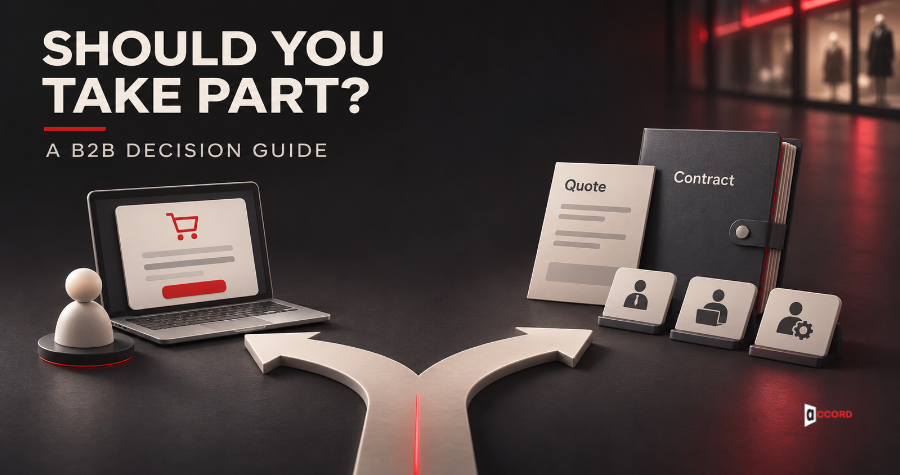
It is Black Friday week, rivals are sending "40% off" messages, and a colleague asks whether your company should do something too. If you sell to other businesses, the answer is not obvious. A discount that works on a pair of shoes can look strange on a contract that three people must approve.
This guide helps you decide in about ten minutes. It gives a five-question test for Black Friday B2B fit, a list of useful things to do with no discount at all, and checks for judging a deal from a software or service vendor. In a B2B growth engine, Black Friday is a week when attention, inboxes and booking pages all get crowded at once, so the real risk is a missed handoff, not a missed sale.
A note on the facts. We could not find an independent study of how B2B companies do in Black Friday week, in replies or in whether emails reach the inbox, so this post states none. The sales figures below are consumer forecasts or survey results reported second-hand, and each is labelled. The five-question test and its scoring are our own starting points, not industry rules.
Does Black Friday apply to B2B companies?
Sometimes. Black Friday is the Friday after US Thanksgiving. It fits B2B companies whose product one person can buy alone, at a public price, in one visit. It fits least when a quote goes to a group of buyers and the decision takes months.
In 2026, Thanksgiving is Thursday 26 November, Black Friday is Friday 27 November, Small Business Saturday is Saturday 28 November and Cyber Monday is Monday 30 November. Thanksgiving is always the fourth Thursday of November, so the dates move each year, but the questions in this post stay the same.
B2B means selling to other businesses instead of to individual consumers. In our view B2B companies fall into two groups.
Small, fast purchases. A software subscription for a small team, a tool, a course. One person often decides, the price is public, and the buyer pays in minutes. These sellers look a little like retailers, so Black Friday can make sense for them.
Large, slow purchases. An agency retainer, an enterprise software contract, a piece of equipment. Several people agree, the price is set per buyer, and the decision takes weeks or months. A one-day offer ends before the committee has met.
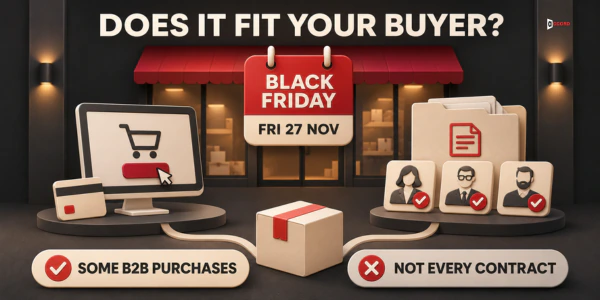
Many companies sit between the two. That is why the answer is a test for each product, not a yes or no for the whole company.
What does the data say about Black Friday B2B selling?
The data is thin. One trade report says many B2B sellers take part, but the sample size is not public. The best-known figures come from DHL eCommerce, a parcel delivery company, and reach us second-hand. They describe online sellers that ship goods, so they are a weak guide for a software or service firm.
Digital Commerce 360 reported on 1 December 2025 that, in a global DHL eCommerce survey of online sellers, 85% of B2B sellers planned to take part in Black Friday that year. It also reported that 63% of sellers said their Black Friday sales rose in 2024 compared with 2023, and that 48% earned more revenue in Black Friday than in a typical selling period. The same article quotes Adobe Analytics, which counted $11.8 billion spent online by US consumers on Black Friday that year, up 9.1% on the year before.
Read the DHL numbers with care. The article does not say how many sellers were asked, or whether the 48% is out of every seller surveyed or only those that took part. We treat the figures as a hint that many B2B sellers do something, not as proof that it pays.
The Adobe figures are about consumers. On 29 September 2026, Digital Commerce 360 reported Adobe's forecast that US online holiday sales for the last two months of 2026 will reach $275.1 billion, up 6.7%. Adobe projected Black Friday at $12.9 billion, up 9.2%, and Cyber Monday at $15.1 billion, up 6.2%.
These are US consumer online forecasts, not B2B results, and a forecast is not a result. They show that attention moves online in this week. They say nothing about whether a company buying a software contract shops on a Friday.
Be careful with any page that gives you a B2B Black Friday reply rate or inbox figure without naming where it came from.
Is your company a good fit? A five-question test
Use five questions about one product or one service at a time. Each answer leans yes or leans no. If four or five answers lean yes, a short, dated test of a discount may be worth running. If two or three lean yes, skip any discount and use the no-discount actions later in this post. If one or none lean yes, do not run a Black Friday offer for that product.
| Question | Leans yes if | Leans no if |
|---|---|---|
| 1. Deal size: can the buyer pay without a budget request? | One person can pay on a company card | It needs a budget request or purchase order |
| 2. Buying committee: who decides? | One person decides alone | Two or more people must agree |
| 3. Sales cycle: how long from first visit to purchase? | Usually seven days or fewer | More than seven days, or you do not know |
| 4. Self-serve: can the buyer start without talking to you? | Yes, through a sign-up or checkout page | No, a call or a quote comes first |
| 5. Price: is the price public? | Yes, on your website | No, each quote is set for the buyer |
Three rules keep the test honest. Score one product at a time, because a company can score 5 on a small plan and 0 on a large one. Count "I do not know" as leans no. If you cannot say how long a typical purchase takes, you cannot plan an offer with an end date, so look at your last ten sales in your CRM (the system where you record deals) and write down the days from first contact to purchase. Use the lines exactly. Four yes answers still count as "worth testing", and three count as "skip any discount". Move the lines only after you have your own results.
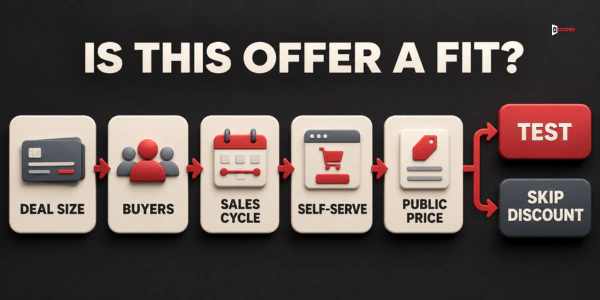
Why these five? A Black Friday offer works by pushing a fast yes, and the questions ask whether your buyer can give one. If you are unsure who decides, our guide to B2B buying committee mapping shows how to find the roles behind a purchase.
If the score is 4 or 5, work out what the offer costs first: the discount per month, times the months, times the buyers who use it.
Where does Black Friday fit in a B2B growth engine?
A B2B growth engine is a connected system that helps the right buyers find, trust and respond. It has five parts: SEO and AEO (answer engine optimization, which makes your pages easy for search tools and AI answer tools to find and quote), lead generation, email, web development and social media. The live guide uses other labels for the same parts: search visibility, account data, outbound outreach, website conversion and social proof.
Black Friday is not one of the five parts. It is a busy week that tests them. The no-discount actions in this post sit in two parts: the page you publish belongs to SEO and AEO, and the booking page and contact form belong to web development. The parts pass signals to each other. A signal is something a buyer does that shows where they stand, such as a visit, a form fill or a booked call. Passing a signal on is a handoff.
The web part receives visits from SEO and AEO and from social media, because someone who saw your post may search your name. It hands form fills and booked calls to the people on your team who answer them.
When the web part is weak, the damage shows up elsewhere. A buyer finds a good page on Friday and fills in the form, but the alert goes to a mailbox that nobody reads until Monday 30 November. By then the signal has gone cold, and the page that earned the visit looks like it failed.
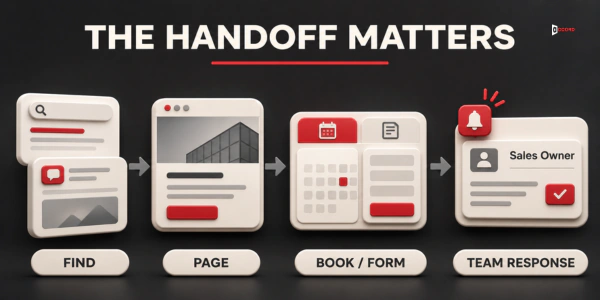
Here is a ten-minute check. Open your booking page on a phone. Does it show open slots from Monday 30 November, and no slot on Thanksgiving Thursday? Send a test message through your own contact form. Does a named person get the alert within five minutes? Then search your company name plus one question a buyer would ask. Does one of your pages show up? Any "no" is the part to fix first. The five minutes is our starting point.
Why do deep discounts backfire in B2B?
A deep discount can backfire in B2B because price is part of a contract and a relationship. In our view three things go wrong. The buyer remembers the low number, a committee asks why the price changed, and existing customers learn to wait. We could not find an independent B2B study that measures this, so treat it as reasoning, not data.
The buyer remembers the number. A company that pays one price in November may ask for that price at renewal. If the lower price was a one-off, you now have an awkward talk a year later.
The committee asks why. One person may enjoy the deal. The finance lead who sees the invoice, or the manager who gets the next quote, sees only that the price moved. "It was Black Friday" may sound weak in a boardroom.
Existing customers may start to wait. If regular customers see a sale every November, some may decide to buy then. That is a guess, not a measured fact. Decide what you will say to a customer who paid full price in October before the offer starts.
If you still want to test an offer on a product that scored 4 or 5, three rules lower the risk.
- Pick a product with a public price and a short buying cycle.
- Fix an end date, and write down the price the buyer pays when it ends.
- Count only the sign-ups above your normal weekly count as gain.
For a product that scored 0 or 1, a Black Friday offer is the wrong tool.
What can you do on Black Friday without any discount?
Four things work in any week: publish one page that answers a buyer's question, clean up the pages buyers use to contact you, plan the next quarter, and measure the week against a normal one. None needs a price change, and each still helps on 1 December.
Publish one page. Pick one question a buyer asks before buying, such as what the service includes or what to prepare before a first call, and answer it plainly. Search tools can take weeks to find a new page, so treat this as work for later months. Nothing here promises a ranking or a citation. It gives a buyer who does find you a better page to land on.
Clean up the contact path. Open the booking page, the contact form, the thank-you page and the pricing page on a phone. Fix broken links and slow forms, and make sure the form alerts a named person. Add the dates your team is away, and set an automatic reply that states the day you return.
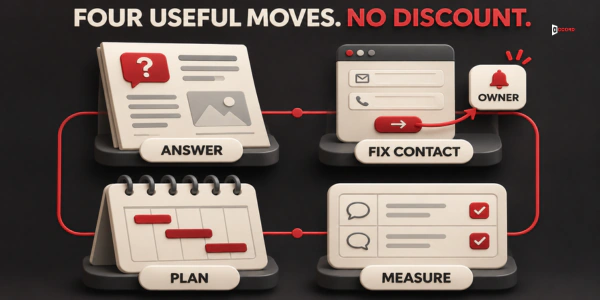
Plan the next quarter. Choose one buyer profile and one offer for the first three months of next year, and write down which part of your growth engine is weakest.
Measure the week. Record the number of real conversations in the three weeks before Black Friday, and compare them with the Black Friday weeks. A conversation is a booked call or a form fill from a real person, not a visit.
What do B2B buyers do around Black Friday and Q4?
Some buyers spend before their budget year ends, some are away for Thanksgiving, and some work as usual. Plan for a mixed picture and measure your own.
Budget years differ. Many US companies use the calendar year, so some teams plan or use budgets in November and December. Others have a fiscal year that ends in June or September, so their budget moment is elsewhere.
Offices are quiet around Thanksgiving. In our view many offices are quiet from Wednesday to Friday of that week, so a message sent then may be read on Monday 30 November. If you sell outside the United States, Thanksgiving may not apply.
If you do not know how your own buyers behave, count the booked calls and closed deals in the last two weeks of November last year. If you have no data, use this year as your first baseline. That is a fair result, not a failure.
How do you judge a Black Friday deal from a software or service vendor?
Ask what you get, for how long, and what you pay when the deal ends. A fair deal answers all three in writing. A deal that cannot answer them, or that ends in a few hours, gives you less time than your own approval process needs.
You are a buyer too, so use these six checks when a vendor sends you an offer. If the answer is "I do not know", ask the vendor in writing.
- Would we buy this at the list price? If not, the discount is hiding a purchase you do not need.
- What exactly is included? Ask for the number of users, hours, features and limits.
- How long does the lower price last? It may cover one month, one year or the whole contract.
- What is the renewal price, and when can we cancel? Put the notice date in your calendar the day you sign.
- Who must approve it, and can they do it before the deal ends? If not, ask whether the same terms are open in January.
- What does it cost if we leave early? Compare the total, not the monthly price.
Here is an example of check 6, with invented numbers. A tool costs $100 a month on a one-year plan, or $80 a month on a two-year plan. The one-year plan costs 12 times $100, which is $1,200. The two-year plan costs 24 times $80, which is $1,920. If you would use the tool for one year and the two-year plan cannot be cancelled, the lower monthly price costs you $720 more.
What should you do on 30 November and in December?
On Monday 30 November, count what happened. In the first week of December, compare it with a normal week, pick one change and write down the date you will check it. If you read this later in the year, the same steps work after any busy sales week.
- Count conversations. On the first working day after Cyber Monday, count the booked calls and real form fills for each week, from the three weeks before Black Friday up to now.
- Compare with a normal week. Use the three weeks before as your range, from the lowest week to the highest. A week inside the range cannot be called different.
- Change one thing. If a week is outside the range, change only one thing, such as the booking page or the page you published. Two changes at once hide which one mattered.
- Write the next check date. Put a date two to four weeks away in your calendar. One week is a small sample.
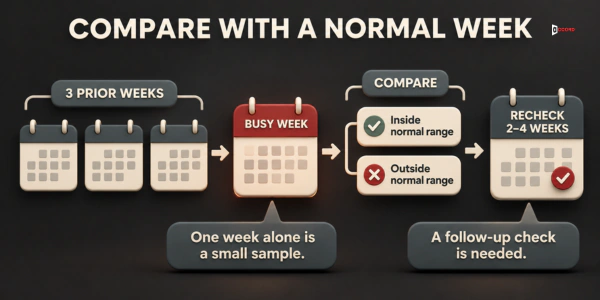
With fewer than about 10 conversations in a group, one extra changes the picture a lot. Keep your plan and wait for more data. If nothing happened, that is also a result: it gives you a baseline.
Imagine: one small company, two products, one week of numbers
Imagine Pinecrest Scheduling, a 15-person company that sells appointment-booking software to dental offices. This example is invented, including every name and number, and it is not a benchmark. Pinecrest has two products. The Starter plan is self-serve, with a public price of $50 a month. The Chain plan is for groups of 20 or more offices, is priced by quote, and needs three people to agree.
Pinecrest runs the five-question test on each plan. Starter scores 5 of 5, because one person decides, pays by card in a day and sees a public price. Chain scores 0 of 5. So Starter may be worth a test, and Chain gets no offer.
For Chain, Pinecrest removes booking slots for Thursday 26 and Friday 27 November and checks that the contact form alerts a named person. For Starter, it tests a 20% discount for the first three months, open to sign-ups from Monday 30 November to Sunday 6 December, and prints the $50 price from month four on the checkout page.
The discount is 20% of $50, which is $10 a month, or $30 per buyer over three months. In the three weeks before, Starter had 18, 22 and 20 sign-ups. That is 60 in total, an average of 20.0 a week. In the week of Monday 30 November, with the offer running, Starter has 29 sign-ups, which is 9 above the average. All 29 buyers get the discount, so the cost is 29 times $30, which is $870, and it buys 9 extra sign-ups. That is about $97 of discount for each extra one, because 870 divided by 9 is 96.67. The other 20 may have bought anyway, since 20 is a normal week.
The discount is only half the picture, because every extra buyer also pays. Over the first three months each discounted buyer pays $40 a month, or $120. The 29 buyers pay $3,480 in total, against $3,000 from a normal week of 20 buyers at the full $150, so the week brings $480 more in three months. That is a hint that the test can pay, not proof: the later months decide, and the next paragraph says when to check.
Pinecrest cannot yet know whether the extra buyers stay after month three, so it writes down a check date of Monday 8 March 2027, when the first three months have passed for every buyer.
Now follow one signal through the growth engine. A dental office manager finds a Pinecrest page on Friday 27 November that answers one question about missed appointments. The page links to the booking page, which shows no slot until Monday 30 November, so the manager books that day. The form alert goes to a named person, who confirms by email the same day. The page is the search visibility part, the booking page is the web part, and the confirmation is the handoff to the team.
Pinecrest also counts booked calls for Chain. The three weeks before had 6, 4 and 5 booked calls, which is 15 in total, an average of 5.0 a week, with a range of 4 to 6. The week of 23 November had 3, below the range, and the week of 30 November had 6, inside it. Each week is under 10 calls, so by the rule above Pinecrest cannot call the dip different. Read together, the two weeks are 9 calls against an expected 10.0, a gap of 1 call. Pinecrest keeps the plan and checks again in two to four weeks.
Frequently asked questions
Next step
Accord sells lead generation, email, SEO and AEO, web and social as one connected growth engine. In a session we map which part of your growth engine Black Friday touches for your product and which part is weakest. If you would like a second pair of eyes, book a 30-minute working session with the Accord team. Bring one product, its price and your last ten sales dates, and we will run the five questions together.