
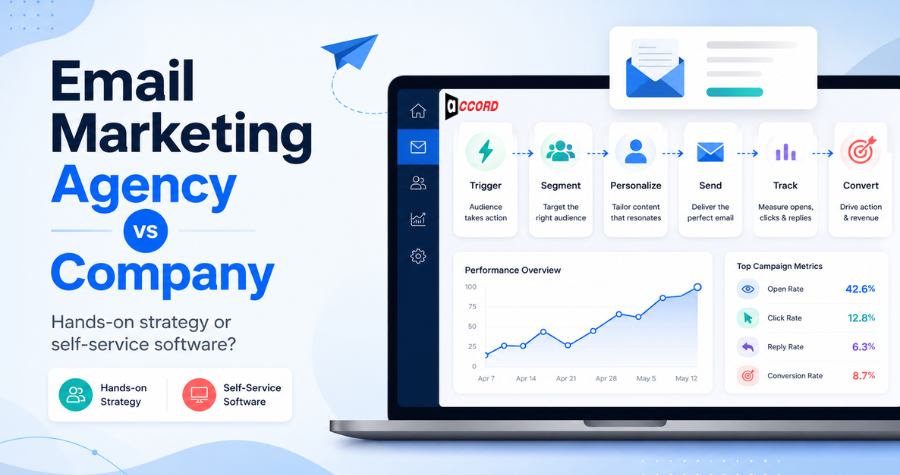
An email marketing agency vs email marketing company decision comes down to one question: how much hands-on strategy and execution do you actually need? An agency manages campaigns, writes copy, builds automation, and reports on what's working — you're paying for people and expertise. A company, in most cases, means a software platform with templates and send tools — you're paying for access, and the actual work still lands on your desk.
You've got a list, you've got products to sell, and your emails still aren't pulling their weight. Open rates sit somewhere in the "fine, I guess" range. Click-throughs barely move the needle. Now you're staring at two paths: hire an email marketing agency, or sign up with an email marketing company that mostly hands you software and a login screen. Pick wrong and you either overpay for hand-holding you didn't need, or underpay for a tool nobody on your team has the hours to actually run. The rest of this post breaks down what each one really offers, where each falls short, and how to figure out which one fits where your business stands right now.
What Is an Email Marketing Agency?
An email marketing agency is a team that runs your email program for you. Strategy, copywriting, design, list segmentation, automation, reporting: all of it gets handled by people who do this work every day, not as a side task wedged between invoicing and customer calls.
Most agencies operate from flows agreed in the written scope. You tell them what you're after, such as more repeat purchases, better lead nurturing, or fewer people unsubscribing, and they build a plan around that. Then they execute it and adjust based on what the numbers actually show. You're not the one logging into a dashboard at 9pm wondering why open rates dipped last week. Someone else is watching that, and they'll flag it before it becomes a pattern.
There's also a structural difference that's easy to miss: an agency typically brings outside perspective. They've seen what works across dozens of accounts, not just yours, so they catch patterns a single in-house person might never notice. A subject line that flops for one industry might be the exact thing that works for another, and an agency that's run hundreds of sends has that context built in.
The tradeoff is cost. Agencies charge for time and expertise, so the monthly fee runs higher than a basic software subscription. But you're also not the one staring at a blank subject-line field at 11pm before a campaign has to go out, and that has a value most spreadsheets don't capture. Our email marketing services cover exactly this end-to-end scope, from strategy through send.
What Is an Email Marketing Company?
This is where the term gets murky, and it trips up a lot of business owners doing their own research. "Email marketing company," in most usage, refers to a software provider: a platform built for sending, automating, and tracking emails. You get the tools: templates, list management, basic automation builders, analytics dashboards that fill up with numbers the moment you start sending.
What you don't get is a strategist. The platform has no idea what your business does, who your customers are, or why last month's campaign fell flat. It will show you the open rate and the click rate, sure. But reading that data and turning it into a decision, such as whether to resend to non-openers, change the send time, or question the subject line, is still on you or whoever on your team has the time and skills to dedicate to figuring it out.
That's the part people underestimate going in. A platform with forty templates and a drag-and-drop builder feels like progress on day one. By week six, when the novelty wears off and the open rates haven't moved much, it becomes obvious that the tool was never the missing piece. The missing piece was someone treating email like an ongoing program instead of a monthly task to check off.
Some companies blur the line by offering "managed" tiers with added support layered on top of the core software. That's worth asking about directly, because the label alone doesn't tell you what's actually included. The core model, though, is software-first: you're renting the toolkit, not hiring the expertise that knows how to use it well.
Main Differences Between an Agency and a Company
The split usually comes down to four things: who does the work, what you're actually paying for, how much oversight you get along the way, and how fast problems get caught.
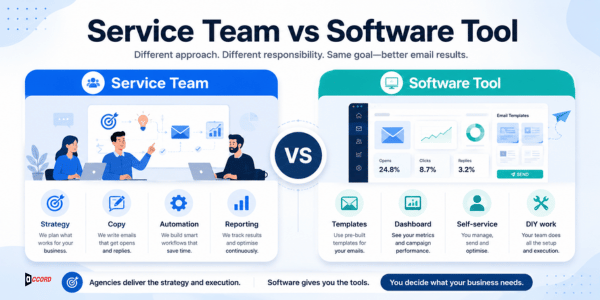
An agency takes ownership of execution from the first email to the last report. A company gives you the tools and steps back, leaving the building, testing, and fixing entirely in your hands. That single difference ripples outward into everything else: cost structure, how much time the work eats out of your week, and whether a dip in performance gets caught in three days or three months.
| Factor | Email Marketing Agency | Email Marketing Company |
|---|---|---|
| Who does the work | Agency team: strategy and execution | You or your internal team |
| Pricing model | Monthly retainer for time and expertise | Subscription based on list size and features |
| Strategy involvement | Built-in, ongoing | Self-directed |
| Time required from you | Low: mostly approvals and feedback | High: you're running campaigns |
| Best for | Businesses without in-house email expertise | Businesses with marketing staff and time |
| Reporting | Analyzed and explained by the agency | Raw data you interpret yourself |
Neither column is automatically the "right" one. A 30-person company with an in-house marketer who genuinely enjoys this work might do fine with the right software. A solo founder juggling five other roles almost never has the room to make that same setup work.
Which One Is Better for Small Businesses?
If you're a small business and email marketing isn't anyone's actual job title, an agency usually wins out. Not because the software is bad, since most platforms today are perfectly capable, but because nobody on a five-person team has the spare hours to learn it properly while also running the rest of the business.
That said, if you already have someone on staff who's comfortable with email tools and genuinely has time carved out for it, a company-style subscription can work fine. The honest answer here depends less on budget and more on whether you have a person, not just a tool, who can turn raw data into actual decisions week after week.
A familiar pattern shows up across a lot of small businesses: they try the DIY software route first because it looks cheaper on paper. Things go okay for the first month or two while the novelty's there. Then around month three or four, growth flattens, the same templates start getting reused because nobody has time to test new ones, and the team realizes the platform was never the bottleneck. The bottleneck was always the time and strategic attention nobody had to spare. That's usually the point an agency conversation starts.
Which One Is Better for B2B Lead Generation?
B2B lead generation runs on sequencing: the right email, to the right segment, at the right point in what's often a long, multi-touch sales cycle. That's genuinely hard to pull off with software alone, because it demands constant adjustment based on how leads actually behave, not a template you set once and leave running. Programs built around B2B lead generation depend on exactly this kind of ongoing sequencing work.
An agency typically handles this better, because B2B nurture sequences need ongoing testing across subject lines, send timing, and segment logic. That testing only works if someone's reviewing results regularly and adjusting the next send accordingly. A company's platform can technically support all of that machinery. The automation builder, the conditional logic, the segmentation rules: it's all there. But someone still has to build it, watch it, and refine it. B2B sales cycles don't leave much room for trial-and-error guesswork while a promising lead quietly goes cold waiting on the next touchpoint.
There's a sequencing problem specific to B2B that software rarely solves on its own: knowing when a lead has gone quiet versus when they're just slow to respond. A platform will tell you someone hasn't opened the last three emails. It won't tell you whether that means they lost interest or they're just buried in a different project this month, and that judgment call shapes whether the next email is a soft check-in or a harder push.
Cost Comparison
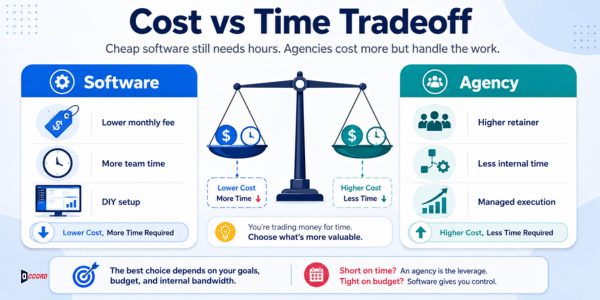
Pricing varies a lot by business size, list volume, and scope of work, so treat any figures here as a broad market estimate rather than a quote you can take to the bank. Software-only platforms tend to start lower, often anchored to a basic monthly fee tied to list size that climbs as your contact count grows. Agencies typically run higher because you're paying for a team's time and judgment, not just server space and a sending engine.
The real cost question isn't "which one is cheaper." It's "which one actually produces results worth the money." A cheap subscription that sits half-used, with templates nobody updates and automations nobody checks, ends up costing more in lost revenue than a higher agency retainer that's actively driving conversions every month. Cheap-but-idle isn't actually cheap once you account for what it isn't generating.
It also helps to think in terms of opportunity cost, not just the invoice. If running a software platform properly eats five to eight hours a week of a team member's time, that's time pulled away from sales calls, product work, or customer service: hours that have a real dollar value even if they never show up on the email marketing line item.
How to Choose the Right Partner
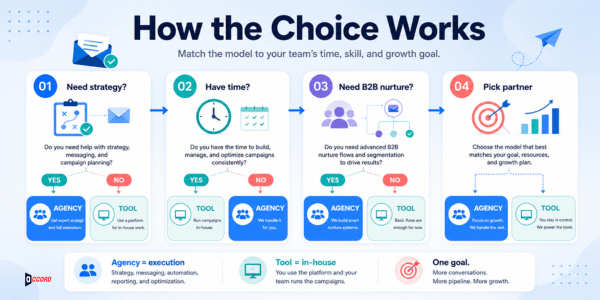
Start with an honest look at your own team before comparing pricing pages. Do you have someone who can dedicate real time and skills to email every single week: writing copy, building flows, checking metrics, adjusting based on what they find, or is it currently nobody's actual job?
If it's nobody's job, an agency closes that gap cleanly. If you have the capacity in-house but want sharper tools, a company-style platform might be all you genuinely need. Either way, come in with specific questions rather than general ones: What's included in the base plan, exactly? How is success measured, and by what timeline? What happens if campaigns underperform for a stretch? Is there a documented process for adjusting course, or do you just request written clarification and wait it out?
Watch how an agency handles the scope question specifically. A team that's confident in its process will tell you plainly what's covered and what isn't, instead of circling around it. If you ask three times and still can't pin down what you'd actually get for the monthly fee, take that as your answer.
Got people in-house already but craving more strategic direction? That's exactly what managed email marketing support is built for: it layers proven strategy on top of the platform your team is already using, so nothing gets thrown out and started over. If you want a longer read on where the category is headed this year, see our breakdown of email marketing trends 2026.
FAQs
Is an email marketing agency more expensive than an email marketing company?
In most cases, yes. You're covering a team's time and strategic input, not just a software license. That said, the higher price tag tends to pay for itself: campaigns convert better, fewer sends get wasted on guesswork, and you're not burning hours testing things that an experienced team already knows won't work.
Can I switch from a software platform to an agency later?
Yes, and it's a common path. Many businesses start with a software-only setup because it looks more affordable, then bring in an agency once they realize they don't have the internal time and skills to run it well on an ongoing basis.
Do agencies use the same email platforms as companies?
Often, yes. Many agencies work inside the same popular sending platforms you'd use on your own. They're managing the strategy, content, and execution within that tool rather than leaving the whole process to you.
What if I only need help with one part, like automation?
Some agencies offer scoped support for specific needs, such as building automation flows agreed in the written scope, rather than taking on full-service management. It's worth asking directly during a consultation whether partial scope is even an option.
Is a managed service the same as full agency service?
Not always, and the difference matters. "Managed" can mean different things depending on the provider. Some add genuine hands-on strategy, while others just mean basic monitoring with minimal involvement. Confirm exactly what's included before assuming it matches what a full agency relationship looks like.
How do I know if my current results are bad enough to switch?
If your open and click rates have been flat for several months despite trying different subject lines or send times, or if nobody on your team has the time to test and adjust campaigns regularly, that's a strong signal it's time to bring in dedicated support.
Can a small business realistically afford an agency, or is that only for bigger companies?
It depends more on current results than company size. A small list that's poorly managed often loses more potential revenue than a larger one being run well, so the math can work out in favor of an agency even for a smaller operation, especially once you factor in the time it frees up internally.