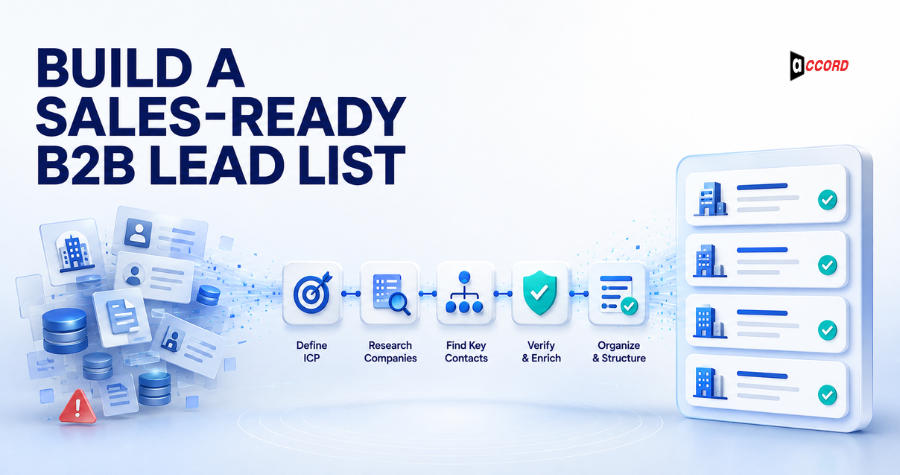
Quick answer: A useful B2B lead list is not a large spreadsheet of names. It is a verified set of accounts and contacts that match a defined ideal customer profile, contain the fields sales needs, and include a reason each account is worth contacting now. Quality comes from research, validation, context, and ongoing maintenance.
A list can contain 10,000 contacts and still create almost no pipeline. That happens when the data looks complete but does not help a salesperson make a decision. The company may be the wrong size. The contact may have changed roles. The email may be risky. The buyer may have no reason to care about the offer.
This is the quiet problem behind many disappointing outbound campaigns. Teams focus on list volume because volume is easy to count. Sales-ready relevance is harder to measure, so it often receives less attention.
In 2026, that tradeoff is becoming more expensive. Buyers expect relevant communication, inbox providers watch sender behavior closely, and sales teams cannot afford to spend their day correcting research. A better list should make the next action clearer. It should tell sales whom to contact, why the account fits, what changed, and how confident the team can be in the data.
This guide explains the process Accord Tech Solutions uses to think about targeted B2B data: start with the market, translate the strategy into research rules, verify each critical field, and package the result for real sales work.
What makes a B2B lead list sales-ready?
A sales-ready lead list combines fit, accurate contact data, buying context, and operational usability. Every record should match documented targeting rules, identify a relevant decision-maker, provide validated contact details, and contain enough context for a salesperson or outreach system to choose a sensible next step.
Four qualities separate a working prospect list from a data dump:
- Account fit: The company falls inside the industries, locations, size bands, technologies, or business models you can serve.
- Contact relevance: The person has a role connected to the problem, budget, evaluation, or implementation.
- Data confidence: Important fields have been checked recently and come from traceable sources.
- Actionable context: Sales can see the trigger, pain hypothesis, segment, or personalization angle without researching the record again.
Notice that an email address alone is not enough. A valid inbox can belong to the wrong person. A relevant person can work at the wrong company. A perfect account can still be mistimed. List quality is the combined strength of the entire record.
Start with an ICP that researchers can actually apply
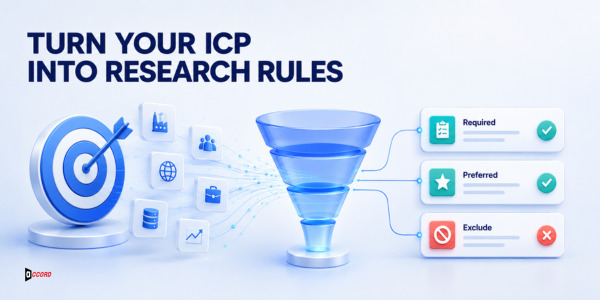
An ideal customer profile becomes useful only when its language can be converted into yes-or-no research rules. Replace broad descriptions such as “growing technology companies” with observable criteria: industry, employee range, operating region, revenue band where reliable, business model, installed technology, current hiring, funding stage, or another relevant signal.
Most weak lists begin with a vague brief. “Find SaaS companies in the USA” leaves too much room for interpretation. A researcher may include pre-revenue startups, global enterprises, consumer apps, agencies with a SaaS tool, and companies that have already closed. The list appears consistent only because all rows contain the word SaaS.
A practical ICP brief should define:
- Required conditions: the account must meet these rules.
- Preferred conditions: these increase priority but are not mandatory.
- Exclusions: these accounts should never enter the list.
- Buyer roles: primary, secondary, and influencer titles.
- Location logic: headquarters, operating market, or contact location.
- Evidence standard: which sources can support each decision.
- Recency standard: how recent a signal or validation must be.
Create examples before full production. Show five accounts that clearly qualify, five that clearly do not, and several edge cases. This small calibration exercise reduces inconsistent judgment later.
Build the account list before finding individual contacts
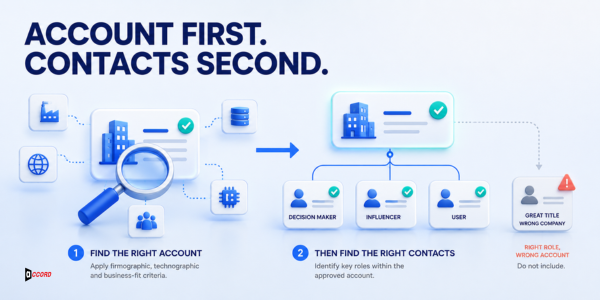
Account-first research protects targeting quality because it confirms the company fits before time is spent finding people. Researchers can evaluate industry, size, geography, business model, technology, hiring, and growth signals at the organization level, then map the most relevant contacts inside the approved accounts.
Contact-first list building often produces a familiar mess: impressive job titles attached to companies the client cannot serve. Account-first work reverses that logic.
Begin with a broad account universe from suitable databases, industry directories, professional networks, company websites, event lists, job boards, public filings, or specialized sources. No single source should be treated as complete. Use each source for the field it handles well, then verify important facts elsewhere.
Score accounts in simple tiers:
- Tier 1: Strong fit plus a meaningful current signal.
- Tier 2: Strong fit without a visible timing signal.
- Tier 3: Partial fit, uncertain evidence, or lower potential value.
The purpose is not to create a complicated predictive model. It is to help the sales team focus its best research and personalization on the accounts most likely to justify it.
Map the buying committee, not just one job title
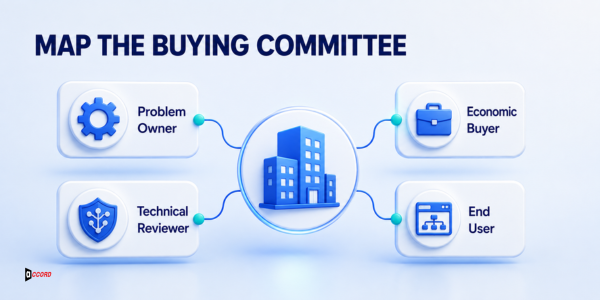
B2B purchasing decisions usually involve several roles, so a resilient lead list maps economic buyers, functional owners, technical evaluators, and likely users. The right contact depends on the offer, company size, buying stage, and problem—not merely on who has the most senior title.
Suppose you sell CRM data cleanup. A chief revenue officer may own the business outcome, sales operations may diagnose the issue, marketing operations may depend on the data, and an administrator may implement the work. Sending the same message to every role ignores how the decision happens.
For each account, define:
- The problem owner who feels the operational pain.
- The economic buyer who can approve budget.
- The technical or compliance reviewer who may block a decision.
- The end user who understands the daily impact.
At smaller companies, one person may fill several roles. At larger organizations, the list may need multiple contacts per account. Label the role each contact appears to play. That label is more useful than a title copied without interpretation.
Choose fields based on the sales action they support
Every column should help targeting, routing, personalization, compliance, or reporting. Collecting fields because a data provider offers them creates clutter and false confidence. Start with the decision sales must make, then include only the information needed to make that decision reliably.
A practical record may include:
- Company name, domain, LinkedIn URL, industry, headquarters, and size band.
- Contact name, normalized title, seniority, department, profile URL, and business email.
- ICP fit tier and the evidence supporting it.
- Trigger or signal with a source URL and observation date.
- Persona, likely pain point, and suggested messaging angle.
- Email validation status and last-verified date.
- Source, owner, campaign, and CRM routing fields.
Avoid mixing assumptions with verified facts. If “likely expanding outbound team” is an inference from several job posts, label it as an inference. If headcount comes from a third-party estimate, identify the source and use a band rather than presenting it as exact.
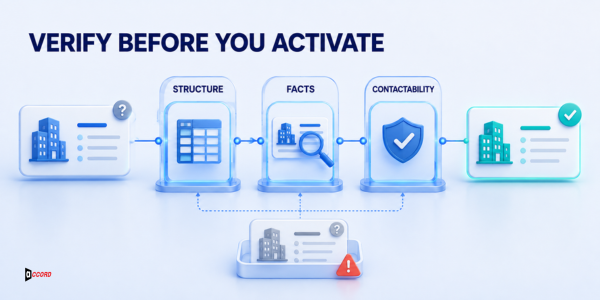
Verify the data before it reaches an outreach tool
Verification is a layered quality-control process, not a single email-checking step. Confirm the company is active, the contact still holds the relevant role, the domain matches the organization, the email is usable, and the record follows the agreed formatting and exclusion rules.
Use at least three layers of review:
1. Structural validation
Check required fields, allowed values, naming conventions, duplicate rules, and formatting. Normalize company domains and job functions so the CRM does not treat small variations as different records.
2. Factual validation
Compare key information against current company pages, professional profiles, reputable databases, and public sources. A source URL and checked date make later review possible.
3. Contactability validation
Use an appropriate email verification workflow, but interpret results carefully. “Valid” means the address appears deliverable; it does not prove the person is the right buyer or that sending an unsolicited message is appropriate. Respect applicable privacy, marketing, and anti-spam rules in the markets you target.
Quarantine uncertain records instead of forcing every lead into a campaign. A smaller ready queue and a separate research queue are safer than one mixed list.
Add a reason to contact each priority account now
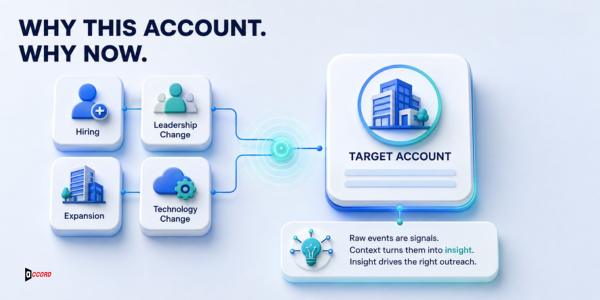
A timely signal turns a static target account into a potential sales opportunity. Useful signals include relevant hiring, leadership changes, expansion, new market entry, technology adoption, funding, regulatory pressure, product launches, or visible operational problems connected to your service.
Signals should pass three tests:
- The event is recent enough to influence a decision.
- It relates directly to a problem your offer can solve.
- A salesperson can cite it naturally without sounding intrusive.
“Congratulations on the funding” is not a strategy. Explain why the event may create a need. Funding plus ten open sales roles could imply new prospecting and CRM requirements. A website migration could create SEO and conversion risk. Expansion into a new region could create data, localization, and campaign needs.
Record the signal source, date, and interpretation separately. This makes it easier for a reviewer to check the reasoning and for sales to choose a relevant opening.
Design the list for CRM and workflow compatibility
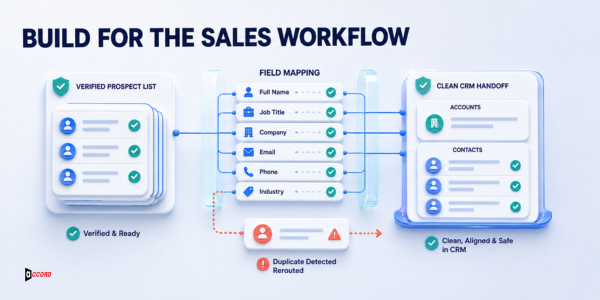
A lead list creates value only when it enters the sales workflow cleanly. Before delivery, align field names, picklist values, ownership rules, duplicate handling, consent or lawful-basis fields where relevant, and campaign attribution with the destination CRM or sales engagement platform.
Test a small import first. Confirm that:
- Existing accounts are matched instead of duplicated.
- Contacts attach to the correct account.
- country, industry, and seniority values map correctly.
- opt-out and suppression data remain protected.
- lead owners and campaign sources populate as expected.
- personalisation fields render safely when a value is missing.
This final operational step is often overlooked. A clean spreadsheet can still damage reporting if it creates duplicate accounts, overwrites trusted fields, or bypasses suppression logic.
Measure list quality with sales outcomes
The best lead-list metrics connect data quality to sales behavior and outcomes. Track acceptance, rejection reasons, bounce rate, positive reply rate, meetings by segment, duplicate rate, missing-field rate, and how often sales must correct records before using them.
Do not evaluate the research team only by leads produced per day. That rewards speed even when accuracy and relevance fall. Use a balanced scorecard:
- ICP acceptance rate.
- Verified-field completion rate.
- Duplicate and stale-record rate.
- Bounce and invalid-contact rate.
- Positive responses by segment and persona.
- Sales-qualified conversations influenced.
Feedback should loop back into the ICP. If a segment repeatedly rejects the offer, determine whether the problem is targeting, timing, positioning, or the offer itself. The list is not separate from go-to-market strategy; it is one of the clearest ways to test it.
How Accord Tech Solutions approaches B2B lead research
Accord Tech Solutions treats lead generation as a connected data and pipeline process. The work begins with ICP rules and account research, then moves through contact mapping, validation, enrichment, segmentation, and delivery in a structure the client’s sales team can use.
The goal is not to promise that every record will become a customer. No responsible provider can guarantee that. The goal is to reduce avoidable waste: wrong accounts, outdated contacts, risky addresses, missing context, and records that do not fit the client’s workflow.
Our B2B lead generation services can support contact prospecting, CRM data enrichment, data validation, online research, and custom lead-generation programs. For teams that also need activation, the list can become the foundation for segmented email outreach, content, SEO, and conversion work rather than remaining an isolated spreadsheet.
A practical pre-launch checklist
Before launching outreach, verify the strategy, the records, and the handoff. A short final review can prevent the most common list failures from becoming sender-reputation, compliance, or sales-productivity problems.
- Is the ICP written as observable inclusion and exclusion rules?
- Has a stakeholder approved examples and edge cases?
- Does every account meet the required conditions?
- Is each contact mapped to a relevant buying role?
- Are critical fields sourced and recently checked?
- Are uncertain facts labeled as estimates or inferences?
- Are duplicates, prior customers, competitors, and suppressed contacts removed?
- Has email status been checked with an appropriate validation process?
- Is there a useful signal or context field for priority accounts?
- Has a test import confirmed the CRM mapping?
- Can sales report why a lead was accepted or rejected?
If several answers are “no,” the list is not ready just because it has reached the requested row count.
Frequently asked questions
How many leads should a B2B lead list contain?
The right size depends on market size, sales capacity, average deal value, and the level of personalization required. Begin with a small, well-defined batch that sales can review quickly. Use the response and rejection data to improve the targeting rules before expanding production.
How often should B2B lead data be verified?
Verify critical contact and company fields as close to campaign launch as practical, then set a refresh schedule based on data volatility. Job titles and employment status can change quickly. Store a last-checked date so users know whether a record is current or needs review.
Should we buy a ready-made B2B lead database?
A database can be a useful starting source, but it should not be treated as a finished campaign list. Apply your ICP, exclusions, role mapping, validation, and compliance process before activation. Generic lists rarely contain the business context needed for relevant outreach.
What is the difference between a lead and a prospect?
Definitions vary by organization. A practical distinction is that a lead is a record that may fit, while a prospect has been reviewed against agreed qualification criteria and is appropriate for a defined sales action. Document your own lifecycle definitions so reporting stays consistent.
Can AI build a B2B lead list automatically?
AI can speed up classification, summarization, research support, and personalization drafting. It can also misread pages, merge entities, or present uncertain information confidently. Use automation with source tracking, deterministic checks, sample reviews, and human judgment for ambiguous or high-value records.
Build a list that earns sales attention
A high-performing B2B lead list does not begin with an export button. It begins with a clear market decision. The team defines who fits, why they fit, which people matter, what evidence is trustworthy, and how the data will move through sales operations.
That approach may produce fewer rows at first. It also produces a list salespeople are more likely to open, trust, and use. When research quality, data validation, messaging context, and CRM readiness work together, list building becomes part of a durable pipeline system—not a one-time spreadsheet purchase.
If your team needs that system, talk with Accord Tech Solutions about building a verified, segmented prospecting workflow around your actual market and sales process.
Methodology and sources
This article is based on Accord Tech Solutions’ documented service positioning and practical B2B research workflow. It avoids guarantees and does not use invented client outcomes. Useful references include the Accord Tech Solutions Lead Generation service, the FTC CAN-SPAM compliance guide, and Salesforce’s State of Sales research.
Last reviewed: August 13, 2026.