
Introduction
B2B marketing attribution is difficult for a simple reason: revenue rarely comes from one isolated marketing touch. A buyer may discover a company through search, read an article, return through LinkedIn, attend a webinar, speak with sales, revisit a case study, and finally enter an opportunity after a referral or direct visit. If the reporting system gives all the credit to one moment, it may produce a clean answer without producing a useful one.
That creates a management problem, not just a reporting problem. Marketing leaders need to decide where to invest. Revenue operations teams need consistent definitions. Sales teams need context about what happened before the conversation. Founders need to understand which activities are contributing to pipeline without treating an attribution estimate as perfect truth.
A useful attribution system therefore does more than assign credit. It creates a shared way to interpret evidence. The goal is to understand which touches were observed, how the chosen model distributes credit, what the model cannot prove, and which business decision the report is meant to support.
This guide explains how to define the attribution question, choose a model, create shared language, design a workable operating process, protect against common biases, and improve the system with real examples over time.
Define the business problem before choosing the model
Do not begin with a dashboard or a preferred attribution model. Begin with the decision the team is trying to improve.
A company deciding how to allocate next quarter's channel budget has a different question from a team trying to understand how buyers first discover the brand. A demand generation leader evaluating campaign influence has a different question from a revenue operations team investigating why opportunities are being credited inconsistently.
Write the business question in plain language. For example: Which channels are consistently involved in opportunities that progress? Where are high-quality opportunities first discovered? Which touches tend to appear before sales conversations? Are we over-crediting the final recorded interaction because earlier activity is missing?
Then define the working unit. In most B2B environments, the useful unit is not a single anonymous click. It is an opportunity journey connected, as reliably as possible, to identifiable contacts, accounts, meaningful touches, stage changes, and revenue outcomes.
Also define a boundary. Attribution can organize observed evidence, but it cannot prove that every recorded touch caused the purchase. A clear boundary prevents the report from becoming more confident than the underlying data.

Create a shared attribution vocabulary
Attribution breaks down quickly when teams use the same words differently. Before selecting a model, agree on the terms that will appear in reports and decisions.
Define what counts as a touch. A meaningful touch might include first discovery through search, an engaged content visit, a webinar registration, a return visit, a campaign response, a sales conversation, opportunity creation, or another interaction the team can identify consistently. Avoid counting every available event simply because the system can capture it.
Define what "source," "influence," and "credit" mean. Source may describe where a contact or opportunity was first identified. Influence may describe a recorded interaction that occurred during the buying journey. Credit is the value an attribution model assigns to one or more of those interactions. These concepts are related, but they are not interchangeable.
The vocabulary should live where the work happens: CRM field definitions, analytics documentation, campaign briefs, reporting notes, and revenue operations playbooks. Each important signal should have a source, an owner, and an update rhythm. If a field cannot be explained or maintained, it should not quietly become decisive.
Understand the main B2B attribution models
No attribution model is universally correct. Each model answers a different version of the credit question, and each introduces its own bias. The practical choice depends on the decision being made and the quality of the available journey data.
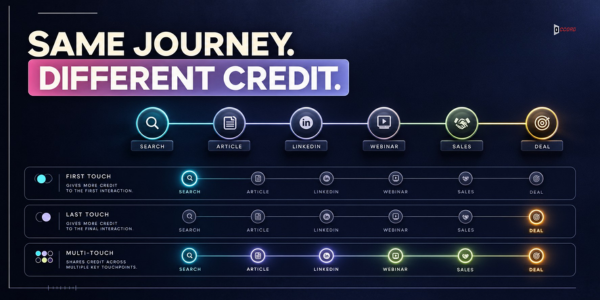
First-touch attribution
First-touch attribution gives primary credit to the earliest recorded interaction. It is useful when the team wants to understand discovery: which channels, campaigns, or content sources are bringing new buyers into the observable journey.
Its limitation is equally clear. Long B2B journeys often contain substantial education, evaluation, sales interaction, and return activity after discovery. First-touch attribution can therefore overstate the importance of acquisition while hiding what helped the opportunity progress.
Last-touch attribution
Last-touch attribution gives primary credit to the final recorded marketing interaction before a defined conversion or milestone. It is simple to explain and can be useful when the immediate question is which activity preceded a conversion.
The risk is last-touch bias. The final interaction may be easy to record without being the most important influence. A direct visit, branded search, or late-stage asset may receive the credit even when earlier content, events, referrals, or sales activity created most of the context.
Linear multi-touch attribution
A linear model distributes credit evenly across the recorded touches in the journey. It acknowledges that several interactions may contribute instead of forcing one winner.
That makes the model useful as a simple multi-touch baseline, but equal credit can create a different distortion. A low-intent interaction and a high-value sales-enabling touch may receive the same weight even when their roles were very different.
Time-decay attribution
Time-decay attribution gives more credit to touches that occur closer to the conversion or opportunity milestone. It can help teams examine late-stage influence while still recognizing earlier activity.
However, proximity is not the same as importance. A decisive early interaction may receive less credit simply because it happened earlier. The model should therefore be used only when recency is relevant to the business question.
Position-based attribution
Position-based models assign more credit to selected positions in the journey, commonly the first and later conversion-related touches, while distributing the remaining credit across interactions in between.
This can be useful when a team believes discovery and conversion deserve additional emphasis. The trade-off is that the weighting is a rule chosen by the organization. It should be documented as a modeling decision, not presented as an objective fact about buyer behavior.
Custom or data-informed attribution
A custom model uses business-specific rules, weights, milestones, or analysis to reflect the journey more closely. Mature teams may use custom approaches when standard models consistently fail to represent how their sales process works.
Customization should come after the team understands its data. A complex model built on missing identities, inconsistent campaign tagging, or incomplete offline activity creates sophisticated-looking output without solving the underlying measurement problem.
The best starting point is therefore not "Which model is most advanced?" It is "Which model produces the most useful view for this decision, given the evidence we can actually trust?"
Choose the model based on the decision
A practical attribution program may use more than one view. The important rule is to connect each view to a specific question instead of switching models until the preferred answer appears.
Use first-touch reporting when the decision concerns discovery. Use last-touch reporting when the team needs a simple view of the final recorded interaction before a milestone. Use a multi-touch model when the question requires a broader view of the journey. Use a custom approach only when the organization has a clear reason for the weighting and enough data quality to support it.
Whenever possible, compare models on the same set of opportunities. If first-touch reporting favors one channel while last-touch reporting favors another, that disagreement is useful. It shows that the channels may be playing different roles rather than proving that one report is wrong.
Document the selected model beside the report. State what receives credit, which milestone ends the journey, how duplicate or repeated touches are handled, how offline interactions enter the record, and which activity is excluded. A number without its attribution rule is easy to misinterpret.

Design the operating model
A good attribution strategy becomes useful when it is translated into repeatable actions. Decide how journey data enters the system, how identities and accounts are connected, which touches qualify, who reviews exceptions, and how the final report reaches the people making decisions.
Map the process from first observable interaction to opportunity and revenue progression. Identify where information can be lost, duplicated, delayed, or assigned to the wrong account. B2B journeys often involve several people from the same organization, so the operating model should make clear whether reporting is contact-level, account-level, opportunity-level, or a defined combination.
Keep the first version manageable. A practical operating model needs minimum data requirements, naming and tracking rules, ownership, an exception path, and a review rhythm. It does not need to automate every judgment.
Walk one real opportunity through the entire process. Can the team explain where it was first discovered, which meaningful touches were recorded, how the model assigned credit, what was missing, and why the final report looks the way it does? If two teams cannot reproduce the same logic from the same evidence, the rule needs clarification before more volume is added.
Use evidence instead of assumptions
Attribution contains uncertainty, so the system must separate observation from interpretation.
A page visit is evidence that a visit was recorded. It is not automatically evidence that the page caused an opportunity. A webinar attendance is evidence of participation. It does not prove that the event was decisive. A sales conversation may be a major influence even when the marketing platform cannot see it.
For every important signal, ask four questions: What was observed? Where did the record come from? When was it recorded? What alternative explanation remains possible?
Use evidence at the level of the decision. If the question is channel investment, inspect opportunity quality and revenue progression rather than click volume alone. If the question is discovery, examine first identifiable sources and the reliability of source capture. If the question is pipeline influence, review meaningful touches across real opportunities and account for known gaps.
A useful attribution record does not need to contain every possible interaction. It needs enough reliable context for another person to understand how the conclusion was produced.

Build the workflow around people
Systems do not create trust by themselves. People trust attribution when the reporting reduces confusion, explains its assumptions, and gives them enough context to act.
Marketing needs a consistent way to describe influence without claiming ownership of every sale. Sales needs visibility into useful pre-opportunity context without receiving a timeline full of meaningless events. Revenue operations needs stable definitions and data-quality rules. Leadership needs reports connected to real business decisions.
Give each role a small set of clear responsibilities. Channel owners should maintain campaign and source hygiene. Revenue operations should maintain definitions, identity rules, and reporting logic. Sales should record relevant offline context when the agreed process requires it. Report owners should explain model limitations rather than hiding them behind a single number.
When a handoff or report fails, diagnose the actual problem. Was the source missing? Was the account match wrong? Was the model misunderstood? Was offline activity absent? Was the milestone defined inconsistently? These are different failures and require different fixes.
Measure quality and learning
Attribution measurement should evaluate the reporting system as well as the marketing activity.
Track whether important opportunities have usable source data, whether campaign naming is consistent, whether meaningful offline activity is represented, whether account and contact records are connected correctly, and whether the same rules are being applied across reports.
Then connect attribution outputs to the business outcome the team actually cares about. Look at opportunity creation, stage progression, pipeline quality, revenue progression, or another defined outcome. Avoid turning every observable activity into a permanent KPI.
Review numeric trends together with real opportunity journeys. A report may show that a channel received more attributed pipeline while the underlying records reveal a tracking change, duplicate activity, or a new rule. Examples help the team distinguish a real business change from a measurement change.
Set review dates for definitions and models as well as results. Buyer behavior, campaigns, tracking systems, sales processes, and data availability change. An attribution rule that was useful six months ago may need to be revised.
Avoid common attribution failure modes
Several problems appear repeatedly in B2B attribution.
Double counting happens when the same interaction, contact, or opportunity contributes more than once in a way the model did not intend. Last-touch bias occurs when the final recorded interaction receives disproportionate attention because earlier influence is harder to capture. Missing offline activity hides calls, events, referrals, partner interactions, or sales-led moments that may matter. Identity gaps separate activity across devices, contacts, or accounts. Inconsistent campaign tagging changes the data before the model even begins.
Another failure mode is false precision. A report may display exact percentages even though the underlying journey contains missing activity and modeling assumptions. Precision in the output should not be confused with certainty about causation.
Scope expansion creates additional risk. A method designed for one segment, sales motion, or conversion may gradually be used for every account and market. Document where the model applies and make "unknown" an acceptable state when the evidence is incomplete.
When results look wrong, review the chain before blaming the final report. Check collection, identity, definitions, exclusions, model rules, offline inputs, and milestone timing. Fix one meaningful issue, test the change on a representative sample, and record why the rule changed.

Create a practical implementation plan
Start with a small but representative set of real opportunities. Choose records that include enough journey variety to expose problems: different discovery sources, multiple content touches, sales activity, return visits, referrals, or offline interactions.
First, document the current state. Identify the business questions, existing source fields, campaign conventions, available journey data, known gaps, and current reporting rules.
Second, agree on the minimum definitions and data required. Decide what counts as a meaningful touch, which conversion or revenue milestone the model will evaluate, how accounts and contacts are connected, and how offline activity is handled.
Third, run the same sample through at least two useful attribution views. For example, compare first-touch with a multi-touch view. Do not ask which model "wins." Ask what each model reveals, what it hides, and which decision each view supports.
Fourth, choose the reporting approach, assign a named owner, and run a short review cycle. Check both the numbers and the underlying opportunity journeys.
Finally, remove rules or fields that do not improve the decision, document the stable version, and expand the process gradually. The first implementation does not need to be perfect. It needs to be transparent enough to improve.

A practical checklist
Before the attribution process goes live, confirm that the team can answer these questions in plain language.
What business decision is this report meant to improve? What is the reporting unit: contact, account, opportunity, or another defined object? Which milestone ends the attribution window? What counts as a meaningful touch? Which model is being used, and why does it fit the decision? What data is excluded? How are repeated touches handled? How are offline interactions recorded? What happens when identity or source data is incomplete? Who owns the definitions? Who reviews exceptions? How often will the model and data quality be reviewed?
Then test the answers against real opportunities. Look for missing context, duplicated activity, unexplained credit, inconsistent source values, and results that look persuasive in a chart but do not survive record-level review.
Keep a short change log. A trusted attribution system should make it possible to see not only what the current rule is, but why it changed.
Questions teams often ask
Is multi-touch attribution always better than first-touch or last-touch?
No. Multi-touch attribution can represent more of the recorded journey, but more detail does not automatically make the conclusion more useful. A simple first-touch view may be appropriate for a discovery question, while a multi-touch view may be more useful for understanding influence across a long journey. Choose the model based on the decision and the reliability of the data.
Should marketing attribution be used to prove causation?
Not by itself. Attribution organizes observed interactions according to a defined rule. It can support investment and reporting decisions, but assigned credit should not automatically be interpreted as proof that a touch caused the outcome. Treat attribution as one decision input alongside experiments, customer research, sales context, cohort analysis, and other evidence where appropriate.
How often should the attribution model be reviewed?
Use a shorter review cycle while the system is new or changing. Once the process is stable, review it on a rhythm that matches the business. Revisit the model when major channels, tracking systems, sales motions, conversion definitions, or buyer behavior change. Review real records as well as aggregate reports.
What should happen when attribution data is incomplete?
Mark the uncertainty clearly. Identify which information is missing, whether it can be recovered, and whether the gap materially affects the decision. Do not force an exact answer simply because the reporting system expects one. An explicit unknown is more useful than unsupported precision.
Can B2B attribution be automated?
Collection, identity matching, routing, calculations, reporting, and quality checks can often be automated. The definitions and interpretation still need human ownership. Automate stable repetition after the team understands the process; do not automate ambiguity and then mistake consistency for accuracy.
Should one attribution model be used for every report?
Not necessarily. Different models can answer different questions. What matters is consistency within a decision context. If several views are used, label them clearly, explain their rules, and avoid combining their outputs as though they measure the same thing.
Conclusion
B2B marketing attribution works best when it is treated as a decision system rather than a contest to identify one channel that deserves all the credit.
Begin by writing down the business decision the report must support. Define the journey and the evidence the team can reliably observe. Choose an attribution model whose bias is understood and appropriate for that question. Keep source definitions, identity rules, ownership, exclusions, and model logic visible. Then review the output against real opportunities instead of trusting aggregate numbers alone.
The strongest attribution system is not the one with the most complicated formula. It is the one that helps the team make a better decision while remaining clear about what is known, what is modeled, and what is still uncertain.