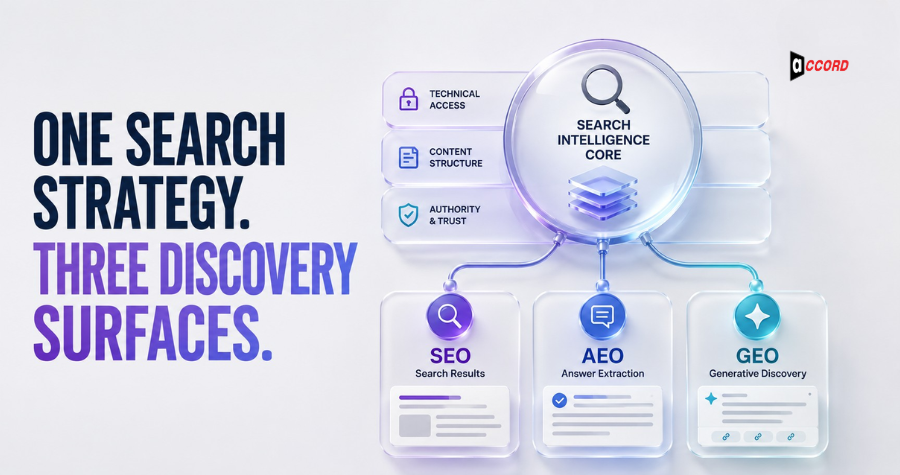
Quick answer: Most B2B companies need SEO, AEO, and GEO as connected practices—not three competing campaigns. SEO builds crawlable, relevant pages that can rank. AEO structures clear answers for question-led results and assistants. GEO improves the clarity, evidence, and entity signals that help generative systems understand and potentially cite a brand. None guarantees visibility.
Search has become a multi-surface discovery journey. A buyer may begin with a traditional Google query, read an AI-generated overview, ask ChatGPT or Perplexity for a shortlist, visit review sites, compare vendor pages, and then return through a branded search.
That behavior has created a crowded vocabulary. Agencies promote SEO, AEO, GEO, AI SEO, LLM optimization, and answer optimization as if each requires a separate content factory. For a B2B marketing leader, the labels can become more confusing than the buyer journey they are meant to describe.
The practical answer is simpler: build one authoritative information system that works for people, search engines, and answer-generating systems. The emphasis changes by surface, but the underlying work overlaps heavily—technical accessibility, search intent, strong content, verifiable claims, clear structure, trusted mentions, and a site that helps visitors take the next step.
This guide explains the distinctions, the shared foundation, and how Accord Tech Solutions would prioritize the work.
What is SEO?
Search engine optimization improves a website’s ability to be discovered, understood, indexed, and ranked in organic search results. It includes technical SEO, keyword and intent research, content, internal linking, page experience, structured data, local signals where relevant, digital authority, and performance measurement.
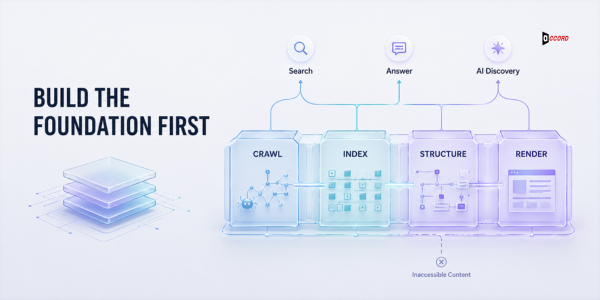
SEO remains the foundation because search and AI systems still need accessible pages and understandable information. If important content is blocked, duplicated, hidden behind broken rendering, or disconnected from the site architecture, adding an FAQ or mentioning “GEO” will not repair it.
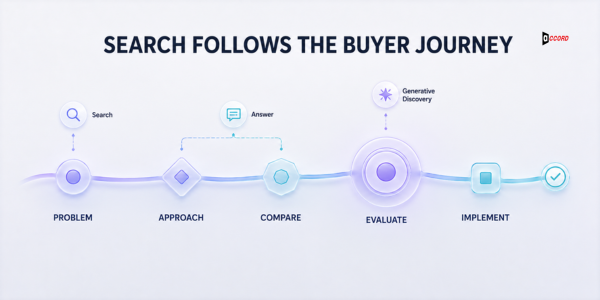
For a B2B company, SEO should connect queries to buyer tasks. Those tasks include identifying a problem, learning an approach, comparing options, evaluating vendors, validating expertise, and contacting a provider. The strategy therefore needs more than high-volume keywords. It needs commercial pages, decision content, technical documentation, examples, FAQs, and clear conversion paths.
What is AEO?
Answer engine optimization structures content so a system can identify a clear, accurate response to a specific question. It uses descriptive questions, concise answer-first passages, supporting explanation, logical headings, definitions, lists or tables where useful, and structured data that truthfully matches visible page content.
AEO is not the practice of writing hundreds of shallow FAQ pages. A useful answer needs enough context to be correct. For example, “How often should CRM data be cleaned?” has no universal date-based answer. A responsible passage explains that review frequency depends on field volatility, business risk, and workflow, then offers a practical decision rule.
Good AEO makes content easier for everyone to scan. A buyer can find the direct answer, then inspect the method, evidence, caveats, and next step. Search systems can isolate the passage without losing its meaning.
What is GEO?
Generative engine optimization improves how clearly AI search and answer systems can understand, retrieve, attribute, and potentially cite a brand’s information. It emphasizes factual clarity, source support, consistent entity information, expert context, original value, passage-level structure, and mentions across credible external sources.
GEO is an emerging practice rather than a single platform-controlled specification. Generative systems use different retrieval methods, models, indexes, partnerships, and citation behaviors. A tactic that changes visibility on one surface may not affect another.
That is why GEO claims require restraint. No agency can guarantee that a particular model will mention or cite a brand. The defensible goal is to make useful information accessible, unambiguous, evidence-backed, and connected to a recognizable entity across the web.
The term became widely discussed after academic work examined how content characteristics might influence visibility in generative responses. The useful lesson is not to manipulate prose for a model. It is to publish information worth retrieving and easy to verify.
SEO vs AEO vs GEO: the practical difference
SEO focuses primarily on organic search discovery, AEO on direct answer extraction, and GEO on visibility within generative responses. Their output surfaces differ, but their strongest tactics share a common base. Treat the terms as lenses for one search program rather than independent silos.
| Dimension | SEO | AEO | GEO |
|---|---|---|---|
| Primary surface | Organic search results | Featured answers, voice and answer systems | AI-generated answers and recommendations |
| Core user need | Find the right page | Get a direct answer | Synthesize and compare information |
| Content emphasis | Intent coverage and authority | Concise question-answer passages | Evidence, entities, attribution, and original value |
| Technical emphasis | Crawling, indexing, rendering, architecture | Structured content and valid schema | Retrieval accessibility and consistent machine-readable context |
| Primary measurement | Qualified organic visibility and conversions | Answer ownership and assisted journeys | Mention, citation, referral, and influenced demand trends |
| Guarantee possible? | No | No | No |
The table describes emphasis, not strict boundaries. A strong comparison page can rank traditionally, supply a concise answer, and become a useful source for an AI response. The same content asset can support all three when it is designed responsibly.
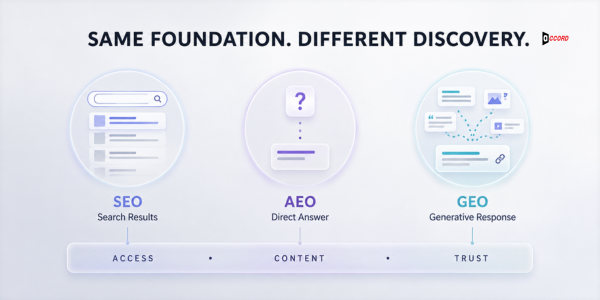
Build the shared technical foundation first
SEO, AEO, and GEO all depend on content that systems can access, render, interpret, and connect. Before creating new AI-focused content, check indexing controls, canonicalization, internal linking, JavaScript rendering, page templates, mobile usability, performance, sitemaps, structured data, and crawl paths.
Important checks include:
- Key content is available in meaningful HTML and not only after fragile interactions.
- robots directives and access controls match the organization’s policy.
- canonical tags identify the preferred page without hiding useful variants incorrectly.
- redirects, status codes, pagination, and duplicate URLs behave consistently.
- important pages receive descriptive internal links.
- structured data is valid and matches content users can see.
- author, organization, contact, and policy information is clear.
- pages load and function on common devices and connections.
Crawler access is a business decision. Different search and AI services publish their own controls, and those controls can change. Review current official documentation and align access with legal, security, content-licensing, and visibility goals.
Map questions to the complete buyer journey
A modern search strategy should cover the questions buyers ask from problem recognition through vendor validation. If a site publishes only broad educational posts, it may attract learners without helping serious prospects evaluate the company. If it publishes only sales pages, it may miss early discovery and comparison needs.
Organize topics into five groups:
- Problem: Why are our outbound replies falling?
- Approach: How does B2B data enrichment work?
- Comparison: Cold email versus email marketing—when should each be used?
- Evaluation: What should a lead generation provider verify?
- Implementation: How should enriched data map into the CRM?
Connect the groups through intentional internal links. Each article should state its primary question, provide a direct answer, explain the process, address limitations, and point to the next useful decision.
Write answer-first passages without becoming shallow
An answer-first passage gives the conclusion in a few sentences, then earns trust through explanation, examples, and evidence. This structure serves busy readers and makes the page easier to quote accurately, but it should not remove nuance from questions that require conditions or tradeoffs.
For every important H2:
- Phrase the heading as a real question or clear topic.
- Answer it directly in roughly one short paragraph.
- Define specialized terms when first used.
- Add a process, example, comparison, or decision rule.
- State limitations where the answer could be misapplied.
- Cite a primary or authoritative source for factual claims that need support.
Avoid burying the answer under a long story. Also avoid producing a page made only of isolated snippets. The surrounding depth is what makes a concise answer reliable.
Strengthen entity clarity and trust
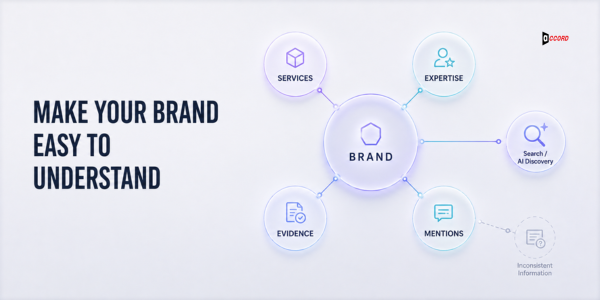
Entity clarity helps systems connect a brand name to its services, people, locations, evidence, and third-party references. Use consistent company information, accurate service descriptions, clear authorship, legitimate contact details, relevant organization schema, and corroboration from trustworthy external sources.
For Accord Tech Solutions, this means describing the business consistently as a B2B growth and technology partner across service pages, profiles, articles, and reputable directories. It also means avoiding old service descriptions or conflicting facts that create ambiguity.
Trust is not created by adding an “expert” label. Show how recommendations were produced, which sources support them, when the page was reviewed, and where facts remain uncertain. Publish original frameworks, checklists, observations, and responsibly documented case studies that give other writers a reason to reference the work.
Use schema as description, not decoration
Structured data helps machines interpret page entities and content types, but it must represent visible, truthful information and does not guarantee a special result. Choose schema types because they accurately describe the page, not because a plugin offers every possible markup option.
Common candidates include Organization, Article or BlogPosting, BreadcrumbList, Service, and FAQPage where the visible content and search-engine policies support their use. Connect authors and publishers consistently. Include dates that reflect actual publication and modification.
Validate markup, monitor search platform reports, and re-check after template changes. Do not mark up hidden reviews, fabricated ratings, or questions that users cannot see.
Measure visibility across search and AI surfaces
A combined program measures qualified discovery, citation or mention patterns, referral behavior, branded demand, and business outcomes. AI answers may not always send a click, so traditional traffic alone cannot describe the whole journey. At the same time, an isolated brand mention is not proof of revenue impact.
Build a measurement set that includes:
- Organic impressions, rankings, clicks, and qualified conversions by intent.
- Landing-page engagement and assisted conversion paths.
- Featured answer or rich-result visibility where observable.
- AI referrals identified in analytics when referral data is available.
- Repeatable prompt-set monitoring for relevant topics, with date, platform, and method recorded.
- Brand mentions and citations, including whether the information is accurate.
- Branded search demand and direct traffic trends.
- Sales feedback about how prospects discovered or validated the company.
Treat AI visibility monitoring as directional. Outputs can change by user, location, model, time, and prompt. Use a stable methodology and look for patterns instead of presenting one screenshot as a market share metric.
Which strategy should your B2B company prioritize?
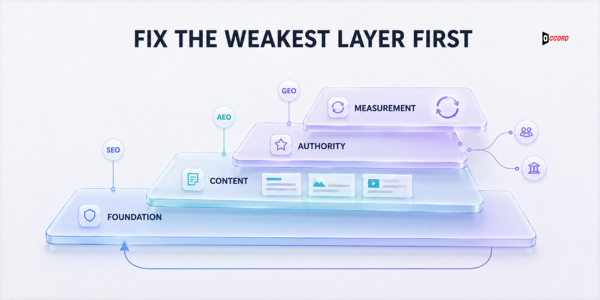
Prioritize the weakest layer that blocks the buyer journey, while maintaining the shared foundation. A site with indexing and architecture problems needs technical SEO first. A site that ranks but gives vague answers needs AEO-oriented restructuring. A credible site that is rarely associated with its category may need stronger entity signals, original research, and external authority for GEO.
A sensible order is:
- Technical accessibility and measurement.
- Clear service, audience, and entity information.
- Intent-led topic and page architecture.
- High-quality content with answer-first passages.
- Evidence, authorship, schema, and source maintenance.
- Credible external distribution and digital PR.
- Search and AI visibility monitoring tied to commercial outcomes.
Do not pause conventional SEO while waiting for a GEO experiment. The durable work usually benefits several surfaces at once.
How Accord Tech Solutions connects SEO, AEO, and GEO
Accord Tech Solutions approaches AI-era visibility as one connected search system. The work can include technical audits, keyword and intent analysis, content architecture, on-page and off-page SEO, local search where relevant, answer-first content, structured data, entity consistency, internal linking, and performance reporting.
Our SEO and AEO services focus on useful discovery and measurable business pathways rather than ranking or citation guarantees. Because visibility does not create revenue by itself, the strategy can also connect with web development, lead generation, email marketing, and social distribution.
The exact mix should follow evidence. Some companies need stronger commercial pages. Others need technical cleanup, clearer expertise, or a content refresh that removes contradictions. GEO should not become an excuse to publish more pages before fixing what already exists.
Frequently asked questions
Is GEO replacing SEO?
No. Generative discovery changes how people encounter information, but it still depends heavily on accessible content, clear topics, credible sources, and recognizable entities. GEO expands the visibility strategy; it does not remove the technical and content foundations associated with SEO.
Is AEO only for voice search?
No. AEO can support featured answers, search summaries, help systems, on-site search, assistants, and other question-led experiences. Its core practice—clear questions, concise answers, supporting context, and accurate structure—also improves usability for human readers.
Can schema make an AI platform cite our website?
No. Valid schema can clarify page meaning, but it does not force a search engine or AI system to display, mention, or cite a page. Content quality, relevance, accessibility, authority, system behavior, and many other factors influence retrieval and presentation.
How long does SEO, AEO, or GEO take?
There is no responsible universal timeline. Results depend on the current site, competition, technical issues, content quality, crawl and discovery cycles, brand authority, resources, and target market. Set milestones around implementation and leading indicators before expecting business outcomes.
How do we know whether AI answers mention our brand?
Create a documented set of representative prompts, test them on a consistent schedule, record platform and date, and assess mention accuracy and citation context. Combine this with analytics, branded-search trends, and sales-source feedback. Treat results as samples, not a complete view of every user’s output.
Build one search system for real buyer questions
SEO, AEO, and GEO are useful terms when they reveal different parts of the discovery journey. They become unhelpful when they produce separate strategies, duplicate pages, and competing dashboards.
Start with the buyer’s question. Publish the clearest responsible answer. Support it with evidence and useful depth. Make the page technically accessible and connect it to a trustworthy company entity. Then measure whether qualified people discover, understand, and act on the information.
If you need a grounded assessment of your current search and AI visibility, contact Accord Tech Solutions to discuss a prioritized SEO, AEO, and GEO roadmap.
Methodology and sources
This article synthesizes Accord Tech Solutions’ search service positioning with primary guidance and research. References include Google Search Central’s AI features and website guidance, Google’s structured data guidelines, the original Generative Engine Optimization research paper, and the Accord Tech Solutions SEO service.
Last reviewed: August 13, 2026.