
Quick Answer
Account research decides which companies are worth targeting and why. Lead generation turns that research into usable account and contact records for outreach, CRM import, and campaign execution. B2B teams need both. Without account research, lead generation becomes volume without fit. Without lead generation, research never becomes a sales-ready workflow.
A large list can look impressive and still fail. It may include companies outside the target market, contacts with weak buying relevance, stale emails, missing source links, and no clear reason for outreach. Sales then blames email copy, while the real problem sits earlier in the process: the account was never qualified well enough.
Good outreach starts before the first message is written. It starts with the account, the buyer role, the current context, and the reason the offer may matter.
What Is Account Research?
Account research is the process of evaluating companies before they enter a campaign. It looks at fit, context, signals, risks, exclusions, and buyer relevance. The goal is not to collect every possible detail. The goal is to answer a practical question: should this company receive sales or marketing attention for this offer now, later, or not at all?
Account research may review industry, geography, company size, business model, hiring activity, technology use, website maturity, content activity, funding or expansion news, product lines, and public buyer signals. It should also record source URLs and observation dates so the team can verify why a company was included.
For example, a company hiring several sales development representatives may have a stronger need for lead research, CRM data, outreach systems, and reporting than a company with no visible growth activity. But the signal should be treated carefully. Hiring suggests a possible need; it does not prove budget or purchase intent.
What Is Lead Generation?
Lead generation turns target accounts into reachable opportunities. It identifies relevant people, verifies contact details, enriches records, segments lists, and prepares data for outreach or CRM use. In a B2B service context, lead generation should not mean scraping random names. It should mean building a list that sales and marketing can actually use.
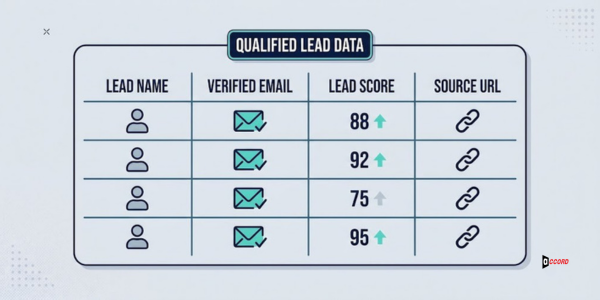
A useful record may include company name, domain, industry, location, employee range, contact name, title, department, seniority, business email, LinkedIn profile, source URL, ICP fit notes, segment, trigger, outreach angle, validation status, and last checked date.
The best lists are not only contactable. They are explainable. A salesperson should be able to see why the account fits, why the contact matters, and what problem the message should address.
Why Does The Difference Matter?
The difference matters because account research improves fit while lead generation improves reach. A team that skips research may produce more rows, but those rows create more sales waste. A team that researches deeply but never operationalizes the findings may produce useful notes that never reach the campaign.
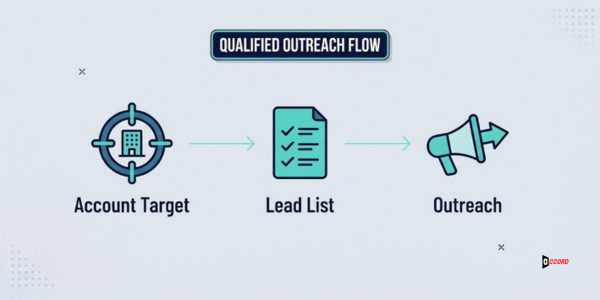
The strongest workflow combines both. Research defines the target market, account tiers, buyer roles, signals, exclusions, and messaging logic. Lead generation converts that strategy into clean, structured records. The outreach team then writes messages from evidence instead of guesswork.
This also improves measurement. When each lead has segment, source, and fit notes, the team can learn which account types produce useful conversations and which should be removed from future campaigns.
What Should Be Researched Before Outreach?
Start with account fit. Does the company match the industry, size, geography, business model, and service need? Then check timing. Is there a visible trigger, pressure, or change that makes the offer more relevant? Finally, check contact path. Can the right buyer, influencer, or technical evaluator be identified?
Important checks include:
- ICP match and exclusions.
- Service relevance.
- Company activity and recency.
- Buyer role and department.
- Source quality.
- Data confidence.
- CRM compatibility.
- Compliance or suppression concerns.
For SEO, AEO, and GEO planning, account research also reveals buyer language. Job descriptions, service pages, FAQs, and public company content show how prospects describe problems. Those phrases can shape blog headings, quick-answer sections, FAQs, service-page copy, and AI-search-friendly entity context.
How Should A Lead List Be Structured?
A lead list should be easy to filter, segment, verify, and import. Avoid single-column lists that contain only names and emails. Sales teams need context, and search/content teams can use the same context to shape topics and service pages.
Recommended fields include:
- Account name.
- Website and LinkedIn URL.
- Industry and company size range.
- Country or region.
- Contact name and title.
- Department and seniority.
- Business email and validation status.
- Source URL and last checked date.
- ICP fit notes.
- Signal or trigger.
- Segment and campaign name.
- Outreach angle.
- CRM owner or routing field.
The source URL and fit notes are especially important. They protect the team from treating guesses as facts and make later QA possible.
When Should Outreach Copy Be Written?
Write outreach copy after research and segmentation are complete. The research should shape the message. A SaaS founder, ecommerce manager, revenue operations leader, and marketing director should not all receive the same angle.
Personalization does not need to be long. It needs to be relevant. A short line based on a real account signal can work better than a generic compliment. The message should connect the observation to a reasonable business question, not claim private knowledge.
For example: "I noticed your team is hiring across several sales territories. When that happens, account data and routing rules often need review before outreach volume increases." That is more useful than "I loved your website."
How Does This Support Accord Tech Solutions' SEO, AEO, And GEO Work?
Account research and lead generation do not only support outbound. They help build a stronger information system. SEO needs pages that answer real buyer questions. AEO needs direct, well-structured answers. GEO needs consistent entity and service context that AI systems can interpret.
When Accord Tech Solutions creates content around lead generation, CRM enrichment, email marketing, SEO, AEO, and GEO content, web development, or social media marketing, the topics should come from real buyer decisions. Research helps identify those decisions and prevents content from becoming generic.
How Accord Tech Solutions Supports This Work
Accord Tech Solutions can support account research, lead generation, CRM data enrichment, contact validation, campaign-ready list building, and outreach preparation. The work can connect with cold email, email marketing, SEO/AEO/GEO content planning, website conversion, and social proof.
The goal is not to promise a fixed number of meetings or leads. The goal is to improve the quality of the inputs that make relevant sales conversations possible. To discuss a campaign-ready research workflow, contact Accord Tech Solutions.
What A Strong Account Research Brief Should Include
A good research brief is more than a target industry and a few job titles. It should define the campaign offer, the buying problem, the account filters, the exclusion rules, the evidence required before an account enters the list, and the way findings will be used by sales.
The brief should answer these questions before research starts:
- Which service is being promoted?
- Which buyer role owns the problem?
- Which companies are not a fit, even if they match the industry?
- Which public signals count as useful evidence?
- Which signals are weak and should be treated as notes only?
- Which fields must be verified before export?
- Which CRM fields will sales actually use?
This matters because vague research instructions create vague lists. If the researcher only knows the industry, the list may include companies that look similar from the outside but have very different needs. A software company selling to enterprise buyers does not need the same outreach angle as a small ecommerce brand trying to clean up product listings. A professional services firm with no visible lead capture path needs a different message from a company already running paid traffic to a strong landing page.
A research brief also protects campaign quality when several people work on the same project. Everyone should apply the same fit logic. If one researcher accepts companies because they are large and another accepts companies because they recently hired sales staff, the final list becomes inconsistent. Sales then sees mixed records and loses confidence.
How To Score Account Fit Without Pretending It Is Perfect
Account scoring is useful when it keeps judgment consistent. It becomes dangerous when it turns guesses into fake certainty. A simple scorecard can help, but each score should be based on visible evidence.
Useful scoring fields include:
- ICP match: Does the company match the agreed industry, size, geography, and model?
- Problem fit: Is there a reasonable reason the offer could matter?
- Trigger strength: Is there a recent signal such as hiring, expansion, new product activity, content push, or website change?
- Contact path: Can the right role be identified?
- Data confidence: Are the domain, source URL, title, and contact details current enough for outreach?
- Exclusion risk: Is there anything that makes the company unsuitable for this campaign?
Do not turn this into a heavy academic model. A three-level score is often enough: strong fit, possible fit, and reject. The notes field matters more than the number. Sales should be able to read the reason quickly and decide whether the outreach angle makes sense.
How Account Research Improves Cold Email Personalization
Personalization gets better when the research explains why the buyer should care. The best account notes do not say, "personalize this." They capture a real signal and suggest a reasonable angle.
For example:
- Signal: Company is hiring outbound sales roles.
- Possible angle: List quality, CRM routing, and outreach preparation may need review before volume increases.
- Safe email line: "I noticed your team is hiring for sales roles. When outreach volume grows, account data and routing rules usually need a quick check first."
That is specific without being creepy. It also avoids pretending to know internal numbers, budget, or priorities.
Another example:
- Signal: Company publishes blog content but has weak service-page CTAs.
- Possible angle: SEO traffic may not be connected to conversion paths.
- Safe email line: "Your team is already publishing useful content. One thing I would check is whether the related service pages give readers a clear next step."
This is where research, lead generation, website conversion, and SEO work together. The account note becomes the bridge between targeting and message relevance.
How To Avoid Compliance And Trust Problems
B2B outreach still needs basic compliance and respect. The FTC CAN-SPAM compliance guide notes that commercial email rules apply beyond bulk consumer campaigns, and Gmail sender guidelines include requirements around authentication, spam rates, sender identity, and unsubscribe handling. Production teams should verify the current legal and platform rules before launch.
At a workflow level, keep these safeguards in place:
- Use accurate sender identity and domain information.
- Do not use deceptive subject lines.
- Maintain suppression lists and opt-out handling.
- Separate cold outbound from subscribed lifecycle email.
- Keep source URLs for records added to a campaign.
- Do not scrape or use sensitive personal traits for targeting.
- Do not imply a relationship that does not exist.
- Keep claims modest and verifiable.
This is not only legal hygiene. It is brand protection. A poorly researched campaign can damage trust before a buyer even visits the website.
How Account Research Supports SEO, AEO, And GEO
Research does not stop at the spreadsheet. It also teaches the content team which questions buyers ask before they respond. If account research repeatedly finds companies with unclear service pages, that can become a blog topic, a checklist, a landing page, or a sales enablement asset.
For SEO, the research helps match topics to real buyer intent. For AEO, it gives question-shaped headings and direct answers. For GEO, it creates consistent language around the company, service category, buyer problem, and proof standard. Google Search Central guidance on helpful, reliable, people-first content says content should be useful for people first, not created only for search engines. Account research helps because it brings the writer closer to the buyer's actual context.
Measurement: How To Know The Research Is Working
Do not judge research quality only by list size. Track whether the campaign creates better conversations.
Useful review points include:
- Percentage of records rejected during QA.
- Bounce or invalid email rate.
- Number of contacts with complete source and fit notes.
- Segment-level reply quality.
- Sales feedback on account relevance.
- Objections repeated by a specific segment.
- Accounts moved to qualified follow-up.
- Content questions that appear during replies.
The purpose of measurement is not to prove that research alone created revenue. It is to identify whether targeting, segmentation, and context are improving. If one segment consistently produces poor replies, tighten the fit rules before writing more email copy.
Practical Workflow For Accord Tech Solutions Clients
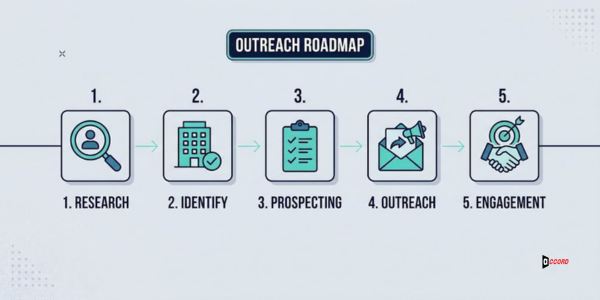
A clean workflow can look like this:
- Define the offer and buyer profile.
- Build account filters and exclusion rules.
- Research account fit and public signals.
- Identify buyer roles and contact paths.
- Verify contact details and source URLs.
- Segment records by problem and outreach angle.
- Prepare CRM import fields.
- Write segment-specific outreach.
- Connect outreach to a relevant service page, landing page, or blog.
- Review response quality and update the research rules.
This is the difference between a list and a system. A list is a file. A system improves each time the team learns which accounts, messages, and pages create useful buyer movement.
Frequently Asked Questions
Is Account Research Part Of Lead Generation?
It can be part of a lead generation workflow, but it has a different job. Account research checks fit, context, and timing. Lead generation prepares the contacts and structured data needed to act on that research.
What Makes A Lead List Good?
A good lead list includes accurate contact data, clear segmentation, source links, fit notes, validation status, and a reason each priority account belongs in the campaign.
Can Account Research Improve Email Replies?
It can improve relevance by helping the team contact better-fit accounts with stronger context. It cannot guarantee replies, because response depends on market, offer, timing, message quality, and follow-up.
Should Every Account Be Personalized?
Not every account needs deep individual research, but every segment should have a clear reason for the message. High-value accounts deserve deeper account-level context.
What Service Page Should This Blog Support?
This blog should support Accord Tech Solutions' lead generation service path, with related links to email marketing, CRM data enrichment, and SEO/AEO/GEO content where relevant.