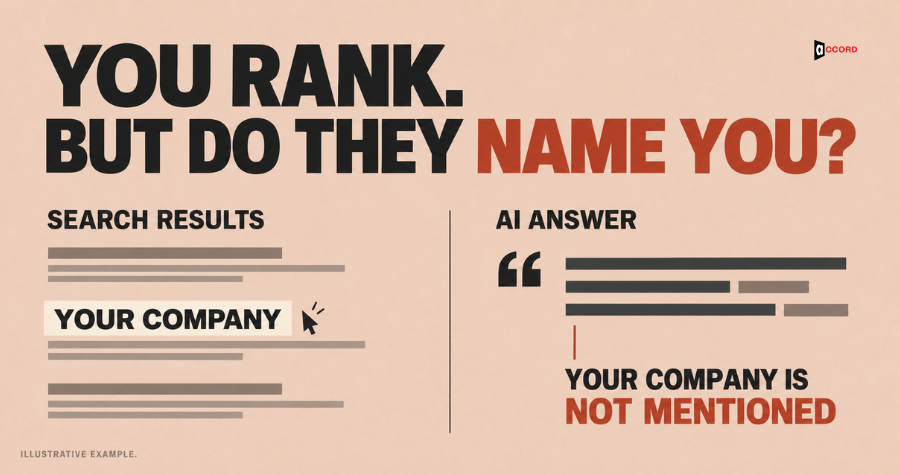
AEO vs SEO is not a contest between two separate programs. For most B2B companies in 2026, the practical plan is simple: keep the SEO work that still earns clicks, add three recurring AEO checks each month, and cut the tasks that do not change what AI tools say about your company. Search engine optimization (SEO) still decides which pages are crawled, ranked and clicked. Answer engine optimization (AEO) makes sure your pages are clear enough for AI assistants to quote, name and trust. This article explains how to split your monthly effort between the two, with a practical table, a sample month for a two-person team and answers to the questions buyers ask most often.
What is the difference between AEO and SEO?
SEO is the work of getting your pages found in search results. It covers crawlability, indexing, page speed, clear titles, internal links, topical depth and the quality of the pages you publish. Success is usually measured with rankings, impressions, clicks and the enquiries those clicks produce.
AEO is narrower and newer. It focuses on the moment an AI assistant or answer engine builds a reply to a question. The questions it asks are different. Is your company named in that reply? Is your explanation clear enough to quote? Do the facts about your company match across the sites the model reads? Success is harder to measure, because an AI answer can mention your company without sending a single click.
A simple way to hold both ideas together is this. SEO earns the right to be read. AEO makes sure what is read can be repeated accurately. You need both, but they answer different questions, so they need different checks. If you want a fuller definition with examples, read our explainer on what AEO is and how it works. The rest of this article assumes you already know the basic terms and want to decide what to do next month.
Does Google still need SEO if AI answers are growing?
Yes. Google describes its AI features, including AI Overviews and AI Mode, as built on the same SEO basics that cover the rest of Search. Pages still need to be indexed, accessible, useful and written for people. The Google AI features guidance is the place to check the current position, because details in this area change over time. Read the source directly rather than relying on a summary from a third party, including this article.
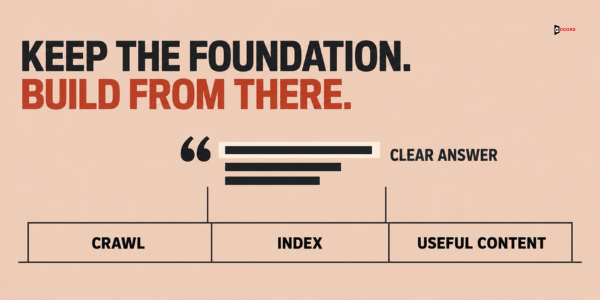
This matters for your budget. If the basics are weak, AEO work cannot repair them. A page that search engines cannot crawl or index is unlikely to be used as a source in an AI answer that draws on Search. A page with a confusing structure, a slow load and a vague title is also a poor candidate for a quotable answer. So the first rule of any monthly plan is to protect the SEO foundation, and then layer AEO work on top of it.
Which SEO work should you keep?
Keep any SEO work that still earns clicks, qualified visits or enquiries. You do not need to keep everything you did two years ago, but you should protect the core that brings in buyers. In most B2B teams that core includes five areas.
First, keep the technical health checks. Indexing errors, broken pages and mobile usability problems stop good content from being seen at all. A short check each month catches most of them before they cost traffic.
Second, keep the pages that already rank for the terms your buyers use. These pages have history, links and visits behind them. Updating them is usually cheaper than starting a new page on the same subject.
Third, keep the internal links between your service pages and your articles. Links help readers move through your site, and they help search engines understand which page is the main answer for each topic.
Fourth, keep titles and meta descriptions that match what the page actually delivers. A title that promises one thing and delivers another loses clicks and trust. Clear titles also help AI systems understand what a page is about, so the same discipline serves both goals.
Fifth, keep a steady refresh cycle for pages that have lost visits. Read the page, check whether the facts are still correct and improve the opening paragraph. Refresh the existing page rather than publishing a near-copy under a new address, because the original page already carries history that a new one would start without.
Keeping the basics also protects you from a quiet problem. Most teams that drop SEO work do so gradually, one skipped month at a time, and they only notice when visits fall. A short monthly list of these five areas makes any gap visible early, before it becomes a lost quarter.
Which three AEO checks should you add each month?
Add three recurring checks. Run them once a month on your most important pages, for example the ten to twenty pages that bring the most enquiries or search visits. Keep a short log of what you checked, what you found and what you changed. The log lets you see progress over time without relying on memory.
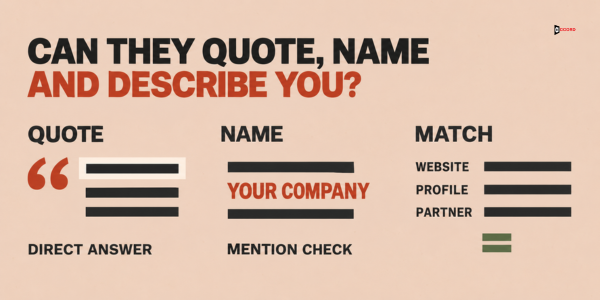
Check one: is the page quotable? An AI tool often lifts a short passage, not a whole article. Read the opening of each key page and ask whether the direct answer appears in the first two or three plain sentences. Does that answer name your service category and your audience in full, rather than relying on a clever phrase? Does the heading match the question a buyer would type into a search box? If the direct answer sits in the sixth paragraph, move it up. If a heading is a slogan, rewrite it as a question.
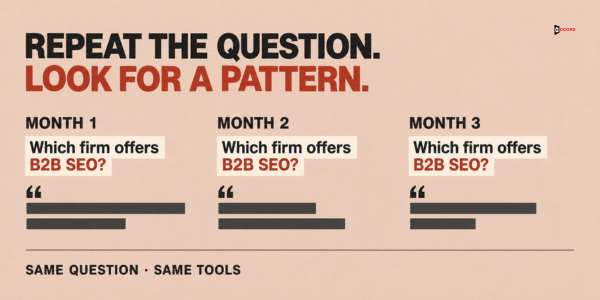
Check two: is the company named in AI answers? Choose a fixed set of five to ten questions your buyers ask, such as which firm handles a given service for a company of a certain size, or how to approach a particular problem. Put the same questions to the main AI assistants each month, and record three things: whether your company appears, how it is described, and which sources are named. Use the same wording every time so the results are comparable. Do not treat a single answer as a trend, because AI answers can vary from one run to the next. Look for patterns across several months instead.
Check three: is the claim consistent across the web? Models build a picture of a company from many sources, not only from your website. Compare your company name, service description, location, founding details and leadership names across your website, business directory profiles, social profiles and partner pages. If one profile says one thing and your site says another, an AI answer may repeat the wrong version. Fix the outlier first, because a single inconsistent source can undo good work on your own pages.
If you have never run these checks, the 30-minute AI visibility audit gives a simple starting list. Use it as a template for your first monthly log, then adjust the questions so they match what your buyers actually ask.
For each check, record the date, the exact question, the assistant you used and a short quote of the answer. A simple spreadsheet with those four columns is enough. Over several months the log becomes your best evidence about whether your changes are being noticed, and it shows which pages still need work before you spend budget somewhere else.
What should you cut from your current plan?
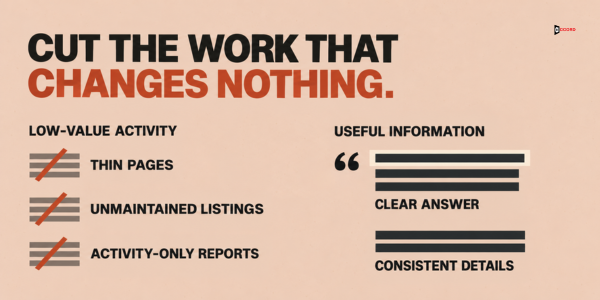
Cut work that does not change what buyers or AI tools can see. This is often the hardest decision, because cut tasks look productive. A long report with many charts feels like progress, and a new batch of pages feels like coverage. The test is simple: if a task does not improve a page, a profile or a claim that a buyer can read, it belongs on the cut list.
Typical candidates include creating many thin pages for near-identical phrases, publishing the same article in several small variations, creating directory listings that nobody maintains, and writing monthly reports that count tasks completed instead of pages improved. Each of these produces activity without giving search engines or AI tools a clearer answer to find.
Review the cut list each quarter rather than each week. Frequent changes make it hard to tell whether a task was ever given a fair chance, and a quarterly review gives results enough time to show. The table below sums up the plan across the main areas of work.
| Work area | Keep | Add | Cut |
|---|---|---|---|
| Technical health | Indexing and crawl checks, mobile usability fixes | Confirm the main answer on key pages is easy to find | Repeated audits that never lead to a fix |
| Core pages | Pages that already earn clicks or enquiries | Quotable opening answers on the top pages | Thin pages built around near-identical phrases |
| Headings and titles | Titles that match what the page delivers | Headings written as the questions buyers ask | Keyword-stuffed titles rewritten every month |
| Off-site profiles | Directory and partner profiles you already maintain | Consistency check of name, service and location | New listings that nobody updates |
| Measurement | Monthly search performance review | The same buyer questions put to AI tools each month | Activity counts with no link to outcomes |
Common mistakes
- Treating AEO as a separate site, a separate file or a separate team, rather than as a set of changes to the pages you already have.
- Rewriting every page at once instead of starting with the ten pages that matter most to your buyers.
- Checking AI answers once and making decisions from that single result.
- Updating the company description on one profile without checking the others.
- Dropping technical SEO checks because AI work feels newer and more interesting.
- Writing answers that are short but vague, with no named service, audience or location.
What does a sample month look like for a two-person team?
Imagine a fictional example: a two-person marketing team at a mid-sized B2B services firm. One person writes and edits content, and the other handles SEO, company profiles and reporting. This is a made-up scenario for illustration only, but the rhythm it shows is easy to copy.
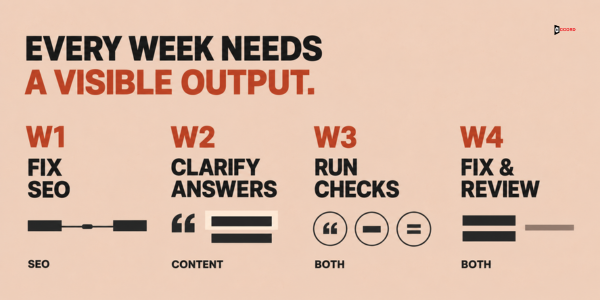
In week one, the SEO person reviews search performance for the top twenty pages, fixes any indexing or title problems and notes which pages lost visits. In week two, the content person rewrites the opening paragraphs of the five pages that bring the most enquiries, so each one answers its main question in plain sentences and uses the full name of the service. In week three, both people run the three AEO checks. They put the same set of buyer questions to the main AI assistants, record how the company is described, and compare the company profile across the website, directories and social pages. In week four, they fix any inconsistent profiles, remove two low-value tasks from the plan, and write a one-page summary for the business owner.
The point of this rhythm is not the volume of work. Each week ends with a visible output on a page, a profile or a claim. If a week ends with only a report and no change, the plan needs adjusting. The same structure also works for a team of any size, because the owner can see at a glance which of the three checks were completed and which pages changed. For a wider view of how this fits into a B2B marketing plan, read our article on SEO, AEO and GEO for B2B strategy.
FAQ: AEO vs SEO questions
Should we stop SEO work and focus only on AEO?
No. AEO builds on the SEO foundation. Pages that cannot be crawled, indexed or clearly understood are poor sources for AI answers. Keep the core SEO work that still earns clicks, then add the three monthly AEO checks on top of it.
How often should we check what AI tools say about our company?
Once a month is enough for most small teams. Use the same set of five to ten buyer questions each time, record the results in the same format, and look for patterns across several months rather than reacting to a single answer. Weekly checks usually produce noise, because the answers shift from run to run, and the time is better spent fixing the pages that the monthly check flags.
Do we need a special AEO file or markup before we start?
Start with the pages and profiles you already control. Fix clear openings, consistent company details and accurate titles first. Check the current AI features guidance from Google before you spend time on any new file format or technical addition, because advice in this area changes. Treat any new format as an extra step, not a replacement for clear pages and consistent company details.
What is the first step for a two-person team?
Pick the ten pages that bring the most enquiries, run the three AEO checks on them, and fix the openings and profile inconsistencies you find. Keep a one-page log of every monthly change so the next review starts from facts, not memory. Repeat the same routine for the next month, and only widen the scope once the first ten pages feel routine.
Next step
If you want an outside view of your own SEO and AEO plan, bring your list of top pages, your current search reports and the questions your buyers ask. Then book your 30-minute working session with the Accord team.