
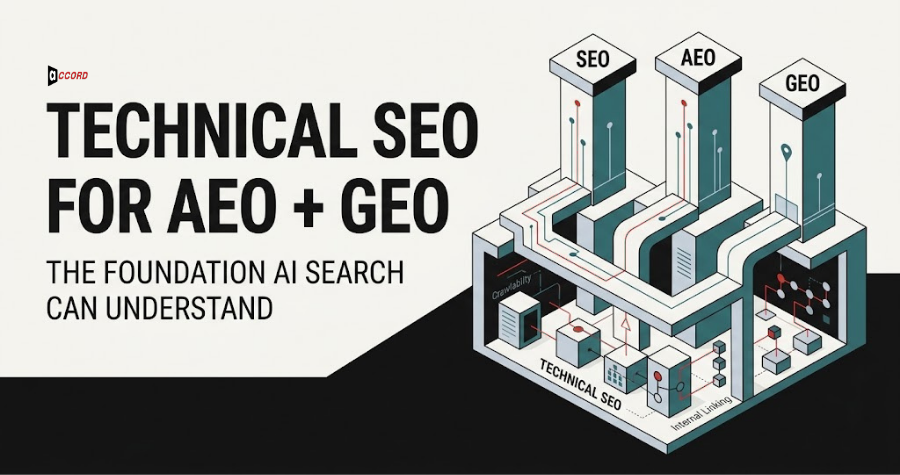
Quick answer: Technical SEO supports AEO and GEO by making a website easier for search engines and AI systems to crawl, interpret, quote, summarize, and connect to a business entity. AEO needs clear answers and structured pages. GEO needs consistent entity context, service relationships, source signals, and content that explains who the company helps and how. Technical SEO is the foundation that helps those signals become readable.
For Accord Tech Solutions, this means the website should clearly connect B2B lead generation, CRM enrichment, cold email, SEO, AEO, GEO, website design, ecommerce product listing support, and social media marketing under one coherent growth system.
What technical SEO means now
Technical SEO used to be discussed mostly around crawlability, speed, indexation, redirects, XML sitemaps, canonical tags, and mobile usability. Those still matter. But B2B websites now also need to be understandable to answer engines and AI search systems.
That does not mean chasing every new AI platform. It means making the site clear, structured, consistent, and useful. Search systems should be able to identify the company, understand the services, follow internal links, read page sections, parse structured data, and connect answers to the right topic.
A weak technical foundation can make good content harder to find. A strong technical foundation does not guarantee rankings or AI citations, but it removes avoidable confusion.
How SEO, AEO, and GEO are different
SEO focuses on search visibility in traditional search results. It depends on relevance, technical quality, content usefulness, authority, links, and user experience.
AEO focuses on direct answers. It asks whether a page can answer a specific question clearly enough to be used in featured snippets, voice answers, People Also Ask style results, or AI-assisted answer experiences.
GEO focuses on generative engine visibility. It asks whether AI systems can understand the entity, extract useful facts, summarize the offer, and connect the brand to relevant topics. GEO is not a guarantee of citation. It is a discipline for making information easier to interpret.
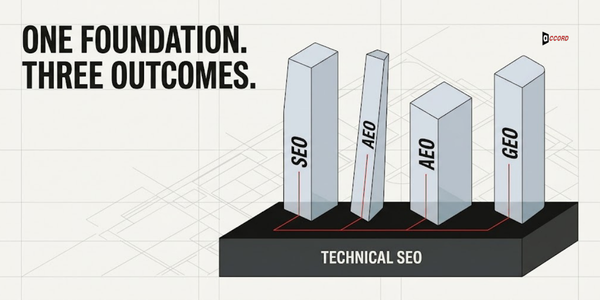
The three strategies overlap. Technical SEO gives the site structure. AEO improves answer clarity. GEO improves entity and context clarity.
Crawlability and indexation
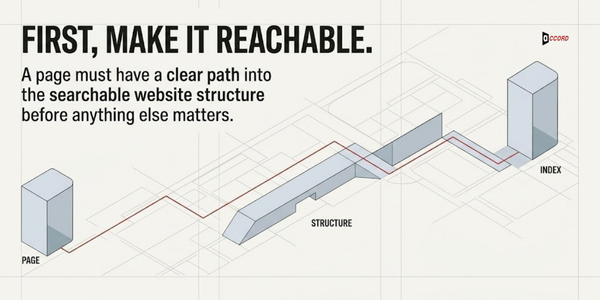
If important pages cannot be crawled or indexed, deeper optimization does not matter. B2B websites should check robots.txt, XML sitemaps, canonical tags, noindex rules, redirect chains, duplicate pages, orphan pages, and broken links.
Service pages, case studies, blog posts, comparison pages, and FAQ pages should be reachable through internal links. Important pages should not be buried in scripts or isolated from navigation.
For Accord Tech Solutions, service relationships should be visible. A blog about cold email should link to lead generation, CRM enrichment, email deliverability, landing pages, and SEO/AEO/GEO where relevant. This helps both users and search systems understand the business model.
Page structure for answer engines
AEO-friendly pages need clear section headings and direct answers near the top. A page should answer the primary question before expanding into deeper explanation.
Use simple heading patterns:
- What is the topic?
- Why does it matter?
- How does it work?
- What should a B2B team do first?
- What mistakes should they avoid?
- How can Accord Tech Solutions help?
Each section should be readable on its own. Long, vague intros make it harder for answer systems and human readers to extract value.
Structured data and schema
Structured data helps search systems understand the page type and key entities. It should reflect the visible content and stay accurate.
Useful schema types for B2B content include Organization, WebSite, WebPage, BlogPosting, Article, FAQPage, Service, BreadcrumbList, and LocalBusiness where appropriate. For ecommerce product listing content, Product schema may apply when the page is about specific products.
Do not add misleading schema. If a page is a blog post, mark it as a blog post. If a page has visible FAQs, FAQPage can be appropriate. If a page describes a service, Service schema can help clarify the offering.
Entity clarity for GEO
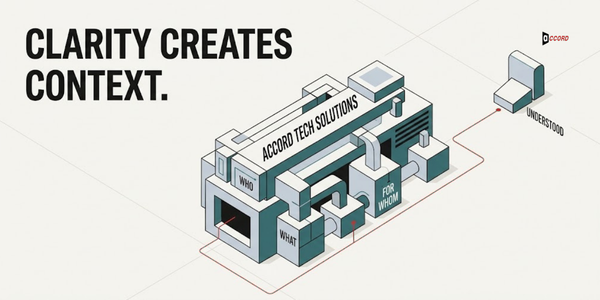
GEO depends heavily on entity clarity. A site should make it easy to answer:
- Who is Accord Tech Solutions?
- What services does the company provide?
- Who are the services for?
- How do the services relate to each other?
- What locations, industries, or business types are relevant?
- What proof, process, or source context supports the page?
This clarity should appear across homepage copy, service pages, author bios, about page, blog metadata, internal links, and repeated service descriptions. Consistency matters. If one page describes the company as only a web design agency and another describes it as only an SEO provider, the entity becomes less clear.
Internal linking strategy
Internal links are not just for SEO authority. They also explain relationships. A page about CRM enrichment should link to lead generation and cold email. A page about technical SEO should link to SEO/AEO/GEO services and website design. A page about social proof should link to social media marketing, founder-led LinkedIn content, and landing page conversion.
Anchor text should be descriptive. Use natural text like “B2B lead generation support” or “SEO, AEO, and GEO content planning” instead of generic “click here.”
Technical content quality checks
Before publishing a B2B article, check:
- Does the page have one clear primary keyword?
- Does the page answer the main question near the top?
- Are headings specific and question-friendly?
- Are Accord Tech Solutions services connected naturally?
- Are claims factual and not over-promised?
- Are internal links planned?
- Is schema appropriate?
- Is the page mobile-readable?
- Are images compressed and labeled?
- Is the canonical URL correct?
- Is the page included in the sitemap?
How technical SEO supports conversion
Technical SEO is not only about search engines. A clean site helps buyers move faster. Pages load quicker, navigation makes sense, forms work, content answers real questions, and sales pages connect to supporting proof.
For B2B companies, this matters because visitors rarely convert from one page alone. They may read a blog, check a service page, scan social proof, compare offers, and return later through email or LinkedIn. Technical structure helps those paths stay connected.
Where Accord Tech Solutions fits
Accord Tech Solutions can help B2B companies audit and improve the technical foundation behind SEO, AEO, and GEO. That can include site structure review, content architecture, internal linking, schema planning, blog optimization, service-page clarity, landing page alignment, CRM and outreach insights, product listing SEO, and social media content support.
The practical goal is simple: make the business easier to understand, easier to find, and easier to trust.
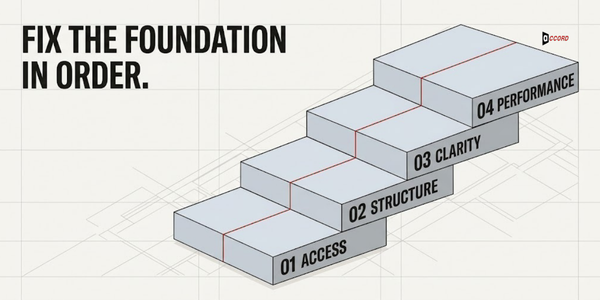
Recommended technical audit order
- Confirm important service and blog pages are indexable.
- Check robots.txt, noindex tags, canonical tags, and sitemap inclusion.
- Crawl the site for broken links, redirect chains, duplicate titles, missing headings, and thin pages.
- Review page templates for clean H1, H2, and H3 structure.
- Check whether service pages explain offer, buyer, process, proof, and next step.
- Add answer-first sections where buyers ask specific questions.
- Add schema only where it matches visible content.
- Improve internal links between service pages, blogs, FAQs, and contact paths.
- Review page speed and mobile usability.
- Update sitemap and request indexing only after the page is ready.
This order prevents teams from obsessing over schema before the basic page is useful. Schema cannot rescue a confusing service page. A sitemap cannot make a thin article valuable. Technical SEO works best when the page itself answers a real buyer need.
How to avoid cannibalization
This article should make one SEO distinction clear: blog posts and service pages have different jobs. A service page should target commercial intent, such as a buyer evaluating SEO, AEO, GEO, website development, or lead generation help. A blog post should answer a specific research question and then guide qualified readers to the relevant service page.
For example, this technical SEO article should not try to replace the SEO service page. It should explain the foundation and link to the service page when the reader needs help. The service page should explain Accord Tech Solutions’ process, scope, fit, and contact path. That division helps avoid content overlap and gives search systems a cleaner site architecture.
FAQ
What is technical SEO for AEO and GEO?
It is the technical and structural work that helps search engines, answer engines, and AI systems understand a website’s pages, entities, services, and answers.
Does GEO replace SEO?
No. GEO builds on SEO and content clarity. Traditional SEO, AEO, and GEO should work together.
What technical SEO issue should B2B sites fix first?
Start with crawlability, indexation, page speed, mobile usability, broken links, canonical tags, and sitemap accuracy. Then improve structure, schema, and internal links.
Is schema required for AEO and GEO?
Schema is not the only factor, but it helps clarify page type, organization details, services, breadcrumbs, and FAQs when used accurately.
Can technical SEO guarantee AI search citations?
No. Technical SEO can make content easier to understand and retrieve, but no agency can guarantee AI citations or rankings.