An SEO services agency should pivot to generative engine optimization (GEO) in 2026 by expanding its existing SEO work, not replacing it. Technical eligibility, useful original content, internal links, and authority still matter; the added GEO layer makes key passages easier for AI Overviews, AI Mode, and other answer engines to retrieve, understand, and cite.
Search visibility is no longer limited to a list of blue links. Google says AI Overviews had more than 1.5 billion monthly users by April 2025, while AI Mode now supports longer, more complex research journeys. For agencies and their clients, that changes the measurement question from “Where does this page rank?” to “Does this brand appear when an AI system assembles the answer?”
The shift affects traffic as well as visibility. In a 2025 analysis of 68,879 Google searches by 900 US adults, Pew Research Center found that users clicked a traditional result in 8% of visits when an AI summary appeared, compared with 15% when it did not. Only 1% of visits to pages with an AI summary produced a click on a cited source. Those figures do not mean organic search has stopped working. They mean rankings, citations, qualified visits, and conversions now need to be evaluated together.
What Is AI Search Optimization?
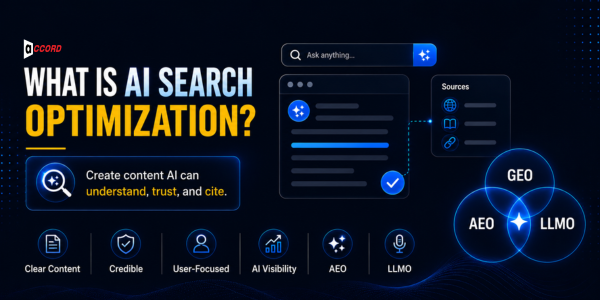
AI search optimization is the practice of making web content technically accessible, genuinely useful, and easy for search and answer systems to interpret. GEO, answer engine optimization (AEO), and large language model optimization (LLMO) are overlapping labels for this work; none removes the need for sound SEO.
The term generative engine optimization was formalized by Aggarwal and colleagues in research presented at KDD 2024. Their benchmark showed that some content changes could improve visibility in generative responses, with results varying by topic and method. That research established a useful field of study, but it did not create a universal formula or a guarantee of citations.
Google’s 2026 guidance is even more direct: from Google Search’s perspective, work described as AEO or GEO is still SEO. A page must be indexed and eligible to show with a snippet before it can appear as a supporting link in AI Overviews or AI Mode, and Google lists no separate technical requirement for inclusion. The practical takeaway is simple: preserve the SEO foundation and improve the quality, structure, and distinctiveness of the information built on top of it.
How Do Google AI Overviews and AI Mode Find Supporting Sources?
Google describes two important mechanisms: retrieval-augmented generation, which grounds responses in pages retrieved from the Search index, and query fan-out, which runs related searches across subtopics. A page therefore needs both conventional search eligibility and information that is useful for a specific part of a broader question.
AI Overviews provide a summary when Google’s systems decide that one adds value to the standard results. AI Mode is designed for more exploratory questions, comparisons, and follow-up queries. The two experiences may use different models and techniques, so the same set of sources will not appear every time.
This is why “write one paragraph and get quoted” is not a dependable strategy. A useful source normally combines several qualities:
- It is crawlable, indexed, and eligible to appear with a search snippet.
- It answers a defined question clearly without hiding the conclusion.
- It contributes original analysis, first-hand experience, or specific evidence.
- Its headings, links, text, images, and structured data agree with one another.
- Its claims are supported by sources a reader can inspect.
GEO vs. Traditional SEO: What Actually Changes?
Traditional SEO and GEO share the same foundation but emphasize different outcomes. SEO helps a page become discoverable and competitive in search results; GEO also evaluates whether the page’s information can support a generated answer. Strong programs optimize for both without treating either as a shortcut.
| Area | Traditional SEO emphasis | Added GEO emphasis |
|---|---|---|
| Discovery | Crawling, indexing, rankings, and snippets | Eligibility to be retrieved as a supporting source |
| Content | Search intent, depth, and keyword relevance | Direct answers, original evidence, and quotable passages |
| Structure | Titles, headings, internal links, and schema | Clear subtopic coverage that supports query fan-out |
| Authority | Reputation, helpful content, and relevant links | Consistent entities, attributable expertise, and verifiable sources |
| Measurement | Rankings, impressions, clicks, and conversions | AI citations, answer presence, referral quality, and assisted conversions |
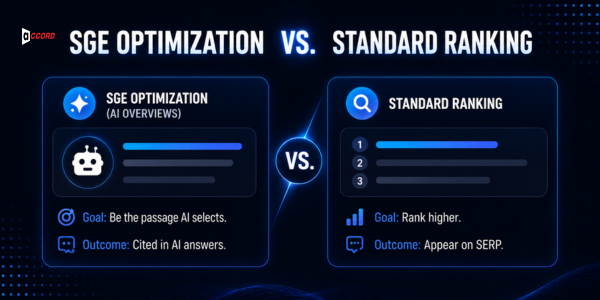
Keywords and backlinks have not become irrelevant. They still help search systems discover relevance and evaluate authority. What has changed is the cost of shallow execution. Repeating an exact phrase cannot compensate for a page that adds no information, and a ranking report alone cannot show whether AI-generated results are changing the journey to the site.
For a broader evaluation of agency capabilities, use this framework for choosing an SEO agency in the USA. It includes the proof, reporting, and AI-search questions a prospective client should ask.
Why Do Semantic Coverage and Entities Matter?
Semantic coverage helps a page explain a subject through its important concepts, people, products, organizations, and relationships. This gives readers a complete answer and creates relevant passages for the related searches an AI system may run during query fan-out.
Consider a page about project management software. Repeating that phrase does not explain how the product fits a buyer’s work. A useful page may need to cover task dependencies, Gantt charts, sprint planning, workload management, integrations, security, pricing, and the needs of different team sizes. Those connected concepts help a reader compare options and give a retrieval system more specific evidence to work with.
Entity coverage should remain natural. Adding names or subtopics only to look comprehensive creates clutter. Each section should answer a real follow-up question, clarify a relationship, or supply evidence that improves the reader’s decision.
A Seven-Step GEO Framework for SEO Services Agencies
A practical GEO program starts with technical eligibility, then improves original information, answer structure, topical coverage, corroboration, media, and measurement. The sequence matters because an excellent passage cannot be selected from a page that search systems cannot crawl or index.
1. Confirm Technical Eligibility
Check crawl access, indexability, canonical URLs, server responses, mobile rendering, internal links, and snippet controls. Google states that a supporting page for AI Overviews or AI Mode must be indexed and eligible to appear in Search with a snippet. Resolve that foundation before discussing special AI tactics.
2. Add Non-Commodity Information
Publish what a generic summary cannot supply: expert observations, original examples, tested workflows, comparison criteria, current product details, or clearly explained data. Google’s 2026 guidance specifically recommends unique, expert-led material that adds value beyond common knowledge.
3. Build Direct-Answer Sections
Use descriptive question-led headings when they match the search intent. Start each major section with a concise answer, then provide nuance, evidence, and examples. The goal is not to write robotic fragments; it is to make the main point easy for a reader and a retrieval system to locate.
4. Map Topics and Entities
List the important subtopics and relationships a qualified buyer needs to understand. Compare that map with the page and the wider site. Fill genuine gaps with useful sections or supporting pages, then connect them through descriptive internal links.
5. Support Claims and Keep Signals Consistent
Attach a source and year to material claims. Make sure the author, organization, service names, dates, and definitions are consistent across the article and the site. Structured data should describe visible content accurately; it should never invent reviews, ratings, people, or services.
6. Optimize Images and Structured Data
Use relevant images with descriptive filenames, accurate alternative text, real dimensions, and efficient loading. Apply supported structured data where it truthfully matches the page. Schema can clarify meaning, but it does not guarantee rankings, citations, or a special search display.
7. Measure Search and AI Visibility Together
Track Search Console impressions, clicks, landing-page conversions, and query groups alongside a repeatable set of AI prompts. Record the engine, location, date, cited URL, and answer context. Google currently includes traffic from its AI features within the Search Console Performance report’s Web search type, so a separate citation log is needed when the team wants answer-level detail.
Review the same prompt set on a schedule, but treat the results as observations rather than permanent rankings. Generated answers can vary by model, context, location, and time.
How Accord Tech Solutions Bridges SEO and GEO
Accord Tech Solutions combines technical SEO, content planning, on-page optimization, internal linking, structured data, and AI-search measurement in one workflow. The purpose is to improve conventional search performance while making important information clearer and more reusable across generated search experiences.
The work begins with the site’s current technical and content baseline. From there, the team identifies high-value questions, content gaps, evidence that only the business can provide, and related pages that should be connected. The delivery scope can include:
- Technical SEO and indexability checks
- Search-intent, topic, and entity mapping
- Expert-led content briefs and direct-answer editing
- Internal-link and structured-data implementation
- AI citation tracking alongside Search Console reporting
- Conversion-focused updates for service and B2B content
Explore Accord Tech Solutions’ SEO services for B2B growth in the USA, or review what the team has learned about what is ranking in Google AI search. Businesses that need a scoped plan can also contact Accord Tech Solutions.
Methodology and Sources
This guide was refined from the supplied draft and checked against Google’s current documentation for AI features and generative AI optimization, Alphabet’s reported AI Overview usage, the original GEO research, and Pew Research Center’s observed click-behavior study. Claims that treated GEO as a replacement for SEO or presented FAQ markup as a guaranteed visibility feature were corrected.
- Google’s guide to optimizing for generative AI features (2026)
- Google Search Central: AI features and your website (current guidance)
- Alphabet Q1 2025 earnings remarks (AI Overview usage)
- GEO: Generative Engine Optimization (KDD 2024)
- Pew Research Center’s Google AI summary click analysis (2025)
- Google Search documentation updates (FAQ rich-result change, 2026)
Last reviewed: August 9, 2026.
Frequently Asked Questions
These answers clarify what GEO changes, what remains part of SEO, how to prepare content for AI Overviews, and what FAQ markup can and cannot do in 2026.
What is generative engine optimization (GEO)?
Generative engine optimization is the practice of improving content so generative search and answer systems can retrieve, understand, and potentially cite it. It combines technical search eligibility with useful original information, clear structure, relevant topic coverage, and verifiable sources. GEO can improve readiness for AI search, but it cannot guarantee a citation.
Is GEO different from SEO?
GEO is best treated as an extension of SEO rather than a replacement. Google says its generative search features rely on core Search ranking and quality systems, and pages need standard indexing and snippet eligibility. GEO adds attention to generated-answer visibility, source citations, direct-answer passages, and broader subtopic coverage.
Do keywords and backlinks still matter for AI search?
Yes. Keywords still help define relevance, and reputable links can support discovery and authority. They work best as part of a complete program that also provides original information, clear explanations, sound technical SEO, and a useful page experience. Repetition or low-quality link volume is not a substitute for those fundamentals.
How do you optimize content for Google AI Overviews?
Start by making the page crawlable, indexed, and eligible for a search snippet. Add expert-led information, answer the main question clearly, cover relevant follow-up topics, use accurate internal links and structured data, and support material claims with sources. Google lists no separate technical requirement or guaranteed tactic for AI Overview inclusion.
Does FAQ schema improve AI visibility in 2026?
FAQ markup does not guarantee AI visibility. Google stopped showing FAQ rich results in Search on May 7, 2026, but a well-written visible FAQ can still help readers and provide a clear question-and-answer structure. Any FAQPage markup should match the visible answers exactly and should not be presented as a ranking or citation shortcut.
How should an SEO agency measure GEO results?
Measure standard search impressions, clicks, conversions, and indexed pages together with a fixed set of AI prompts. For each observation, record the engine, date, location, cited URL, and answer context. Compare trends over time, because generated answers can vary and should not be reported as permanent rankings.
Build Search Visibility for Both Journeys
The durable 2026 strategy is not SEO or GEO. It is technically sound, people-first SEO that also recognizes how generated answers retrieve and present information. Agencies that connect those two disciplines can report a fuller picture of visibility and build content that remains useful whether a buyer clicks a result, explores an AI answer, or does both.
Start with one high-value topic. Verify that the existing page is technically eligible, replace commodity explanations with first-hand value, make each section answer a real question, and measure both search performance and AI citations. Then use what the evidence shows to improve the next page.