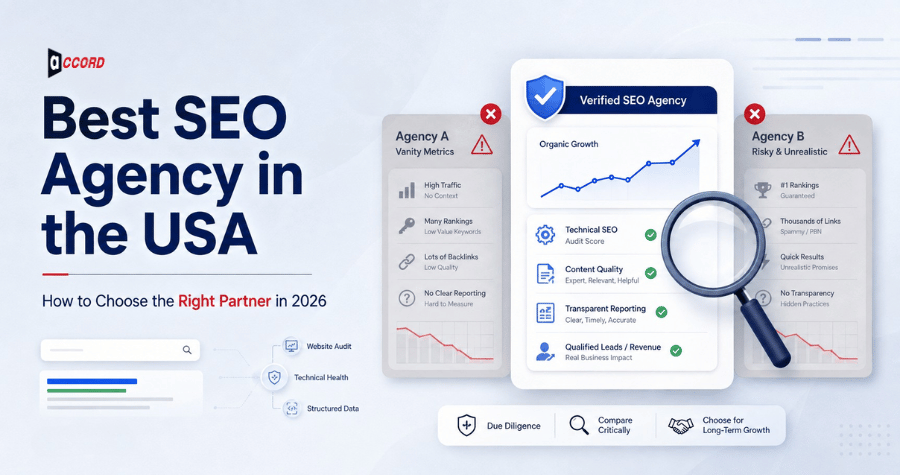
To choose the best SEO agency in the USA in 2026, check five things: whether the agency ranks for anything itself, whether its case studies name a starting point and a timeline, who actually does the daily work, how it earns links, and what it can show you in AI search results. Agencies that guarantee rankings fail all five.
Finding the best SEO agency in USA markets is harder than it looks. Type that phrase into Google and you get thousands of results, every one of them claiming to be number one. Award badges everywhere. Five-star reviews everywhere. Promises of first-page rankings everywhere. So how do you separate a genuinely good partner from a company that is simply good at marketing itself?
That question matters more in 2026 than it ever has. Search has changed. AI-generated answers now sit above most results, and the gap between agencies that understand this and agencies still selling 2019 tactics has never been wider.
This guide gives you a practical framework you can use before you sign anything. No hype, no scare tactics. If you want the broader view of service types and packages first, read our companion guide on how to choose the right SEO services in the USA. This piece is about vetting the partner.
Why does choosing the right SEO agency matter more in 2026?
It matters more because the margin for average work has disappeared. Only 1.74% of newly published pages reach Google's top 10 within a year, down from 5.7% in 2017 (Ahrefs). Meanwhile 72.9% of top-10 pages are more than three years old. A weak agency no longer produces slow results. It produces none.
A few years ago, a mediocre SEO agency could still move the needle. Publish some blog posts, build a few links, fix your title tags, and rankings would slowly climb. The bar was low enough that average work paid off.
That era is over. Ahrefs' ranking study found the share of new pages breaking into the top 10 inside twelve months fell to 1.74%, while the average number-one result is now about five years old (Ahrefs). Established pages hold their ground far longer than they used to, which means anything you publish has to be meaningfully better than what is already there, not merely present.
There is also a real risk factor. Bad SEO can hurt you. Spammy link building, thin content produced at scale, and manipulative tactics can trigger penalties that take months or years to recover from. Choosing poorly is not a neutral decision. It can set your business back.
The good news is that capable agencies stand out clearly once you know what to look for.
How has AI search changed what a good SEO agency looks like?
AI answers now absorb clicks that once reached websites. Pew Research Center found users click a result 8% of the time when an AI summary appears, versus 15% when it does not (Pew, July 2025). Ahrefs measured 58% lower click-through on AI Overview keywords (December 2025). Ranking no longer guarantees traffic.
This is the single biggest change to the job, and it is the fastest way to tell a current agency from an outdated one.
Pew Research Center tracked 68,879 real Google searches from a panel of US adults and found that when an AI summary appeared, the click rate on any result dropped from 15% to 8%. Only 1% of users clicked a source listed inside the AI summary itself (Pew Research Center, July 2025). Ahrefs, looking at keywords where AI Overviews appear, found the top-ranking page took a 58% lower click-through rate by December 2025, up from a 34.5% gap measured in April of that year (Ahrefs).
Read those numbers together and the implication is uncomfortable but simple. You can hold position one and still lose traffic. An agency that reports only on rankings is measuring something that has partly stopped paying.
The citation test most agencies quietly fail
Here is a number from our own work rather than a published study. In July 2026 we ran our AI-visibility tracker across 24 commercial queries in our service lines and checked which domains Google's AI Mode actually cited. Accord was cited in zero of them. Reddit was cited on 12 of the 24 queries, YouTube on 11, and Clutch on 7.
We publish that because it makes the point better than a success story would. Being cited by AI engines is a separate discipline from ranking, most agencies are not yet winning it, and the ones that claim otherwise should be asked for evidence. Our own reasoning on this sits in what is actually ranking in Google AI search.
So ask any agency you are considering a direct question: show me a query where a client of yours is cited in an AI Overview, in Perplexity, or in ChatGPT. An honest agency will either show you one or tell you plainly that it is early and describe what it is testing. An agency that answers with confident generalities about "AI SEO expertise" and no example is selling a label it has not earned.
What do the best SEO agencies do differently?
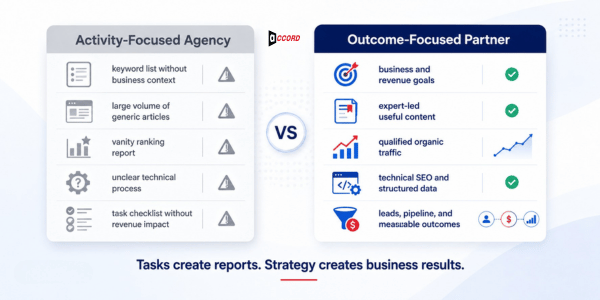
The strongest agencies share five habits: they start from your business model rather than a keyword list, they quote honest timelines of four to eight months, they treat content as a craft instead of a volume target, they employ people who genuinely understand technical SEO, and they report on qualified traffic and revenue rather than tasks completed.
They start with your business, not your keywords
Weak agencies ask for a keyword list and get to work. Strong agencies ask about your margins, your best customers, your sales cycle, and where revenue actually comes from. They want to know which products are worth ranking for and which are not. SEO that ignores business context might grow traffic, but it rarely grows revenue.
They are honest about timelines
Anyone who promises first-page rankings in thirty days is either lying or planning to use tactics that will eventually hurt you. A trustworthy agency will tell you that meaningful results usually take four to eight months depending on your industry, your starting point, and your competition. Ahrefs' data supports the caution: while about 41% of pages that do reach the top 10 got there within a month, the overwhelming majority of new pages never reach it at all inside a year. Honesty about that up front is one of the clearest signals of a good partner.
They treat content as a craft, not a commodity
In 2026, publishing large volumes of generic content is worse than publishing nothing. Search engines have become very good at recognizing material written to fill space rather than to help people. The best agencies invest in writers who understand your industry, interview your internal experts, and produce work your customers would actually want to read.
They understand technical SEO deeply
Site speed, crawlability, structured data, internal linking, and how your site handles JavaScript all affect rankings. Many agencies gloss over this because it is hard. The good ones have people who know how websites work under the hood and can talk to your developers in their own language.
They report on outcomes, not activity
A weak agency sends a monthly report listing tasks completed. A strong agency shows movement in qualified traffic, leads, and revenue attributed to organic search. Activity is easy to fake. Outcomes are not.
How do you evaluate an SEO agency step by step?
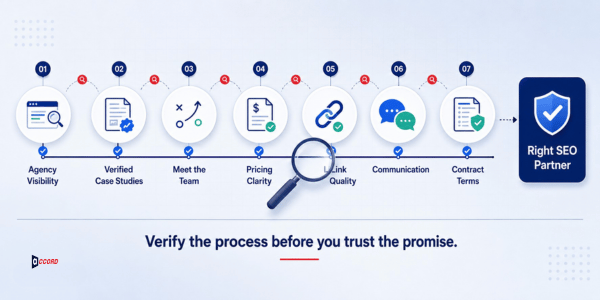
Run every candidate through seven checks: do they rank for anything themselves, do their case studies survive scrutiny, will you meet the people doing the work, how do they build links, how do they behave during the sales process, what do the contract terms say, and can they show real results in AI search.
Step 1: Check whether they practice what they preach
This is the simplest test available and most buyers skip it. Search for the services the agency claims to offer. Do they rank for anything themselves? An agency does not need position one for the most competitive terms in the industry, but if it has zero organic visibility for anything, ask why.
Look at their own website too. Is it fast? Is the content useful? An agency's own web presence is a preview of the work you will receive.
Step 2: Ask for relevant case studies, then verify them
Every agency has case studies. The question is whether they are relevant to you and whether they hold up under scrutiny.
Ask for examples from your industry or from businesses with a similar model. A local plumbing company and a national software firm need completely different strategies, and an agency that has only done one should not be your first choice for the other.
Then dig into the numbers. Ask what the starting point was, how long results took, and what specifically drove the improvement. A case study that says "traffic grew 300 percent" without context is marketing, not proof. Growing from 100 visits to 400 is a very different story from growing 50,000 to 200,000.
Step 3: Talk to the people who will actually do the work
Many agencies send their best salespeople to pitch meetings and then hand your account to a junior team you never met. Before signing, ask to speak with the strategist who will manage your work day to day. Ask them direct questions about your site. Their answers will tell you more than any pitch deck.
Four questions worth asking:
- Biggest opportunity on our site?
- What happens in the first ninety days?
- What would tell you something is failing?
- How do you handle Google updates?
You are not testing for perfect answers. You are testing for honesty, curiosity, and real thinking rather than a rehearsed script.
Step 4: Look closely at their link building approach
Links remain one of the strongest ranking factors, and they remain the area where agencies most often cause damage. Ask any agency to explain its link building process in plain language.
Good answers involve creating genuinely useful content, building relationships with relevant publications, digital PR, and earning mentions through original research or expertise. Bad answers involve guaranteed link quantities, private networks, or vague references to "partner sites." If an agency guarantees a specific number of links per month at a fixed price, those links are almost certainly bought from low-quality sources.
Step 5: Evaluate how they communicate before you are a client
How an agency treats you before you sign is the best behavior you will ever see from them. If they are slow to respond, vague in their answers, or pushy about closing now, expect worse once the contract is signed.
Pay attention to whether they listen. A good partner asks more questions than they answer in early conversations. An agency that arrives with a one-size-fits-all package before learning anything about you is selling a product, not a partnership.
Step 6: Check the contract terms carefully
Reasonable agencies offer contracts you can exit with thirty to sixty days notice after an initial period. Be cautious about anything that locks you in for twelve months with no exit clause. Long lock-ups often exist because the agency knows clients would leave if they could.
Also confirm that you own everything created for you. Your content, your data, your analytics access, and any tools built for your site should belong to you, not the agency. This sounds obvious, but plenty of businesses have learned the hard way that walking away meant losing years of work.
Step 7: Ask what they have actually done in AI search
Apply the citation test from earlier in this guide. Ask for one query where a client appears in an AI Overview, Perplexity, or ChatGPT, and ask what they did to get there. Ask how they measure it, because most agencies have no measurement in place at all. The answer to that single question separates agencies operating in 2026 from agencies operating in 2019.
How much should an SEO agency in the USA cost?
Ahrefs polled 439 SEO providers and found agencies charge an average of $3,209 per month, with 78.2% billing on monthly retainers. Small local programs commonly run $1,000 to $2,500 a month, mid-market $3,000 to $7,500, and competitive enterprise work above $10,000. The number matters far less than what the money buys.
SEO pricing in the American market varies enormously, and the headline figure tells you very little on its own. Ahrefs' survey of 439 SEO service providers put the average agency retainer at $3,209 per month, with most respondents billing monthly rather than hourly or per project (Ahrefs, SEO Pricing survey).
What matters is the breakdown. Ask directly:
- How many hours monthly on our account?
- Who works on it, at what seniority?
- Which deliverables are guaranteed?
- Where do the links come from?
Low entry pricing is not automatically a warning sign. A tightly scoped program for a small local site, covering a technical fix list, on-page work, and a modest content cadence, can be delivered honestly at a low monthly figure. What should worry you is low pricing attached to a broad promise. If an agency quotes a few hundred dollars a month and describes an unlimited scope covering content, technical work, and link building for a competitive national keyword set, the math does not support the promise, and the shortfall usually shows up as outsourced content or purchased links.
The useful question is not "is this cheap?" but "what specifically am I getting for this, and who is doing it?" For a fuller cost comparison, see our roundup of affordable SEO services agencies in the USA.
What is different about choosing a B2B SEO agency?
B2B changes three things: search volumes are far smaller but each keyword can carry a six-figure deal, sales cycles are long enough that attribution needs pipeline tracking rather than form fills, and your buyers are experts who detect shallow content immediately. Weight relevant B2B case studies more heavily than agency size.
If you sell to other businesses, your evaluation needs an extra layer. A B2B SEO agency USA based or otherwise faces challenges that consumer-focused agencies often do not understand.
B2B search volumes are smaller. The keywords that matter might get only a few hundred searches a month, but each one could represent a six-figure deal. An agency trained to chase high-volume consumer keywords will optimize for the wrong things entirely.
B2B sales cycles are longer, which makes attribution harder. Someone might read your blog post in March and become a customer in October after a dozen other touchpoints. Ask any B2B-focused agency how it measures success across long cycles and how it connects organic traffic to pipeline rather than just to form fills.
B2B content also demands genuine subject matter depth. Your buyers are experts. Content that reads like it came from twenty minutes of research damages your credibility rather than building it. The right agency will have a process for extracting knowledge from your internal experts and turning it into work that earns trust.
If B2B is your world, weight industry experience heavily. An agency with three relevant B2B case studies is usually a safer bet than a larger, flashier agency that mostly serves ecommerce brands.
Which red flags should end the conversation?
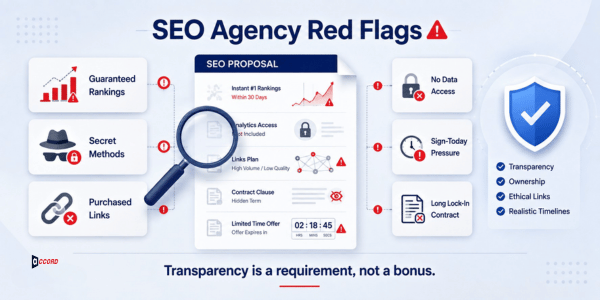
Seven warning signs should stop a deal outright: guaranteed rankings, claimed special access to Google, refusal to explain methods, withholding your own analytics, pressure to sign today, an unshareable portfolio, and reporting built on keywords nobody searches. One is a problem. Two or more means walking away.
- Guaranteed rankings or guaranteed timelines
- Claims of a special Google relationship
- Methods withheld as "proprietary"
- No access to your own analytics
- Pressure to sign today
- A portfolio they will not share
- Reports on keywords nobody searches
Add one more for 2026: an agency claiming AI search expertise that cannot show a single citation for itself or any client. Confidence is not evidence.
Any one of these is a problem. Two or more means you are looking at an agency that profits from client confusion.
What should you ask yourself before you sign?
Three questions decide whether SEO will work for you at all: are your timeline and budget expectations realistic, can you supply access, feedback, and subject matter input on a regular basis, and is your website in good enough technical shape to support the investment? An honest no here saves months.
Choosing the best SEO agency in USA markets for your situation is only half an evaluation of them. The other half is an honest evaluation of yourself.
Do you have realistic expectations about timelines and budget? Are you prepared to give the agency what it needs from your side, including analytics access, prompt feedback, and time with your internal experts? Is your website in good enough shape to support an SEO investment, or do you need design and development work first?
The businesses that get the most from SEO treat their agency as a partner rather than a vendor. They respond to requests, share business context, and stay engaged. If you plan to sign a contract and disappear, even the best agency will struggle to deliver.
How does Accord Tech Solutions approach SEO partnerships?
Accord Tech Solutions treats search as an infrastructure problem rather than a creative one, which means measurable inputs, documented methods, and client ownership of all data and content. Founded in 2012 and serving the US market for twelve years through a Wyoming LLC, the team publishes its own tracker methodology instead of asking clients to trust unverifiable claims.
Accord is an engineering-led B2B digital marketing agency working with US clients from a Dhaka base, operating in the States through a Wyoming LLC. The approach behind our SEO services for B2B growth in the USA follows the same logic this guide recommends you demand from anyone: channels are treated as systems that can be measured, debugged, and repeated, not campaigns that either work or do not.
In practice that means three commitments. Every engagement documents what is being done and why in language a non-specialist can audit. Every client owns their analytics, their content, and any asset built for them, with no exceptions and no hostage-taking on exit. And measurement covers AI search visibility alongside classic rankings, using the same tracker methodology whose unflattering baseline is published earlier in this guide.
We would rather show you a real starting number and the plan to move it than a testimonial. If you are running the seven-step framework above across a shortlist, you are welcome to run it against Accord's own SEO agency offering with the same scrutiny. That is the point of publishing the framework.
Methodology and sources
This guide combines published third-party research with Accord's own measurement. External figures come from named, dated studies: Ahrefs' SEO pricing survey of 439 SEO service providers, Ahrefs' ranking-timeline study and its December 2025 AI Overview click-through analysis, and Pew Research Center's July 2025 study of 68,879 Google searches drawn from a tracked US adult panel. The AI-citation figures for 24 commercial queries come from Accord's internal AI-visibility tracker, run on 6 July 2026 against Google AI Mode, and are published as measured, including the zero-citation baseline for our own domain.
The evaluation framework itself is drawn from patterns across agency selection processes rather than from any single client engagement. No client-specific performance numbers appear in this guide. Pricing bands describe general market ranges, not Accord's rate card.
Last reviewed: August 4, 2026.
Frequently asked questions
How much does it cost to hire an SEO agency in the USA?
Ahrefs' survey of 439 providers puts the average agency retainer at $3,209 per month. Small local programs often run $1,000 to $2,500, mid-market work $3,000 to $7,500, and competitive national campaigns above $10,000. Judge a quote by the hours, seniority, and deliverables behind it rather than by the number alone.
How long does SEO take to show results?
For most businesses, meaningful movement appears within four to eight months, compounding after that. Ahrefs found only 1.74% of new pages reach Google's top 10 within a year, and most top-10 pages are over three years old. Newer sites and competitive industries sit at the longer end. Promises of major results in weeks are a warning sign.
What is the difference between an SEO agency and a freelancer?
A freelancer is one person, which usually means lower cost but limited capacity and a narrower skill set. An agency gives you a team covering strategy, content, technical work, and link building. Freelancers suit small sites with simple needs. If your business depends heavily on organic traffic, a full team is usually worth the higher price.
Should I choose a local agency or work with one remotely?
Location matters far less than fit. SEO work happens online, and most agencies serve clients nationwide without meeting them in person. Choose on relevant experience, communication quality, and proven results rather than proximity. The exception is local search: if your revenue depends on it, confirm the agency has genuine local SEO experience wherever it is based.
How do I know if my current SEO agency is doing a good job?
Look at outcomes over six to twelve months. Is qualified organic traffic growing? Are leads or sales from search increasing? Do reports explain what was done and why in plain language? If reports only list tasks or rank obscure keywords, ask harder questions. A good agency welcomes that scrutiny rather than dodging it.
Should an SEO agency be able to show results in AI search?
They should at minimum be measuring it. Pew found clicks fall from 15% to 8% when an AI summary appears, so ranking alone no longer guarantees traffic. Ask for one query where a client is cited in an AI Overview, Perplexity, or ChatGPT. An honest "it is early, here is what we test" beats confident claims with no example.
Do B2B companies really need a specialized agency?
Not always, but it helps significantly. A B2B SEO agency understands small search volumes carrying high deal values, long sales cycles that break simple attribution, and the need for genuinely expert content. A generalist can succeed in B2B, but only with real case studies proving it. Ask for those before you commit.
Final thought
There is no single best agency, because the right partner for a national retailer is not the right partner for a regional law firm or a software startup. What exists is a best partner for you, and finding them takes patience and the right questions.
Talk to at least three agencies. Ask the uncomfortable questions about pricing, links, timelines, and AI citations. Verify case studies instead of taking them at face value. Trust the agency that tells you hard truths over the one that tells you what you want to hear. The right partner will not promise magic. They will promise a process, show evidence that the process works, and communicate honestly along the way. If you want to put that standard to work, start by comparing your shortlist against how Accord structures its SEO engagements.