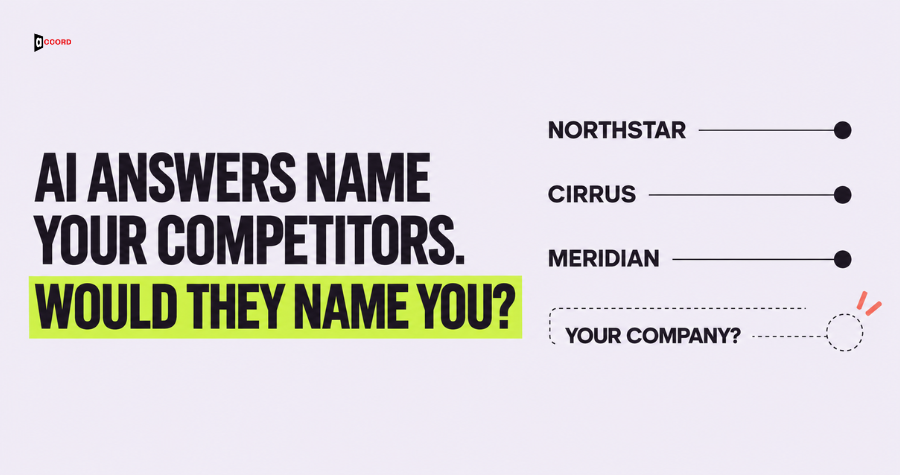
AEO for B2B means making your pages easy for AI tools to quote and name when a buyer asks a question about your category. SEO helps a page rank. AEO asks a second question: when ChatGPT, Perplexity, Gemini or Google AI Overviews write an answer, do they use your page and say your company's name?
This guide is the B2B version. It is written for services and SaaS companies that sell to other businesses. You will get a plain definition, a clear view of where AEO fits next to SEO, and an eight-point checklist you can run on any page in about ten minutes. If you want help running it, our SEO and AEO services cover the same work.
Why does AEO matter for a B2B company?
B2B buyers research alone before they talk to sales. Some of them now start with a question typed into an AI tool. The question might be "Which agencies help SaaS companies with outbound?" or "What should a managed IT contract for a law firm include?"
The tool writes one answer. That answer usually names only a few companies. A buyer can build a shortlist from it without opening a single website.
If your company is not named, you are not on that shortlist. That can happen even when your page ranks well in classic search. This is the problem AEO tries to fix.
AEO is not a new channel you must chase. It is the work of making the pages you already have clear enough to quote.
How is AEO different from SEO and GEO?
Think of three questions:
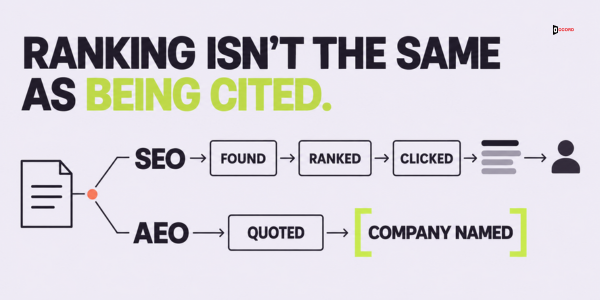
- SEO: Can this page rank and earn a click?
- AEO: When an AI tool writes the answer, does it use this page and name us?
- GEO: Generative engine optimization. Most people use it as another name for AEO.
Treat AEO and GEO as one job, not two projects.
The groundwork is shared. Google says the best practices for SEO remain relevant for AI features in Search. It also says there are no additional requirements to appear in AI Overviews or AI Mode (Google Search Central: AI features and your website). So AEO is not a replacement for SEO. It is a closer look at how clear and quotable each page is.
If you want the general definition first, read our guide to what AEO means. To see how SEO, AEO and GEO fit into one B2B plan, read SEO, AEO and GEO: a B2B strategy that fits together.
How do you score a page for AEO?
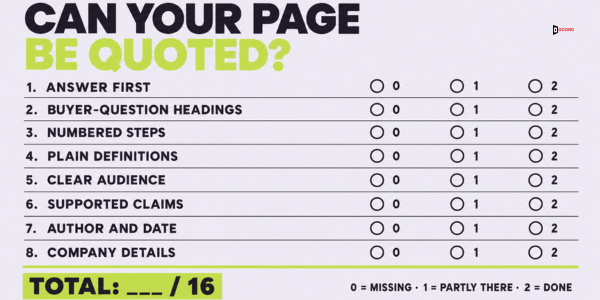
Score each of the eight checks below with one of three marks:
- 0: Missing.
- 1: Partly there.
- 2: Done.
The top score is 16. Treat any page under 11 as a page to fix first. That cut-off is our own working rule of thumb, not an industry standard. Its job is to help you compare your pages with each other and pick where to start.
Run the checklist on one page at a time. Start with the page that sells your main service.
The 8-point B2B citation checklist
1. Does the answer come first?
What it means: The first two to four sentences answer the main question of the page. There is no warm-up paragraph.
Pass test: Cover everything except the first paragraph. Does a reader still get the answer?
Fail sign: The first paragraph talks about "today's fast-changing market."
Example (fictional page, for illustration):
- Before: "In today's fast-paced legal world, technology sits at the heart of every successful practice."
- After: "Managed IT for law firms means one outside team runs your helpdesk, security and backups for a fixed monthly fee."
2. Do the headings match real buyer questions?
What it means: Your H2 headings read like what a buyer would type or ask out loud.
Pass test: Could a buyer paste each heading into an AI tool as a question?
Fail sign: Headings such as "Our Approach" and "Why Choose Us."
Example:
- Before: "Our Approach"
- After: "How much does managed IT cost for a 30-person law firm?"
3. Are steps and criteria numbered?
What it means: If a process has stages, number them. If a choice has criteria, list them.
Pass test: Can someone quote step three without rereading the whole page?
Fail sign: The process is one dense paragraph.
Example:
- Before: A paragraph that says onboarding "involves several stages including discovery and setup."
- After: A five-step list: discovery call, access review, setup, test, handover.
4. Is every key term defined once, in plain words?
What it means: If the page uses a term such as "fractional CMO" or "SOC 2 readiness," define it in one sentence the first time it appears.
Pass test: Would a smart reader outside your industry understand each term?
Fail sign: Jargon with no definition.
Example:
- Before: "We provide SOC 2 readiness."
- After: "SOC 2 readiness means preparing your company for an audit that checks how you protect customer data."
5. Does the page say clearly who you serve?
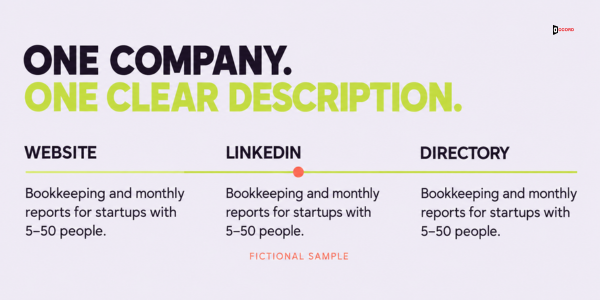
What it means: One sentence names your customer, your service and the result you are responsible for. The same sentence appears on your homepage, your LinkedIn page and your directory listings.
Why it matters: AI tools pull from many places. If each place describes you differently, the picture of your company is blurry.
Pass test: Open the three places side by side. Do they say the same thing in nearly the same words?
Fail sign: The homepage says "growth partner." LinkedIn says "digital agency." A directory says "marketing company."
Example:
- Before: "We are passionate about partnering with ambitious brands."
- After: "We do bookkeeping and monthly reports for startups with five to fifty people."
6. Are claims backed or labeled?
What it means: Numbers link to a source. Examples are labeled as examples. Claims you cannot support get cut.
Pass test: Can you point to a source for every number on the page?
Fail sign: "The leading provider" or "proven results" with nothing behind it.
Example:
- Before: "We deliver industry-leading results."
- After: Remove the claim, or replace it with a result you can show, with the date and the source.
7. Does the page show who wrote it and when?
What it means: The page has a named author or team, a visible updated date and an About page that explains the company.
Google's guidance on helpful content asks you to think about "Who, How and Why" behind your content. One of its questions is whether it is obvious to visitors who wrote the page (Google Search Central: creating helpful, reliable, people-first content).
Pass test: Can a visitor tell who wrote the page, when it was last reviewed and where to learn about the company?
Fail sign: No byline, no date, no link to an About page.
Example:
- Before: A page with no byline and no date.
- After: "By the Accord Tech Solutions team · Last reviewed October 2026."
8. Are your company details marked up?
What it means: Organization structured data states your legal name, logo, website and official profiles in a form machines can read.
Be honest about its limits. Google says you do not need special schema markup to appear in AI features. So this check will not earn a citation by itself. It is housekeeping. It removes doubt about who you are, and it supports check 5.
Pass test: Does the site have Organization markup that matches the visible text on the page?
Fail sign: No markup, or markup with an old company name or logo.
Example:
- Before: No Organization markup on the homepage.
- After: Markup with the company name, logo, website address and links to the official LinkedIn page.
Which pages should you check first?
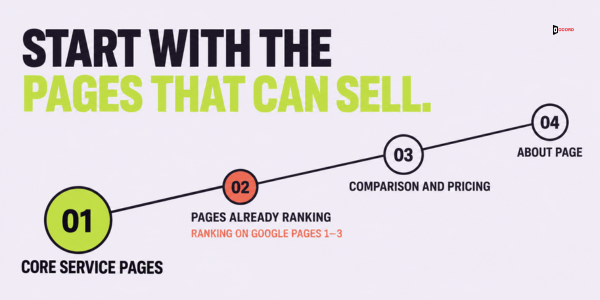
Do not start with the blog archive. Start where a citation is most likely to lead to a sales conversation:
- Service pages for your core offer.
- Pages that already rank on pages one to three of Google for a category question.
- Comparison and pricing pages. Buyers ask AI tools to compare options.
- Your About page. People and AI tools check it to see who you are.
Fix one page a week and score it again after each rewrite. In four weeks you have four stronger pages instead of four new thin ones.
Many of these fixes are technical as well as editorial. Our guide to technical SEO for AEO and GEO covers the technical side. For the writing side, see how to optimize content for AEO and featured snippets.
What should you do with your scores?
Sort your pages from the lowest score to the highest. Then look at the pattern.
- Low on checks 1 to 4: The page is hard to read. Fix the writing first: answer first, question headings, numbered steps, plain definitions.
- Low on checks 5 to 7: The page is unclear about who you are or why to trust you. Fix the company description, the sources and the byline.
- Low on check 8 only: Add the markup, but do not expect it to change much by itself.
Do the writing fixes before the technical ones. A page that is hard to quote stays hard to quote, whatever the markup says.
For harder technical problems, such as pages that are not indexed, look for the cause first. A page must be indexed and eligible to show with a snippet in Google Search before it can appear as a supporting link in AI Overviews.
What mistakes should you avoid when you run the checklist?
Four mistakes come up again and again.
Scoring generously. It is easy to give yourself a 2 because you know what the page means. Score it as a stranger would. If a reader has to guess, it is a 1 at best.
Rewriting every page at once. A big rewrite is slow, and you cannot tell which change helped. Fix one page, score it again, and then move to the next.
Chasing the tool instead of the page. Each AI tool works differently, and each can change without notice. A clear page that states who you are and what you do helps with all of them. A trick aimed at one tool does not last.
Stuffing the page with claims. Adding "leading" and "best" does not make a page easier to quote. A plain sentence with a source does. If you cannot back a claim, cut it.
Keep a short note of what you changed on each page and the date. When you check the AI tools next month, you will know which fix to look at.
How do you know if AEO is working?
No one can promise that a given AI tool will name you by a given date. AI answers change from one day to the next. You can still watch for signs.
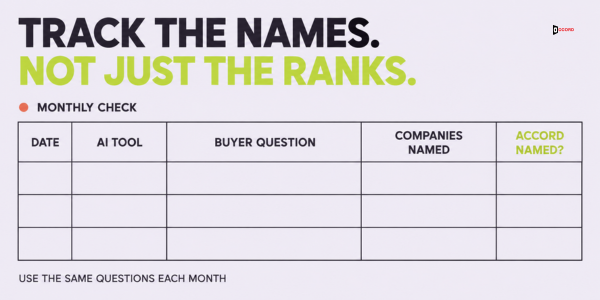
Once a month, do these four things:
- Ask three AI tools the same buyer questions. Write down who is named.
- Check Search Console for searches that include your company name.
- Check your analytics for visits that come from AI tools.
- Ask new prospects how they found you.
Use the same questions each month so the results are comparable. Give it a full quarter before you judge the trend. Small numbers at the start are normal.
FAQ
What is AEO for B2B, in one sentence?
AEO for B2B is making your pages clear and trustworthy enough that AI tools quote them and name your company when buyers ask questions about your category.
Do I need special markup or an AI text file for AEO?
Not for Google. Its guidance says you do not need new machine-readable files, AI text files or special markup to appear in AI Overviews or AI Mode, and there is no special schema to add. Clear pages matter more than extra files.
Is AEO replacing SEO for B2B companies?
No. Google says SEO best practices remain relevant for AI features in Search. Keep your SEO healthy, and treat AEO as a closer check on whether each page is easy to quote.
Can a small B2B firm show up next to big brands in AI answers?
It can happen, especially on narrow questions. A focused page that answers "managed IT for 30-person law firms" may fit that question better than a big brand's generic page. Nothing is certain, so aim your first rewrites at the narrow questions where you are the obvious specialist.
Next step
Want a second opinion on your checklist score? Book a 30-minute working session with the Accord team: book a 30-minute session on Calendly. Bring one service page and three questions your buyers ask. You will leave with the first two fixes to make on that page.