

Should you hire your own appointment setter or pay a provider to book first meetings? A 90-day outsourced pilot is often the lower-risk first step, because you can leave it, as long as the contract keeps the list and the sending accounts in your hands. In-house tends to fit better when meetings are frequent and steady, each one is worth a lot, and the sale is long with several buyers. If you do not know your own numbers yet, collect them before you pick either path. Below are six screening rules, a qualified meeting definition you can copy, one counting rule, and the contract questions to settle before you sign.
Our live guide on how to answer a positive cold email reply starts after a person has said yes (see the 24-hour booking checklist). This post comes earlier. It decides who finds the people and books the first meeting. In our reading, the pages now ranking for this topic mostly compare cost and speed, using the vendor's own numbers. Even Smartlead's comparison guide, one of the strongest we read, defines a held meeting but not a qualified one, and gives only general advice on who owns the list.
What is B2B appointment setting, and what does Accord sell?
B2B appointment setting is the work of finding the right person at a target company, starting a conversation, and booking a first meeting between that person and one of your salespeople. The person who does this work is called the setter. A setter does not close the sale.
Accord runs cold email campaigns aimed at booked meetings, with a weekly booked-call report in its Cold Outbound Engine package. It also sells lead generation, which means researching target companies and contacts. Accord's public pages do not list phone-based appointment setting as a service. We sell part of what this guide describes, so weigh our advice with that in mind.
A note on the numbers. The limits in this guide, such as 8 meetings a month, 3 and 10 times its cost, 90 days and 20 booked meetings, are Accord's own screening rules for a first answer. They are not industry benchmarks, and they do not replace real quotes, your own capacity and your management time. Every dollar figure in the Imagine example is invented. A price or claim from another company is labeled as that company's view, from a page we opened on 27 and 29 October 2026. The legal points come from the FTC page we read on 27 October 2026; check it, and ask a lawyer, before you rely on them.
How does B2B appointment setting work, in-house or outsourced?
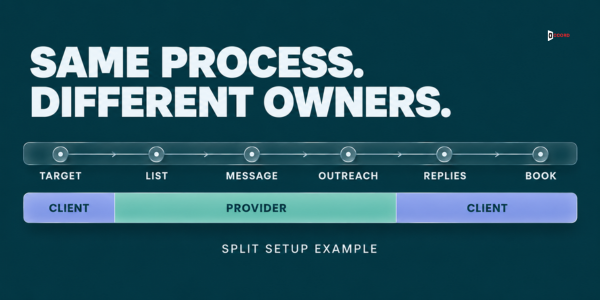
Both options run the same six steps. Only who does them, and whose accounts they use, differs.
- Agree on who to reach. Write the target customer description: industry, company size, job titles, and exclusions.
- Build the list. Someone researches the companies and contacts, either you or the provider.
- Write the messages. This means email copy, a phone script, or LinkedIn messages.
- Send and call. Messages go out from mailboxes (email accounts), phone lines or LinkedIn accounts, which can be yours or the provider's.
- Handle the replies. Someone reads each reply and sorts it: interested, question, not now, wrong person, or a request to stop.
- Book and report. The meeting goes on your salesperson's calendar, and a report shows what happened.
A common middle path is a split setup: the provider does steps two to four, and your own staff answer replies and run the meeting.
How do you choose between in-house and outsourced?
Use six rules as a first screen. Rules 1 to 3 each point toward in-house, toward outsourced, or give no vote. Rules 4 to 6 are checks that must pass under either option. Use your own numbers, not a vendor's.
| Rule | Points to in-house when | Points to outsourced when |
|---|---|---|
| 1. Volume: qualified meetings held per month | About 8 or more, month after month | Fewer than about 8 |
| 2. Meeting value: what one qualified meeting is worth, compared with what it costs | 10 times its cost or more | At least 3 times its cost, but under 10 times |
| 3. Sales cycle: days from first meeting to signed contract, and people in the decision | About 90 days or more, with three or more people | Under 90 days, with one or two people |
A rule gets no vote when its answer is unknown, such as volume for a program that has not started, or mixed. Rule 3 is mixed when its two parts disagree, such as 120 days with two people, and uneven volume is mixed too.
Rule 1: Volume. In-house points at about 8 or more qualified meetings held a month, and outsourced below 8. Below about 8, one setter's salary and overhead are spread thinly: at the $6,800 a month for one setter in the example below, 8 meetings cost $850 each ($6,800 divided by 8). A vote at 8 only says volume no longer argues against a hire, not that in-house is cheaper. Also work out the cost per qualified meeting held at your low, expected and high volume. If the cheaper option changes, volume is uneven.
Rule 2: Meeting value. Multiply your average first-year contract value by the share of qualified first meetings that become customers, using gross profit instead of revenue if you know it. Find the share from your last 20 qualified first meetings in your CRM (the tool where you keep records of people and deals), counting only meetings old enough to be won or lost. At 1 in 10 that is only about two wins, so treat it as a rough range. If you do not know your share, mark the rule unknown.
Compare the value with the cheaper option's cost per qualified meeting held. Minimum line: if one meeting is worth less than 3 times that cost, the margin is too thin to absorb a weak month, so work on the offer or the target list first. It applies to a steady month, not the ramp-up. Our reasoning for 10 times: a very valuable meeting justifies a person who learns your offer deeply.
Rule 3: Sales cycle. In your CRM, find the days from first meeting to signed contract for your last 10 won deals, and note how many people took part in each decision. If you cannot read both answers from your records, ask your sales lead for a best guess, or mark the rule unknown.
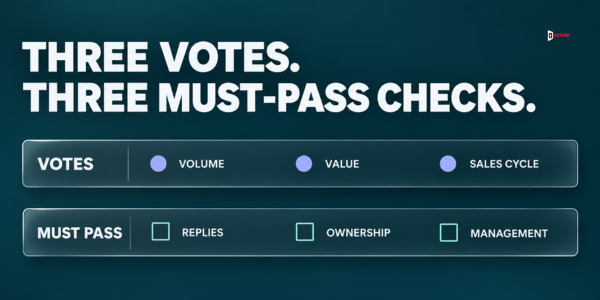
Rule 4: Replies (must pass). A yes only helps if someone answers fast. Test: name the person who reads the reply inbox, who covers when they are away, and the time limit for the first answer. Pass: one named person and one backup. Fix: if nobody is named, do not start.
Rule 5: List and account ownership (must pass). Test: could you end the contract in 30 days and leave with the target list, all replies, the message text and the sending accounts? Pass: yes, in writing. Fix: if the answer is no or "I do not know", ask for the terms before you pay, using the contract questions below. Our guide to checking outsourced lead research shows how to approve a list sample.
Rule 6: Capacity and management (must pass). Either option needs someone to brief, coach and check the work. An in-house hire also needs weeks of hiring and training before output is steady, and you must be able to pay through them. Test: name the person with a fixed weekly slot, then ask a new colleague to explain in two minutes who you help and why they should take a meeting. Pass: a name, a slot, and a clear explanation. Fix: with no name, wait. If the explanation is unclear, write a one-page brief of the target customer, problem, proof and exclusions.
How to read your answers. First check the minimum line in Rule 2. Then count the votes from rules 1 to 3.
- Two or more rules point to in-house: start in-house, with a founder or a part-time team member before you hire.
- Two or more rules point to outsourced: run a 90-day outsourced pilot.
- One or more rules unknown, and no pair of votes: you do not have enough information yet, which is not a case for outsourcing. Spend two to four weeks collecting your last 20 first meetings, your last 10 won deals, and two provider quotes that state what they count as a meeting. Then score again.
- All three known but split: compare real quotes with your own cost per qualified meeting held. If you still cannot choose, a short outsourced pilot is the easier one to leave.
Fix any of rules 4 to 6 that fails before you start either option. If real quotes, your capacity or your management time point the other way, trust them over this screen.
What is a qualified meeting, and how do you count meetings held?
"Meeting" can mean a time on a calendar, a call that took place, or a call with the right person. Use three separate terms.
A booked meeting is on both calendars, accepted by the person, and matches the target list. A held meeting took place: the named person joined, and the conversation lasted at least 15 minutes, which is our starting point. A qualified meeting is a held meeting that passes the written definition below. You can copy it and change the details.
A qualified meeting is a first conversation that took place and meets all four conditions. (1) The person works at a company that matches the written target customer description and is not on the exclusion list. (2) The person's role can decide the purchase, or strongly influence it, according to the role list in the brief. (3) The person said, in a call or reply, that they have the problem the offer addresses, or agreed to the meeting after reading what it covers. (4) The person is not a current customer, an open deal, a competitor, or someone who already had a qualified meeting with us in the past 90 days.
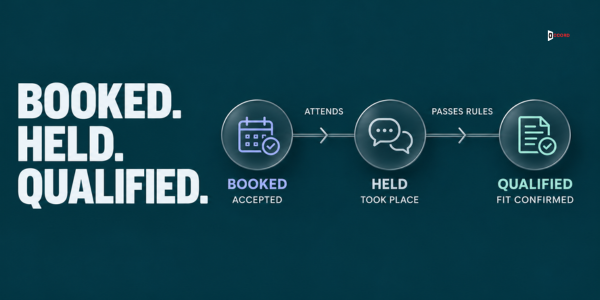
If the named person did not join, the meeting is booked but not held, even if a colleague joined. Settle in writing whether a named substitute may count.
One counting rule for every number. Put each meeting in the month it was booked. Follow that month's group for a fixed window, such as 30 days from the booking date. A meeting booked on 28 October and held on 12 November still belongs to October. Close the month's report when the window ends, and mark anything still ahead as "pending". Then use the same three rates everywhere, with the same top and bottom numbers:
show rate (also called meeting-held rate) = meetings held divided by meetings booked
qualified rate = qualified meetings divided by meetings held
cost per qualified meeting held = total cost of the option for that month divided by qualified meetings held from that month's group
Use "per qualified meeting held" for both options. Which option looks cheaper can change with the count, as the Imagine example shows. Small samples swing: with 20 booked meetings, one meeting moves the show rate by 5 points. We treat fewer than about 20 booked meetings in a month as too few to read the rates, which is our own reporting guideline and not a statistical rule. In that case, judge on the running total of all months so far.
Settle in writing: a meeting that is moved and then held counts once, and one person counts once in 90 days, even if two programs reached them. The salesperson who ran the meeting marks it in the CRM within one business day as held, no-show, moved or canceled, and qualified yes or no with a reason from a short fixed list. Use your CRM, not the provider's report, for payment.
What does each option really cost?
Count everything, not just the headline fee. For an in-house setter, include salary, payroll tax and benefits, the manager's time, list data, tools and hiring costs. For a provider, include the fee, setup fees, extra charges, and your own time for briefing and answering replies. Then divide by qualified meetings held. The FAQ below compares the three usual pricing models.
Do not set your plan from price ranges you find online. SalesRoads describes a pay-per-performance model at $15 to $100 per appointment set. Smartlead's guide cites a published outsourced range of $50 to $1,500 or more per booked meeting. These are vendor views that may count different things, so do not compare them with each other or with your own cost.
The same warning applies to break-even claims. Smartlead's guide puts the break-even at about 26 held meetings a month, but that rests on its own assumptions, including a $60,000 salary, $350 per booked outsourced meeting and a 25% no-show rate, and Smartlead sells outsourced services. It differs from our 8 because it measures where in-house cost falls below an outsourced price, while our 8 is only a rough point below which one setter's cost is spread thinly.
What should you check before you sign with a provider?
Put every answer in the contract or in an attached brief.
Who owns the list? Ask for the contact list, the research notes and every reply to be yours from day one, and handed over in a usable file when the contract ends. Accord's email marketing page says lists, domains, mailboxes and reporting live in the client's accounts.
Whose accounts send the messages? Ask whether messages go out from your own domains (the web addresses your email comes from) and mailboxes, or from the provider's. Sending reputation is the record mailbox providers keep of whether people want mail from an address, and if the provider's accounts built it, you leave without it.
Who answers replies? Get a written list of what the provider may say alone, such as meeting times, and what goes to you, such as price. How are stop requests handled? The FTC's guide to the CAN-SPAM Act, the US law on commercial email, says the law makes no exception for business-to-business email. An opt-out request, which is a request to stop receiving email, must be honored within 10 business days. The opt-out mechanism must keep working for at least 30 days after you send a message. You cannot contract away your legal responsibility, and both the company whose product is promoted and the company that sends the message can be held responsible (the FTC CAN-SPAM compliance guide). Ask how stop requests are recorded and checked. This is general information, not legal advice, and phone and LinkedIn messages have separate rules.

What triggers payment? Say whether you pay for booked meetings, held meetings or qualified meetings. Say who decides when you disagree, and what happens to a meeting your salesperson rejects, such as a replacement or a credit.
What are the term and the exit? Ask for the minimum length, the notice period, the fees to leave, what a setup fee covers, and the handover steps. Who staffs the program? Ask who the people are, whether work is passed to another firm, and whether they also work for your direct competitors. A refusal to answer in writing is itself an answer.
What should the weekly report show?
Ask for a sample report before you sign. For each meeting it should show the dates booked and held, the company, the person and role, the status, and the reason for any no-show or rejection. For the program it should show messages sent, replies, positive replies (from a real person, showing interest), stop requests, and meetings booked, held and qualified. Test: pick five meetings at random and compare the report with your CRM. Pass: all five match. Fix: correct the report before the next payment.
How can you start without a long commitment?
Run a 90-day pilot. If your rules point to in-house, start with a founder or a part-time team member before you hire. Otherwise run it outsourced, with a short term, the ownership rights above, and an exit. Before day one, write the target customer description, the qualified meeting definition, the counting rule and the report fields.
A month's group closes 30 days after its last booking, so not every booking made in the pilot is final at day 90. Review in three steps. At day 30, look at replies and booked meetings only, because no group has closed yet. At day 60 and day 90, judge the cost per qualified meeting held and the qualified rate on the groups that have closed. At day 90, make a first decision by comparing that cost with the value of a meeting from Rule 2, and judge on the running total if fewer than about 20 meetings have closed. Then hold a final review about 30 days after the last booking, once the final group has closed, to confirm or change the day-90 decision with the complete numbers.
Imagine: one steady month, two options
This example is invented, and every number is a sample. A company sells a service with an average first-year contract value of $40,000 and wins a deal from 1 in every 10 qualified meetings held, so one qualified meeting is worth $4,000 in revenue. The owner compares two options for one steady month, after setup. Each count is one month's group of booked meetings, read after its 30-day window.
Option A is two in-house setters. The monthly cost is $13,600: $9,000 in salary ($4,500 each), $1,800 in payroll tax and benefits, $1,600 for the manager's time, and $1,200 for list data, sending tools and CRM seats. Option B is a provider that charges $400 for each booked meeting that matches the target list: 32 meetings cost $12,800, plus $600 of your own staff time, which makes $13,400.
| Sample month | Option A: two setters | Option B: provider |
|---|---|---|
| Monthly cost | $13,600 | $13,400 |
| Booked meetings | 30 | 32 |
| Held (show rate) | 24 (80%) | 24 (75%) |
| Qualified (qualified rate) | 20 (83%) | 18 (75%) |
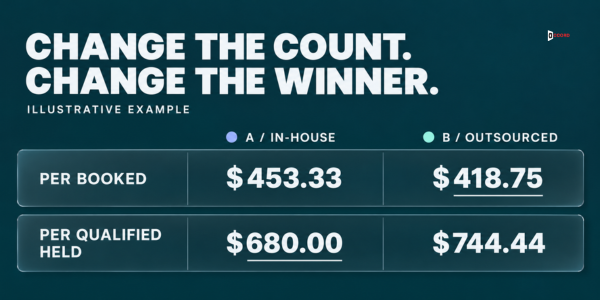
| Cost per booked meeting | $453.33 | $418.75 |
| Cost per held meeting | $566.67 | $558.33 |
| Cost per qualified meeting held | $680.00 | $744.44 |
Judged by booked or held meetings, B looks cheaper. Judged by the agreed measure, A is cheaper by $64.44. The ranking flips because the counts have different bottom numbers.
The gap is small next to the $4,000 value of one meeting, so the owner turns to the rules. Volume: 18 to 20 qualified meetings a month is above 8, so it points to in-house. Value: $4,000 is about 5.9 times $680 and 5.4 times $744.44, which clears the 3-times minimum line and, being under 10 times, points to outsourced. Sales cycle: 60 days with two people deciding points to outsourced. Two rules point to outsourced, and the three checks pass, so the owner runs an outsourced pilot and asks to pay for held meetings: 8 of the 32 booked meetings were not held, which would have cost $3,200 (8 times $400). At day 90, the owner decides again with real numbers.
Sensitivity note. This result is fragile. On salary, at $5,500 for each setter with all other costs unchanged, A would cost $16,000, or $800 per qualified meeting held, and B would be cheaper on every count. On margin, the example used revenue, and gross profit is the better base. At a 60% gross margin a meeting is worth $2,400, about 3.5 and 3.2 times the two costs, which passes. At 50% it is $2,000, about 2.9 and 2.7 times, under the line, and the owner would fix the offer or the list before starting. On ramp months, if Option A's two setters produce 24 qualified meetings in their first three months, those months cost $40,800 (3 times $13,600), or $1,700 per qualified meeting. The $4,000 value is only about 2.4 times that cost, under the minimum line, so budget ramp months separately.
Frequently asked questions
Is outsourced appointment setting cheaper than hiring in-house?
It depends on volume, the contract and what you count. At low volume a per-meeting price can cost less than a salary, and at steady high volume a salary can cost less. Compare your own cost per qualified meeting held.
What is the difference between an appointment setter and lead generation?
Lead generation finds people who might buy, for example by building a list. Appointment setting ends in a booked first meeting with a salesperson. Many providers do both, so ask what the price covers.
How many meetings should a setter book each month?
There is no reliable public figure, because the pages we read count different things. Our starting point is about 8 qualified meetings held a month, below which one setter's cost is spread thinly. Measure your own for two or three months, and judge on the running total if a month has fewer than about 20 booked meetings.
Should we pay per booked meeting, per held meeting or a monthly fee?
Paying per booked meeting is simple but leaves you carrying the cost of no-shows. Paying per qualified meeting held is closer to your goal but needs a clear definition. A fixed monthly fee, called a retainer, gives the provider stable income but less pressure to deliver.
Who should answer replies if we outsource?
Let the provider handle scheduling and plain facts. Send anything about price, scope or fit to a named person on your team, with a time limit for that handoff.
Does hiring a provider move legal responsibility for cold email to them?
No, it does not remove your own responsibility. The FTC guide to the CAN-SPAM Act says you cannot contract away your legal responsibility, and both the company whose product is promoted and the company that sends the message can be held responsible. This is general information, not legal advice.
Next step
If you would like a second pair of eyes on your own choice, book a 30-minute working session with the Accord team. Bring your last 20 first meetings from the CRM and any provider quote, and test the six rules together.