
When a positive cold email reply arrives, answer it the same business day with a short message that does one thing: answer the question that was asked, and offer two specific times for a call. This guide gives you a checklist for the first 24 hours, then the steps that follow once the call is booked, and two simple numbers that show whether your replies turn into real conversations.
What is the checklist for the first 24 hours?
The first day has one goal: move the person from "interested" to a time on both calendars. Work down this list in order. Each step is explained in the sections below.
| When | What to do |
|---|---|
| Hour zero, as the reply lands | One named owner sees the alert. If the person asks you to stop, remove them from every sequence before anything else. |
| Within your written reply limit | Read the reply twice, pick the kind of "yes", and write that group in your CRM, the tool where you keep records of people and deals. |
| Same business day | Send a short answer in the same thread. Answer the question that was asked, then offer two specific times, with the time zone. |
| Minutes after a time is picked | Send the calendar invite and a one-line confirmation in the thread. |
| By the next business day | If no time was picked, send one short follow-up. If a time was picked, check that the invite was accepted. |
Everything after the booking, such as reminders, no-shows, the handoff and reporting, comes in the "After booking" part of this guide.
What counts as a positive cold email reply?
A positive cold email reply is a message from a real person, written in response to your outreach, that shows some interest. It does not have to say "yes, let us meet". "Sounds interesting, can you tell me more?" is positive. So is "I am not the right person, but talk to Maria." Both deserve a thoughtful answer, but not the same one.
An automatic out-of-office message is not positive. A request to stop contact is not positive either, and it comes before everything else in this guide. If someone asks you to stop, remove them from every sequence, in every tool, before you do anything else.
This post starts after the yes. If you want help sorting all kinds of replies, including opt-outs, objections and automatic messages, read the Accord guide to cold email reply handling. That page covers the sorting workflow. This one covers one narrow job: getting a meeting booked and actually held after a person has shown interest. A positive reply is only the halfway point. Between the reply and a held meeting, people forget, get busy, pick a time that does not work, or never see the invite.
Who sees the reply, and how fast?
Hour zero: one person owns the reply. Before any reply arrives, decide who reads the inbox where replies land and who answers. If the answer is "whoever sees it first", two people will answer, or nobody will. Name one owner and one backup.
Set a reply time and write it down. Many guides quote response-time statistics, with figures such as five minutes or fifteen minutes. This guide does not repeat them, because we could not tie them to a primary study of cold email replies. What is safe to say is simple: a person who replied is thinking about your message now, and their interest fades as the day goes on. A written time limit also stops the reply from sitting in a shared inbox while everyone assumes someone else has it.
For a starting point, read the speed-to-lead guide on follow-up by trigger. It proposes one business hour for a positive cold email reply, and it shows how to set a clock, an owner and a backup for each type of trigger. That figure is a proposal from that post, not a rule from any mailbox provider. Choose a limit your team can really meet. A one-hour limit that is missed every week is worse than a four-hour limit that is always met. Turn on an alert in your sending tool too. The alert starts the clock. A human reply stops it.
First, what kind of yes is it?
Read the whole reply twice before you write a word. Then put it into one of five groups. The group decides the shape of your answer.
A clear yes. The person says they would like to talk, or asks when you are free. This one is easy, and the most common mistake is to make it hard by sending a long pitch.
A question first. The person wants one fact before they commit, such as what you charge or how a service works. Their question is the real message. Do not skip it.
"Send me info." This is the most misread reply. It may mean "I am curious". It may also mean "please leave me alone politely". Treat it as mild interest, not as a request for a meeting.
A referral. The person says someone else handles this, and may name them. They have done you a favour, so reply with thanks and handle the new contact with care.
Interested, but not now. The person gives you a time, such as "come back after the new year", or a reason, such as "we are in the middle of a project". This is a dated task, not a lost lead.
If you cannot tell which group a reply belongs to, do not guess. Ask one short question, or ask a second person to read it. A person who wrote "send me info" and then gets three calendar links in a row learns that nobody read their message. Write the group in your CRM before you send your answer. It takes ten seconds, and it makes your reporting honest later.
What does a good first answer look like?
Every good first answer follows the same three rules. Keep it short, answer the question that was asked, and end with one clear next step. Two or three short sentences are usually enough for a yes. Reply in the same email thread, so the person can see their own words and your original message. Do not repeat your pitch. They already read it, and they replied.
Here are example answers for each group. Adapt them, and do not copy them word for word. Change the names, the times and the details so each message sounds like it came from a person who read the reply.
For a clear yes. For example: "Thanks, Dana. Glad this was useful. Would Tuesday at 10:30 or Wednesday at 2:00 Eastern work for a 20-minute call? If neither suits you, tell me what does."
For a question first. For example: "Good question. Our monthly price is usually between [your lowest price] and [your usual upper price]. Three things move it: how many people you want to reach each month, how many mailboxes and domains that needs, and whether you want us to handle the replies too. If you tell me your rough monthly volume, I can send an exact figure today. Would Thursday at 11:00 or Friday at 9:30 work if you would rather talk it through?" Replace the brackets with your real range. If you cannot share a range, name the things that set the price, as above. Either way the person gets a real answer first, and the call is an offer, not a gate.
For "send me info". For example: "Of course. Here is a one-page summary: [link]. If it helps, I can also walk you through it in 15 minutes and show how it would look for your team. No pressure either way." The information comes first, which respects the request. The offer is small and optional. It does not push a calendar link at someone who only asked to read.
For a referral. For example: "Thank you, Sam, that helps. I will write to Maria now. May I mention that you suggested her, or would you rather I did not?" Ask before you name the person who referred you. Never imply that the new contact asked to hear from you if they did not. Then write to the new contact in a fresh, short message that is honest about how you got their name.
For interested, but not now. For example: "Understood, and thank you for telling me. I will write again in the first week of January. If anything changes before then, my door is open." Then put a real reminder in your CRM with the date. Do not move this person into a general sequence that may email them before the date they gave you.
These examples have three things in common. Each is under 70 words, answers the person's own words, and asks for one thing.
Should you offer two times or send a booking link?
Both work. Each has a cost.
Two specific times. You write: "Tuesday at 10:30 or Wednesday at 2:00." The person only has to say "Tuesday works". This is quick, personal and easy to answer from a phone. The cost is the back and forth if neither time fits, and the risk that someone else books a slot you offered before the person answers.
A booking link. You send a link to a page with your free times, such as one made with Calendly or the scheduling tool in your calendar. The person picks any slot, and the invite is created for you. This saves several messages and works across time zones. The cost is that a bare link can feel cold as a first answer, and some people do not click links from people they have not met. Accord sells outbound and email services, not scheduling software, so we have no stake in which tool you choose. We mention Calendly only because we use it ourselves.
For a first answer, a good middle path is to offer two times in your message and add a link as a backup: "If neither works, here are my other open times: [link]." The person can reply in one word or pick a slot alone. Neither path is wrong.
A few small settings make either method safer. Set a minimum notice time, so nobody books a call for twenty minutes from now when you are not ready. Google Calendar's appointment schedules, for example, have a minimum notice setting with a default of four hours, according to Google's own help page. Add a buffer between calls, so a late call does not push the next one. Write the time zone in your message, as "10:30 Eastern" and not "10:30".
If the person picks neither time and goes quiet, follow up once the next business day with a short note. If that gets no answer, try again about three days later, and then stop. This is a starting point, not a rule. One short cold email follow up after a reply is a service. Five in a week is pressure.
After booking: what should you do the moment a time is picked?
Send the calendar invite right away. Do not wait until the end of the day. A time that is agreed in writing but not on a calendar is easy to lose.
The invite is part of your reply, so give it care. Put both names in the title, such as "Dana and Priya: 20-minute call on cold email setup". Add one line to the description that says what the call is about. Include the video link or phone number, and the time zone. Add the person who will lead the call, even if that is not you. Then reply in the thread with a one-line confirmation that repeats the day, time and time zone and asks the person to tell you if anything looks wrong.
Keep the call short. A 20-minute or 30-minute first call is easier to say yes to than an hour. If the person asks you to include a colleague, add that person at once. A second person from the buyer's side is a good sign.
How do you cut the risk of a no-show?
A no-show is a meeting where the other person does not join and does not tell you. They are common, and most are not rude. People forget, a problem pops up on their side, or the invite sits unread. A little work after the booking cuts the number of no-shows.
One day before: a short reminder with a reason. Send a plain note that repeats the time, says where the link is, and asks if there is anything the person wants you to cover. This reminds, and it gives them a reason to think about the call. Many calendar tools send reminders for you, but check what the reminder says, because some cannot be edited. A personal note is usually warmer than an automatic one.
On the day: one more nudge. Send a very short message in the morning, or about an hour before, with the link again.
Make it easy to reschedule. Add a line to the invite or the reminder that tells the person to reply with a better time if this one no longer works. A rescheduled meeting is much better than a silent no-show, so make rescheduling easier than skipping.
If the person does not show up. As a starting point, wait ten minutes. Then send a kind, short message and offer a new time. For example: "Hi Dana, I think we missed each other. No problem at all. Would Thursday at 10:30 or Friday at 2:00 work instead?"
Do not scold, and do not write "I waited for you". Treat a no-show as a missed message, not as a refusal. Try once more the next business day, and once more three business days later if you have heard nothing. After that, mark the record "no-show, no reply" in your CRM and pause.
Should you ask questions before the call?
You may ask, but keep it small. Ask at most two questions before the call. Every question you ask is work for the other person, and a long form before a first call can turn a warm yes into silence.
Choose questions that change how you run the call, and that you could not find yourself. Good examples are "What would make this call a success for you?" and "Who else should join us?"
Do not ask questions you can answer with a short look at their website or profile. Do not ask about budget in the first message, because a stranger may not want to share it yet. That belongs in the call, once they trust you a little. Send the questions with the reminder, not in a separate message. If the person does not answer, run the call anyway.
How do you pass the context to the person who runs the call?
If the person who sent the cold email is not the person who runs the call, the handoff is where information goes missing. The buyer already explained what they want. If the next person asks the same questions again, the buyer will feel nobody listened.

Give the call owner a short note with five things.
- Who the person is, their role, and their company.
- Their exact words from the reply, copied and pasted.
- What you promised in your answers, such as a one-page summary or a price range.
- Anything the person said about timing, other people involved, or what they use today.
- The call time, the link and the answers to your pre-call questions.
Send it before the meeting, not after. The call owner should read it in two minutes and know where to start. If you made a promise that is not yet kept, put it at the top.
For a wider look at who owns each step between a lead, a reply and a held meeting, see the marketing-to-sales handoff guide. It names an owner for each move, even in a company with no dedicated operations role.
What should you record in the CRM?
If you do not write down what happened, you will repeat the same mistakes. Record these items for every positive cold email reply, in the same place each time.
First, the date and time the reply arrived, and the date and time of your answer. The gap between them is your real reply time. Second, the group you chose: clear yes, question first, send info, referral, or not now. Third, the next step you offered. Fourth, the status: time offered, meeting booked, meeting held, no-show, rescheduled, or closed, with a reason. Fifth, any promise you made and its due date.
Use a short list of fixed status words. If you write "booked", "scheduled" and "set up" for the same thing, your report will be wrong. Do not delete a record when a meeting fails. A closed record with a clear reason, such as "no reply to times offered", teaches you something. A deleted record teaches you nothing.
How do you measure whether replies become meetings?
Two numbers tell you most of what you need. They are simple, so define them in writing and use the same definitions every month.
First, fix the counting rule. A positive reply belongs to the month in which it arrived, and it stays in that month's group, called a cohort, even if the meeting is booked later. Then choose one observation window and keep it. As a starting point, our proposal is 30 days from the date of the reply. A reply that arrives on 28 October and books a call on 4 November counts in October's numbers. Close October's report once the window for its last reply has ended. Any meeting still in the future at that point is marked "pending" and left out of the meeting-held rate until it takes place or is cancelled.
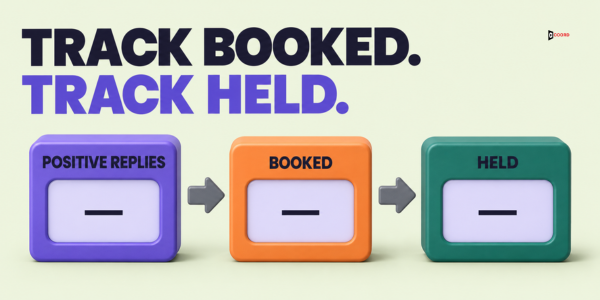
Reply-to-meeting rate. This is the share of positive replies that end in a booked meeting. The formula is: meetings booked within the window from that month's positive replies, divided by that month's positive replies, times 100. Use only human, positive replies as the bottom number. Do not count automatic replies or opt-outs. Count each person once.
Meeting-held rate. This is the share of booked meetings that took place. The formula is: meetings held, divided by meetings booked, times 100. A meeting that was moved and then held counts as one booked and one held. A meeting that never took place counts as booked but not held.
The two numbers answer different questions. A low reply-to-meeting rate points to the gap between the reply and the booking: check your reply time, your first answer and how you offer times. A low meeting-held rate points to the gap between the booking and the call: check your invite, your reminders and your no-show handling.
Do not set a goal from a number you saw in a blog post. Vendors publish figures for what share of replies become calls, and the figures vary a lot, and they rarely say how they counted. Measure your own for two or three months first, then set a small improvement target, such as five more points. Treat a month with fewer than about 20 positive replies as a rough guide only, because one or two people can swing a small number a long way.
Keep these two rates apart from "reply rate", which is the share of all emails sent that received a reply. Reply rate tells you about the outreach. These two tell you about what you did next. If positive replies are rare in the first place, the problem is earlier, and five checks to improve cold email deliverability is the place to start.
Imagine: 40 positive replies in one month
This example is invented, and the numbers are simple on purpose. Imagine a small software company that sends cold email to operations managers. In one month it receives 40 positive replies from people. It counts them as one cohort and follows each reply for 30 days.
Of those 40, 28 book a meeting. The reply-to-meeting rate is 28 divided by 40, which is 70%. Of the 28 meetings, 21 are held. The meeting-held rate is 21 divided by 28, which is 75%. So 21 held meetings came from 40 positive replies.
The team looks at the 12 replies that did not book a meeting. Five people never answered the two times offered. Four asked for information and went quiet after the summary. Three said "not now". It also looks at the seven meetings that were not held. Four people had not seen the invite, two asked to move and nobody followed up, and one cancelled.
The team makes four small changes. It offers two times in the first answer and adds a booking link as a backup. It follows up once, on the next business day, when nobody picks a time. It sends a personal reminder the day before each call. And it answers any reschedule request the same business day.
The next month's cohort is again 40 positive replies, measured with the same 30-day window. This time 32 book a meeting, so the reply-to-meeting rate is 80%. Of those 32, 27 are held, so the meeting-held rate is about 84%. That is 27 held meetings from 40 positive replies, against 21 before. The company did not increase its initial outreach volume. It added a reminder and a follow-up after the reply, and it handled the same number of replies with more care. Real results will differ. The point is the method: count the leaks, find where they happen, and fix the largest one.
Frequently asked questions
How soon should we answer a positive cold email reply?
Answer the same business day, and sooner if your team can manage it. Pick a time limit you can actually meet, write it down, and name an owner and a backup. The speed-to-lead guide proposes one business hour as a starting point.
Should the first answer include a calendar link?
Often times first and a link second. Two specific times feel personal and are quick to answer. A link saves back and forth and helps across time zones. If the person only asked for information, send the information first.
What if the person says "send me info" and nothing else?
Treat it as mild interest. Send the information in a short reply, then make one small, optional offer, such as a 15-minute walk-through. If the person does not reply, follow up once after a few business days and then pause.
How many follow-ups are too many after a positive reply?
There is no official rule. As a starting point, follow up once after one business day, once more about three days later, and then stop. Stop sooner if the person asks you to. Always honour a request to stop at once.
What should we do if the person does not show up to the call?
Wait about ten minutes, then send a kind, short message with a new time. Do not scold or write "I waited for you". Try once more the next business day and once more about three business days later. After that, mark the record "no-show, no reply" in your CRM and pause.
Which month do we count a positive reply in if the meeting is booked later?
Count it in the month the reply arrived. Keep each month's replies as one group, and follow that group for a fixed window, such as 30 days from each reply, which is our proposal. A reply from 28 October that books a call on 4 November still counts in October. Meetings still in the future when you close the report are marked "pending".
Next step
If you would like a second pair of eyes on your reply process, book a 30-minute working session with the Accord team. Bring three real positive replies and the answers you sent, and use the time to check the first answer, the offer of times and the handoff together.