
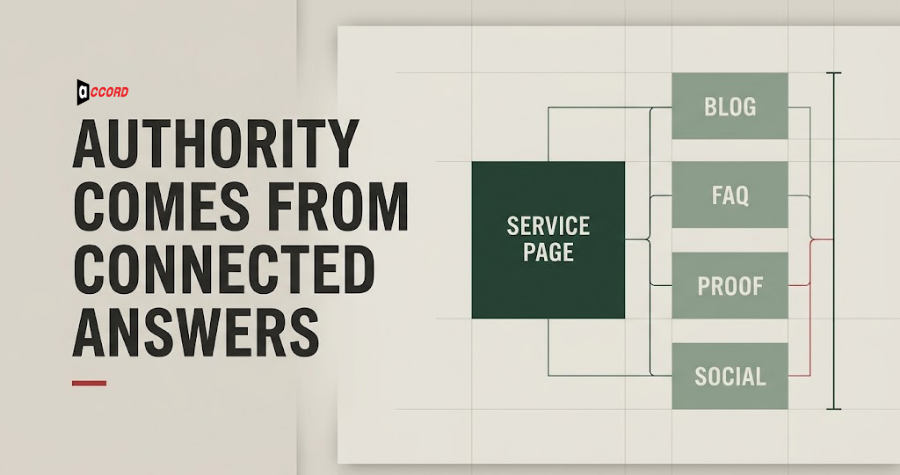
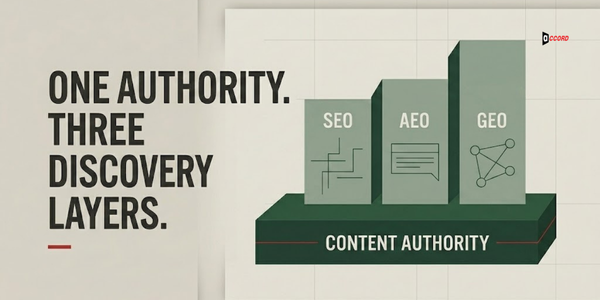
Quick answer: A B2B content authority engine is a connected system of service pages, blog posts, FAQs, case-style proof, social content, and internal links that helps buyers and search systems understand what a company does. It supports SEO by covering search demand, AEO by answering specific questions, and GEO by making the company's entity, services, and expertise easier for AI systems to interpret.
Authority is not built by publishing random posts. It is built by repeatedly answering the right buyer questions with clear, useful, and connected content.
What content authority means for B2B companies
In B2B, buyers rarely make decisions from one piece of content. They search Google, ask AI tools, scan websites, compare vendors, check LinkedIn, read reviews, and look for proof that the company understands their problem.
Content authority means your digital presence gives consistent answers across those moments. A buyer should be able to understand who you help, what problem you solve, how your service works, what related services support it, and what the next step looks like.
For Accord Tech Solutions, authority should connect multiple service areas: B2B lead generation, CRM enrichment, cold email, SEO, AEO, GEO, website design, landing pages, ecommerce product listing SEO, and social media marketing. The stronger the connection, the easier the brand becomes to understand.
Why random blogging does not work
Many B2B blogs fail because they publish disconnected topics. One week the article is about cold email. Next week it is about website design. Then a generic post about AI. The topics may be useful, but without a system they do not build a clear market position.
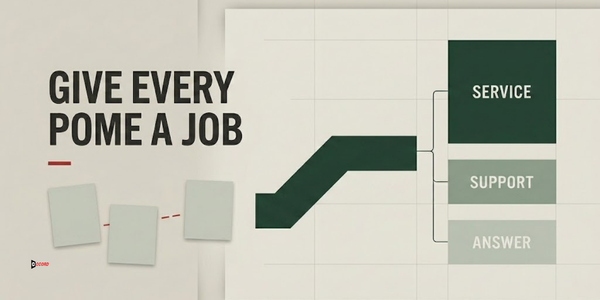
A content authority engine starts with themes. Each theme should support a service, buyer question, or sales objection. Then the company builds clusters around those themes.
Example clusters for Accord Tech Solutions:
- Lead generation: lead lists, account research, signal-based targeting, CRM data quality.
- Cold email: deliverability, personalization, automation, reply handling, campaign measurement.
- SEO/AEO/GEO: technical SEO, answer-ready content, AI visibility audits, schema, topical authority.
- Website conversion: landing pages, full websites, CRO, social proof, service-page clarity.
- Social trust: founder-led LinkedIn, reviews, testimonials, content repurposing, brand consistency.
- Product listing SEO: ecommerce data, titles, descriptions, images, attributes, marketplace readiness.
How SEO fits into authority
SEO helps buyers find the content. It starts with search intent, keyword mapping, page structure, internal links, and content depth. A strong SEO page should have one clear primary topic, enough supporting detail, and a reason to exist in the wider site architecture.
For B2B SEO, the best topics often come from sales conversations, CRM patterns, cold email replies, website analytics, and customer questions. Keyword tools help, but they should not replace buyer insight.
How AEO fits into authority
AEO is about direct answers. Each article should include answer-first sections, plain definitions, comparison tables where useful, and FAQs that match real buyer questions.
AEO-friendly writing avoids vague introductions. It gives the useful answer early, then expands. This helps both human readers and answer systems.
Good AEO questions include:
- What is CRM enrichment?
- When should a B2B company use cold email?
- Does a campaign need a landing page or full website?
- How does technical SEO support AI search?
- What should be automated in B2B email workflows?
How GEO fits into authority
GEO is about being understandable to generative search systems. The content should make entity relationships clear. That means the site should consistently explain Accord Tech Solutions, its services, its audience, and how those services connect.
GEO also benefits from factual structure: author or company context, dates, methodology notes, internal links, FAQs, schema, and clear service definitions. Do not add inflated claims. AI search visibility should be supported through clarity and usefulness, not promises.
The role of social proof
Authority is not only content volume. Buyers want evidence. Social proof can include testimonials, review snippets, case-style examples, before-and-after explanations, founder posts, client outcomes where approved, and process documentation.
For service businesses, process proof is especially useful. If public client results are limited, show how the work is done: audit steps, checklist examples, data fields, campaign QA, content framework, or website conversion review process.
The role of internal linking
Internal links turn separate articles into a system. A content authority engine should link blogs to service pages, service pages to supporting blogs, FAQs to deeper explanations, and case-style proof to relevant offers.
For example, an article about cold email automation should link to CRM enrichment, cold email, lead generation, landing pages, and SEO/AEO/GEO. This gives readers a next step and helps search systems understand topical relationships.
A practical authority workflow
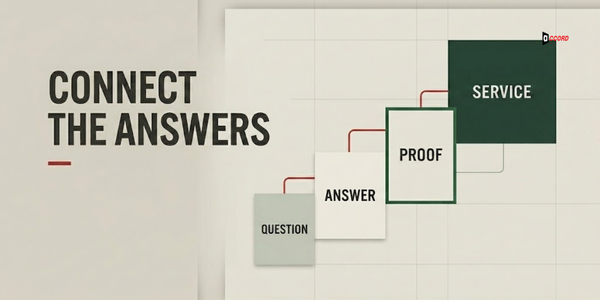
First, define the business pillars. For Accord Tech Solutions, these include lead generation, cold email, SEO/AEO/GEO, web design, social media, CRM/data, and product listing support.
Second, list buyer questions for each pillar. Use sales notes, CRM fields, email replies, support questions, competitor pages, and search data.
Third, map content types. Some questions need blog posts. Others need service-page sections, FAQs, LinkedIn posts, short videos, or landing page copy.
Fourth, publish connected assets. Every article should support a service, a buyer stage, or a sales objection.
Fifth, update content regularly. Content authority improves when pages stay current, linked, and aligned with the offer.
Where Accord Tech Solutions fits
Accord Tech Solutions can build the content authority system behind B2B growth. That may include topic mapping, SEO blog planning, AEO-style FAQ development, GEO-focused entity clarity, service-page copy, technical SEO review, CRM-to-content insight mining, social media repurposing, and landing page alignment.
The goal is not to flood the website with articles. The goal is to make the company easier to find, understand, and trust.
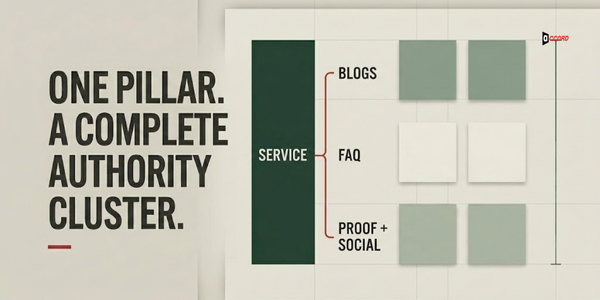
How to turn one pillar into a full authority cluster
A content authority engine becomes practical when one pillar can produce a clear set of pages. Take B2B lead generation as an example. The main service page should explain who the service is for, what problems it solves, what the process includes, what data quality standards matter, and how a buyer can contact Accord Tech Solutions.
Supporting articles can then answer research-stage questions:
- What is account research?
- How is lead generation different from list building?
- Why does CRM enrichment matter before outreach?
- What makes a cold email list high quality?
- How should outreach connect to a landing page?
- What metrics should a B2B team track after campaign launch?
Each article should link back to the lead generation service page and to the most relevant supporting articles. That lets the reader move from learning to evaluation without feeling pushed. It also helps search systems see the relationship between the pillar and the supporting answers.
The same model can be used for SEO/AEO/GEO, email marketing, website development, social media marketing, and product listing SEO. The topic changes, but the logic stays the same: service page for commercial intent, blog articles for buyer questions, FAQs for specific doubts, and social content for distribution and trust.
Editorial quality rules for authority content
Authority content should not sound inflated. It should be specific, accurate, and useful. Before publishing, check whether the article adds something meaningful beyond a generic summary. Google's helpful content guidance asks creators to consider whether content provides substantial, complete, or comprehensive information and whether readers leave feeling they have learned enough to achieve their goal. That is a good editorial test for this blog batch.
Use these checks:
- Does the article answer the main question in the first section?
- Does each heading serve a real buyer question?
- Are claims sourced or clearly framed as operational guidance?
- Are Accord service mentions natural and relevant?
- Are internal links mapped to the buyer journey?
- Are external links authoritative and current?
- Does the article avoid pretending AI citations or rankings are guaranteed?
- Does the FAQ match visible content?
- Is the schema plan accurate to the page?
How social content extends authority
A blog does not finish its job at publication. It should feed LinkedIn posts, short videos, carousel slides, newsletter snippets, and sales follow-up resources. A 2500-word article can become several platform-native pieces without repeating the same caption everywhere.
For example, this article can become:
- A LinkedIn post about random blogging vs content systems.
- A carousel showing the six Accord topic clusters.
- A short video explaining service page vs blog page roles.
- A newsletter note with the authority checklist.
- A sales follow-up link for prospects asking about SEO or AI search.
This keeps social media connected to SEO and GEO. The same ideas appear across channels, but each platform gets the right format, hook, and CTA.
Content maintenance and last-reviewed process
Authority content loses value when it becomes stale. Each article should have a last reviewed date and a reason to update. Update content when service offers change, Google publishes relevant guidance, AI-search behavior changes, internal links move, product pages change, or sales hears a new objection repeatedly.
Do not update the date just to look fresh. Update the content when the article actually changes. Then record what changed in production notes.
FAQ
What is a B2B content authority engine?
It is a connected content system that explains a company's services, answers buyer questions, supports search visibility, and builds trust across website and social channels.
How does content authority help SEO?
It helps by covering related topics deeply, improving internal links, matching search intent, and giving search engines clearer context about the company's expertise.
How does content authority help AEO?
It gives answer engines direct, concise answers to buyer questions through clear headings, quick definitions, FAQs, and structured sections.
How does content authority help GEO?
It helps AI systems understand the company entity, service relationships, audience, process, and factual context.
How often should B2B content be updated?
Important service and pillar content should be reviewed regularly, especially when offers, tools, search behavior, or buyer questions change.