

A contact answers your outreach with "Sure, send me a time." You book 30 minutes. On the call you learn that the person has no say in the decision, no money set aside and no plan to act this year. Half an hour is gone. In a B2B growth engine (the connected set of services that brings in buyers), this is a gap in lead generation, the part that decides who deserves a conversation. A reply went into the pipeline (the list of buyers on their way to a sale) as if it were a sale. Five short B2B lead qualification questions, asked before the meeting is booked, can catch some of these cases while they still cost a short exchange.
The questions, the limits and the rule in this post are our own starting points, not industry standards. The one outside source, Salesforce's page on a framework called BANT, is linked where it appears.
What does it mean to qualify a lead before the meeting?
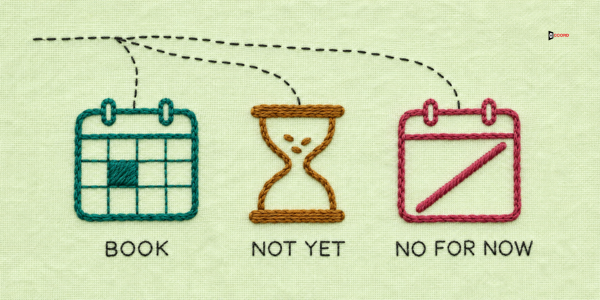
To qualify a lead is to decide whether this person and this company deserve a meeting now. The decision comes after someone shows interest and before a time goes on the calendar. It has three results: book the meeting, not yet (wait), or no for now (decline).
Qualifying is not the same as scoring. A lead score is a number or rating built from signals about fit, interest and timing. Our guide to a B2B lead scoring model that sales teams can trust shows a scorecard that combines fit, intent, timing and evidence. The questions in this post go to the person, because only the person can tell you what problem they have and when they want it solved.
What should you check yourself before asking anything?
Do not ask a person for facts you can find in two minutes on public pages. It feels like homework. Check three facts first.
Company fit. Does the company belong to the kind of business you serve? Your ideal customer profile (the type of company you help best) is the test.
Size and place. Does the company sit inside the size range and the countries you serve? Its website and public profile pages usually show this.
Role. Does the person hold a job that touches the problem you solve? A marketing coordinator may care about your offer without deciding anything. That is a fact to note, not a reason to stop.

If the company fails the first or second check, do not send the five questions. Send a short, kind reply that says you are not the right fit and, if you know one, name a better option. If only the role is a poor match, go on and use question 4 to find the right person.
What are the five B2B lead qualification questions to ask before booking?
Ask these in this order, and change the nouns to match your offer.
| # | Question to copy | What it tells you |
|---|---|---|
| 1 | "What is the problem you want to fix?" | Whether you solve their problem |
| 2 | "What made this a priority now?" | Whether something real is pushing them |
| 3 | "When would you want it in place?" | Whether the timing fits a normal start |
| 4 | "Who else would take part in the decision?" | Whether the person can decide, or can bring in the one who does |
| 5 | "Is there a budget for this, or would it need approval first?" | Whether money is available or on its way |
These cover the same ground as BANT. Salesforce's BANT page, dated 3 September 2024, describes BANT as a lead qualification framework built on four factors: budget, authority, need and timeline. Questions 5, 4, 1 and 3 match those four. Question 2, why now, is our addition.
The same page warns that, used as a rigid checklist, BANT can hurt rapport and produce a generic pitch. It may also be too simple when several people take part in the decision. That is why this post asks for a reading of each answer, not a score. It is also why question 4 asks "who else" instead of "are you the decision maker?"
How do you read the answer to each question?
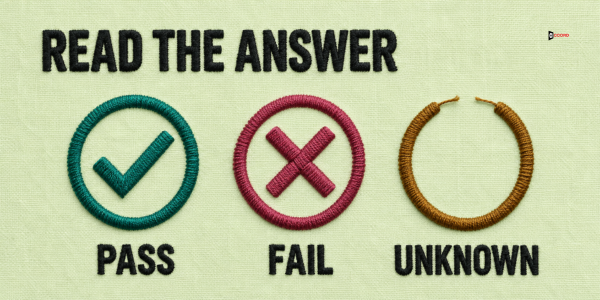
Give every answer one of three labels. Pass means the answer shows a fit. Fail means the person clearly says there is a mismatch. Unknown means no answer, a vague answer, a shrug or "I do not know." Unknown is not a Fail. It means you have not learned the fact yet.
Question 1: What is the problem you want to fix?
This is the most important question. A meeting about a problem you do not solve helps nobody.
Pass: the person names a specific problem that you handle, such as "our monthly sales report takes two days to build." Fail: the person names a problem you do not handle. Unknown: the answer is broad ("we want to grow") or missing. If the answer is broad, ask once for an example: "What does that look like on a normal week?"
Question 2: What made this a priority now?
A reason to act now separates real interest from curiosity.
Pass: the person names an event or a cost, such as a new manager, a missed target, a launch or a failed audit. Fail: the person clearly says there is no priority or no plan, for example that they are only gathering ideas or that it is not a priority this year. Unknown: a shrug or a blank, such as "no particular reason." Ask once: "Was there a recent event that made you reply now?"
Question 3: When would you want it in place?
Your own sales cycle sets the pass line. A workable starting point is six months.
Pass: a date or period within six months. Fail: a date later than six months, such as "probably late next year." Unknown: "soon," "when we are ready," "maybe next year" or no answer. For "maybe next year," ask "Do you mean early in the year or later?" Change the six months to fit your business. A firm that needs a year from first contact to signature should use a longer window.
Question 4: Who else would take part in the decision?
"Who else" avoids "Are you the decision maker?", which can sound like a test of the person's rank.
Pass: the person decides alone, or names the other people and is willing to bring them in or introduce you. A person who says "my director signs off, and she can join" passes. Fail: the person says the decision sits elsewhere and they cannot involve the people who make it, so the meeting could not lead to a decision. Unknown: no answer, "I am not sure how it works," or a named decider with no word on whether they can join. Ask "Could she join the call?"
Question 5: Is there a budget for this, or would it need approval first?
This question comes last, and the wording gives two easy ways to answer. You do not need a number, only whether money exists or can be approved.
Pass: money is set aside, or the person explains who approves it and says the request is likely to be considered. Fail: the person says there is no money for this and none coming this year. Unknown: "I do not know," "we have not set it yet," an approver named with no word on whether approval is likely, or no answer.
How do the answers become book, not yet or no for now?
Use one rule for every contact, so two people on your team reach the same result from the same answers.
- If any answer is a Fail, the result is no for now. Do not book. Reply kindly, say what you heard, and note the reason in your records.
- If there is no Fail and question 1 is Unknown, the result is not yet. The meeting needs a problem to discuss.
- If there is no Fail and question 1 passes, count the Unknowns among questions 2 to 5. Two or fewer: the result is book. Three or more: the result is not yet.
Two cases are worth noting. A person who answers one question and goes silent leaves at least four of the five Unknown, so the result is not yet, even if that single answer was strong. And if a person answers later, run the rule again on all five answers.
Why allow two Unknowns? People often do not know the budget or the decision path before they talk to a seller, and the call can settle some of those facts.
Where does qualifying a lead fit in a B2B growth engine?
A B2B growth engine is a connected system that helps the right buyers find, trust and respond, as our guide to the B2B growth engine puts it. It has five parts: SEO and AEO (being found in search and in AI answer tools), lead generation, email, web development and social media. The guide describes the same parts by their jobs: search visibility, account data, outbound outreach, website conversion and social proof. Each part sends signals (signs of buyer interest, such as a reply or a form fill) toward one pipeline.
We place qualifying in lead generation (the guide's account data), because it uses and feeds the ideal customer profile that the three-fact check relies on. The signals it checks come from the other parts: a reply from email, a form fill from the web, a direct message from social, a request from someone who found you through search. It hands on two things. A book result goes to the pipeline as a booked call with the five answers attached. A no for now goes to email, which can write again later, and its reason goes back to the list-building side of lead generation, which can change who it adds.
When this part is weak, the other parts pay for it. Email keeps writing to people who said they will not act for a year. The web form keeps collecting vague requests. Sellers fill their calendars, and the meeting count can look healthy while few meetings lead anywhere.
Here is a check you can finish in ten minutes. Open your last 10 booked meetings, or all of them if you have fewer. For each one, look for two things. The first is where the contact came from (email, form, social or search). The second is a written note of the problem the person wanted solved, in the invite, your CRM (the tool that holds your contact records) or an email. Suppose a third or more of the meetings lack either one, such as 4 of 10 or 2 of 6. Then your email, form, social and search steps may not be passing the facts along, and question 1 is the place to start. If you have no booked meetings yet, make sure your form and your reply template both ask question 1.
How do you ask without sounding like an interrogation?
Five questions in a row from a stranger feel like a form to fill in. Three habits help.
Give a reason for asking. A stated reason usually makes a request feel fairer. One sentence is enough, as in the sample reply below.
Ask in two messages, not one. Send questions 1 and 2 first, since they are about the problem and are easy to answer. Send 3, 4 and 5 in the second message, after the person has said something.
Use their words. If the person writes "our reports are a mess," reply with "When you say a mess, is it the time or the numbers?" That shows you listened, and it leads into the second message.
Here is a first reply you can adapt.
Hi [first name], thank you for the reply.
So that I send the right person to a meeting and do not waste your time, may I ask two short questions first?
What is the problem you want to fix?
And what made it a priority now?
A rough answer in a line each is fine.
[Your name]
What if the answer is "I do not know," or the person will not answer?
"I do not know." This is an honest answer, and a common one on budget and on the decision path. Mark the question Unknown and say "That is fine." Then ask who would know, for example whether someone could tell you the budget range. If the person names someone, you may have the start of an answer to question 4. Ask whether that person can join.
"I would rather talk about that on the call." Respect it and mark Unknown. If the person says this to question 1, or to three of the other four, the result is not yet. Say so kindly: "I want the meeting to be useful for you, and I need a little more to prepare. Would a short written note first work?"
No reply to your questions. Wait two business days, then send one reminder that repeats only the most important unanswered question, usually question 1. If there is still no reply, mark the contact as not yet and pause writing. Set a reminder to try once more in a month, then stop. The same wait and reminder apply to the second message. If it goes unanswered, questions 3 to 5 are Unknown, and the result is not yet.
Where do you ask: in a reply, on a call or in a form?
The same five questions work in three places.
In an email or LinkedIn reply. The sample above fits here.
On a short phone call. Ask questions 1 and 2 first, then listen, and take notes. Offer to follow up in writing, because a person caught off guard may say "I do not know" more often.
In a form. A form can ask questions 1 and 3 as simple fields. Keep it short. Our guide to a B2B contact form: which fields to keep, which to cut and what to ask instead goes through the choices. Ask the other questions in a reply.
Imagine: 20 interested contacts and one rule
Imagine a four-person firm called Tallgrass Analytics, which builds sales reports for B2B companies. This example is invented, including every name and number. The numbers are not a benchmark, and they show only how the rule works. In one month, 20 contacts show interest: 12 reply to Tallgrass's outbound email and 8 fill in the website contact form. Tallgrass writes the source next to each contact. Every percentage below is out of the 20 contacts. It asks over two messages, waits two business days and sends one reminder.
First the three-fact check that Tallgrass does itself. Three contacts fail it: two work at firms with fewer than ten employees, below the smallest size Tallgrass serves, and one is outside the countries it serves. Those three get a kind reply and no questions. That is 3 of 20, or 15%. The other 17 get the five questions.
Here is one contact in full. Priya Nair, an operations director at an invented company called Northfield Tooling, answered an outbound email. Her answers:
Question 1: "Our monthly sales report takes two days to build and the numbers differ between teams." This passes.
Question 2: "Our new vice president asked for one set of numbers for the January board meeting." This passes.
Question 3: "In about ten weeks." That is inside six months, so it passes.
Question 4: "I run the project. My vice president signs off, and she can join the meeting." This passes.
Question 5: "I do not know yet. Finance has not set the figure." This is Unknown.
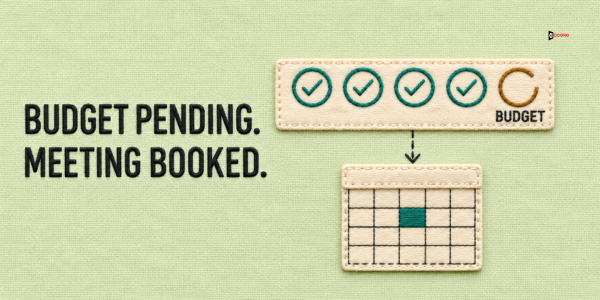
There are no Fails, question 1 passes, and there is one Unknown among questions 2 to 5. The rule says book. Tallgrass books the meeting and gives its seller a note with Priya's answers and the line "budget still open".
Now the whole batch of 20:
Book: 8 contacts (40%). Three passed all five questions, three had one Unknown and two had two Unknowns. All eight passed question 1 and had no Fail.
No for now: 4 contacts (20%). Three said they wanted it in place later than six months, a Fail on question 3. One said there was no money this year, a Fail on question 5.
Not yet: 5 contacts (25%). Two never named a problem, so question 1 is Unknown. One of them replied without a problem and gets a short guide and one question. The other never replied, even after the reminder, so Tallgrass waits a month. Three named a problem but left three of the other four questions Unknown, so each of them also gets a short guide and one question.
Out of scope on the three-fact check: 3 contacts (15%).
The groups add up: 8 plus 4 plus 5 plus 3 is 20, and the four percentages make 100%.
What moves between the parts. The three contacts with a later timeline go on the email list for a message in six months. The contact with no money this year is kept with that reason and checked again at the next planning season. The three out-of-scope firms tell the list-building side of lead generation to add two filters to the next list: ten or more employees, and the countries served. The two contacts who never named a problem both came from the form. The form gave Tallgrass no hint of the problem, so it adds a one-line field for it and checks next month whether form contacts answer question 1 more often. If one question is Unknown for more than 5 of the 20 contacts (an invented limit), Tallgrass changes that one question for the next 20 contacts.
What happens after the questions pass?
Booking is the next step, and the answers should travel with it. Put them in the invite or in the notes the seller reads before the call. Open the meeting with "From your note, I understand the problem is the monthly report and that the January date matters. Is that still right?"
For the booking message itself, our guide on how to respond to a positive cold email reply and book the call gives a checklist for the first 24 hours.
For a no for now, a short message is enough. Here is one to adapt.
Hi [first name], thank you for the answers.
From what you wrote, [the reason you heard, such as the timing or the budget], so I will not book a meeting yet.
If the date moves closer, reply here and we will pick it up. I will keep the note we made.
[Your name]
For a not yet, send one useful item, such as a one-page example, and ask the most important missing question, usually question 1. Then wait. If the next reply still leaves the result at not yet, set a check in a month and then stop.
Frequently asked questions
How many questions should I ask before booking a B2B meeting?
Five is a workable number, because it covers the problem, the reason, the timing, the decision and the money. Ask two in the first message and three in the second.
Should I ask about budget before the first meeting?
Ask it, but make it easy to answer. The wording "Is there a budget for this, or would it need approval first?" does not demand a figure. "Set aside," "needs approval" and "I do not know" are all useful answers. Put it last, after the person has described the problem.
What if the lead refuses to answer a question?
Treat it as unknown, not as a no. A simple rule: a contact can leave up to two of reason, timing, decision and budget unanswered and still get a meeting, as long as the problem is clear. If the person will not describe the problem, or skips three of those four, say you need a little more to prepare and offer a short written note first.
Is BANT still enough to qualify a B2B lead?
BANT covers four useful topics: budget, authority, need and timeline. The five questions to ask are the problem, the reason for acting now, the timing, who else decides and the budget. They cover the same four topics and add a reason for acting now.
What if the person is not the decision maker?
That is not a failure by itself. Asking who else takes part in the decision passes if the person names who decides and is willing to bring them in or introduce you. Book the meeting with both people if you can. If the person says they cannot involve the decider at all, that is a Fail, and the result is no for now.
Where do the answers go after I book or decline a meeting?
Into the same record your other teams read, such as your CRM or a shared sheet. For a booked meeting, the answers go to the seller before the call. For a lead you decline for now or put on hold, the reason goes to lead generation (whoever builds your lead lists) and to email.
Next step
If you would like a second pair of eyes on your own questions, book a 30-minute working session with the team behind this post. We talk through your questions and map which part of your growth engine this topic belongs to and which part is weakest. There is no obligation, and you can use everything in this post without us. Accord sells SEO and AEO, lead generation, email, web development and social media as one connected growth engine, so we have an interest in this subject.