
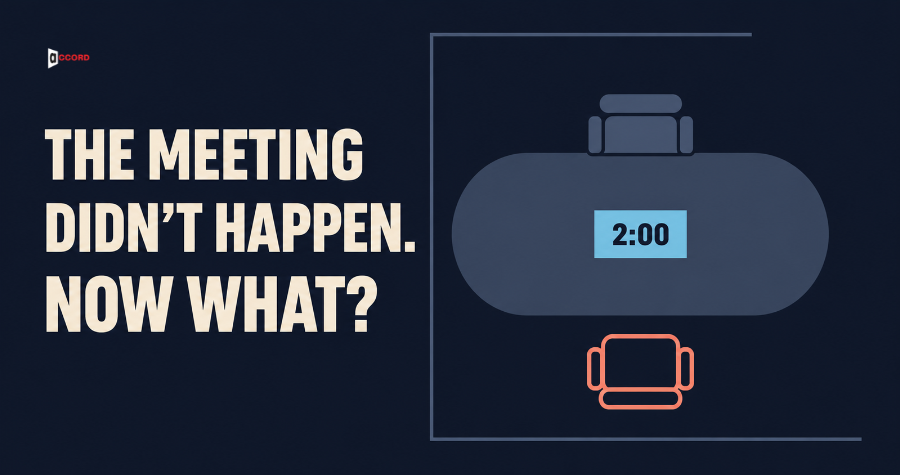
The call was set for 2:00. It is now 2:10, you are alone in the video room, and the person who booked the call has not written. A good follow-up plan for a B2B meeting no-show fits on one page. It has a first message the same day, a second the next business day, a closing note, a point where you stop and an honest way to count the miss. Below is wording you can copy for each.
A missed meeting is also a break inside a B2B growth engine. Email, one of its five connected services, hands a booked call to the pipeline, the set of conversations on their way to a sale, and a miss means nothing was handed on.
Reminders before the call are in our guide to responding to a positive cold email reply. The tries, gaps, limits and counting rules here are our own starting points, not industry rules, because no primary source sets them.
What counts as a no-show, and what does not?
A no-show is a booked meeting where nobody from the other side has joined by the end of minute 10 after the start time, and the person did not ask to move or cancel it by the start time. You check at minute 11.
A request to move or cancel is notice, not a no-show. "Something came up, can we move it?" at 1:58 means the meeting was moved, so offer new times at once. A message at exactly 2:00 counts as before the start. "Running late" is not a request to move: the meeting stays on, and the 10-minute rule still applies. A request that arrives after the start time still counts as a no-show, but it is a human reply: skip the tries, answer by hand and offer new times.
Joining late is not a no-show. A person who joins by the end of minute 10 is on time for our purposes, and you can note "late". At minute 11, if nobody has joined, it is a no-show, even if the person wrote "running late" at 1:59. If the person joins after you marked it and you are still there, hold the meeting, change the status to "held, late" and lift the email pause.
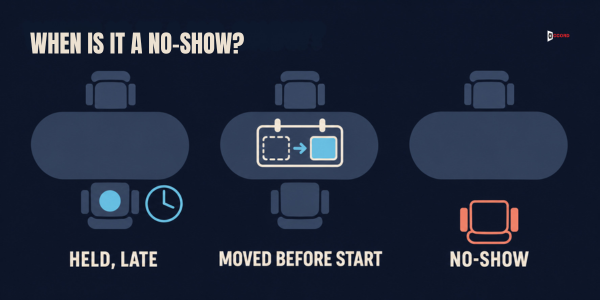
Your own mistake is not a no-show. A wrong link, a time zone mix-up or an invite sent to an old address is yours. The test: could a careful person have joined using only what you sent? If not, apologize first and record "our error".
An invite that was not clicked is still a no-show if the person agreed to the time. Agreeing in writing or choosing the slot on your booking page books the meeting. If the person never agreed, it was never booked, so it is not a no-show and not in the rate.
If you cannot tell whether the miss was yours, count it as a no-show and use the careful first message.
Where does a missed meeting fit in a B2B growth engine?
A growth engine is a connected system that helps the right buyers find, trust and respond to a company, as the guide to the B2B growth engine defines it. The work falls into five services: SEO and AEO (search and AI-answer visibility), lead generation, email, web development and social media. The guide calls the same five parts search visibility, account data (lead generation), outbound outreach (email), website conversion (web development) and social proof (social media). If the call came from email, a missed meeting belongs to the email part, which starts conversations and keeps them going. If the call came from a LinkedIn message or a web form, the status still has to reach whichever tool sends your email, so it can pause.
Each part passes signals to the others. A signal is something a buyer did, such as a reply, a booking or a miss. In a typical setup, the email part receives the reason you contacted this person and the contact record from lead generation, and the booking page and invite from web development. It hands on a held meeting to the pipeline, and a clear status (no-show, recovered, or quiet until a date) back to the lead records.
When the follow-up is missing, the other parts act on wrong information: the email sequence tool may send a cold pitch the morning after a missed call, and the lead list may still show "booked", so the monthly count of booked meetings looks better than it is.
To check in ten minutes whether your own parts are connected, open your last five no-shows, or all you have (if none, use your next one). For each, ask three yes-or-no questions. Does the record show "no-show" with a date? Is the person paused or removed in every automatic email sequence? Did the invite show the time in the person's time zone? Any "no", or any "I cannot tell", is a place where two parts are not connected.
What should you do in the first ten minutes?
Before you write, in case the mistake is yours:
- Check your side. Open the meeting link from the invite, not from memory. Confirm the time zone on the invite and the address it went to.
- Check for a request to move or cancel. Look at the email thread, any chat tool, your phone and your booking tool.
- Stay in the room through minute 10. Do not message the person during the wait.
- At minute 11, if nobody has joined, mark the meeting "no-show" in your CRM, which is the tool where you keep customer records, and write the time. If your tool has no such status, use one fixed word in a notes field. Then pause any automatic email to this person.
- Send the first message within the hour after the start time.
What does a good b2b meeting no show follow up look like?
It has three written tries and then a pause. Count days in business days, which are Monday to Friday. Day 0 is the day of the missed meeting.
| Situation | What you send | When | Then |
|---|---|---|---|
| First no-show by this person | Try 1: a kind note with two new times. Try 2: an easier choice. Try 3: a closing note | Try 1 on day 0, within the hour. Try 2 on day 1. Try 3 on day 4 | Pause and record "no-show, no reply" |
| Second no-show by the same person | Hand-over note that gives the next step to the person, then a closing note | Same day, then day 4 | Pause and record |
| The person replies at any point | Stop the tries and answer by hand | The same business day | Book a time or record the answer |
| An out-of-office auto-reply arrives | Nothing now. An auto-reply is not a human reply | The next try on its due day, or on the first business day after the return date if that is later. If the return date is more than 10 business days away or not given, record "no-show, away" and set a reminder for the return date (10 business days ahead if none) | Keep the original gaps between tries, then record "no-show, no reply" after try 3 |
Same thread, same subject. Reply under the original invite or email so the person sees the history. If you start a new email, use the subject "Our call on [date]" in all of them.
Short, with one main ask. Write about 40 to 80 words. Try 1 asks for a time, try 2 for a choice between two options and try 3 for a reply of any kind. Each message may add one easy way out, such as "tell me when to write again".
No blame. Do not write "I waited for you", "you missed our meeting", "as per my last email" or "just checking in". "I was sitting there for 15 minutes" is the same blame in other words.
The booker's name and your usual footer. Send each message from the mailbox of the person who booked the meeting. If the person asks you to stop, add the address to your do-not-email list the same day. The FTC's CAN-SPAM guide allows 10 business days and makes no exception for B2B email, so same day is our safer practice.
Try 1: What should the first message say?
Send it within the hour after the start time. It tells the person you noticed and offers two new times with the time zone, so a short reply is enough. Square brackets show what you replace. Pick times from your real calendar, on different days.
Subject: Our call on [date]
Hi [first name],
I think we missed each other for our [time] [time zone] call today. No problem at all.
Would [day] at [time] or [day] at [time] [time zone] work instead?
If neither suits you, reply with a time that does, or tell me if this is no longer a priority.
[Your name]
If you are not sure the miss was your fault, use this version. It takes a little of the blame without claiming it.
Subject: Our call on [date]
Hi [first name],
I did not see you on the call at [time] [time zone] today. I may have sent the wrong link, so here it is again: [link].
If a different time is better, would [day] at [time] or [day] at [time] [time zone] work?
[Your name]
Try 2: What should the second message say a day later?
Send it on the next business day, in the same thread, only if the person has not replied. Nobody picked a time from the first message, so another request for a time is likely to meet the same silence. Offer two options instead, each answered with one word. The first holds a time for the person. The second removes the call for now.
Subject: Our call on [date]
Hi [first name],
Our call on [date] did not happen, and I do not want it to turn into a chore for you.
Two easy options. Reply "time" and I will hold [day] at [time] [time zone] for you. Reply "questions" and I will send the three questions I planned to ask, so you can answer in writing.
If the timing is wrong, tell me when to write again.
[Your name]
Before you send the second option, write the three real questions you would have asked on the call, easy to answer in a few lines. If you cannot name three, offer a short summary instead.
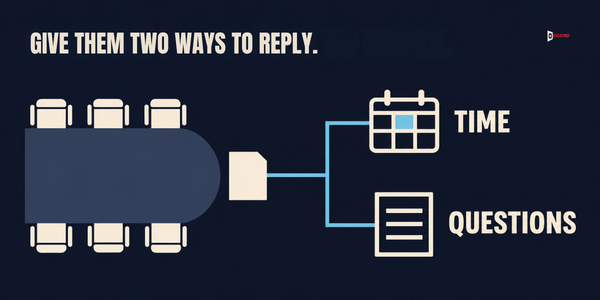
The second message must give the person something the first one did not. This one adds a way to move forward without a call. "Following up on my last note" fails. Our cold email follow-up sequence guide covers the same question for emails sent before anyone replies.
Try 3: How do you close the loop?
Send the last message in the same thread on business day 4, three business days after try 2. It says plainly that this is the last note for now and gives three ways to answer.
Subject: Our call on [date]
Hi [first name],
I have written twice about the call we missed, so this is my last note for now.
If you still want to talk, reply with any time that suits you and I will make it work.
If now is not the right time, tell me when to write again, for example next quarter.
If this is no longer a priority, a one-word "no" is fine.
[Your name]
A clear no is a good result, because it lets you close the record. After try 3 you send nothing more. For a second no-show, change the line to "I have written once about the second call we missed".
When do you let go, and what happens after?
You let go after the closing note, if the person has not replied. A fourth to someone who ignored three looks like pressure. If your own records show recoveries only on try 1 and try 2, shorten the plan.
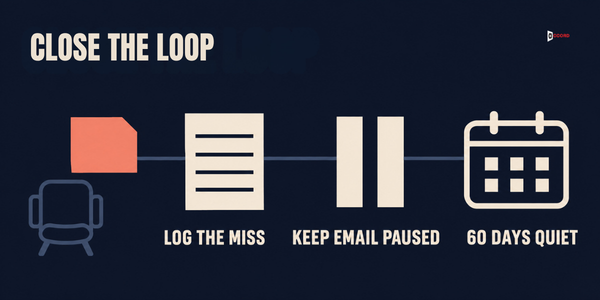
"Let go" does not mean delete. After the closing note, do three things. First, change the record to "no-show, no reply", and keep the date, the three send dates and the reason the meeting was booked. Second, keep the person out of every automatic email sequence, so no new pitch arrives. Third, set a quiet period of 60 days with no new outreach, unless the person writes first or something real changes, such as a new role at their company. Any later message should lead with the new reason, not with the missed call.
Three edge cases need their own rule.
The person no-shows a second time. Fresh times again can signal that a missed call costs nothing. So send this hand-over note the same day and the closing note on day 4. Then pause, and book no more meetings with this person unless they ask. A second no-show counts even if the first was months ago.
Subject: Our call on [date]
Hi [first name],
We missed each other again today. Schedules change, so I will leave the next step with you.
When you would like to talk, reply with a time and I will confirm it. There is no hurry.
[Your name]
The person replies "not now". That is a human reply, so the tries stop. Ask which month to write again if the person did not say, and set a reminder in your CRM, not a place in a general sequence.
You cannot tell whether the person saw any of it. Emails can land in spam. The rule stays the same.
What if the person writes back later?
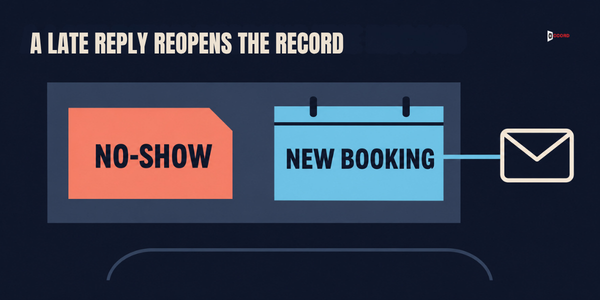
A reply can arrive an hour after try 1 or two months into the quiet period. Answer on the same business day, by hand, and offer two times. If it arrives during the tries, cancel the remaining ones. If it arrives after the pause, reopen the record, book the new meeting and keep the earlier no-show in the history. If the person misses the new meeting too, that is a second no-show, so use the hand-over note.
Subject: Our call on [date]
Hi [first name],
Thank you for writing back. No apology needed.
Would [day] at [time] or [day] at [time] [time zone] work for you? If another time is easier, tell me and I will fit around you.
[Your name]
How do you count no-shows in a report?
Booked meetings look busy, but only held meetings are conversations. So pick one definition, one denominator and one month rule, and keep them. A rate has a numerator, the count on top, and a denominator, the count underneath. Change either one and last month cannot be compared with this month.
Booked meeting. A meeting with a date and start time that the person agreed to, in writing, by accepting the invite or by choosing the slot on your booking page.
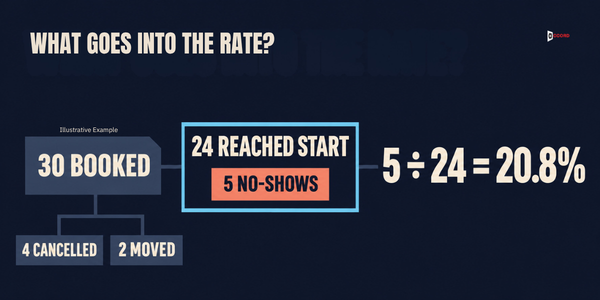
Meeting that reached its start time. A booked meeting whose start time has passed, minus meetings cancelled by either side or moved before the start, and minus meetings lost to your own error. This is the denominator. It equals held meetings (including "held, late") plus no-shows, so no meeting is in both. Report the cancelled, moved and own-error meetings beside it, outside the rate. This is a no-show rate, not a held-out-of-booked rate, so the two will differ.
No-show rate. No-shows, as defined at the top of this post, divided by meetings that reached their start time, counted by the month of the original start time. Do not restate a report that has gone out: record any later change, such as "our error" or "held, late", as a separate line in the month it was found.
Recovered. A no-show is recovered when a new meeting with the same person is held on or before day 30 after the missed start time. The recovery share is the recovered count divided by all no-shows, reported once the 30 days have passed. The new meeting is a new booking: it counts in the month it reaches its start time, like any other meeting, and the original miss stays a no-show in its own month.
Why does the denominator matter? RevenueHero, a scheduling company, published a no-show benchmark in December 2024. It reports 419 no-shows among 6,428 meetings from the previous week across 15 industries, which is 6.5%. It lists 4,895 completed meetings, says some meetings were still scheduled for the future and gives no general definition of a no-show.
If the other 1,114 meetings (6,428 minus 4,895 minus 419) had no outcome yet, the same 419 no-shows divided by the 5,314 meetings with an outcome would be 7.9%. That is our own arithmetic, and the report does not confirm it. One set of data gives 6.5% or 7.9% depending on the denominator, so say which one you use.
Imagine: one month of 30 booked meetings
Imagine a three-person consulting firm that books first calls with finance managers. This example is invented, including every number, and the numbers are not a benchmark. The five no-shows below all fell in the last five days of October.
Thirty meetings had an October start time. Four were cancelled before the start, two were moved to November and none was lost to the firm's own error, so 24 reached their start time (30 minus 4 minus 2). Nineteen were held and 5 were no-shows (19 plus 5 equals 24).
The no-show rate is 5 divided by 24, which is 20.8%. Dividing by all 30 would show 16.7%, which breaks the firm's own rule.
Here is what happened to the 5 no-shows, and which signal each sent to the other parts of the firm's growth engine. At minute 11 for each one, the firm set the status to "no-show" and paused the person's automatic emails.
Person A replied an hour after try 1 and picked a time, and the meeting was held 5 days later. Person B replied "time" to try 2, and the meeting was held 7 days after the no-show. Both meetings entered the pipeline as held, with the no-show kept in each history.
Person C answered try 3 with "not now, write in January". Email kept C's automatic emails paused, and lead generation got a January reminder, so C did not return to a general sequence.
Person D never replied. The record became "no-show, no reply" with a 60-day quiet date, so the next time the firm built a contact list, D was left out until that date passed.
Person E also let the three tries pass, then wrote 19 days after the no-show. The firm answered the same day, and the meeting was held 24 days after the miss. The lead record received the "recovered" status and the quiet date was cleared, and the held meeting went to the pipeline.
A, B and E were held within 30 days of the miss, so they are recovered. The recovery share is 3 divided by 5, which is 60%, reported in early December once all 30 days had passed. C and D were not recovered. The three recovered meetings were held in November and count there as new meetings, so they do not change October's 19 held or the rate. The firm sent 12 follow-up tries for the 5 no-shows (1 plus 2 plus 3 plus 3 plus 3 equals 12).
With only 5 cases, one more recovery would move the share from 60% to 80%, so read the direction, not the number.
Frequently asked questions
How long should you wait before calling a meeting a no-show?
Wait through minute 10 after the start time, then mark a no-show at minute 11 if nobody has joined. If the person joins by then, the meeting is held and noted as late.
How many times should you follow up after a missed meeting?
Our starting point is three written tries over four business days for a first no-show: one within the hour, one the next business day and a closing note on day 4.
Should you call or text instead of sending an email?
No. Email in the same thread is the plan, and a call or text is not part of it. We have not checked texting rules, so ask a legal adviser before texting buyers.
Does a rescheduled meeting count as a no-show?
No, if the person asked to move or cancel by the start time. Count it as a moved meeting, and count the new meeting when it reaches its start time. A request that arrives after the start time still counts as a no-show, but answer it by hand.
What is a normal no-show rate for B2B meetings?
No outside number states its definition clearly enough to serve as a goal. RevenueHero's December 2024 report gives 6.5% for 6,428 meetings from one week across 15 industries, with no general definition of a no-show. Measure your own rate for two or three months first.
How does handling no-shows fit with the rest of a B2B growth engine?
The no-show status should reach the email tool, the lead record and the monthly count: it pauses automatic email, sets a quiet date and shows in the count. Fix the one that still treats the person as booked.
Next step
In a working session, we map which part of your growth engine a missed meeting touches and which part is weakest. If you would like that, book a 30-minute working session. Bring your current no-show messages and last month's list of booked meetings, and we will test the definitions and the three tries against your own numbers. Accord sells lead generation, email, SEO and AEO, web and social as one connected growth engine, so we have an interest in this subject.