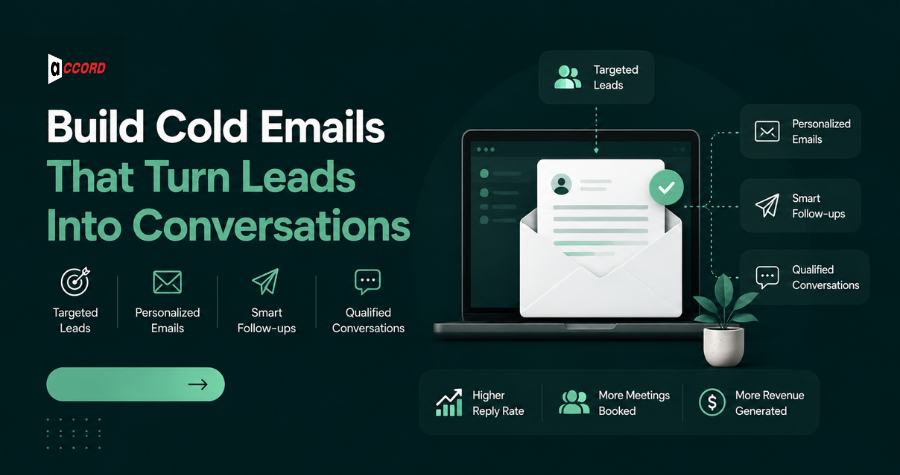
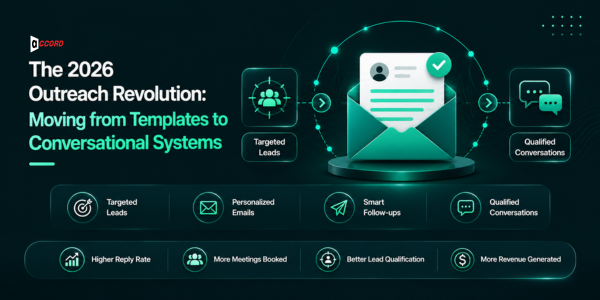
A cold email system turns targeted leads into qualified conversations by connecting eight steps: audience definition, contact research, email verification, message writing, follow-up, inbox protection, reply handling, and sales qualification. Each step has a clear owner and measure. That structure helps a team learn from replies instead of sending more messages without knowing what went wrong.
A good cold email does not begin with a subject line. It begins with a clear reason to contact a specific company and a specific person. The message is only one part of the work.
This guide covers the full path from account selection to a sales conversation. For a separate list of common errors, read Accord Tech Solutions' guide to cold email mistakes to avoid in 2026.
What Is a Cold Email System?
A cold email system is a repeatable process for choosing suitable accounts, finding the right contacts, sending relevant messages, managing follow-ups, and moving useful replies to sales. It also records why people respond or decline. A campaign sends emails. A system shows the team what to repeat, what to change, and when to stop.
A weak result can come from several places: account fit, contact role, email accuracy, message clarity, or slow reply handling. Managing each step separately helps the team find the real problem. For example, bounces point to data or setup, while many replies with few useful conversations can point to a loose qualification rule.
A simple cold email system has eight connected parts:
- Define the target account.
- Choose the right contact.
- Verify every email address.
- Write a relevant message.
- Plan useful follow-ups.
- Protect the sending domain.
- Sort and answer replies.
- Record qualified conversations.
How Do You Define the Right Target Before Outreach?
Define the target with a written ideal customer profile, or ICP, that covers industry, company size, location, business problem, buying role, and reasons the need may be timely. Then add a clear exclusion list. A narrow target gives researchers, writers, and salespeople the same standard for deciding who belongs in a campaign.
An ICP describes the type of company most likely to need the offer and be able to buy it. It is not a list of every business that could use the service.
Start with six questions:
- Which industry has this problem?
- What company size fits?
- Which locations can we serve?
- Who owns the problem?
- What creates urgency now?
- Who should be excluded?
The contact rule should name both role and responsibility. A title alone is often too broad, so research should confirm that the person's job matches the problem named in the email.
| Qualification area | Question to answer |
|---|---|
| Company fit | Does the account match the agreed industry, size, location, and service need? |
| Contact fit | Does this person own, influence, or report on the problem? |
| Timing | Is there a current event that makes the message relevant? |
| Exclusion | Is there any reason the account should not be contacted? |
How Do You Build and Verify a Targeted Lead List?
Build the list from the approved ICP, then verify the company, the person's role, and the email address before sending. Keep the source and verification date beside every record. A smaller list with clear fit is more useful than a large list that forces the writing and sales teams to guess why each contact was included.
Researchers can use company websites, professional profiles, public records, event lists, and trusted data providers. A database result is a starting point, not proof that a contact is current.
Each record should answer four questions: Is the company a fit? Is the person connected to the problem? Is the contact detail current? Is there a truthful reason to reach out now?
Useful timing signals can include a new location, a relevant job opening, a product launch, a change in leadership, or a public statement about the problem your service addresses. These signals support context. They do not prove that a company is ready to buy.
Check the company domain, confirm the person's role, verify the email address, remove duplicates, and place opt-outs on a permanent suppression list. Save the date of the last check because contact data changes. A contact becomes a targeted lead only after passing the campaign's fit and verification rules.
How Do You Write Cold Emails That Start Real Conversations?
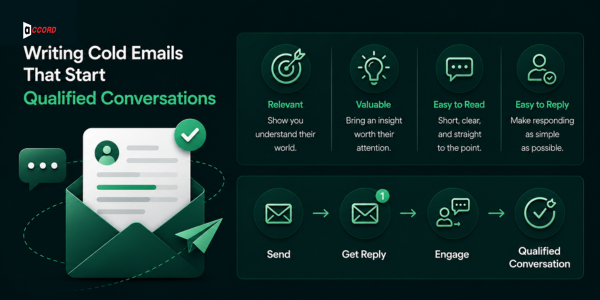
Write one short message around one relevant problem and one easy question. Show why the person was selected, explain the useful outcome in plain language, and ask for a small next step. Personalization should come from business context, not a first name token. The goal is a useful reply, not an immediate sale.
The first line should prove relevance without pretending to know more than you do. Refer to a public company event, a role-based responsibility, or a clear pattern in the person's market. Avoid compliments that could be sent to anyone.
Connect the observed context to a problem you can help solve. Keep the claim modest and specific. Do not promise revenue, meetings, or any result without approved evidence. Close with an easy question. If interest appears, the next reply can confirm fit and suggest a short call.
A useful first email usually contains four parts:
- Relevant reason for contact
- Clear problem connection
- Simple, credible outcome
- One low-pressure question
Read the email aloud before it enters a sequence. Remove jargon, long introductions, vague claims, and any sentence that sounds copied from a sales page. If the contact cannot understand the point in one quick read, the message is not ready.
What Should the Follow-Up and Reply Process Include?
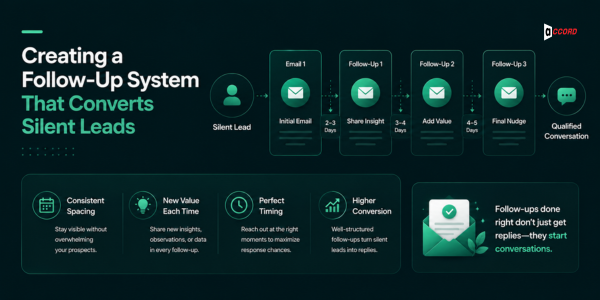
A follow-up process should set the number of messages, the gap between them, the purpose of each message, and the stop rules. It should also assign reply owners and response times. Each follow-up needs a new reason to respond. Repeating the first pitch with different wording adds pressure but gives the contact no new value.
A sequence is a starting plan, not a fixed law. The right pace depends on the market, offer, and feedback.
Give every message a separate job. One can clarify the problem. Another can share a short checklist or observation. A later message can ask whether another person owns the issue. The final message should make it clear that the sender will stop contacting the person.
Stop the sequence when someone replies, asks to opt out, changes company, or produces a hard bounce. The system should prevent another scheduled email from going out after any of those events.
Reply handling needs its own rules. Use simple categories:
- Interested
- Needs more information
- Not now
- Wrong person
- Not interested
- Opted out
Positive replies should move to a person who can answer questions and confirm fit. Negative replies and opt-outs should update the campaign record immediately. A useful response loses value when it waits in a shared inbox without a clear owner.
How Do You Protect Email Delivery and Follow US Rules?
Protect delivery by authenticating the sending domain, using accurate contact data, raising volume carefully, watching complaints, and honoring every opt-out. For US commercial email, use truthful sender details and subject lines, include a valid postal address, and provide a clear opt-out method. Technical setup cannot make unwanted or misleading email safe.
Email delivery means reaching the inbox instead of being rejected or filtered. It depends on sender identity, sending behavior, recipient feedback, list quality, and message content.
Google's email sender guidelines require all senders to personal Gmail accounts to use SPF or DKIM authentication. Senders above Google's bulk threshold must use SPF, DKIM, and DMARC, meet domain alignment rules, and support one-click unsubscribe for marketing and subscribed messages. Google also advises senders to raise volume slowly and monitor domain reputation.
SPF identifies allowed senders, DKIM adds a verifiable signature, and DMARC sets failure handling and reporting. Test all three before campaign volume rises.
Legal compliance is a separate responsibility. The Federal Trade Commission's CAN-SPAM guide says the law covers commercial email and has no business-to-business exception. It requires accurate routing information, a subject line that matches the message, a valid postal address, a clear opt-out method, and action on opt-out requests within 10 business days.
Rules vary by market. Companies sending outside the United States should obtain legal guidance there. This article is not legal advice.
Before launch, check these items:
- SPF record is valid.
- DKIM signing is active.
- DMARC reporting is reviewed.
- Contact addresses are verified.
- Sender details are accurate.
- Opt-out works without friction.
- Suppression lists stay permanent.
For a deeper technical review, use Accord Tech Solutions' email delivery and sender trust checklist.
How Do You Turn a Reply Into a Qualified Conversation?
A reply becomes a qualified conversation when the company fits the target profile, the contact has a clear role in the decision, the problem matches the offer, and there is a reasonable next step. Interest alone is not enough. The reply process should confirm fit without turning the first response into a long form or a hard sales pitch.
Start by separating positive replies from polite responses, referrals, objections, and opt-outs. Then ask only what is needed to decide whether a short sales conversation makes sense.
A simple qualification check covers five points:
- Account matches the ICP.
- Contact owns the problem.
- Need is clearly stated.
- Timing is reasonable.
- Next step is agreed.
The reply owner should record the result in the customer relationship management system, or CRM. That record needs the original campaign, message angle, contact role, stated need, and outcome. This lets the team compare which audience and message combinations create useful conversations.
With permission, a suitable but delayed contact can move to an agreed follow-up date. A contact who says no or opts out should not enter another campaign.
Which Cold Email Measures Matter Most?
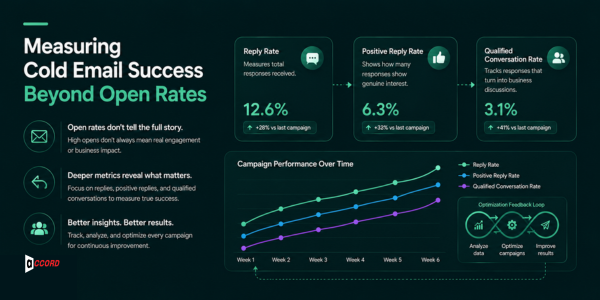
The most useful cold email measures are valid delivery, total reply rate, positive reply rate, qualified conversation rate, meetings held, and sales opportunities created. Review them by audience and message version. Open rate can help with limited testing, but it should not be the main success measure because third-party tracking cannot always confirm a real open.
Google states that it does not track open rates and cannot verify the accuracy of open rates reported by other tools. That is one reason to judge the system by human responses and sales outcomes rather than opens alone.
| Measure | What it helps diagnose |
|---|---|
| Valid delivery | Contact quality and sending setup |
| Total replies | Whether the message gets a response |
| Positive replies | Whether the audience and offer connect |
| Qualified conversations | Whether targeting produces sales value |
| Meetings held | Whether handoff and scheduling work |
| Sales opportunities | Whether conversations match real demand |
Review results by industry, company size, role, timing signal, message, and researcher. A single overall rate can hide a strong segment inside a weak campaign. Keep sample sizes visible and avoid calling an early result a proven pattern.
End each review with one decision: keep the segment, change one part, pause it, or stop it. Several changes at once make results hard to explain.
How Accord Tech Solutions Builds Cold Email Systems
Accord Tech Solutions treats cold email as a managed research and sales process. The work can cover target definition, account research, contact verification, message planning, sending setup, follow-up rules, reply sorting, and reporting. The exact scope is agreed in writing, so the client knows which tasks Accord handles and which remain with the sales team.
The process starts with the offer and ICP. Researchers verify accounts against approved criteria, and writers use those criteria for each audience group. Sending begins after data, domain setup, sequence rules, and opt-out checks are complete.
During a campaign, reporting focuses on replies, qualified conversations, meetings held, and useful sales feedback. Weak segments can be paused before they consume more contact data or sender reputation. Strong segments can be tested with one careful change at a time.
Typical work areas include:
- ICP and account criteria
- Contact research and verification
- Message and sequence planning
- Sender setup and monitoring
- Reply sorting and handoff
- Weekly performance review
Businesses that need help with this process can review Accord Tech Solutions' B2B lead generation services. Service scope, timing, and expected measures should be confirmed before any campaign begins.
What Does a Practical 30-Day Setup Plan Look Like?
A practical 30-day setup plan uses the first week for targeting, the second for data and sending checks, the third for message and reply preparation, and the fourth for a limited launch. The purpose is not to reach full volume in one month. It is to prove that the process works and reveal what needs correction.
Week 1: Targeting
Write the ICP, contact roles, qualification rules, exclusions, and offer. Review a small sample of accounts with sales before building the full list.
Week 2: Data and Sending
Research and verify contacts. Configure authentication, test the opt-out process, set suppression rules, and confirm that replies will reach a monitored inbox.
Week 3: Message and Handoff
Write message versions for each audience group. Prepare follow-ups, reply categories, qualification questions, response owners, and CRM fields.
Week 4: Limited Launch
Start with a controlled group. Check bounces, replies, complaints, and handoff speed every day. Change only one major item between test groups.
By month-end, the team should have a documented process, a clean test record, and a clear choice about the next audience and message.
Methodology and Sources
This guide was refined from the supplied draft and checked against Google's current email sender guidance, the US Federal Trade Commission's CAN-SPAM business guide, Accord Tech Solutions' existing cold email coverage, and recent 2026 practitioner discussions. Community comments informed the questions covered, but no unsupported reply-rate, revenue, or meeting claims were used as facts.
The article separates cold outreach from subscriber email marketing, avoids fixed performance promises, and treats legal rules as a subject for qualified advice. Product names from the source draft were removed because the operating process matters more than a vendor list in this guide.
Last reviewed: August 6, 2026.
Frequently Asked Questions
These questions cover the decisions teams usually face before launching a cold email system: what the system includes, how narrow targeting should be, how many follow-ups to plan, which delivery records matter, how to define a qualified reply, and when outside support may help. The answers give a starting point, not a universal rule.
What should a B2B cold email system include?
A B2B cold email system should include a written target profile, contact research, email verification, message rules, a follow-up plan, sender authentication, opt-out handling, reply ownership, qualification criteria, and reporting. Each stage should have an owner and a recorded outcome, so the team can find problems without guessing or blaming the copy alone.
How targeted should a cold email list be?
The list should be narrow enough that every contact shares a clear business problem and can receive the same core message honestly. Company fit, contact responsibility, location, timing, and exclusions should be written before research begins. If the team cannot explain why a contact belongs in one sentence, that record needs another review.
How many cold email follow-ups should you send?
There is no fixed number for every market. Start with a limited sequence in which each follow-up adds a new reason to respond, then review replies and complaints. Stop when the contact replies, opts out, changes role, or reaches the agreed end of the sequence. Do not keep sending because a schedule allows it.
Which domain records are needed for cold email?
SPF, DKIM, and DMARC should be configured and tested for the sending domain. Google's minimum requirements vary by sending volume, but using all three gives a clearer identity and reporting setup. Teams should also confirm reverse DNS where relevant, use secure delivery, raise volume carefully, and monitor complaints, bounces, and domain reputation.
What makes a cold email reply qualified?
A qualified reply comes from a company that matches the target profile and a person who owns or influences the problem. The response should show a relevant need, reasonable timing, or agreement on a useful next step. A friendly answer is not automatically qualified, and a referral may require a new contact check.
When should a business use a cold email service?
Outside support may help when the company has a clear offer but lacks time or staff for research, contact checks, sender setup, sequence management, reply sorting, and reporting. Before hiring, confirm the written scope, data sources, opt-out process, legal responsibilities, reporting measures, and who owns each sales reply after it arrives.
Build a System You Can Explain
A reliable cold email program is easy to explain from start to finish. The team can show why each account was selected, when each contact was checked, what each message is meant to do, who answers replies, and how a conversation becomes qualified. If those answers are missing, sending more email will only make the gaps harder to manage.
Begin with a narrow audience and a controlled test. Protect the sending domain, respect every opt-out, and judge the work by qualified conversations and sales outcomes. Then improve one part at a time based on what real replies show.