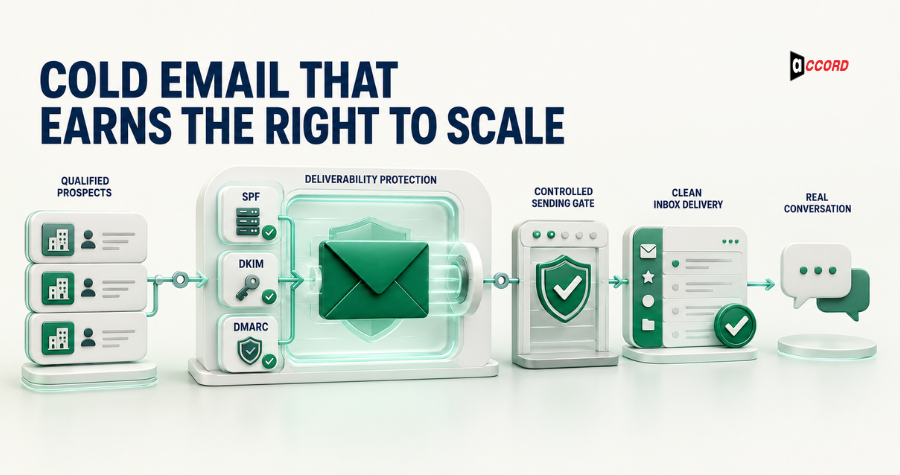
Quick answer: A deliverability-first cold email system protects sender reputation before it tries to scale. It uses authenticated domains, verified and relevant contacts, controlled sending patterns, clear opt-out handling, plain-language messages, and reply-based optimization. No setup guarantees inbox placement, but disciplined infrastructure and targeting can reduce avoidable risk and create better sales conversations.
Cold email campaigns rarely fail because of one weak subject line. More often, the whole system is misaligned. A team buys a broad list, connects it to new sending accounts, uploads several templates, and increases volume before learning whether the audience or offer is right.
The early dashboard can look busy. Messages are sent. Opens may appear. A few automated replies arrive. Then bounce rates rise, response quality falls, and sales begins to distrust the channel.
That is not a copywriting problem alone. It is an infrastructure, data, relevance, and operational discipline problem.
In 2026, a sustainable cold email program should be designed from the recipient backward. The prospect should understand why the message reached them, what problem it concerns, and what small next step is being proposed. At the same time, the sending setup should make identity clear, respect provider requirements, process opt-outs, and avoid behavior that resembles indiscriminate bulk mail.
This guide explains how Accord Tech Solutions approaches that connected system.
What does “deliverability-first” mean in cold email?
Deliverability-first means earning the right to send before increasing campaign volume. The team establishes domain authentication and monitoring, defines a narrow audience, validates contact data, sets conservative operating rules, and launches controlled tests. Copy and scale come after the foundations are stable—not before.
Deliverability is not the same as delivery. A message can be accepted by a receiving server yet filtered away from the primary inbox. It is also not a permanent score that a tool can certify. Providers use their own signals, recipients behave differently, and sender reputation changes over time.
A useful system therefore manages the inputs the sender can control:
- Identity and authentication.
- List source, accuracy, and relevance.
- Sending patterns and account health.
- Message quality and recipient expectations.
- Bounce, complaint, reply, and opt-out handling.
- Monitoring, testing, and corrective action.
The objective is not to “beat” spam filters. It is to behave like a responsible business sender and contact a carefully selected audience with a legitimate, relevant reason.
Build the sending foundation before writing sequences
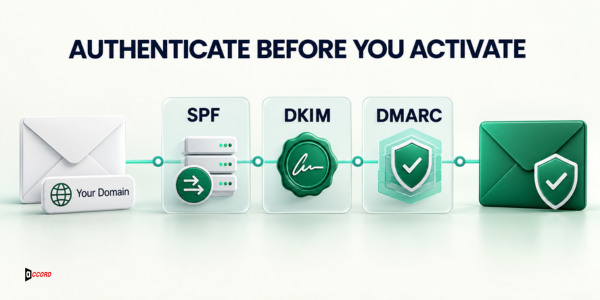
A cold email campaign should begin with domain ownership, authentication, mailbox security, tracking decisions, and monitoring. At minimum, teams need to understand SPF, DKIM, and DMARC, configure them correctly for the actual sending services, and confirm that message identity aligns as intended.
These controls serve different purposes:
- SPF identifies servers allowed to send mail for a domain.
- DKIM adds a cryptographic signature that helps receivers verify the message was authorized and was not altered in transit.
- DMARC tells receiving systems how to evaluate alignment and provides a framework for reporting and policy.
Configuration is not a copy-and-paste ritual. Multiple sending systems, forwarding, DNS mistakes, and misaligned domains can change the result. Use official provider documentation, test records, review authentication headers, and involve a qualified technical administrator when the environment is complex.
Mailbox security matters too. Use strong access controls, multi-factor authentication, controlled permissions, and documented ownership. A compromised sending account can create far more damage than a weak campaign.
Separate reputation protection from reputation theater
Sender reputation improves through legitimate, wanted communication and sound operations—not through a magic warm-up number. Gradual, consistent use can help teams identify configuration or quality problems, but artificial engagement cannot substitute for relevant recipients, responsible sending, and real replies.
There is no universal daily volume that guarantees safety. Appropriate volume depends on account history, domain reputation, audience, provider, complaint behavior, message type, and many other signals that senders cannot fully see.
Use internal operating guardrails instead of universal promises:
- Start with a small, qualified segment.
- Keep sending patterns stable enough to diagnose.
- Pause accounts showing unusual bounce, block, or complaint behavior.
- Investigate the source rather than simply moving traffic elsewhere.
- Increase volume only after data and response quality remain acceptable.
Avoid rapidly cycling through domains or accounts to escape poor results. That treats the symptom while leaving the targeting, copy, data source, or compliance problem untouched.
Make list quality part of deliverability
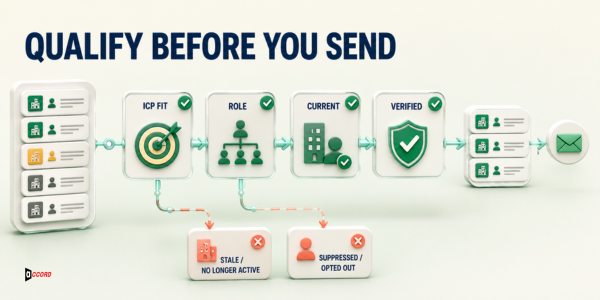
List quality affects both business relevance and sending risk. A campaign should contact people who match a documented ideal customer profile, hold a relevant role, work at an active company, and have contact data checked close to launch.
Email verification helps identify some obvious risks, but it cannot decide whether a recipient is appropriate. A technically valid address can still belong to the wrong persona, an old employee, a catch-all domain, or someone outside the intended market.
Before a record reaches the sending queue, confirm:
- The account meets the required ICP rules.
- The role is connected to the problem and offer.
- The company and person appear current.
- The address has an appropriate validation status.
- The record is not duplicated, suppressed, previously opted out, or otherwise excluded.
- The source and most recent check date are recorded.
Segment uncertain records into a research queue. Do not let a deadline turn incomplete data into sendable data.
Write for recognition, relevance, and low friction
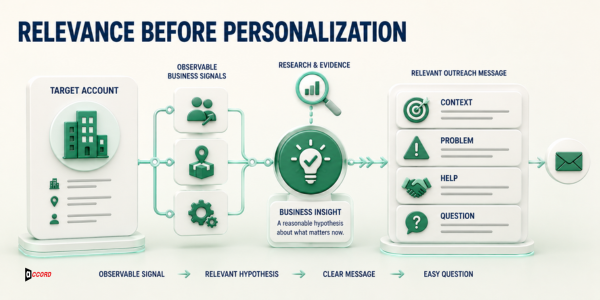
Effective cold email copy helps the reader recognize the context quickly, judge relevance, and respond without decoding a pitch. It usually works better when it focuses on one problem, one credible reason for contact, one clear value hypothesis, and one low-friction question.
A useful first message can follow this logic:
- Context: Why this company or person entered the research set.
- Problem hypothesis: The operational issue that may follow from that context.
- Relevant help: What your team does in plain language.
- Proof or process: A credible detail without invented results.
- Next step: A question the reader can answer easily.
For example, a relevant opening is not “I noticed you are an innovative company.” That could be sent to anyone. A better opening connects a current, public observation to an operational implication: the company is hiring across several sales territories, which may increase the need for account research and clean CRM routing.
Do not pretend to know a private pain point. Use language such as “may,” “often,” or “worth checking” when the evidence supports only an inference.
Keep personalization honest and useful
Good personalization explains relevance; it does not merely prove that a sender found a profile. Useful details change the substance of the message. Weak details decorate the first sentence and lead into the same generic pitch.
Personalization can happen at several levels:
- Segment level: Common problem for a defined market and persona.
- Account level: Company-specific signal, technology, expansion, or initiative.
- Role level: Responsibility and likely evaluation criteria.
- Individual level: A genuinely relevant public contribution or event.
Use the deepest level only when the value of the account and quality of evidence justify the research. A strong segment message sent to a carefully matched audience is better than automated “personalization” built from unreliable facts.
AI can help summarize public information and draft variants, but every claim should remain traceable. Remove awkward compliments, private-sounding assumptions, and facts the sender could not reasonably know.
Design follow-ups as a sequence of new reasons
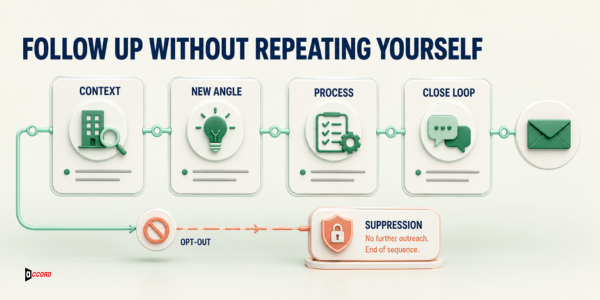
A follow-up should add useful context, not repeat “just checking in” several times. Each message can introduce a different angle: a clearer problem, a practical observation, a short process, a relevant resource, or a simpler question.
A restrained sequence might include:
- Message one: context, problem hypothesis, and a small question.
- Message two: a second operational angle or useful checklist.
- Message three: a brief explanation of the working process.
- Final message: a clear close-the-loop note with an easy opt-out.
Sequence length and timing should reflect the market, offer, and applicable rules. More touches do not automatically produce more qualified replies. If the audience is wrong, repetition multiplies the mismatch.
Thread messages when it helps context, but test how the sequence renders across devices. Keep signatures clear, links limited, and formatting simple. Never hide identity or make opting out difficult.
Treat opt-outs and suppression as system requirements
Unsubscribe handling should be fast, durable, and shared across every tool that might contact the person. An opt-out recorded in one campaign but ignored by another mailbox or CRM workflow creates legal, reputational, and recipient-experience risk.
Maintain a central suppression process that can account for:
- Explicit unsubscribe requests.
- Negative replies requesting no future contact.
- Global and campaign-specific exclusions.
- Existing customers or active opportunities when prospecting is inappropriate.
- Internal do-not-contact and competitor rules.
- Jurisdiction-specific consent or lawful-basis requirements.
Cold outreach laws and platform policies vary. CAN-SPAM in the United States, privacy and electronic marketing rules in other regions, and provider requirements may all apply differently. Obtain qualified legal advice for your specific markets and data practices rather than treating a blog checklist as legal approval.
Measure conversations, not vanity metrics
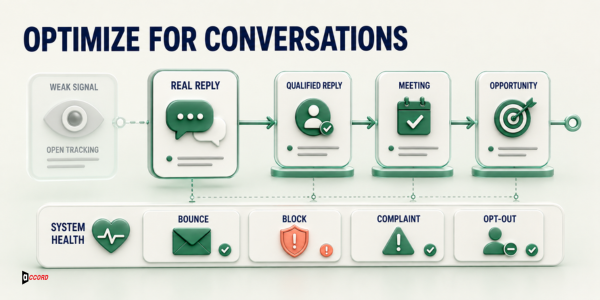
Cold email performance should be evaluated by deliverability health and meaningful sales outcomes. Open tracking is increasingly incomplete and can create its own technical tradeoffs, so use it cautiously. Prioritize bounce behavior, complaint signals, reply quality, qualified conversations, meetings held, and opportunities influenced.
Useful categories include:
- Delivered, bounced, blocked, or deferred.
- Positive, neutral, negative, automated, or unsubscribe reply.
- Qualified conversation by segment and persona.
- Meeting booked and meeting held.
- Opportunity created or influenced.
- Account or mailbox requiring investigation.
Look beyond the campaign average. One segment may generate strong conversations while another creates most negative replies. One data source may produce more stale contacts. One offer may work for operations leaders but not executives. Segment-level evidence tells you what to change.
Do not optimize a subject line because it produced more opens if the resulting conversations became less relevant. The sales outcome is the purpose of the system.
Diagnose problems in the right order
When performance drops, check infrastructure and data before rewriting every message. A disciplined diagnosis prevents teams from changing several variables at once and losing the ability to identify the cause.
Use this order:
- Authentication, DNS, mailbox access, and provider warnings.
- Bounce categories, blocks, and unusual sending changes.
- List source, recency, role accuracy, and suppression logic.
- Segment fit and the reason for contact.
- Offer clarity, copy, call to action, and follow-up design.
Run small controlled tests. Change one meaningful variable, set an observation window, and document the result. If a mailbox shows severe issues, pause and investigate rather than pushing through a sequence to preserve a schedule.
How Accord Tech Solutions builds cold email systems
Accord Tech Solutions connects cold email strategy with data quality, deliverability controls, segmentation, copy, execution, and reporting. That matters because a campaign cannot be repaired by copy alone when its underlying account selection or technical setup is weak.
Our process can include ICP definition, account and contact research, validation, campaign architecture, audience segmentation, message development, controlled launches, response classification, and iterative optimization. We use AI where it can improve research and workflow efficiency, with human review for judgment and quality control.
The objective is qualified conversation—not a promise of a particular open rate, reply rate, inbox position, or number of meetings. Results depend on the market, offer, data, infrastructure, timing, reputation, and sales follow-through.
Explore Accord Tech Solutions’ email marketing services and lead generation services to see how audience research and activation can work as one growth system.
Frequently asked questions
Can cold email still work in 2026?
Yes, cold email can still create B2B conversations when the sender has a legitimate, relevant reason to contact a carefully selected business audience and operates responsibly. It is less likely to work as a high-volume shortcut built on broad lists, generic copy, and weak technical controls.
Does SPF, DKIM, and DMARC guarantee inbox placement?
No. Authentication helps receiving systems verify sending identity and is an important foundation, but it does not guarantee inbox placement. Providers also consider reputation, recipient behavior, message characteristics, complaints, list quality, and other signals that may not be visible to the sender.
How many cold emails should a mailbox send per day?
There is no universal safe number. Appropriate volume depends on mailbox and domain history, provider rules, audience quality, response behavior, message type, and sending consistency. Start conservatively, monitor health, and scale only after the system produces stable, legitimate engagement.
Should cold emails include an unsubscribe link?
The correct method depends on applicable law, provider rules, sending configuration, and campaign context. Recipients must have a clear and reliable way to stop future messages, and the request should feed a durable suppression system. Seek legal guidance for the jurisdictions you target.
Is cold email the same as email marketing?
No. Cold email usually begins a one-to-one B2B conversation with a researched prospect who may not know the sender. Email marketing generally communicates with subscribers, customers, or an opted-in audience at scale. They require different expectations, workflows, messaging, and measurement.
Build the system before scaling the send
Cold email becomes more dependable when each layer supports the next. Clear ICP rules improve list quality. Better data supports relevant messages. Relevant messages create healthier responses. Careful operations protect the infrastructure that makes future communication possible.
That is the real meaning of deliverability-first. It is not a technical trick or a claim that every message will reach the primary inbox. It is a decision to protect long-term channel health while creating outreach a real buyer can understand and answer.
If your team is ready to replace disconnected tools and templates with an accountable workflow, contact Accord Tech Solutions to discuss a cold email system built around your market, offer, and sales capacity.
Methodology and sources
This guide reflects Accord Tech Solutions’ service positioning and established sender best practices. Technical requirements can change, so verify them with your email and mailbox providers. References include Google’s email sender guidelines, Yahoo’s sender best practices, the FTC CAN-SPAM compliance guide, and the Accord Tech Solutions Email Marketing service.
Last reviewed: August 13, 2026.