
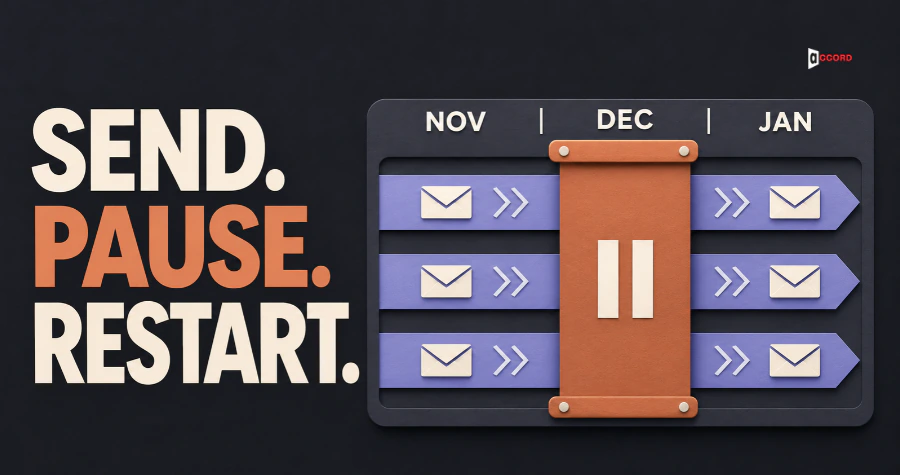
US Thanksgiving is Thursday 26 November 2026, and December follows fast. Your list is ready, but you do not know whether to keep sending, stop until January, or send twice as much before everyone leaves. A wrong guess can cost weeks of silence, or emails sent to people who are away.
The quieter risk is a good reply that arrives when nobody reads the mailbox, so the call never happens. In a B2B growth engine, that is a broken handoff between email and your booking page. The answer for cold email during holidays is not a plain yes or no. It is a dated calendar and a three-point check before each send.
We could not open an independent study of reply rates for cold email during holidays, so this post states none. The dates, volume levels and gaps below are our own starting points.
Where does holiday cold email fit in a B2B growth engine?
A B2B growth engine is a connected system that helps the right buyers find, trust and respond. It has five parts: SEO and AEO (answer engine optimization), lead generation, email, web development and social media. The live post names them search visibility (SEO and AEO), account data (lead generation), outbound outreach (email), website conversion (web) and social proof (social). SEO and AEO help buyers and AI answer tools find you, lead generation lists who to reach, email starts conversations, web pages turn attention into a booked call, and social builds trust.
The parts pass signals to each other. A signal is something a buyer does that shows where they stand, such as a reply, a form fill or a booked call. Passing a signal on is a handoff.
Holiday timing belongs to the email part. It receives an account list from lead generation and, often, a page or post the reader has already seen. It sends on signals, such as replies, to your team and a booking link to the web part.
When this part is weak, the damage shows up in the other parts. If email pauses but lead generation keeps adding accounts, the accounts you chose in November wait unsent, and a job post or launch that justified a message is stale by January. If a yes arrives on Tuesday 22 December and your booking page still offers 29 December, the buyer picks a day when nobody is at work.
Here is a ten-minute check. Open your booking page, your sending tool and your list source. Is your booking page free of any slot from Wednesday 23 December to Friday 1 January? Does whoever builds your lists know the date your first messages stop? Can you name who reads each mailbox on each sending day? Any "no" is the part to fix before you send.
What is the plan for cold email during holidays, week by week?
The calendar runs from Monday 23 November 2026 to the restart on Monday 4 January 2027. "Normal" means the number of emails you sent per working day (Monday to Friday) in the three weeks before 23 November, first messages and follow-ups together. It is also your daily cap, or 50 per mailbox if that is lower. The two pauses are called pause windows: Wednesday 25 to Friday 27 November, and Wednesday 23 December to Friday 1 January. In this post, a business day is a Monday to Friday outside the pause windows. Other public holidays, such as Veterans Day, count as business days, because many firms work.
| Dates (2026-27) | New first messages | Follow-ups due | Daily cap on emails sent |
|---|---|---|---|
| Mon 23 to Tue 24 Nov | Yes | Yes | Normal |
| Wed 25 to Fri 27 Nov (Thanksgiving is Thu 26) | No | No, clock frozen | 0 cold emails |
| Mon 30 Nov to Thu 17 Dec | Yes | Yes | Normal |
| Fri 18 to Tue 22 Dec | No | Yes | Normal |
| Wed 23 Dec to Fri 1 Jan | No | No, clock frozen | 0 cold emails |
| From Mon 4 Jan | Yes | Yes | Normal |
Thanksgiving. In our view many offices are quiet around the holiday, so the plan pauses Wednesday to Friday. Monday 30 November is six calendar days after the last send, so it restarts at normal volume.
The last first message. The last new first message goes out on Thursday 17 December, so its follow-up 1 lands before the pause, on Tuesday 22 December. One sent on Friday 18 December would wait 17 days for follow-up 1, until Monday 4 January. Follow-ups to people who already heard from you still go out on 18, 21 and 22 December. Sequences that start from Monday 7 to Thursday 17 December will show one gap of 16 to 19 calendar days between follow-ups. That is the price of the freeze.
The second pause. It covers Christmas Day (Friday 25) and New Year's Day (Friday 1 January 2027). No cold email goes out, so no send can ignore a stop request that arrives then. Read the sending mailboxes on Wednesday 23 December, to catch stop requests from the last sends, and again on Tuesday 29 December. Add every stop request to your do-not-email list, and answer each real reply with one line that gives your January call dates.
Restart. Monday 4 January returns to normal, not above it.
If you sell mainly outside the United States, these dates do not fit. Look up each reader's public holidays and rebuild the table.
Should this email go out today? Three checks
Run these before each send. Send only if all three are true.
- The calendar allows this kind of email today. The table shows, for each date, what may go out.
- Nothing shows the reader is away. An automatic away reply you have already received counts. For your top accounts, also check the company site for a closure notice. If either shows an absence, hold the email until two business days after the return date.
- Someone on your team can read and answer a reply within one business day. If nobody will be at the mailbox, do not send that day. For any send from 18 to 22 December, that person must also read on 23 and 29 December, for stop requests and real replies. A stop request left unread is a risk you cannot take back.
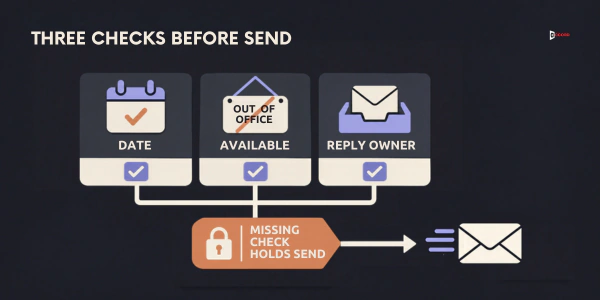
If any check fails, the email waits. If nothing shows an absence, check 2 passes. In our view an away reply costs little, because it pauses the reader and gives you a return date.
A reply to someone who wrote to you is not a cold send. Answer it on the same working day when someone is at the mailbox. It sits outside the calendar and the daily cap, but do not book a call inside a pause window. What if nobody replies? Check the batch in the order our guide to cold email deliverability gives, then read the measuring section below.
How should you change sending volume around the holidays?
Keep volume steady where you can, and change it in small steps. Google's email sender guidelines have a section called "Increase sending volume slowly to avoid delivery problems". It tells senders without a history of large volumes to avoid sudden spikes, to send at a consistent rate and to start low. Its example is that immediately doubling previously sent volumes could lead to rate limiting or reputation drops. A small sender is exactly who that advice is for.
Yahoo says something close in its sender FAQ. It names no volume threshold, warns that a sudden spike of activity could get you flagged as a compromised sender, and advises spreading campaigns out over time.
Three rules follow. They are our reading, not rules from Google or Yahoo.
Do not catch up. If you normally send 80 emails a day from two mailboxes and try 160 on Tuesday 24 November to make up for the pause, you have doubled your own volume in a day. Let the pause-day emails go unsent, or move them to open days that stay at or under the normal cap.
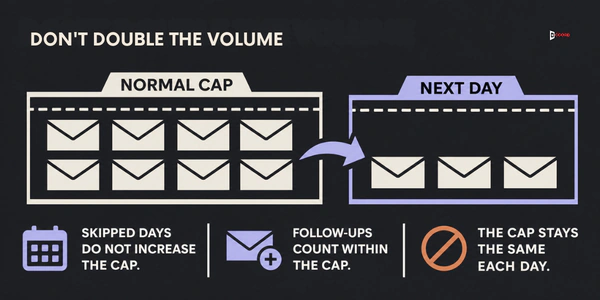
Count everything. Volume is every email sent from a mailbox in a day, first messages and follow-ups together. Our deliverability guide uses at most 50 a day per mailbox as its starting point.
Restart at normal, not above. We do not know how a provider reads a two-week gap, so do not exceed your normal volume after it. If you do not know your normal volume, read it from your sending tool for the three weeks before 23 November.
After the restart, send follow-ups first, oldest due date first, then new first messages with the room left under the cap. If follow-ups fill the cap, move the rest to the next day. Never raise the cap to clear a pile.
How do follow-up gaps change when there is a pause?
Our post on the cold email follow-up sequence sets four emails, with follow-ups on business days 3, 7 and 12 after the first message, which is day 0. That post moves a single holiday send to the next business day. This plan replaces that rule: freeze the clock for the pause windows, because a whole run of days is closed. Pause-window days do not count, no follow-up goes out inside one, and none is skipped.
Take a sequence that starts on Tuesday 15 December. Follow-up 1 (day 3) goes out Friday 18 December. Day 4 is Monday 21 December and day 5 is Tuesday 22 December, and then the clock freezes. Day 6 is Monday 4 January, follow-up 2 (day 7) goes out Tuesday 5 January and follow-up 3 (day 12) on Tuesday 12 January. The gap between follow-up 1 and follow-up 2 is 18 calendar days. The daily cap may delay a follow-up, and late is safer than a spike.
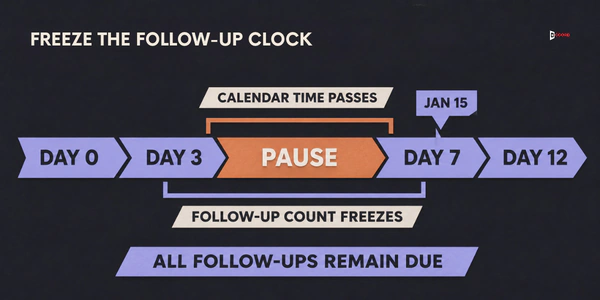
A sequence that starts on Friday 4 December finishes on Tuesday 22 December, the last start date that does. What if you start later? Send and let the clock freeze, as above. Hold the first message until Monday 4 January only if it depends on a fact that may go stale, such as a job post or a launch.
The stop rule does not change. Any genuine reply, stop request or spam report ends the sequence that day, so check for them on the first morning back, before the first send.
What should you change in the wording?
Your first message keeps its four parts: reason, problem, help and one question. Only the timing words change.
Use dates, not relative words. "Next week" means something else if the reader opens the email five days later. Write "on Tuesday 5 January".
Do not guess the reader's mood or invent a deadline. "I know this is a busy time" assumes something you do not know. "Before the year ends" is a reason only if something real ends then, such as a price you can name.
Here is a reply to a yes that arrives just before the pause. Offer call dates on open days only. Square brackets show what you replace, and you send it in the same thread.
Subject: [The same subject line as the thread]
Hi [first name],
Thank you for the reply. Here are the two samples I mentioned: [link to a public page].
If you would like to talk it through, I can do [Tuesday 5 January] or [Wednesday 6 January] at [time and time zone].
Our team is away from [Wednesday 23 December] to [Friday 1 January], so I will answer in full on [Monday 4 January].
[Your name, job title and business name]
The two call dates must also be open on your booking page.
How do you handle out-of-office replies?
An out-of-office reply is an automatic message saying the person is away. If the text would be the same for any sender, it is automatic. If it refers to your email or answers it, such as "I am out until 4 January, please send it then", a person wrote it, and it is a real reply. Take that reader out of the sequence and set a reminder for the date given.
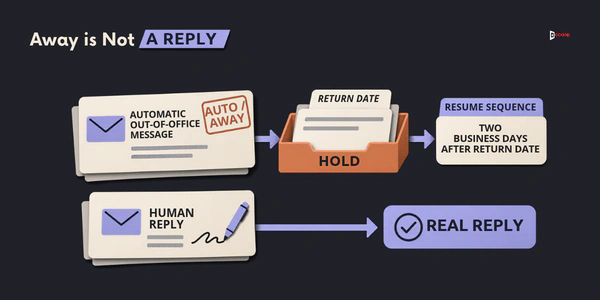
Do not count an automatic reply as a reply, and do not answer it. An away message says nothing about interest. Count it on its own line, as the measuring section shows.
Record the return date and pause the reader. Restart the sequence two business days after that date, with the step it paused on, and keep the usual gaps after it. In the running example, an away reply on Wednesday 16 December that says back on Friday 18 December restarts the sequence on Tuesday 22 December with follow-up 1. Pause-window days are not business days, so a restart never lands inside a pause.
If there is no return date, use a default. For an away reply that arrives from Tuesday 22 December to Friday 1 January, use Monday 4 January as the return date, so the restart is Wednesday 6 January. At any other time, restart 10 business days after the away reply arrives.
If the person has left the company, treat it as a wrong-person reply. End the sequence for that address and write a new first message to the right contact.
How do you measure holiday weeks fairly?
A holiday week can look worse than a normal week only because of how you count. We count conversations, not only emails sent, and we compare like with like, with the same number to divide by every time.
Step 1: group by send week. A send group is all first messages sent in one week, Monday to Friday.
Step 2: use one rate. The rate is genuine replies divided by delivered first messages in the send group. A delivered email is one that was sent and not returned as undelivered. A genuine reply is any reply written by a person that is not a stop request, whether it says yes, no, not now or wrong person. Automatic replies and stop requests are counted in Step 6.
Step 3: use one window. Count genuine replies that arrive within 14 business days of the first message, on the frozen clock. A reply that arrives inside a pause window counts as arriving on the next open day. The window covers all four emails, so check that each send group sent all four.
Step 4: set a baseline. The baseline is the three full work weeks before the plan starts: the weeks of 2, 9 and 16 November. Use the same list group and message in the holiday weeks. The range runs from the lowest weekly rate to the highest. It is a rough first look: with only three weeks, a normal week can land outside it about half the time.
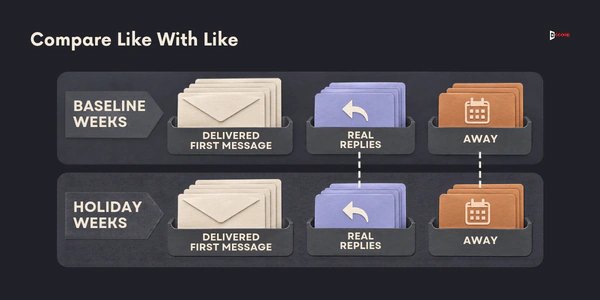
Step 5: read each holiday week against the range. Read the three December send weeks, those of 30 November, 7 December and 14 December. They run at normal volume, so volume does not muddy the comparison. A rate inside the range means you cannot call the week different. A rate outside it is not proof, so the size rule and the away share carry the decision.
The size rule. Call a week different only if its send group has at least 200 delivered first messages, which gives about 10 genuine replies at a 5% rate. This is our starting rule, not a statistical test, and it only decides whether to move one date next year. A smaller sender should not raise volume to get there.
Step 6: record two more rates. Count away replies and stop requests, each divided by delivered first messages, in the same 14-business-day window. An away share at least double its baseline (count a baseline of 0 as 1) fits the idea that readers are away. A rise in stop requests is a warning to check your list.
Use a pass line and a fix. If the holiday weeks fall inside the baseline range, keep the plan. If two or more holiday weeks are below the range, meet the size rule, and the away share is at least double its baseline, plan to end first messages one week earlier next year. Find that year's starting day by this year's rule: the last day on which follow-up 1 still lands before the second pause. Then rebuild the whole table. If the send groups are too small to read, say so and keep the plan. "We do not know" is a fair result in a first year.
Imagine: one small team, one holiday plan, six send weeks
Imagine Marisol Quinn, founder of Larkfield Route Planning, a three-person company that sells route-planning software to small heating and cooling firms. This example is invented, including every name and number, and is not a benchmark. Marisol sends from two mailboxes. A normal week has about 100 first messages, and her follow-ups bring the daily total to at most 80 emails.
She follows this post's calendar and reads the results on Monday 25 January, after every 14-business-day window has closed. Every send group sent all four emails. Each group has 100 delivered first messages. The week of 14 December has them Monday to Thursday, and the cap delays a few follow-ups by a day.
| Send week | Genuine replies | Rate | Away replies |
|---|---|---|---|
| 2 Nov (baseline) | 7 | 7.0% | 2 |
| 9 Nov (baseline) | 5 | 5.0% | 1 |
| 16 Nov (baseline) | 8 | 8.0% | 2 |
| 30 Nov | 6 | 6.0% | 4 |
| 7 Dec | 3 | 3.0% | 9 |
| 14 Dec | 4 | 4.0% | 14 |
The baseline range is 5.0% to 8.0%. The baseline away replies are 5 of 300, or 1.7%, and the holiday away replies are 27 of 300, or 9.0%.
How does she read this? The week of 30 November is inside the range, so she cannot call it different. The weeks of 7 and 14 December are 2.0 and 1.0 points under the lowest baseline week, but each group has 100 delivered emails, below the 200 the size rule asks for, so she cannot call them different either. The away share rose from 1.7% to 9.0%, which fits readers being away but does not prove a cause. She keeps the plan, and she does not double her volume to reach 200.
Now follow one signal through her growth engine. A yes to a first message from the week of 7 December arrives on Tuesday 22 December, the last open day. Her booking page has been closed for 23 December to 1 January since 7 December, so it offers Tuesday 5 and Wednesday 6 January, the same two dates as her reply. The buyer books Wednesday 6 January, and the call lands on her calendar. The 27 away replies are different. They stay out of the reply rates, and each goes to her sequence tool with its return date.
Frequently asked questions
Next step
Accord sells these five services as one connected growth engine. In a session we check how your email, list and booking page share the holiday dates, and which part of your growth engine is weakest. If you would like a second pair of eyes, book a 30-minute working session with us. Bring your daily volume, your follow-up schedule and the list groups you plan to email by 17 December.