
It is Tuesday, 9:14 a.m. A buyer you have been emailing for two weeks fills in the form on your website: "We plan routes for 14 trucks by hand. Can someone call me about pricing?" At 10:00 a.m., the next email in your outbound sequence goes to the same person and begins "Just checking that you saw my last note." The colleague who watches the form has written back too. The buyer now has two replies from two people who do not know about each other.
The short answer: the sequence pauses (we aim for 15 minutes), one owner is decided, and that one person replies (we aim for one business hour). In a B2B growth engine, this is a handoff between the email part, which starts conversations, and the web part, which receives them, so your rules for lead ownership inbound and outbound have to say who replies when the two meet. The rest of this post shows how to spot the match, choose the owner, write the reply and repair a message that already went out.
Why does a form fill in the middle of a sequence cause a clash?
A sequence is a series of scheduled emails, and sometimes calls or LinkedIn tasks, that a tool sends to one contact until the contact replies or the series ends. A form fill is a person using the contact form on your site to ask you something. A download or newsletter form is not a request, so this post leaves it out.
The sequence belongs to the person who set it up, often a sales development rep, and it runs on a timer. The form belongs to whoever watches it that day, and it runs on a reply-time target, the time within which someone must answer.
Nothing connects the timer to the form unless you connect them. So a buyer who asked a direct question gets a nudge written for a stranger. Replies to the emails themselves are a different case, and this post covers only the form. The limits and times below, and the extra rule at question 3, are our own starting points and judgment, not industry standards.
Where does a form fill in a sequence fit in a B2B growth engine?
A B2B growth engine is a connected system that helps the right buyers find, trust and respond. In our version, five services are the parts: search visibility (SEO and answer engine optimization, or AEO), lead generation, email, web and social.
This topic sits where two parts meet. The sequence is the email part and the form is the web part. A form fill is a signal, something a buyer does, that travels from the web part back to the email part, and the email part has to stop when it arrives. If the form also overwrites the first source with "website form", lead generation never learns that its list produced a buyer.
Here is a ten-minute check. Take your last five form fills, or all of them if you have fewer. For each one, look in your sequencing tool and your CRM (customer relationship management tool, the database of your contacts and deals). Was the person in an active sequence when the form arrived? Does the record still show both the first source and the form? If you cannot tell for even one, the two parts are not connected yet. With no forms yet, run the test in the next section.
What does your sequencing tool stop on its own?
Do not assume your tool pauses when a form arrives. A reply, a booked meeting or an unsubscribe happens inside the tool, but a form fill often happens on your website, which may be a different system from your sequencing tool.
One example, as read on 14 November 2026, is HubSpot. Its help page on unenrolling from a sequence, last updated 30 September 2026, lists the automatic triggers, such as a reply to a sequence email, a meeting booked through a link in one, an unsubscribe, an undeliverable email and workflows. A form submission is not on that list by itself. Its page on using workflows with sequences, last updated 30 October 2026, describes an Unenroll from sequence action and uses a contact submitting a form as its example trigger for enrolling. So a workflow that removes a contact from a sequence after a form submission can be set up in HubSpot, depending on your plan and your setup. That page does not walk through that exact case. Unenrolling stops upcoming steps only, so an email already sent is not undone, and it removes the contact rather than pausing, so note the step number. Other tools may differ.
Ask whether your tool stops on a form, and whether it can pause a contact or only remove one. Then test your own setup, even if the answer is yes. Put an address you own into a sequence with the next step due in an hour, fill in your own form with that address, and see whether the step is still scheduled.
What is the five-step rule when a sequence contact fills in the form?
- Match. Search your sequencing tool and your CRM for two different kinds of match. A contact match is the same person: the form's email address, or the same name at the same company. A company match is a different person at the same company, found by the company's web address. If the tool does not show sequence status in the CRM, trust the tool. Look for someone in an active sequence, meaning enrolled and not finished, even if the next step is days away.
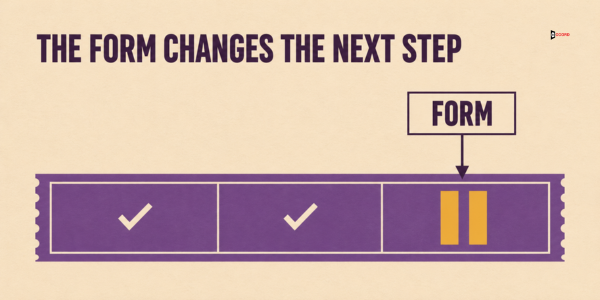
- Pause. If you find a contact match, pause that contact before anything else, within 15 minutes of the form arriving. A pause keeps the contact's place. If the tool has no pause, remove the contact and note the step number, so you can restart at the right step later. For a company match, the account-level rule in the edge cases below applies.
- Decide the owner. Use the table in the next section. If you cannot decide in ten minutes, the fallback owner (one named person, defined below) takes the lead for now.
- Reply once. The owner answers what the form asked, from one person, within the reply-time target. Our target is one business hour for any form that asks a question or a call, unless you set another.
- Log. Record the owner, the reason, the sequence, the first source and the step that did not go out ("stopped before step 4" means step 4 was held back). Remove the contact from the sequence after the owner has replied.
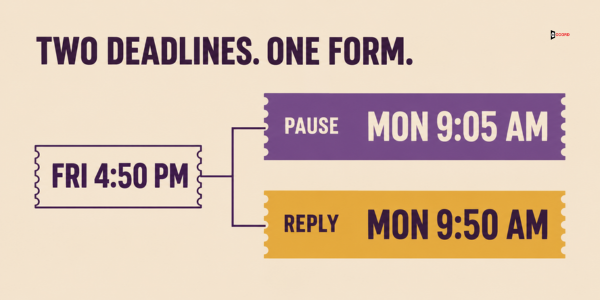
The 15-minute pause and the one-business-hour reply both count working hours only. With a 9 to 5 day, a form at 4:50 p.m. on Friday must be paused by 9:05 a.m. on Monday and answered by 9:50 a.m. on Monday. A sequence step that goes out in between counts as a stray message and gets the repair below, so set your tool to send only in working hours if it can.
If the form email matches nobody but the name and company do, or you cannot tell, treat it as a contact match and pause. A pause costs a few hours, and a second message to a buyer who just asked you a question costs more. If the match later proves wrong, count it as a false match in the monthly check.
Who owns the lead when a sequence contact fills in the form?
For lead ownership inbound and outbound, use the questions from our post on lead ownership rules, adapted to forms. Question 2 is reworded, question 3 gets an addition and a tie rule, and the question about a source's default owner is dropped, because a form fill in a sequence has a known sender. The addition: the sender of a live sequence already has a history with this person, so the sender counts as owner when there is no account owner. The live post's default owner is called the fallback owner here.
One role needs a name first. The fallback owner is one named person, with a named backup, who takes any lead the questions do not settle.
Every row starts with a pause, and the owner tells the sender if the sender is someone else. Go in order and stop at the first yes.
| Question | If yes, the owner is |
|---|---|
| 1. Does the company have an open deal? | The owner of that deal |
| 2. Does the form name one person, or point at the sender's emails, as in "Following up on the emails from your team"? | That person, or the sender |
| 3a. Is there an account owner or a named sender, with at most one person in those roles? | That person |
| 3b. Are the account owner and the sender two different people? | The fallback owner (a tie) |
| 4. None of the above | The fallback owner |
The fallback owner replies and keeps the lead, unless they hand it on in writing within one business day. An open deal comes first because a buyer already in talks should hear from one voice.
What should the first reply say?
The reply should answer the form, with one plain line about the earlier emails and no leftover pitch.
Here is a sample for the case where the sender owns the lead. The names are invented, and the call offer is fine because the contact asked for a call.
Subject: Your question about pricing
Hi Priya,
Thank you for writing on our site. You told us you plan routes for 14 trucks.
A price range also depends on how many delivery stops each truck makes per day. If you tell me that, I can send a range today.
I also wrote to you last week about route planning. I have stopped those emails, so you will hear from me only.
If you would rather talk, would a call on Wednesday at 10:00 or Thursday at 2:00 suit you?
Mei
Here is a sample for the case where a different person owns the lead.
Subject: Your question about pricing
Hi Priya,
Thank you for writing on our site. I am Ravi, and I will look after your request.
You may also have had emails from my colleague Mei about route planning. Those have stopped, so you will hear from me only.
[One or two lines that answer what the form asked.]
Ravi
Answer before you ask. Say the earlier emails have stopped only if they have, so check the pause first. Leave out opens, clicks and page visits your tools recorded. Send from one named person, not "the team".
How do you log the source so nothing gets lost?
A form fill must not erase the sequence. If your system shows only "Source: website form", you lose the fact that outbound work started the conversation. If it shows only "outbound", you lose the fact that the buyer came to you.
Keep both facts in separate fields. Five are enough. First source: the first thing that reached the contact: the sequence name, the list or lead source it came from, and the date of step one. Never overwrite it. Latest source: the form, with the date, the time and the page. Sequence status: paused or removed, the step that did not go out, the time and who did it. Owner and reason: the owner and the question number, for example "question 3, sender". Stray message: yes or no, and if yes, which step and what time.
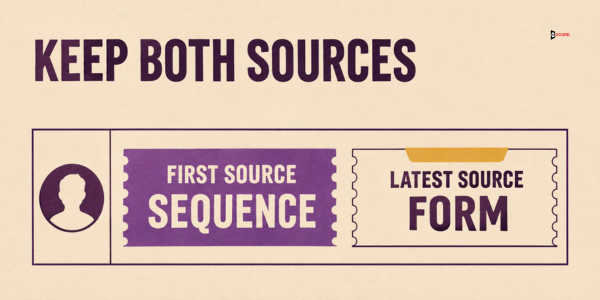
If your tool has no second source field, use a notes field with the same labels, and count the lead once in your pipeline. The form may also create a second record. Link it to the first before the owner replies, so the owner sees the whole history. Merge the two only after you confirm that both records are the same person: the same email address, or the same name, company and job title. A company match alone is never enough to merge. Our guide on CRM deduplication rules covers how to plan a merge and how a merge can change who owns a record.
What if the sequence sends a message after the form arrived?
Pause now. Stop further steps first, because the next one may be due soon.
Read what went out. A follow-up that ignores the form, such as "Just checking in", is the mildest kind. A pitch about the same thing the contact asked about, or a meeting request, is next. A message that conflicts with what the contact said, or that arrived after a stop request, is the serious kind.
Add one sentence. If nobody has answered the form yet, the owner's first reply starts with: "You may have had an automatic follow-up from [sender's name] today. Please ignore it. [Owner's name] has your request and is handling it." If the owner is the sender, it reads: "You may have had an automatic follow-up from me today. Please ignore it. I have your request and I am handling it." If the owner already replied, send the line as a separate note the same day.
Log it and find the cause. Mark "stray message: yes" with the step and time. Then ask why: a slow pause, a form nobody checked for an hour, or a step queued in advance.
For the serious kind, add one thing: if the contact asked to stop, in the form or in any reply, remove the contact from every sequence and add the address to your do-not-email list the same day. A contact who unsubscribed earlier and then fills in the form can get a direct answer to the question, but stays out of every sequence. Cold email rules differ by country, so check yours. This is not legal advice.
If the buyer does not answer the owner's reply, the contact moves to your normal follow-up for inbound requests, not back into the sequence.
What are the edge cases?
Someone else at the same company fills in the form (a company match). Priya is in the sequence, but her colleague Tom fills in the form. This is our account-level rule, and you may set a different one: pause every sequence contact at that company until the owner decides. The owner then resumes each one at a chosen step, or removes them, and logs which. Tom's form counts as a confirmed match in the monthly numbers. The HubSpot page above describes a setting that removes a contact when a colleague at the same company replies, so check whether your tool can do this for a form.
The owner wants the contact back in the sequence. The HubSpot page says re-enrolling sends the emails as new sends and lets you pick a starting step. So choose the step on purpose, in writing, and do not start again at step one.
How do you check each month that the rule works?
Each month, count five things. Three of them are rates with the same base: confirmed matches, meaning forms that matched an active sequence by email address, name or company, where you checked and found the sender was that contact or a colleague at the same company. A false match is a pause that turned out to match nobody in a sequence. Count false matches on their own and keep them out of the base. They show how often your matching rule pauses a sequence for nothing. With no confirmed matches, leave the rates blank. The message count has no base. Write one line on the cause of each miss.
| Count | Aim |
|---|---|
| Confirmed matches paused within 15 minutes | All of them |
| Sequence messages sent after a form arrived | Zero |
| Confirmed matches answered within the reply-time target | All of them |
| Confirmed matches with both sources logged | All of them |
| False matches (paused, but nobody matched) | No target: read each cause |
One more number is for information, not a target: confirmed matches divided by the contacts in an active sequence that month. A result of zero may mean nobody matches forms to sequences.
Imagine: one contact, one form and one stray message
This example is invented, including every name and number, and the numbers are not a benchmark. Imagine Marlow Route Software, a seven-person company that sells route-planning software to food distributors. Mei is the sales development rep and sends the sequence. Ravi is an account executive on duty for the form this week. Joan is the founder and the fallback owner. The reply target is one business hour, and the pause target is 15 minutes.
Lead generation gave Mei a contact: Priya Nair, an operations manager at an invented company, Kesterton Foods Distribution. Priya has received three of the five steps in Mei's sequence, and step four is due Tuesday at 10:00 a.m. Here is the version where the rule works.
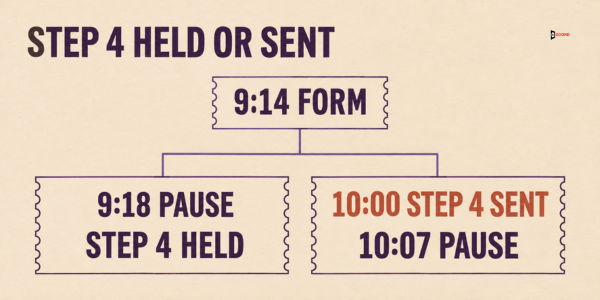
At 9:14 a.m., Priya fills in the form on the pricing page with the same request as in the opening. The form names nobody. At 9:16, Ravi searches Marlow's CRM, which shows sequence status, and finds her after step 3 of 5 of Mei's sequence, with step 4 due at 10:00. At 9:18, 4 minutes after the form, Ravi pauses the sequence.
At 9:20, Ravi asks the questions. There is no open deal, and the form names nobody and does not mention the emails. Kesterton has no account owner, but Mei is the named sender of an active sequence, so at question 3a Mei owns the lead. At 9:22, Ravi writes to Mei: "Priya Nair at Kesterton asked about pricing and a call on our form. She is in your sequence. I paused it before step 4. You own it. Please reply by 10:14."
At 9:48, Mei sends the first reply from the template, 34 minutes after the form. At 9:52, she removes Priya from the sequence and logs the five fields. The first source stays "route planning sequence, list: food distributors, step 1". The latest source is "form, pricing page, 9:14 a.m." The step that did not go out is step 4. Priya gets no stray message.
The form fill was the signal that told the email part to stop. Priya counts once in the pipeline, the list of conversations that may become sales, and the first-source field shows that the food distributor list produced a buyer.
Now change one fact. Suppose Ravi opens the form at 10:05 a.m., after step four went out at 10:00. He pauses the sequence at 10:07, 53 minutes after the form, and tells Mei. Mei replies at 10:25, which is 71 minutes after the form and 11 minutes past the target. Her reply starts with the sender version of the repair line, and she logs "stray message: yes, step 4 sent at 10:00 a.m.".
Over the next month, 120 Marlow contacts are in an active sequence, and seven forms match one of them by email address, name or company. Ravi checks each match. Six are confirmed, each once, and one is a false match: a different Priya Nair at another company, so that pause was for nothing. The second version above is one of the six, from a different contact. The 6 confirmed matches are 5.0% of the 120 contacts. Here are the counts for the 6. Five were paused within 15 minutes, or 83.3%, and the miss is the second version. One sequence message went out after a form, also in that case. Five were answered within the target, or 83.3%, with the same miss. Five had both sources logged, or 83.3%, because on one other form the first source had been replaced by "website form", which hid the outbound work. The false match count is 1, and Ravi keeps the rule as it is, because one wasted pause costs a few hours.
Ravi locks the first-source field and adds the sequence status to the form alert. Owners of the 6 were 1 at question 1, 1 at question 2, 3 at question 3a and 1 tie at question 3b that went to Joan, which adds up to 6. With 6 confirmed matches, one case moves a rate by 16.7 points, so Ravi reads the reasons, not the percentage.
Frequently asked questions
Should I stop the sequence as soon as a contact fills in my form?
Yes, pause it. A form is an open request, and the next sequence step does not answer it. Pause first, decide the owner next, and remove the contact once the owner has replied.
Who should reply when a sequence contact fills in the form?
One person, chosen in order: the owner of an open deal, the person the form names or the sender it points at, the account owner or sender, and then the fallback owner, one named person who takes any case the rules do not settle. If the answer is unclear after ten minutes, the fallback owner replies for now.
Does my sequencing tool stop automatically when someone fills in a form?
Not by default. HubSpot's help page on unenrolling from a sequence, read on 14 November 2026, does not list form submissions as an automatic trigger, though its workflows can unenroll a contact. Other tools differ, so test yours with an address you own.
What if the sequence already sent a message after the form arrived?
Pause the sequence first. Then ask the contact, in one sentence, to ignore the automatic follow-up, either at the start of the owner's first reply or in a short separate note. Log the stray message and find the cause.
How do I record the source when outbound and inbound both touched the lead?
Keep two source fields. The first source is the sequence, its list and the date of its first step, and it is never overwritten. The latest source is the form, with its date and page.
What if a colleague of a sequence contact fills in the form?
That is a company match, not a contact match. Pause every sequence contact at that company until the owner decides, then resume or remove each one and log which.
Next step
If you would like a second pair of eyes on your own rule for lead ownership inbound and outbound, book a 30-minute working session with the Accord team. In the session, we fill in the five steps together. Bring your sequence names, the person who watches your form, and the last three cases where a buyer got two replies. Accord sells lead generation, email, search visibility, web and social as one connected growth engine, so we have an interest in this subject.