
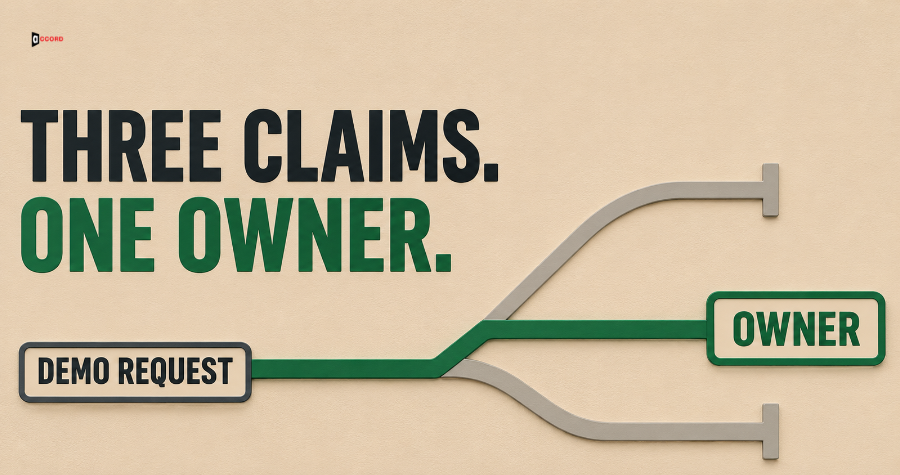
A demo request arrives from a distribution company. Three weeks ago, your sales development rep (the person who sends first emails and books meetings) wrote to their finance manager. Two weeks ago, your founder met their CEO at an event. Since September, a third colleague has been listed as the owner of the company in your customer database. By Tuesday afternoon, all three have sent a reply, or none of them has because each one thought another was on it. The lead ownership rules in this post settle that in a few minutes: five questions, asked in a fixed order, and the first yes decides the owner.
You get a copyable one-page rule, a worked conflict, a plain rule for the moment when nobody knows who owns the lead, and a test you can run on last month's leads. The order of the questions, the 30-day window and the one-business-day targets are Accord's own starting points, not industry standards. The only outside sources, two pages from one software vendor, are linked where they appear.
Why do three people claim the same lead?
A lead is a person at a company who could become a customer and who has done something that reaches you. They filled in a form, replied to an email, asked a question at an event, or were introduced by someone. Three people can claim the same lead because leads arrive through different doors, and each door has a different person standing at it.
A website form goes to whoever is on duty. A reply to a cold email goes to the person who sent it. An event chat feels like it belongs to the person who had it. Meanwhile the company already sits in the database under someone else's name. Each claim is reasonable. Nothing says which one wins.
Without a written order, teams fall back on habits. Some give the lead to whoever replies first, which rewards speed over fit. Others give it to whoever "knows them", which is not written anywhere and cannot be checked.
This post is narrower than our guide to the marketing-to-sales handoff without a revenue operations team. That guide decides who owns each step as a lead moves from marketing to sales. This one decides who wins when more than one person could own the same lead.
What does it mean to own a lead?
Lead ownership rules need a clear meaning of "owner". Here is the meaning used in this post.
The owner is one named person. The owner answers for the next step with that lead, and is the only person who contacts the lead about a sale until the owner passes the lead on in writing. Other people help through the owner. A colleague who wants to say hello tells the owner first.
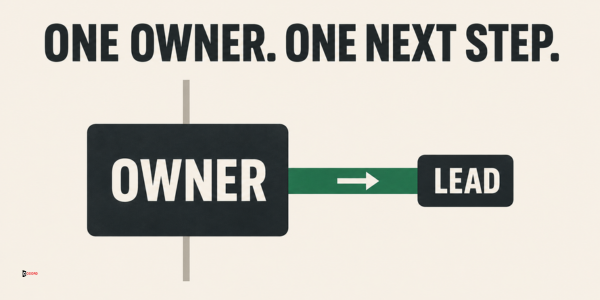
There is one exception. If the lead wrote to someone who is not the owner, that person may send the lead one introduction message, but only after the owner agrees. The message names the owner, says the owner will follow up, and has no sales talk. The sender logs it in the CRM. After that, the owner takes over.
Four terms come up often. An account is the record of a company in your customer database, usually called a CRM (customer relationship management tool). The account owner is the person named on that record. A deal, or open deal, is a record of a possible sale that is not closed and has had a recorded action in the last 30 days. A recorded action is an email, a call or a meeting that someone logged in the CRM. If it is not logged, it did not happen as far as the rule is concerned.
Ownership is not credit and it is not pay. Who earns a commission is a separate decision, written down separately. If you mix the two, people fight about ownership when they mean money. This post covers only who contacts the lead and answers for what happens next.
One more limit: this rule is for sales leads. A current customer who writes in with a support question goes to whoever looks after that customer, and the rule below does not apply.
Which five questions decide who owns the lead?
Ask the questions in order. Stop at the first yes. The answer to that question names the owner, and the later questions do not matter.
| Order | Question | If yes, the owner is | What counts as evidence |
|---|---|---|---|
| 1 | Does the company have an open deal? | The owner of that deal | A deal in the CRM, not closed, with a recorded action in the last 30 days |
| 2 | Did the lead reply to one person, or name one person? | That person | The reply thread, or the name in the lead's own words |
| 3 | Does the company have an account owner? | The account owner | A name on the account that was there before the lead arrived |
| 4 | Does the lead's source have a default owner? | The source owner | Your written list of sources and their owners |
| 5 | None of the above | The default owner | One named person with one named backup |
The order is our judgment, and another team could choose a different one. What matters is that it is written down before the conflict. Here is the reasoning behind each position.
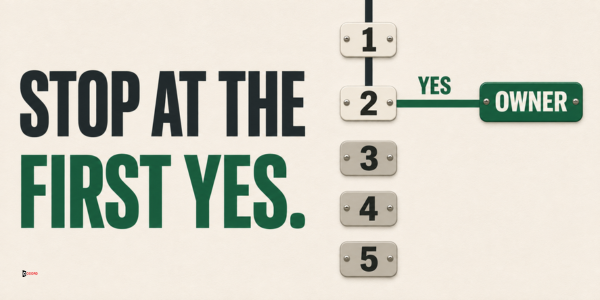
Question 1: an open deal comes first. A company that is already in talks should hear from one voice. If a second person writes to another contact there, the buyer may see two sellers who do not talk to each other. So the deal owner takes any new lead from that company, even a new person in a different department. A team can write exceptions, for example when a second product is sold by a different person. An exception counts only if it was written before the lead arrived.
Question 2: the person the lead chose. When a lead replies to one person's email, or writes a name in a form or message, the lead has made a choice. Overriding that choice may make the buyer repeat themselves. The soft forms count as well. A reply to a campaign email that was sent in one rep's name is a reply to that rep. A lead who writes "Joan told me to look at this" has named Joan.
Two things do not count: a reply to a team mailbox or a newsletter, and a line such as "a colleague mentioned you". Neither names a person. A lead's choice also does not expire. A reply to an email that is 90 days old still goes to the person who sent it, as long as that person still works for you. If the lead names two people, that is a tie, and the tie rule below applies.
Question 3: the account owner. If no deal is open and the lead chose nobody, the company relationship decides. The evidence is the account owner as recorded before the lead arrived. A note written afterwards that says "I know this company" is not evidence. In a 2020 post, the vendor Gradient Works argues that sales reps should own accounts and not individual leads. That is one vendor's view. For a small team, we put the lead's own choice (question 2) ahead of the account.
Question 4: the source owner. Many leads come from sources with a natural owner, such as the rep on duty for website demo requests or the person who ran the webinar. Write these in a short list. The handoff guide linked earlier has a table of sources and clocks that you can reuse.
Question 5: the default owner. One named person, plus one backup, owns any lead the first four questions cannot settle. As a starting point, make this the founder or the head of sales. The default owner is not a dumping ground. They decide within one business day who should work the lead, and they write down why.
What do you do when two answers collide?
Sometimes the questions give two owners at the same level, not one. Two deals are open for the same company with different owners. A lead names two people. Two account owners are listed for one company because of a merge. We call this a tie.
The tie rule is short. The default owner decides within one business day, and writes the reason next to the lead in one sentence. Until then, nobody contacts the lead except the default owner, and only if the lead asked for a reply. Do not let the two claimants settle it between themselves, because the lead waits while they talk.
A second collision is slower. The owner takes no recorded action by the reply-time target your team has set. Our starting point is one business day for a lead that asked for contact, and our guide to a speed-to-lead response-time promise by trigger explains how to choose it. When the target passes with no action, the lead moves to the default owner, and the move is logged.
A third collision comes from the past. A rep holds a lead for months with no activity and will not let go. That is why the rule defines an open deal by a recorded action in the last 30 days. The Gradient Works rules-of-engagement toolkit gives 60 days of inactivity as its example, so the number is a choice. Pick one you can check, and apply it to every deal in the same way.
What if nobody knows who owns the lead?
"I do not know" is a real answer. The CRM has two records for the company. The email came from a free mail address with no company name. The rep who last wrote to the company left in the summer. Without a rule, either everyone asks in the team chat, which invites three people to say "I know them", or nobody does anything.
Use this rule instead. It has four steps and takes about ten minutes.
- Check the records only. Search the CRM for the company name and the web address, and look for an open deal. Search the shared inbox for earlier messages to or from that person. Do not ask the team who knows them. Memory is not a record, and a question to the team starts three claims.
- Treat each unanswered question as "no". If, after ten minutes, you cannot tell whether a deal is open, answer question 1 with no, and move to the next question. Do the same for any other question you cannot answer.
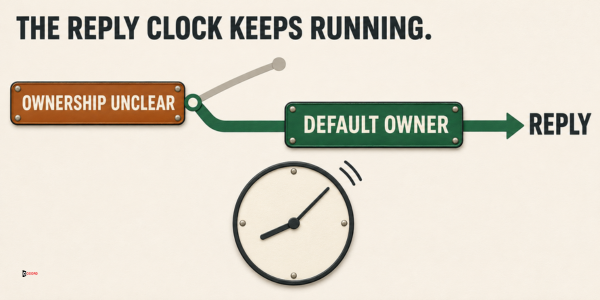
- Let question 5 catch what is left. The default owner becomes the provisional owner. Provisional means the default owner may reply to the lead if the lead asked for contact, and must decide the real owner within one business day.
- Write the gap down. In one line, say what was missing: no account owner, two records, no source. The line is what fixes the rule later.
The speed-to-lead clock does not stop while ownership is unclear. It starts when the buyer acted. If the buyer asked for contact on Tuesday morning, the default owner replies on Tuesday, and the ownership question can finish on Wednesday.
If two records for one company caused the doubt, ask the person who looks after your customer data to merge them. Our guide on CRM deduplication rules covers how to do that without changing owners by accident.
Imagine: one demo request, three possible owners
This example is invented, including every name and number. Imagine Oakline Software, a five-person company that sells scheduling software to distributors. Joan is the founder and head of sales, and she is the default owner. Ravi is an account executive, and Mei is a sales development rep. Joan's backup is Ravi.
On Tuesday, Tom Ellis, an operations director at Pellbrook Supply, replies to an email that Mei sent 21 days ago to Pellbrook's finance manager. Tom writes: "Can someone show me how this works?" Joan met Pellbrook's CEO at an event 14 days ago and logged a note, but she created no deal. Ravi has been the account owner for Pellbrook since September.
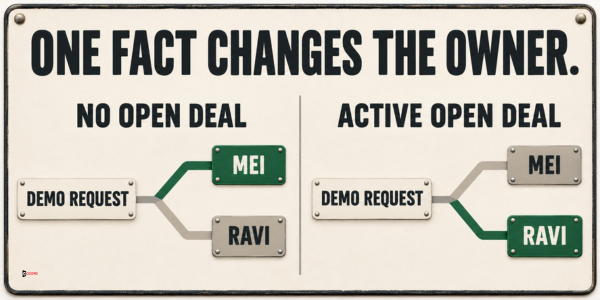
Run the five questions. Question 1: is there an open deal? No. Joan's note is a note, not a deal. Question 2: did the lead reply to one person? Yes. Tom's message answers Mei's email, so Mei owns the lead. The later questions do not matter, even though Ravi is the account owner and Joan has met the CEO.
Mei sends a same-day note to Ravi and Joan: "Tom Ellis at Pellbrook replied to my email and asked for a demo. I own it and will book it today." She may pass the lead to Ravi, but only with a one-line reason in the CRM. Until then, it is hers.
Now change one fact. Suppose Ravi had an open deal with Pellbrook, with an email logged 9 days ago. Question 1 is now a yes, and the owner is Ravi, even though Tom replied to Mei. Mei does not ignore Tom, and she does not sell to him either. She asks Ravi whether she may introduce him. Once Ravi says yes, she sends one short message that names Ravi as the person who will follow up, so Tom hears from a name he has already seen, and she logs it. That is the one introduction the rule allows. Ravi takes it from there.
Over the same week, 14 new leads reach Oakline. Two are decided at question 1, three at question 2, four at question 3, three at question 4 and two at question 5. That adds up to 14. The two that reached question 5 are 2 of 14, or 14.3%. One came from a free mail address and one had two company records. Thirteen of the 14 had a final owner recorded within one business day, or 92.9%. The fourteenth took two days, because the default owner was travelling and the backup had not been told. The fix was one line in the rule: the backup must be named in the rule, and the backup is told.
Before using the rule, Oakline ran it on 10 leads from the month before. Nine of the 10 gave exactly one owner with no discussion. The tenth named two people in the message, which produced the tie rule. These sample numbers are not a benchmark, and 10 leads is a small test. They show the method, not what your numbers will be.
What does the one-page lead ownership rule look like?
Here is a version to copy. Square brackets show what you replace. Keep it to one page, put it where the whole team can see it, and have the head of sales and the head of marketing approve it. If you have no marketing lead, the founder approves it.
Lead ownership rule for [company name], version [date], approved by [name].
One lead has one owner. The owner is the only person who contacts the lead about a sale, and answers for the next step, until the owner passes the lead on in writing with a one-line reason.
One exception: if the lead wrote to someone who is not the owner, that person may send the lead one introduction message, only after the owner agrees. The message names the owner, contains no sales talk, and is logged in [CRM name].
An open deal is a deal in [CRM name] that is not closed and has a recorded action in the last [30] days. An action that is not recorded does not count.
Ask these questions in order. The first yes decides the owner. If you cannot answer a question after ten minutes of checking records, treat the answer as no.
Question 1. Does the company have an open deal? The owner is the owner of that deal. Written exceptions: [list, or "none"].
Question 2. Did the lead reply to one person's message, or write one person's name? The owner is that person, if that person still works here. A reply to a team mailbox or a newsletter names nobody.
Question 3. Did the company have an account owner before the lead arrived? The owner is the account owner.
Question 4. Does the lead's source have a default owner? The owner is listed here: [source and owner, one per line in your own copy].
Question 5. If none of the above applies, the default owner is [name]. The backup is [name]. The default owner decides the real owner within [one business day] and writes the reason.
Ties: if two answers collide at the same question, the default owner decides within [one business day] and writes the reason. Nobody else contacts the lead until then.
Reply time: if the owner records no action within [one business day] of the lead's request, the lead moves to the default owner.
Changes: only [name] may change this rule. Every change gets a date and a version number. Ownership claims made after a lead arrives, such as "I know them", do not count.
How do you test the rule before you trust it?
Run the rule on past leads before you use it on new ones. In our estimate this takes about an hour, and it finds the holes while they are cheap.
Take 10 leads from last month. Pick a mix of forms, email replies, events and referrals. Give them to someone who did not work them. That person runs the five questions for each lead, using only the records as they stood on the day the lead arrived. Count the leads where the questions give exactly one owner without anyone debating it. That number is the numerator, and the 10 leads are the denominator.
As a starting target, 8 out of 10 should settle on the questions alone. This is Accord's own number and not a benchmark, so adjust it for your team. The leads that did not settle are the useful ones. Each one points to a missing line: a source without an owner, a company with two records, or a case the questions do not cover. Add one line to the rule for each gap, then run the test on 10 different leads.
How do you check each week that the rule works?
Pick one person to look at three numbers every week.
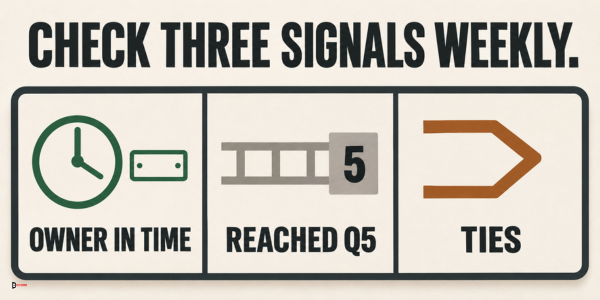
Owner recorded in time. Leads whose final owner was recorded within one business day of arriving, divided by all new leads that week. Count the week the lead arrived. Only the final owner counts. A provisional owner, the default owner who replies while the real owner is still undecided, does not count. The event that counts is the CRM entry naming the final owner, so a lead that gets its final owner on day two is a miss, even if a provisional owner replied on day one. Aim for all of them, and write one line of reason for every miss.
Share that reached question 5. Leads decided at question 5, divided by all new leads that week. If more than 1 in 5 reach question 5 for a month, the questions above it are missing something. Likely causes are companies with no account owner and sources with no default owner. Fix those, not the default owner's workload.
Ties. Count the ties the default owner decided, and read the reasons. A repeated reason is a rule waiting to be written.
If the numbers look fine but people still argue, ask each person which question they used on their last disputed lead. If they cannot say, the rule is on paper only. Walk through one real lead in your next weekly meeting.
What about leads that do not fit the five questions?
A few more cases may come up. Write a line for each one as it appears.
An owner leaves. The default owner reassigns that person's open deals and accounts within one business day of their last day, using the same five questions. Do not leave their leads where they are. A lead owned by someone who is gone is owned by nobody.
A referral names nobody. A partner or customer sends someone over without naming a seller. Treat it as a source and give the source an owner under question 4. If the referral names a person, question 2 decides.
The lead asks for a different person later. The owner may pass the lead on, with a one-line reason. If the owner refuses and the lead insists, the default owner decides. The buyer's request is evidence, but it does not change the owner by itself.
Frequently asked questions
Who should own a lead when marketing and sales both touched it?
Use the five questions in order: open deal, the person the lead chose, account owner, source owner, default owner. Marketing owns a lead only as the named source owner in question 4, and even then the owner is one person, not a department.
Should the first person to reply to a lead own it?
No. A "first to reply" rule rewards whoever is at their desk, not whoever fits best. Replies count only when the lead replied to a person's own message (question 2).
How long can a rep hold a lead without doing anything?
One business day for a lead that asked for contact, and 30 days without a recorded action for an open deal. Both are our starting points. Pick numbers you can check and apply them to everyone.
Should reps own companies or individual leads?
Both, at different questions. The company has an account owner, but the lead can have a different owner when the lead chose a person or a deal is open. For small teams, we put the lead's own choice ahead of the account.
Do we need a CRM to use lead ownership rules?
You need one place where the records live. A shared spreadsheet of deals and account owners can work for a very small team. A CRM also logs actions with dates, which the 30-day window needs.
What if the owner never contacts the lead?
It moves to the default owner after one business day with no recorded action, and the move is logged.
Next step
If you would like a second pair of eyes on your own rule, book a 30-minute working session with the Accord team. Bring 10 leads from last month and the names of the people who could have owned each one, and we will run the five questions together. You can use everything in this post without us. Accord sells outbound, email and lead-generation services, so we have an interest in this subject.