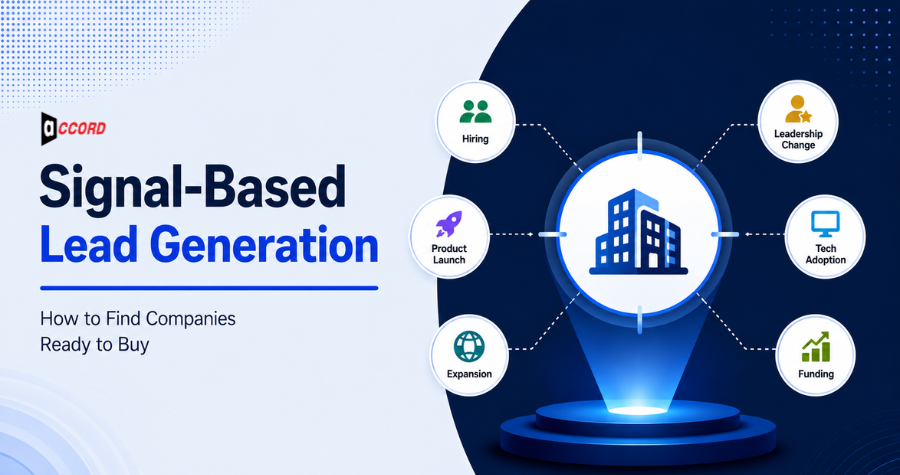
Quick answer: Signal-based lead generation prioritizes companies that match your ideal customer profile and show a recent, relevant change connected to your offer. Useful signals may include hiring, expansion, leadership changes, technology adoption, funding, product launches, or research behavior. A signal suggests timing; it does not prove purchase intent, so human validation remains essential.
Traditional lead generation asks, “Which companies could buy from us?” Signal-based lead generation adds a second question: “Why might this account care now?”
That distinction matters because a company can fit your ideal customer profile for years without entering an active buying cycle. It may have the right industry, size, location, and technology but no current pressure to change. Another company with the same basic fit may have just opened a new territory, hired a revenue operations leader, replaced a major platform, or started building a team related to your service.
The signal does not guarantee a purchase. It gives sales a better reason to prioritize research and begin a relevant conversation.
The best programs combine fit and timing without confusing public activity with private intent. They define signals before collecting them, verify the event, record when it happened, explain why it matters, and learn which combinations actually lead to qualified conversations.
What is signal-based lead generation?
Signal-based lead generation is a research and prioritization method that combines stable account fit with time-sensitive evidence of change. It helps sales and marketing focus on accounts where a relevant problem, initiative, or decision may be more active than it is across the broader market.
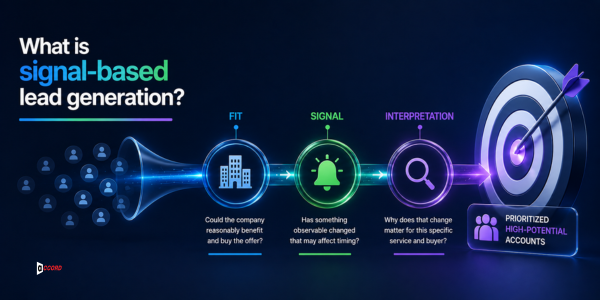
The method has three layers:
- Fit: Could the company reasonably benefit from and buy the offer?
- Signal: Has something observable changed that may affect timing?
- Interpretation: Why does that change matter for this specific service and buyer?
All three are necessary. A signal without fit creates noise. Fit without a signal may still be useful for long-term account coverage, but it gives less guidance about timing. A fit-and-signal combination without interpretation produces awkward outreach that simply repeats a news item.
Fit and intent are not the same thing
Fit describes the company’s structural match; intent describes evidence that the company may be exploring or experiencing a relevant need. Treating one as the other causes sales teams to over-prioritize visible activity and under-invest in market definition.
Fit tends to rely on slower-changing attributes: industry, location, business model, company size, customer type, regulatory environment, and installed technology. Signals tend to be more time-sensitive: hiring, executive changes, new initiatives, platform migrations, public research, funding, acquisitions, or expansion.
Some vendors use “intent data” to describe aggregated content-consumption or research patterns. That can be useful, but it remains probabilistic. It may show that people associated with an organization researched a topic; it does not necessarily identify the buyer, approved project, budget, or decision stage.
Use careful language internally. “Shows a relevant signal” is more accurate than “ready to buy” unless sales has directly confirmed the need.
Which B2B buying signals are worth tracking?
The best buying signals are observable, recent, connected to a problem your offer solves, and specific enough to support a next action. Signal value depends on context. The same event can be important for one service and irrelevant for another.
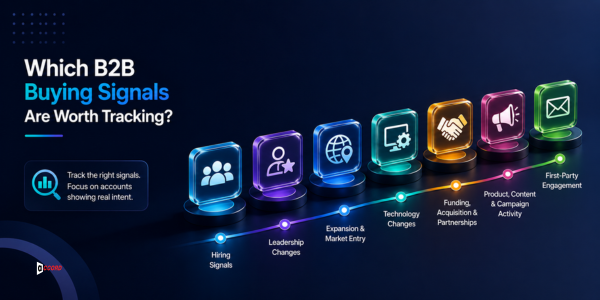
Hiring signals
Open roles can reveal investment priorities and operational gaps. A company hiring sales development representatives may need lead research, data, enablement, and outreach systems. A new marketing operations role may indicate upcoming CRM and automation work.
Read the job description, not only the title. The responsibilities, tools, territory, and reporting line explain more than the hiring announcement.
Leadership changes
New executives often review strategy, vendors, tools, and team structure. The value of the signal depends on the leader’s function and time in role. A newly appointed CRO may influence pipeline systems; a new CTO may care about platform architecture and integration.
Do not assume dissatisfaction or budget. Use the change as context for a relevant hypothesis.
Expansion and market entry
New offices, regions, languages, product lines, or customer segments can create website, SEO, data, content, and campaign needs. Confirm that the announcement reflects active operations rather than a distant aspiration.
Technology changes
A new CRM, marketing platform, analytics tool, or web framework can create implementation and data requirements. Technology detection is imperfect, and tools can coexist during migration, so corroborate the observation before referencing it.
Funding, acquisition, or partnership
Capital and corporate events may create resources or pressure, but they are overused signals. The event matters only when it can be connected to a likely initiative: headcount growth, system consolidation, new-market demand, or a changed go-to-market model.
Product, content, and campaign activity
Product launches, new service pages, large content programs, events, and advertising can show where a company is investing attention. A launch with unclear landing pages may create a conversion question; expanding into several topics may create a search architecture question.
First-party engagement
Website visits, event attendance, content downloads, email replies, demo activity, and past sales conversations can be powerful because they come from direct interaction. Use them with appropriate privacy, consent, access, and retention controls. Not every pageview represents a person asking to be contacted.
Create a signal-to-service map
A signal-to-service map states which events matter for each offer and explains the business logic between them. This prevents a research team from collecting news simply because it is available and gives sales a defensible reason for the account’s priority.
For each service, document:
- The observable event.
- The possible operational implication.
- The buyer roles most likely to care.
- The evidence required.
- The signal’s useful time window.
- The questions sales should ask rather than assume.
Example: several open sales roles across new territories may create a need for larger prospecting coverage and cleaner routing. Relevant buyers could include revenue operations, sales development leadership, and the CRO. The outreach should ask how the team is preparing account data for expansion, not claim that its database is broken.
The map also defines exclusions. A hiring post from nine months ago or a role that has already closed may be too stale. A funding announcement may not matter for an offer unrelated to growth or operations.
Find signals from sources you can verify
Signal research should prioritize traceable sources and store the source URL, observation date, and interpretation with each record. Company websites, official newsrooms, job pages, regulatory filings, reputable media, professional profiles, technology documentation, event pages, and first-party systems can all contribute.
Use source hierarchy. A company’s current careers page is stronger evidence of an open role than an old aggregator page. An official announcement is better evidence of a launch than an unsourced social repost. Third-party databases can speed discovery, but important signals should be checked when the account justifies the effort.
For every priority record, separate:
- Observed fact: “The company lists five open enterprise sales roles.”
- Source and date: Where and when the fact was checked.
- Inference: “This may increase account-research and CRM-routing needs.”
- Confidence: How reliable and relevant the conclusion appears.
That structure helps sales use the signal honestly and makes stale records easier to refresh.
Score fit and signals separately
Separate fit scoring from signal scoring so a short-lived event does not make a poor-fit account look attractive. Then combine the scores into a practical priority tier with explicit rules and room for review.
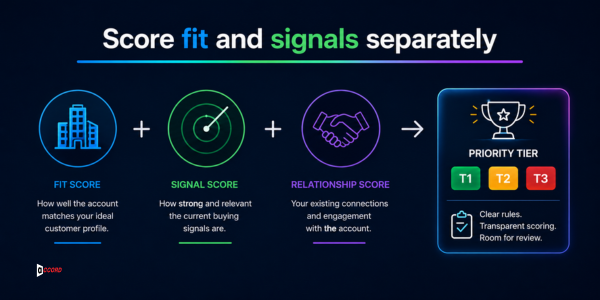
A lightweight model can use:
- Fit score: industry, size, geography, business model, technology, and exclusions.
- Signal score: relevance, recency, source confidence, and strength of business implication.
- Relationship score: existing engagement, prior conversation, referral, or known customer connection.
Use transparent scoring that sales can question. A complex model is not automatically better. If users cannot explain why an account is Tier 1, they will not trust the priority.
Review results by segment. If high-scoring accounts consistently reject the offer, the weighting or underlying hypothesis needs adjustment.
Match the contact to the signal
The person you contact should have a plausible role in the change identified by the signal. A company-level event may affect several members of a buying committee differently, so role mapping is more useful than simply selecting the most senior executive.
For a website migration, marketing may own content and conversion, engineering may own architecture, and leadership may own risk and budget. For CRM cleanup, revenue operations may diagnose the system, sales leadership may feel the productivity cost, and an administrator may implement changes.
Label the likely role of each contact: economic buyer, functional owner, technical evaluator, or user. Then adapt the question and evidence to that role. Never claim that public information reveals a person’s private priorities.
Turn a signal into a relevant message
A signal-based message should connect the observed event to a reasonable business question without exaggerating what the sender knows. The signal creates context; the message still needs a clear problem hypothesis, credible help, and an easy next step.
Use this structure:
- State the observation accurately and briefly.
- Explain the operational question it raised.
- Describe the relevant process or capability.
- Ask whether the topic is a current priority.
Avoid generic celebration followed by an unrelated pitch. Also avoid invasive language such as “we saw your team researching.” First-party or intent signals require careful governance and tact; a recipient should not feel surveilled.
If the signal is weak, use it only for internal prioritization and lead with the broader role-relevant problem.
Build signal workflows into the CRM
Signals create value when they enter a governed workflow with ownership, expiration, source, and a next action. Without that structure, teams accumulate alerts they never use or keep acting on events long after they are relevant.
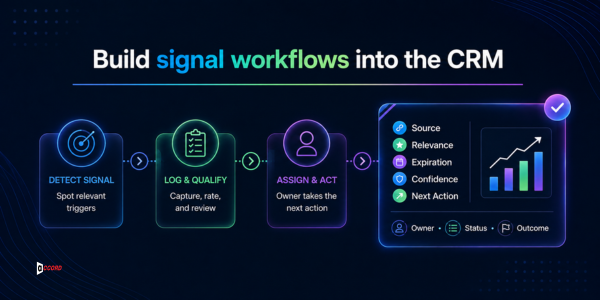
Useful CRM fields include:
- Signal category and description.
- Source URL and observed date.
- Expiration or review date.
- Confidence and relevance rating.
- Related service or campaign.
- Contact role and suggested question.
- Owner, status, and outcome.
Set alerts carefully. A small number of high-confidence events is more useful than a feed that trains users to ignore notifications. Define what happens when several signals occur at once and how existing customers, open opportunities, competitors, or suppressed contacts should be treated.
Measure whether signals improve sales decisions
Evaluate signals by their contribution to account acceptance, relevant replies, qualified conversations, meetings, and opportunities—not by how many alerts the system produces. Compare signaled and non-signaled cohorts carefully while accounting for differences in fit and sales effort.
Track:
- Accounts accepted or rejected by sales.
- Time from signal observation to action.
- Positive and negative replies by signal type.
- Qualified meetings and opportunities by fit-and-signal tier.
- Stale, incorrect, or misleading signals.
- Sources producing the most usable evidence.
- Sales feedback on the suggested message angle.
Review false positives. They reveal whether the problem lies in source accuracy, interpretation, timing, fit, or contact mapping. A signal program improves through disciplined feedback, not by adding more data feeds.
How Accord Tech Solutions builds signal-led prospecting
Accord Tech Solutions combines ICP research, account discovery, verified contact mapping, data enrichment, and relevant public signals to create prioritized prospecting datasets. The workflow is designed to help sales understand both account fit and the reason an account may deserve attention now.
Our B2B lead generation services can include contact prospecting, online research, validation, CRM data enrichment, and custom targeting logic. Where appropriate, those records can support segmented email campaigns, social outreach, or sales follow-up.
We do not label every active company “ready to buy,” and we do not guarantee meetings from a signal. The value comes from reducing arbitrary prioritization and giving sales a more credible starting point for research and conversation.
Frequently asked questions
What is a B2B buying signal?
A B2B buying signal is an observable event or behavior that may indicate a relevant business need is becoming more active. Examples include hiring, expansion, leadership changes, technology adoption, product launches, or first-party engagement. A signal is evidence for prioritization, not proof of budget or intent.
What is the difference between intent data and trigger events?
Intent data commonly refers to research or content-consumption patterns that may indicate topic interest. Trigger events are identifiable business changes such as a new executive, funding, hiring, or expansion. Both require context, validation, and careful interpretation before sales action.
How recent should a sales signal be?
The useful window depends on the event and sales cycle. A new job posting may require quick action; a market expansion may remain relevant for months. Define expiration rules by signal category and store an observation date so sales knows when to re-check the evidence.
Can AI identify buying signals?
AI can help classify articles, summarize company changes, map signals to hypotheses, and prioritize review. It can also confuse entities, use stale pages, or overstate intent. Keep source links, confidence rules, deterministic checks, and human review for high-value or ambiguous accounts.
Are website visitors automatically qualified leads?
No. A visit can have many explanations and may not identify the relevant person or buying stage. Use first-party engagement in accordance with privacy and consent requirements, combine it with account fit and other evidence, and avoid outreach that makes people feel monitored.
Use timing as evidence, not a promise
Signal-based lead generation is valuable because it makes prioritization less arbitrary. It gives sales a current reason to research one qualified account before another and helps the message begin with genuine context.
The discipline lies in what happens around the signal: define fit, verify the event, separate facts from inference, map the right contact, set an expiration, and learn from outcomes. Done well, this process creates a more focused pipeline. Done carelessly, it creates another noisy data feed.
If your team wants a signal-led research workflow built around its actual ICP and service logic, contact Accord Tech Solutions to discuss account research, contact verification, and CRM-ready delivery.
Methodology and sources
This article is based on Accord Tech Solutions’ lead generation, online research, and CRM data-enrichment process. It does not claim that public signals prove intent or guarantee outcomes. References include the Accord Tech Solutions Lead Generation service and LinkedIn Sales Solutions guidance on sales triggers.
Last reviewed: August 13, 2026.