
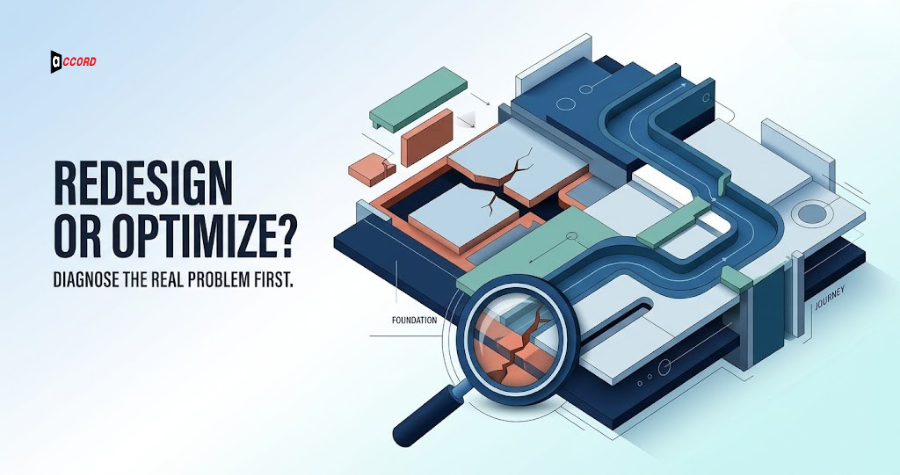
Quick answer: Choose a website redesign when the underlying platform, information architecture, brand system, accessibility, or core experience cannot support business needs. Choose CRO when the foundation works but specific messages, pages, forms, or journeys underperform. Many B2B sites need a phased combination: repair critical foundations, then optimize high-value conversion paths with measured tests.
“We need a new website” can mean several different things.
Sales may mean the service pages do not support current conversations. Marketing may mean the site cannot launch landing pages quickly. Leadership may mean the brand looks dated. Development may mean every update breaks a template. Prospects may simply mean they cannot tell what the company does.
Those are not the same problem, and they do not require the same investment.
A redesign changes a broad part of the site’s foundation or experience. Conversion rate optimization improves how effectively an existing experience helps qualified visitors take meaningful actions. One is not automatically more strategic than the other. The right choice depends on the evidence, the scale of the problem, and whether the current system can support the desired future state.
This guide provides a decision framework for B2B leaders before they commit budget, timeline, and internal attention to either path.
What is a website redesign?
A website redesign is a substantial change to the site’s structure, visual system, content experience, technology, or all four. It may include replatforming, navigation and information architecture, templates, brand application, mobile behavior, accessibility, content migration, integrations, analytics, and technical SEO controls.
A redesign should solve structural business and user problems. It is not merely a fresh coat of color. If the project changes the design while preserving unclear positioning, broken content ownership, and weak measurement, the site can look new without becoming more useful.
The scope can range from a focused template redesign to a complete platform rebuild. Define what is actually changing and why before using “redesign” as a catch-all project name.
What is conversion rate optimization?
Conversion rate optimization is a continuous process of identifying friction, forming evidence-based hypotheses, improving experiences, and measuring whether qualified visitors progress more effectively. CRO can involve research, copy, UX, forms, page structure, offers, experiments, analytics, and technical fixes.
CRO is not limited to changing button colors or running an A/B test. Many B2B websites do not have enough comparable traffic for every decision to rely on a traditional experiment. Teams can also use analytics, session evidence, form diagnostics, user interviews, sales feedback, usability tests, and message testing.
The “conversion” should reflect a meaningful stage: a qualified inquiry, meeting, trial, assessment, content-assisted sales journey, or another business action. Increasing low-quality form fills is not an improvement if sales rejects them.
Website redesign vs CRO: the core difference
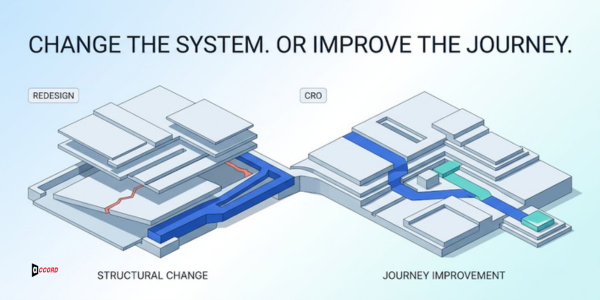
A redesign changes the system when the system cannot support the required experience; CRO improves performance within a system that is still viable. Redesign work is broader and less easily isolated. CRO work is typically narrower, iterative, and designed to preserve learning between changes.
| Decision area | Website redesign | CRO |
|---|---|---|
| Main question | Can the current system support the business? | Where does the current journey lose qualified users? |
| Scope | Broad architecture, design, platform, or templates | Focused pages, messages, actions, and friction |
| Typical cadence | Defined project with migration and launch | Ongoing research, prioritization, and iteration |
| Evidence | Structural constraints and widespread user problems | Page and journey performance evidence |
| Main risk | Migration loss, scope growth, delayed launch | Local gains that do not solve structural limitations |
| Measurement | Baseline preservation plus post-launch outcomes | Hypothesis-level behavior and business outcomes |
The two approaches can overlap. A redesign should use conversion research, and CRO sometimes discovers a structural limitation that requires development.
Signs your B2B website needs a redesign
A redesign becomes appropriate when important problems are systemic, repeated across the site, and difficult to solve safely inside the current architecture. The evidence should extend beyond visual preference.
The platform blocks essential work
Marketing cannot create or update priority pages without developer intervention, integrations fail repeatedly, security or software support is ending, or the content model cannot represent current services. If every small improvement requires a workaround, the platform may be creating ongoing operational cost.
The information architecture reflects an old business
The company has changed markets, services, audiences, or positioning, but the navigation and page structure still represent the previous model. Adding more menu items may not solve a hierarchy built on obsolete assumptions.
The experience fails across devices or accessibility needs
Templates repeatedly create unreadable text, inaccessible controls, poor keyboard behavior, unstable layouts, or broken mobile journeys. Individual patches may help, but widespread pattern failures often point to the design system and component library.
The brand and offer are materially misaligned
The site attracts the wrong buyer, describes services inconsistently, or cannot express the trust level expected for the current market. This is deeper than preferring a newer visual trend. The identity and buyer promise no longer match the business.
Technical debt makes change risky
Unknown dependencies, unsupported plugins, duplicated templates, weak deployment controls, and undocumented integrations can turn ordinary updates into incidents. A planned rebuild may be safer than indefinite patching, provided migration risk is managed carefully.
Signs your website needs CRO first
CRO is usually the better first step when the technology and structure are serviceable but performance problems concentrate in specific pages, messages, forms, or transitions. Focused work preserves the foundation and generates learning faster.
Qualified traffic reaches the site but does not act
If relevant visitors land on appropriate pages yet fail to continue, investigate the value proposition, proof, CTA, form, and page sequence. The answer may be a content and UX change rather than a new platform.
One traffic source or device underperforms
A paid campaign may have weak message match. Mobile users may struggle with a form. Organic visitors may enter through educational content with no logical commercial path. These are focused journey problems.
Users understand the brand but hesitate at the decision
Sales interviews may reveal recurring objections that the website does not answer: process, security, deliverables, fit, timeline, or implementation. Adding the right evidence near the decision can be more valuable than replacing the visual design.
The site is measurable and easy to update
A stable content system, trustworthy analytics, and reusable components make iteration feasible. Use that advantage. A redesign could introduce risk without solving a clearly defined limitation.
When you need both redesign and CRO
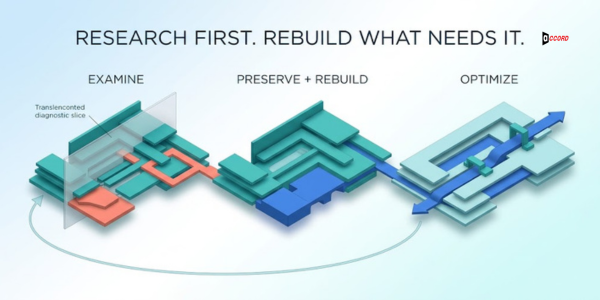
A combined approach is appropriate when structural problems require redevelopment but conversion research is needed to define what the new system should accomplish. CRO should inform the redesign before launch and continue afterward; it should not be postponed until the new site is already fixed in place.
A phased combination can look like this:
1. Audit the current experience, technology, search visibility, analytics, and sales feedback. 2. Fix urgent issues such as broken forms, misleading pages, or security problems. 3. Define buyer journeys and content requirements. 4. Prototype and test high-risk messages or flows. 5. Build the new design system and platform around validated needs. 6. Migrate content and SEO signals carefully. 7. Confirm tracking and functionality before launch. 8. Establish a post-launch baseline and optimization backlog.
This avoids treating launch day as the end of learning.
Audit four systems before deciding
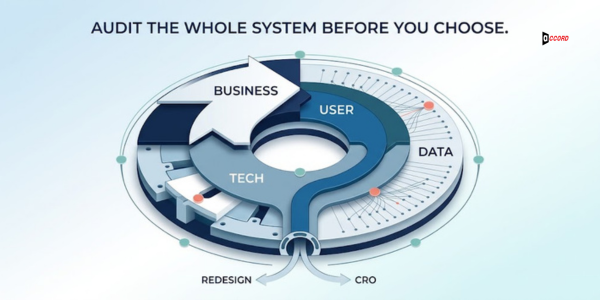
A defensible decision reviews business fit, user experience, technology, and measurement together. Looking at only one system creates an incomplete diagnosis.
1. Business and message system
Can a new visitor identify the audience, offer, outcome, differentiation, and next step? Do service pages match current sales conversations? Does the content answer evaluation questions honestly?
2. User and conversion system
Can visitors navigate, compare, trust, and act across devices? Where do they leave? Which forms fail? What questions do prospects ask sales because the site did not answer them?
3. Technology and search system
Is the site secure, maintainable, accessible, indexable, performant, and integrated with required tools? Can teams publish without creating duplicate URLs, broken templates, or tracking gaps?
4. Data and governance system
Are meaningful events tracked accurately? Can CRM data show lead quality and source? Who owns pages, approvals, updates, experiments, and technical maintenance?
Score findings by severity and reach. If critical failures cluster across all pages and systems, redesign is more likely. If the foundation is sound and issues cluster in several journeys, CRO may be enough.
Calculate the cost of change—not only project price
The real cost includes internal time, content migration, integration work, SEO risk, training, maintenance, opportunity delay, and the cost of leaving known problems unresolved. A low design quote can become expensive if it excludes the work required to launch safely.
For a redesign, account for:
- Discovery and stakeholder alignment.
- Content inventory, rewriting, and migration.
- Design system and component development.
- SEO mapping, redirects, metadata, and structured data.
- Analytics, CRM, form, scheduling, and automation integrations.
- Accessibility and cross-device testing.
- Quality assurance, launch support, and maintenance.
For CRO, account for research, analytics reliability, design and development capacity, experiment duration, traffic limitations, and the operational ability to implement winners. Cheap tests that never reach production do not create value.
Protect SEO during a redesign
A redesign can affect organic visibility when URLs, content, internal links, metadata, rendering, or technical controls change. Protect important signals through a documented inventory, one-to-one redirect mapping where appropriate, content review, staging controls, crawl tests, analytics checks, and post-launch monitoring.
Before launch:
- Crawl and export the current site.
- Identify pages with traffic, links, conversions, and strategic value.
- Map retained, merged, redirected, and removed URLs.
- Preserve useful content and intent—not only keywords.
- test canonical tags, robots directives, sitemaps, status codes, and structured data.
- confirm internal links and navigation.
- verify analytics and conversion events.
After launch, monitor indexing, crawl errors, rankings, landing-page traffic, conversions, and form behavior. Some fluctuation may occur, but missing redirects or blocked pages require quick action.
Test without waiting for perfect traffic
B2B teams can make evidence-based improvements even when traffic is too limited for frequent statistically powered A/B tests. Combine quantitative and qualitative evidence, prioritize obvious usability defects, and state the confidence level behind each decision.
Useful methods include:
- Analytics and funnel review.
- Form error and completion analysis.
- Session or interaction evidence collected responsibly.
- User interviews and moderated usability tests.
- Sales and customer success call analysis.
- Message comprehension tests.
- Prototype comparisons.
- Before-and-after cohort monitoring with clear caveats.
Do not present a small sample as conclusive. The purpose is to reduce uncertainty enough to make a better decision, then keep observing.
How Accord Tech Solutions chooses the right scope
Accord Tech Solutions evaluates whether a B2B site needs focused optimization, targeted development, or a broader redesign based on the actual constraint. The goal is to build a digital experience that turns search, outreach, and social attention into trust and measurable action.
Our website design and development services include custom development, responsive design, WordPress, Laravel, React interfaces, website maintenance, and conversion landing pages. Work can connect with SEO, content, lead generation, email, and CRM integrations.
We do not recommend a complete rebuild merely because it creates a larger project. If the current platform can support the desired journey, a focused CRO roadmap may be the responsible starting point. If the foundation blocks every meaningful improvement, incremental patches may cost more over time.
Frequently asked questions
How often should a B2B website be redesigned?
There is no responsible fixed schedule. Redesign when the platform, architecture, brand, content system, accessibility, or user experience no longer supports business needs. A well-maintained site can evolve for years through component updates and CRO without requiring a complete periodic rebuild.
Is CRO only A/B testing?
No. CRO includes research, analytics validation, usability, copy, journey design, forms, performance, accessibility, and implementation. A/B testing is one method. Lower-traffic B2B sites can use multiple evidence sources and focused pre/post monitoring with appropriate caution.
Will a redesign improve our conversion rate?
Not automatically. A redesign can improve performance when it solves validated problems, but it can also introduce new friction or migration loss. Establish baselines, define target journeys, test high-risk assumptions, protect search signals, and measure qualified outcomes after launch.
Should we redesign before changing our brand positioning?
Usually the positioning and audience decision should inform the redesign. Building templates before clarifying the offer often creates expensive rework and visually polished ambiguity. Validate the message and information architecture early, then design the system that expresses them.
How long should we measure CRO changes?
The observation period depends on traffic, conversion frequency, sales cycle, seasonality, and the size of the change. Define the decision rule before launch and avoid ending a test because an early result looks attractive. Include lead quality and downstream outcomes where possible.
Diagnose before you rebuild
A redesign and a CRO program are not competing signs of ambition. They are different responses to different evidence. Redesign when the system cannot support the required experience. Optimize when the system is viable but the buyer journey contains identifiable friction. Combine them when research must guide a necessary rebuild.
The key is to name the real problem before selecting the solution. That protects budget, preserves useful assets, reduces migration risk, and gives the team a clearer definition of success.
If you need an evidence-led assessment of your current website, contact Accord Tech Solutions to discuss its message, conversion paths, technology, SEO, and the most responsible scope for improvement.
Methodology and sources
This article reflects Accord Tech Solutions’ connected approach to web development, conversion, SEO, and measurement. References include the Accord Tech Solutions Website Development service, Google’s guidance on site moves with URL changes, and W3C Web Accessibility Initiative resources.
Last reviewed: August 13, 2026.