
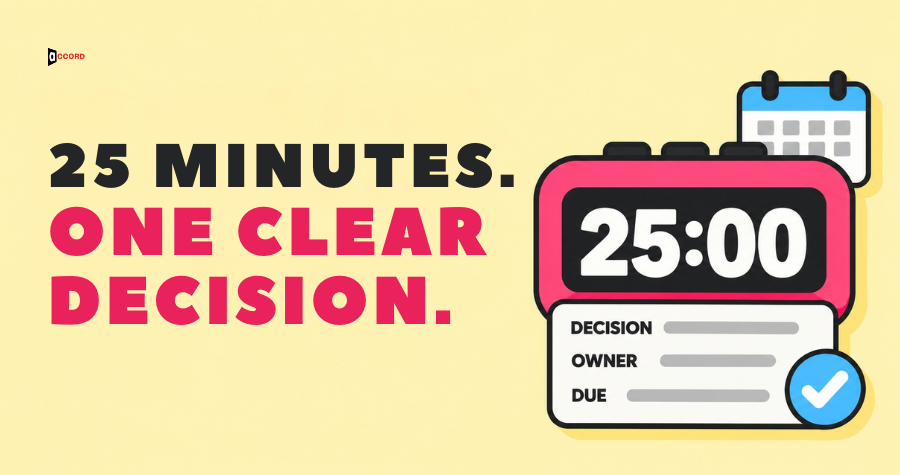
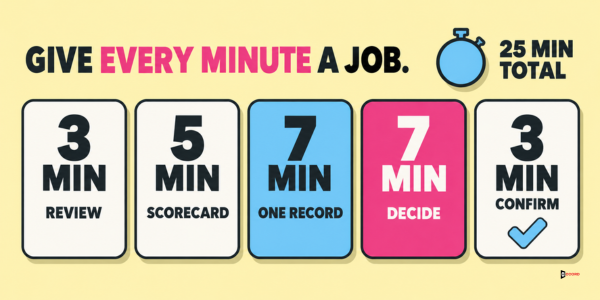
A useful weekly marketing and sales meeting takes 25 minutes and has five blocks: three minutes to check last week's decisions, five to read six scorecard numbers, seven to walk through one CRM record, seven to make one decision, and three to confirm owners and dates. Keep the same time, the same sheet and the same people every week. End every meeting with one written decision that has an owner and a date. The 25-minute length leaves five minutes of margin inside a 30-minute calendar slot, which stops the meeting from running into the next one. The sections below give you the scorecard, a decision log you can copy and a monthly variant.
Who should attend a weekly marketing and sales meeting?
Keep the group to four to six people. Every extra person adds minutes and removes decisions. A workable list for a B2B team with 25 to 150 people looks like this:
- The head of sales or the person who owns the meetings number. This person decides.
- The head of marketing, or whoever runs the channels. This person explains the numbers on the lead side.
- One sales rep or SDR. This person knows what actually happens to the leads.
- The person who owns the website and the CRM. This person fixes the problems the meeting finds.
- A facilitator. This person keeps time and writes the log. Rotate the role monthly, so nobody feels the meeting belongs to someone else.
Agencies and outside vendors usually do not need to attend every week. Invite them for the monthly block instead, or ask them to send their numbers in advance in the same format as the scorecard.
What should be ready before the meeting starts?
A meeting cannot make a decision with numbers that arrive late. Agree on two small rules.
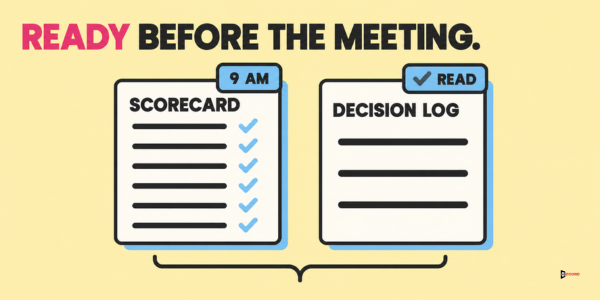
First, the scorecard is filled in by 9 a.m. on the day, by the person who owns each number. The meeting does not start until the sheet is complete, and a blank cell is read aloud as "not reported." Second, everyone spends five minutes before the meeting reading the sheet and the last decision log. The meeting then starts with discussion, not with reading aloud.
Keep one shared sheet with two tabs: the scorecard and the decision log.
What does the 25-minute agenda look like?
| Minutes | Block | The question to answer | What you write down |
|---|---|---|---|
| 0 to 3 | Last week's decisions | Which decisions are done, and which are not? | Done or not done, next to each decision |
| 3 to 8 | Scorecard | Which number moved, and what moved it? | One sentence per number that moved |
| 8 to 15 | One record walk | What does the CRM record behind the biggest move say? | The step where it stalled, the owner and the cause |
| 15 to 22 | One decision | What will we change this week? | The decision, owner, date and how we will know it worked |
| 22 to 25 | Owners and dates | Does every action have a name and a date? | The final log entry |
Use a visible timer. When a block runs out of time, write the open question in the log and move on. A parked question is better than an unfinished block that eats the next one.
Which six numbers belong on the scorecard?
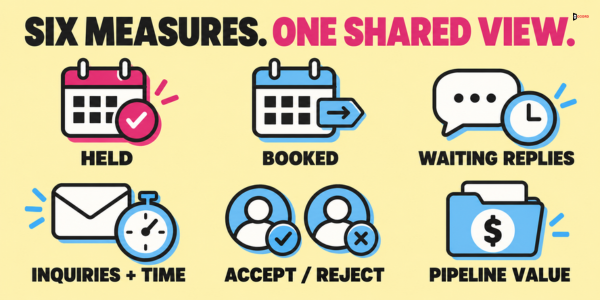
Choose six numbers that follow a buyer from first contact to a held meeting, and keep them the same every week. These six work for most B2B teams:
- Qualified meetings held, this week and month to date. This is the number the rest of the sheet explains. A qualified meeting is held with a person who can buy, at a company that fits your written definition.
- Meetings booked for next week. A thin calendar for next week is the earliest sign of a thin week ahead.
- Positive replies waiting longer than one business day. Count the people who asked for times, prices or details and have not received a human answer. The target is zero.
- Website inquiries received and the median time to a first human reply. Two numbers in one row, because volume without speed misleads.
- Leads accepted and rejected by sales, with the top rejection reason. This keeps marketing and sales talking about the same list.
- Pipeline value created from meetings held this month. Take it from the CRM and tag it by source, so the link between channel and money is visible.
Here is the sheet with invented sample values. They show the layout and are not results from a real company.
| # | Number | Owner | Target | Last week | This week |
|---|---|---|---|---|---|
| 1 | Qualified meetings held | Sales lead | Set by you | 3 | 2 |
| 2 | Meetings booked for next week | Rep or SDR | Set by you | 5 | 4 |
| 3 | Positive replies waiting over one business day | Rep or SDR | 0 | 1 | 4 |
| 4 | Website inquiries and median time to first reply | Marketing lead | Set by you | 6 and 5 hours | 9 and 3 days |
| 5 | Leads accepted and rejected, top reason | Sales manager | Set by you | 8 and 4, wrong person | 7 and 6, could not reach |
| 6 | Pipeline created from meetings held, month to date | Sales lead | Set by you | Value from the CRM | Value from the CRM |
Each number has an owner who fills it in and a target that you set from your own history. This guide does not set targets, because the right figures depend on your market, price and sales cycle. Clean records matter here, so read sales pipeline hygiene for cleaner forecasts if the CRM numbers are hard to trust.
How do you run each block without sliding into status updates?
The failure to avoid is a round where each person reports what they did. The agenda above avoids that by asking a question in every block. Here is how to run each one.
Last week's decisions (3 minutes). The facilitator reads each decision and its owner. The owner answers "done" or "not done." There is no explanation unless the decision is not done, and then the owner gives one sentence: what blocked it. An undone decision moves to this week's list and gets a new date.
Scorecard (5 minutes). Read only the numbers that moved or missed their target. The facilitator asks, "What do we think moved it?" Accept one sentence per number. If the cause is unknown, write "unknown" and add it to the stuck-lead block.
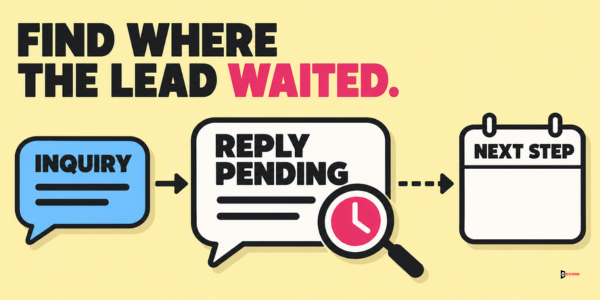
One record walk (7 minutes). Open the CRM record behind the number that moved the most: a lead waiting for a reply, a rejected lead, or a meeting that did not happen. Read its timeline aloud: source, first touch, last touch and next step. Then ask where it stalled and who owned that step. Walking through one real record shows more than discussing averages.
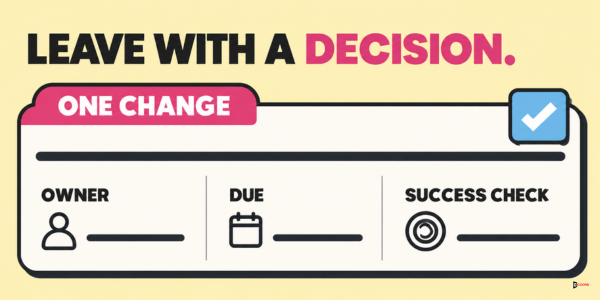
One decision (7 minutes). The group chooses one change for the week. It can be small: move positive replies to a monitored inbox, change the button text on one page, or pause a sequence that produces rejections. Write the decision in one sentence, with an owner, a date and the sign that it worked.
Owners and dates (3 minutes). The facilitator reads the log aloud. Anyone who hears a decision without a name or a date says so, and the facilitator fixes it before the meeting ends.
What does the decision log look like?
Keep the log in the second tab of the same sheet, with six columns: date, decision, owner, due date, how we will know it worked, and review date. Imagine the log entries below. They are invented to show the format, and they are not real results.
| Date | Decision | Owner | Due | How we will know | Review |
|---|---|---|---|---|---|
| 3 Nov | Send positive replies to one monitored inbox | Sales lead | 7 Nov | Zero replies waiting over one business day | 17 Nov |
| 3 Nov | Rewrite the button on the pricing page | Marketing lead | 10 Nov | More clicks on the booking link than the previous two weeks | 24 Nov |
| 10 Nov | Add a "could not reach" reason code to the CRM | CRM owner | 14 Nov | The reason appears in next week's rejection count | 17 Nov |
Notice that every row has a person and a date, and that "how we will know it worked" names something you can count. A decision without that last column is a wish.
What changes in the first meeting of the month?
Add 15 minutes to the first meeting of each month, and use them for three things.
First, compare the month's totals with the previous three months for each of the six numbers. A single bad week is noise. Three months in the same direction is a pattern. Second, drop one task or channel experiment that did not move a number, and say so out loud. Dropping is as important as adding, and a team that never stops anything slowly buries its own priorities. Third, pick one test for the coming month, with a clear measure of success. For a deeper look at connecting marketing activity to revenue in these reviews, read how to prove marketing ROI with pipeline data, and use B2B marketing attribution models to choose a simple way to credit sources.
Why do weekly marketing and sales meetings fail?
Four habits cause most of the damage. Each has a simple fix:
- The meeting becomes a status round. Ask a question in every block and write a decision at the end.
- The numbers arrive during the meeting. Fill the scorecard before 9 a.m. and read a blank cell as "not reported."
- Decisions have no owner. Refuse to close the meeting until every decision has a name and a date.
- The meeting turns into blame. Trace the step, not the person. The question is "where did the lead stop?" and not "who dropped it?"
If the decision log is empty for several weeks, move the meeting to every two weeks and keep the scorecard weekly, instead of holding a meeting for form's sake.
Imagine: one Monday for a 30-person software company
The details of this example are invented. Imagine a software company with a sales lead, a marketing lead, one rep and a person who looks after the website. On Monday, the scorecard shows that qualified meetings held fell compared with the previous week, and booked meetings for next week look thin. Website inquiries rose, but the median time to a first reply is three days.
The facilitator asks what moved the number. The marketing lead says the extra inquiries came from a new landing page. The group traces one of them: it was submitted on Wednesday evening, went to a general inbox, and the one person who checks that inbox was at a conference until Monday.
The decision is small and specific: form messages go to two named people, with a backup during travel, and the CRM gets a "first reply sent" date field. The log records the owner, the date and the sign that it worked: a median time to first reply under one business day by the review date. The meeting ends at minute 24, and the next one starts by checking whether the two-person routing worked.
How do you start next week?
You do not need approval, a tool or a long setup. Do these three things before the first meeting:
- Send the invitation and the sheet. Create a spreadsheet with two tabs, name an owner for each of the six numbers, and book a recurring 30-minute slot.
- Fill in the first scorecard by hand. The first week may take an hour because some numbers are hard to find. That effort is the first finding: any number nobody can produce is a gap to close.
- Hold the meeting and end it on time. One traced lead, one decision, one owner, one date. Then stop.
By the fourth meeting, you will have four decisions on paper and a scorecard that people trust. That trust is worth more than any single change, because a team that trusts its numbers argues about what to do and stops arguing about whether the numbers are right.
Frequently asked questions
How long should a weekly marketing and sales meeting be?
Twenty-five minutes works for most teams, because it leaves margin inside a 30-minute slot. If the meeting regularly runs over, remove a block or an attendee. Do not extend the time.
Should an agency attend the weekly meeting?
Usually not every week. Ask the agency to send its numbers in the scorecard format before the meeting, and invite it to the first meeting of the month for a short review.
Should the meeting be weekly or every two weeks?
Start weekly, because in a two-week rhythm a stuck lead waits a full two weeks for attention. If the decision log is empty for several weeks in a row, move to every two weeks and keep the scorecard weekly.
What tool should we use for the scorecard and the log?
A shared spreadsheet is enough. The tool matters less than the habits: the same six numbers, filled in before the meeting, and a log with an owner and a date for every decision.
Next step
If you would like help setting up the scorecard and the first decision log for your team, book a 30-minute working session with the Accord team. Bring the six numbers for the last two weeks, even if some of them are estimates, and use the time to run the first meeting together.