
Account-based marketing, or ABM, means choosing a short list of named companies and working on them one at a time, instead of trying to reach everyone who might buy. This guide is for a founder or sales lead with a team of two to four people who wants to run small business account based marketing without paid ads. It has six steps: choose and research your accounts, map who helps decide, send personal outreach, share something useful, follow up fast, and score each account on one sheet. For 30 accounts, plan on about 54 hours of setup and outreach, then a 60-day window for each account before you judge the results.
A note on the numbers. Every count, time and limit in this guide, such as 30 accounts, 60 days and one business day, is an Accord starting point for a team of two to four people. None of them is an industry benchmark. We quote no success rates from other sources, because we could not tie any to a primary study. Change the numbers after your first cycle. Accord sells outbound, email and lead-generation services, so we have an interest in this topic, but everything below can be done in-house.
What is account-based marketing?
Most marketing starts wide: you reach many people, and some turn out to be a fit. Account-based marketing starts narrow. You pick the companies you most want to work with, then decide who inside each one matters. Lead generation, as the word is often used, starts with people: a form someone filled in, or a list of contacts that match a filter. Account-based marketing starts with the company and treats messages, content and sales calls as one effort.
What are the six steps, who does each one, and how long do they take?
Here is the whole plan on one page, with times for 30 accounts. Accord's account research guide explains what to research before outreach. This post covers the full cycle, from the first list to the scorecard review.
| Step | Who does it | Output you can check | Time, a starting point |
|---|---|---|---|
| 1. Choose and research accounts | Sales lead picks, researcher writes | A sheet of 30 accounts, one note each | 10 hours |
| 2. Map who helps decide | Researcher, sales lead checks five | Two named people per account where findable | 8.5 hours |
| 3. Send personal outreach | Sales lead | Up to three emails per person, LinkedIn used by hand | Up to 25 hours |
| 4. Share something useful | Marketer prepares, sales lead sends | One useful item per account | 10 hours |
| 5. Follow up fast | Sales lead and a named backup | Every reply answered within your limit, never later than one business day | About 1 hour per engaged account |
| 6. Score and review | Sales lead | A weekly review and a closed cohort | 30 minutes a week, 1 hour to close |
Steps 1 to 4 add up to 53.5 hours for 30 accounts: 10, 8.5, 25 and 10. Step 5 adds about 1 hour per engaged account, and Step 6 adds 30 minutes a week while accounts are in their 60-day windows.
What does small business account based marketing look like without ads?
"Without ads" here means no paid media at all: no LinkedIn ads, no Google ads, no sponsored placements and no paid retargeting. This guide is for a team with more time than ad money.
Each step takes the place of something ads would do. Research and the buying committee, the group of people who have a say in a purchase, tell you who to reach. Personal messages reach them, helpful content gives them a reason to answer, and follow-up turns an answer into a meeting. A simple sheet replaces the ad dashboard. Ads buy reach quickly. This approach costs your own time and is slower, so it is the wrong plan if you need to reach hundreds of accounts.
Step 1: How do you choose 30 accounts and research each one?
What to do. Write your ideal customer in three lines: the kind of company, the problem you solve for it, and what would rule a company out. If you cannot fill in two of the three lines, look at your last few good customers and write the lines from them. Pick 30 accounts that fit. Each one is a target account, a company on your named list. Thirty is small enough to research by hand. It is too few for firm conclusions, so plan on two or three cohorts.
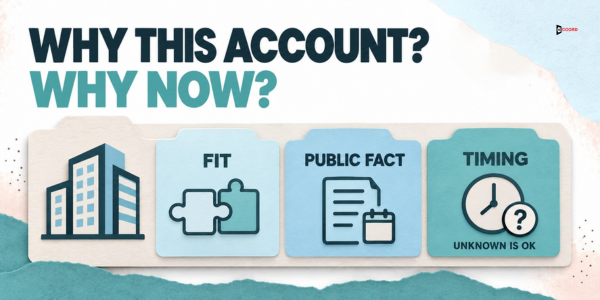
For each account, write a short note with four lines. Say what the company does. Say which problem of yours it probably has. Add one recent, public fact with its date and source, such as a job post or a press release. Finish with "why now", or write "no timing reason yet". A timing reason raises priority, but this plan does not depend on one.
Who does it. The sales lead chooses the accounts, and the researcher writes the notes.
Test and output. The output is a sheet with 30 rows and one note per row. The test passes when a colleague who reads a row can say why the account is there without asking you. If a row fails, replace the account. If you do not know a fact, such as the company size, write "unknown" and never guess.
Time, a starting point. About 10 hours: 2.5 hours to agree the list, and 15 minutes per account for the notes, which is 7.5 hours.
Step 2: How do you map the people who help decide?
What to do. In each account, find the people who have a say in buying what you sell. A buying committee is that group. Its size varies by company, and no fixed number applies to all.
Look for three kinds of role: the person who lives with the problem, the person who controls the money or has the final say, and someone who could block the purchase. Job titles are only clues, because the same title can mean different things in different companies.
Public pages cannot prove who decides, so mark every person "assumed" until they or a colleague confirms the role in a reply, and then update the mark in the sheet. Aim for two named people per account where you can find them.
Who does it. The researcher, with the sales lead checking five accounts.
Test and output. Each account row shows up to two named people, each marked "assumed" or, after a reply, "confirmed". If you can find only one person within the 15 minutes, you may still start, but flag the row. Then ask that person, in your second email, who else should see the idea. If you cannot find anyone, replace the account.
Time, a starting point. About 15 minutes per account, so 7.5 hours for 30, plus about 1 hour for the sales lead's check of five accounts. The total is 8.5 hours.
Step 3: How do you send personal outreach without ads?
What to do. Write one email per person, built from the note. The first sentence should be about their company, not yours. Ask one small question, and make it easy to say no. An account is contacted once you have sent at least one message to at least one person there. That day is the account's day 0, and its 60-day window starts. Follow the email rules: the US CAN-SPAM law applies to business email too, and the FTC's compliance guide says it makes no exception for business-to-business messages. The law asks for truthful sender details and subject lines, a valid postal address, a clear way to opt out, and a plain sign when a message is an advertisement. The FTC guide covers any message whose main purpose is to promote a product or service, so "advertisement" here does not mean paid media. You must honor an opt-out request within 10 business days. This is not legal advice, and contacts outside the US fall under other laws.
As a starting point, send up to three emails per person over about three weeks. Then pause. A Step 4 item goes out as email 2 or email 3 for one person at that account, so it is not an extra email.
Use LinkedIn by hand, and for different jobs than email. LinkedIn's help page on connecting with other members says to invite only people you personally know and who know you, and to add a personal note. It lists inviting people you do not know, and sending many invitations in a short time, as the most common causes of invitation restrictions. Our own reading is that a reply to your email, or a real link such as a shared event, is a sensible sign that someone knows who you are. That is our judgment, not LinkedIn's rule. Section 8.2 of LinkedIn's User Agreement bars scraping and bots, so do not use automation tools or browser extensions that send messages or collect profiles.
Who does it. The sales lead sends, because people reply to people.
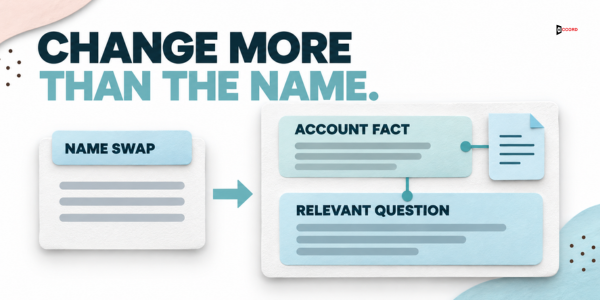
Test and output. The output is up to three emails per person. Test every first email: put another company's name in place of the one you wrote. If the message still makes sense, it is not personal, so rewrite it. Here is an invented first email that passes the test, written by the company in the example near the end of this guide:
Subject: Northfield Foods is hiring a second warehouse planner
Hi Maria,
I saw that Northfield Foods is hiring a second warehouse planner (your careers page, 12 September). I work on inventory software for regional food distributors, so I wondered how your team tracks stock today. Would a one-page stock count checklist be useful? If not, tell me and I will not write again.
Alex
It is short, it opens with a dated public fact, it asks one question and it gives an easy way out. The footer is left out here, but every real email still needs the postal address and the opt-out line.
Time, a starting point. About 10 minutes per first email, 5 minutes per follow-up email and 5 minutes of LinkedIn work per person. For up to 60 people (30 accounts, two each), that is 10 hours for first emails, up to 10 hours for 120 follow-up emails and 5 hours for LinkedIn. The total is up to 25 hours, and fewer people means fewer hours. The LinkedIn time covers following the company page, reading the profile and posts, and one real comment.
Step 4: What helpful content can you send to a named account?
What to do. Helpful content for named accounts is something made or chosen for that company and sent privately, not a public page or a form. There are three kinds.
The first is a recommended guide: an existing article or checklist that answers a likely question, plus two lines on why it fits their company. The second is a one-page summary for the account: three things you noticed from public information, and two things they could try. Write one only for your best-fit accounts, such as 10 of the 30. The third is a direct answer: a short, honest reply, used only when a person has asked a question. It is a reply, not email 2 or 3, and it is outside the 30 items.
Who does it. The marketer prepares each item. The sales lead sends it.
Test and output. Ask: would this still be useful to the person if they never bought from us? If the answer is no, it is a sales pitch with a different name, so drop it.
Time, a starting point. Preparing takes about 10 minutes per recommended guide for 20 accounts, which is 3.3 hours, and about 40 minutes per summary for the other 10 accounts, which is 6.7 hours. The total is 10 hours. Sending is counted in Step 3.
Step 5: How should sales follow up when someone replies?
This step covers who owns a reply and how it is counted. For wording, see Accord's guide to responding to a positive cold email reply.
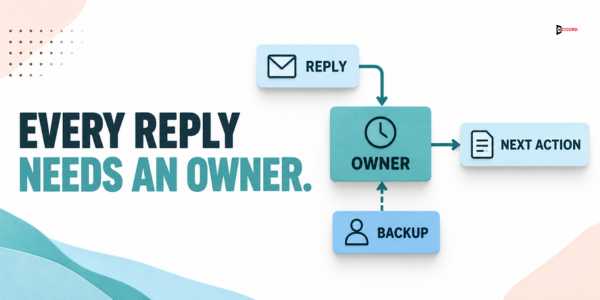
What to do. Name one owner for replies, the sales lead, and one backup. When any person at a target account replies, answer as fast as you can manage. Accord's speed-to-lead guide uses one business hour for a positive reply to cold email, so aim for that hour. Set one business day only as the outer limit, the longest we would accept for a team of two to four. Record the reply in the sheet the same day.
Then set the status. An account becomes engaged when at least one qualifying reply arrives by day 60. A qualifying reply is a message from a real person, by email or LinkedIn, that is not one of these four: an automatic out-of-office reply, a request to stop contact, a flat "no thanks" or a "wrong person" reply. A reply from a colleague you did not write to counts, once. Opens and clicks never count, because software can trigger them without a person reading anything.
Each reply that does not qualify has its own next move. After a request to stop contact or a flat "no thanks", stop writing and mark the account "closed with reason". After a "wrong person" reply, add the contact it names to the sheet and keep the account as contacted. A "not now" does qualify, with or without a date. It makes the account engaged but not meeting-booked, so write a dated reminder for the date they gave you, or 60 days later if none. Ask before adding a second person; do not go around the one who replied.
Who does it. The sales lead, with a named backup.
Test and output. Every reply has a logged date, a status and an answer sent within your limit, never later than one business day. Fix a miss by changing the owner or backup. If a reply is unclear, such as "send info", send the information and ask one question.
Time, a starting point. About one hour per engaged account over the cycle, covering replies, preparation and the call itself.
Step 6: How do you score accounts and review them each week?
What to do. Keep one sheet with one row per account, with these columns: account, date of first contact, people named, people messaged, engaged (yes or no, with date), meeting-booked (yes or no, with date), last action, next action and owner. Use fixed status words: "not contacted", "contacted", "engaged", "meeting-booked", "paused", "unknown" and "closed with reason". Do not delete a row when an account goes quiet. This sheet is your scorecard, and it counts accounts, not emails or replies. Here is one invented row, with the owner joined to the next action to fit:
| Account | First contact | People named / messaged | Engaged | Meeting-booked | Last action | Next action (owner) |
|---|---|---|---|---|---|---|
| Northfield Foods | 3 March | 2 / 1 | Yes, 11 March | No | Sent checklist, 14 March | Email second person by 24 March (sales lead) |
Hold a 30-minute review once a week. Agree the next action for each engaged account, then look at contacted accounts with no reply after three emails and decide whether to pause or try a different person.
Two different 60-day counts. Each account has its own 60-day window, from its day 0 to its day 60. A reply or an agreed meeting counts only if it arrives inside that window. A cohort is the set of accounts first contacted in the same calendar month, and the whole cohort is reviewed once, on day 60 of its last account. For example, account A is first contacted on 2 March and account B on 13 March. A's window ends on 1 May and B's on 12 May, so the March cohort closes on 12 May, even though A's own window ended 11 days earlier. So a cohort can take more than 60 days to close, counted from its first message. If first messages are spread over a whole month, it can take up to about 90 days.
The two rates. A meeting-booked account is an engaged account where a person has agreed to a first meeting by day 60 and the time is on both calendars. An account that books through a link without writing a reply counts as engaged and meeting-booked both. A meeting booked on day 60 counts, even if the call itself happens after the cohort closes. A meeting agreed after day 60 does not count for this cohort. At the review, calculate the engaged-account rate, which is engaged accounts divided by contacted accounts, and the meeting-booked rate, which is meeting-booked accounts divided by engaged accounts. For one end-to-end figure, divide meeting-booked accounts by contacted accounts.
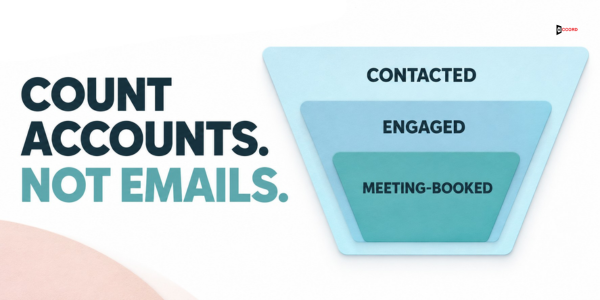
How much to trust one cohort. If all 30 accounts are contacted, one engaged account changes the engaged-account rate by about 3.3 percentage points. If 9 accounts are engaged, one meeting-booked account changes the meeting-booked rate by about 11 percentage points. So treat one cohort as a rough guide, especially under about 20 accounts, and set a target only after two or three cohorts.
Who does it. The sales lead.
Test and output. The output is a closed cohort with both rates and a short list of causes. The test passes when every rate shows its top and bottom number, so anyone can recompute it. If a reply is unclear, mark the account "unknown" and decide at the next review.
Time, a starting point. 30 minutes a week and about one hour to close a cohort.
Imagine: two cohorts of 30 accounts
This example is invented, its numbers are simple on purpose, and they are not a typical or target result. Imagine a small company that sells inventory software to regional food distributors. It followed the six steps with 30 target accounts in March, first messaging them between 2 March and 13 March, and closed that cohort on 12 May. It did not yet flag one-person accounts or ask them for a second name, and it had no reply time limit or backup owner. The May cohort was another 30 accounts, first messaged between 18 May and 29 May and closed on 28 July.
| Result | March cohort | May cohort |
|---|---|---|
| Contacted accounts | 30 | 30 |
| Engaged accounts | 9 | 11 |
| Meeting-booked accounts | 3 | 5 |
| Engaged-account rate | 30% | about 37% |
| Meeting-booked rate | about 33% | about 45% |
| Meeting-booked out of contacted | 10% | about 17% |
| Engaged, with two names at first contact | 8 of 20 (40%) | 9 of 22 (about 41%) |
| Engaged, with one name at first contact | 1 of 10 (10%) | 2 of 8 (25%) |
In March, two other accounts sent a flat "no thanks" and were marked "closed with reason", so they are not engaged. The other 19 stayed silent.
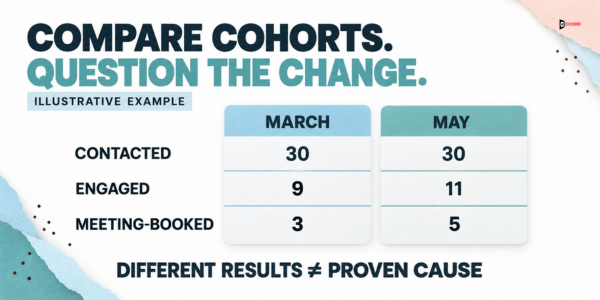
What changed. Of the 6 March accounts that were engaged but not meeting-booked, 4 replied once and went quiet, and the team had taken three to four days to answer them. Two said "not now" and got a dated reminder. Because every reply had a logged date, the first weekly review in April showed the slow answers, and the team set a one-business-day limit and a backup owner that week. No cohort started in April, because the team was answering March replies and spent about 18.5 hours on Steps 1 and 2 for the next list. For May, it flagged one-person accounts, asked each one for a second name in email 2 and reported them as a separate group.
What the numbers do not prove. Two things changed between March and May, the answer limit and the second-name ask, so the team could not say which one helped. One-person accounts may also be harder, smaller companies, so the March gap may not come from the number of names. The gain from 9 to 11 engaged accounts is too small to prove anything.
What it cost. For March, Steps 1 to 4 took about 49 hours, and Step 3 was about 21 of them because 50 people, not 60, were emailed. Step 5 took 9 hours, 1 for each engaged account. Step 6 took 6 hours: ten 30-minute reviews plus 1 hour to close. That is about 64 hours for 3 meeting-booked accounts, a cost to count before you compare this plan with ads. The method is to score each account, find the largest gap, fix it and count again.
Frequently asked questions
What does ABM stand for, and how is it different from lead generation?
ABM stands for account-based marketing. Lead generation usually starts with people who match a filter or filled in a form. Account-based marketing starts with a company you chose and asks which people inside it have a say. The two can run side by side.
Do we need an ABM platform to start?
Not for 30 accounts. A spreadsheet, a work mailbox and a LinkedIn profile are enough. In our view, a paid platform may help later.
How long and how many hours does a first cycle of account-based marketing take?
Each account has its own 60-day window, counted from its first message. A cohort is reviewed when its last account's window ends, so if first messages are spread over a month, the review can come up to about 90 days after the first one. Steps 1 to 4 take up to about 53.5 hours for 30 accounts, then about an hour per engaged account and 30 minutes a week.
Is it allowed to email and message people at target accounts?
In the US, the FTC says CAN-SPAM covers business email, so you need truthful sender details, a postal address and a working opt-out. LinkedIn asks members to invite people they personally know, and bars bots and scraping. This is not legal advice.
What counts as an engaged account and a meeting-booked account?
An engaged account is a contacted account where at least one real person has sent a qualifying reply by day 60. An automatic reply, a request to stop contact, a flat no and a wrong-person reply do not qualify. A "not now" does. A meeting-booked account is an engaged account where a first meeting is agreed and on both calendars. Opens and clicks do not count.
Should we add paid ads later?
You can, but decide after two or three cohorts, using your own scorecard. Keep the same two rates and the same window, so you can compare accounts reached with ads and without them.
Next step
If you would like a second pair of eyes on your first account list for this plan, book a 30-minute working session with the Accord team. Bring your ideal customer in three lines and 10 draft accounts, and check the fit reasons, the people named and the first message together.