
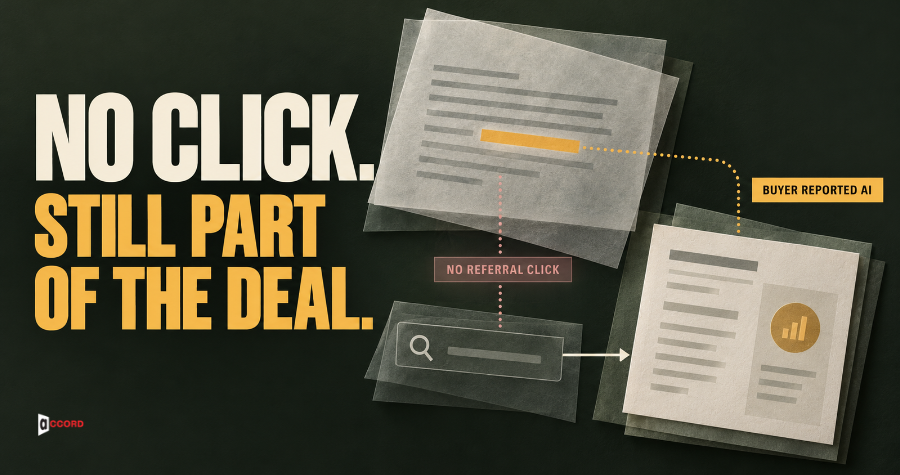
A buyer asks an AI assistant for firms like yours, sees your name, and later types it into a search box. Your report files that visit as search or direct, and the AI step disappears. This guide shows how to count those sales as AI-influenced opportunities. Many people search for the idea as AI influenced pipeline. It means the possible sales, called opportunities, where your own records show an AI answer played a part. The closest live Accord post, how to measure AI search citations and pipeline, covers what to collect. This guide covers how to label, count and review opportunities from it.
By the end you will be able to:
- Give every opportunity one of four labels, and mark whether the buyer said it or you inferred it.
- Set up the form question and first-visit fields behind those labels.
- Report the counts each quarter with two coverage numbers.
Why do some deals look as if they came from nowhere?
A click-based source report can name AI only when a click or referrer carries it. A buyer asks an AI assistant (a chat tool such as ChatGPT or Gemini that writes an answer instead of listing links) for firms that do what you do. Your name appears in the answer. A few days later the buyer types your name into a search box, or goes straight to your site.
Your analytics may now file that visit under organic search or under direct (Google's help page defines Direct as visitors who arrive by a saved link or by entering your web address). Often nothing in either record points back to the AI answer.
Two mistakes are easy: saying nothing, so the report shows zero AI effect, and claiming every direct visit as AI. The middle path for AI search attribution is to write down what the buyer says and what you can verify, label what the record shows, and count the same way each quarter. That is labeling and counting, not crediting. For a credit model, read the Accord guide to B2B marketing attribution models; this post picks none.
A note on the numbers
The windows, thresholds and pass lines here are Accord's starting points, not industry standards, so change them to fit your sales cycle. We quote no outside statistics. We read the Google help pages named below between 27 and 31 October 2026; they can change.
What does AI influenced pipeline mean, and how do AI sourced and AI assisted differ?
A CRM (customer relationship management tool) is the software where you keep records of people, companies and deals. An opportunity is one possible sale, kept as one CRM record; "deal" means the same thing, but this guide says "opportunity" from here on. An "AI answer" is text that an AI assistant or AI search feature writes in reply to a question, such as ChatGPT, Gemini or the AI summary at the top of some Google results.
Pipeline normally means the list of opportunities that are still open, with their expected value. So this guide uses pipeline only for the dollar value of open opportunities. For open, won and lost opportunities together, it says AI-influenced opportunities: those labeled AI sourced or AI assisted.
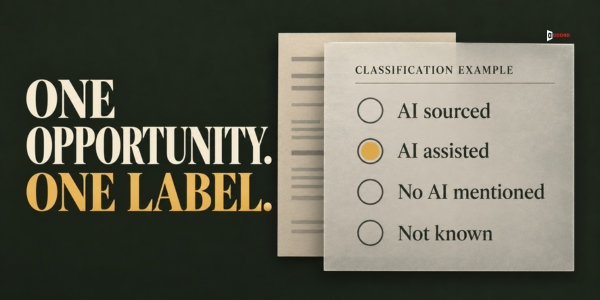
Every opportunity gets exactly one of four labels.
| Label | What the record shows | Basis it can have |
|---|---|---|
| AI sourced | An AI answer was the first contact: the buyer says so, or a tracked first visit came from an AI assistant and the buyer names no first source. | Buyer-stated or Inferred |
| AI assisted | AI appears in the buying process but is not shown to be the first contact. For example, a colleague mentioned your name, and the buyer then asked an assistant to compare three firms. | Buyer-stated or Inferred |
| No AI mentioned | The buyer was asked and gave no AI answer, or the records show a different first source and nothing mentions AI, and no tracked AI visit applies. It does not mean no AI was used. | Buyer-stated only if the buyer was asked; otherwise Inferred |
| Not known | The question was not asked, the answer was blank or "I do not remember", and no record shows a first source or a tracked AI visit. | None; leave the basis blank |
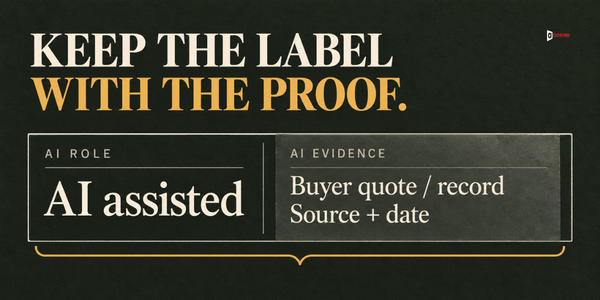
The basis is the second thing to record. Buyer-stated means the label rests on the buyer's own words: a form answer, a first-call answer or a message the buyer wrote. Inferred means it rests on a tracked visit or other records, such as a partner's introduction email. When the two point different ways, the label follows the records and the basis is Inferred. A "no" the buyer actually said tells you more than a label set because the records are silent; the basis shows which one it is.
Choose the label in this order. AI sourced only when the evidence says AI was the first contact. If the buyer names a different first source, or says only that they used AI without saying when, use AI assisted. A tracked AI visit alongside a different named first source, or alongside a buyer who says they used no AI, is also AI assisted: write both facts in the evidence field. Otherwise use No AI mentioned, then Not known. One label per opportunity means the counts always add up. The Accord post on proving marketing ROI with pipeline data explains the sourced-versus-influenced split for marketing as a whole.
What evidence can a small team actually collect?
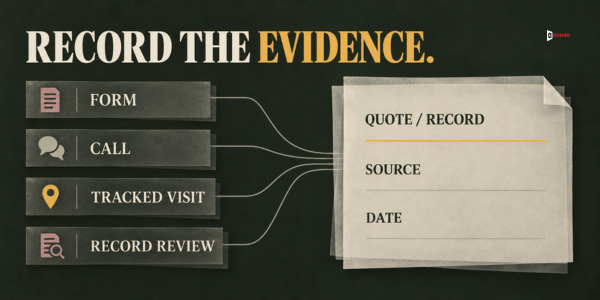
Four kinds of evidence are within reach, and none needs a new paid tool.
1. The form answer. Add one question to every demo, contact and booking form: "How did you first hear about us?" Give fixed answer choices and an optional text box. A fixed list is quick to count; the text box catches what it misses.
A sample list: a search engine; an AI answer (such as ChatGPT or an AI summary in Google Search); a person you know; social media; an article, podcast or event; an email from us; other; I do not remember. Always include the last choice, or some people will pick any answer to finish the form. Make the choice required and the text box optional, because a required text box invites filler. A required choice adds a step, so try it on one form first.
2. A question on the first call. Give each sales rep (sales representative) one sentence for early in the first call. For example: "While you were looking at options, did you ask an AI tool like ChatGPT or Gemini for suggestions? If so, what did you ask?" Ask it the same way every time and write the buyer's own words in a notes field. A quote such as "I asked it for the top three firms in our niche" is evidence; "used AI" is much weaker.
3. Tracked visits from AI assistants. This is the only evidence that comes from a click. Google Analytics, the free website reporting tool from Google, sorts visits into groups called channels. Its default channels include AI Assistant, described as visitors who arrive from sources like ChatGPT, Gemini, Deepseek, Copilot or Grok. A visit lands there when its medium is set to "ai-assistant", or when the referrer (the web address of the page the visitor came from) matches Google's list of AI assistants.
Two cautions come from the same page. It says the AI Assistant channel excludes Google's AI Overviews and AI Mode, which it counts under Organic Search. It also does not publish the full list of assistants, so test with a real visit or build a custom channel group. The page has the current rules.
A visit appears here only if someone clicked and the click carried a referrer or source tag you can read. A buyer who reads an answer and then types your name leaves nothing in your analytics. To use a visit as evidence on an opportunity, your form must store the first-visit source and its date (setup step 3). If you cannot set that up, report AI assistant visits as a side figure.
4. A review of closed opportunities. Once a quarter, a person reads existing records for written signs of AI use. It has its own section.
The monthly citation log, a rise in searches for your company name, "share of voice" scores and Search Console's report on AI features (covered later) are not evidence on an opportunity. They show whether AI answers mention you, not which opportunities they touched.
How do you set up the form question and the CRM fields?
Each step has a test, a pass line and a fix.
- Write the rules on one page. Put the four labels, the two bases, the window and the four numbers (defined in the counting rules) in one shared document. Test: ask a rep and a marketer to label the same ten closed opportunities from the notes. Pass: they differ on no more than two. Fix: tighten the wording that caused the differences.
- Add the form question. Test: submit a test form and pick each answer. Pass: the answer and text appear on the CRM record. Fix: connect each form box to the matching CRM field, or ask your CRM administrator.
- Store the first-visit source and its date. Ask whoever owns your website or form tool to save three values when a person first arrives. They are the referrer, any source tag at the end of the link (a UTM tag), and the date and time of that visit. Send them with the form in hidden boxes and keep them on the CRM record. The form stores raw values, not Google Analytics's channel, so you compare the referrer with a list of AI assistants that you keep. Check your privacy notice and consent rules first; this is not legal advice. The rules after this list keep the values usable.
- Add three fields on the opportunity. "AI role" is a single-select field (one value picked from a list) with the four labels, Not known pre-selected. "AI basis" is a single-select field with Buyer-stated and Inferred; it stays blank for Not known and is required for every other label. "AI evidence" is a text field where the person who sets the label pastes the quote, its source (form, call, tracked visit or review) and the date. The rep who runs the first call sets all three, and one named person checks the evidence field each month for labels with no quote behind them. Test: open a recent opportunity. Pass: label, basis and evidence appear together. Fix: make the evidence text mandatory for any label other than Not known.
- Give reps the call question. Test: read notes from five first calls. Pass: it was asked in at least four. Fix: add the sentence to the call template.
- Check the AI Assistant channel in Google Analytics. Test: find the channel in your traffic acquisition report. Pass: you see last month's sessions (a zero is a fact, not a failure). Fix: if it is missing, ask your analytics owner.
Three rules make the step 3 values usable:
- Save once. A return visit must not overwrite the values already stored.
- Keep them long enough. Hold them at least 90 days in the visitor's browser and as long as the record exists on the CRM; some browsers delete them sooner, so expect the count to run low. An empty value means "no tracked visit", never "no AI".
- Send the visit date, not the form date, because the 90-day check compares it with the date the opportunity was created.
Tests for step 3: open your site from a link ending in ?utm_source=test, submit the form and read the CRM record. Click a link from another website and read the referrer box. Then return later through a different link and submit again. Pass: the record keeps the first values and the first visit time. Fix: ask the site owner to add the hidden boxes, pass them to the CRM and stop the overwrite. This stores only the first visit, so an AI visit on a later return is not captured.
If you already use the Yes, No or Unknown field from the citation post, reread the evidence behind each Yes and choose sourced or assisted. Move No to No AI mentioned only if the buyer was asked, and Unknown to Not known. A guessed label is worse than an honest blank, because it looks like data.
What are the counting rules?
The unit. Count opportunities by their CRM opportunity ID, not contacts or companies. Three people from one company filling in forms about the same purchase are one opportunity and one label. A separate project or purchase that your CRM holds as its own opportunity counts separately, with its own label from its own evidence. A repeat purchase by an existing customer usually has a first visit older than the window, so label it from the buyer's own words. Write the split test on your rules page, for example "a different scope, budget or decision", and apply it when the opportunity is created, not after the quarter closes.
The group. Put each opportunity in the quarter in which it was created, and keep it there, even if it closes later.
The window. A tracked first visit from an AI assistant counts only if its stored date is no more than 90 days before the date the opportunity was created. A statement from the buyer counts if it was made before you close the report. Close the report 30 days after the quarter ends, using the records as they stand then. A label found later goes in a note, not in the closed report, so two quarters compare on one rule.
Four numbers. Each is a fraction of the opportunities created in the quarter.
Label coverage = opportunities with any label other than Not known ÷ all opportunities created in the quarter.
Buyer-stated coverage = opportunities whose basis is Buyer-stated ÷ all opportunities created in the quarter.
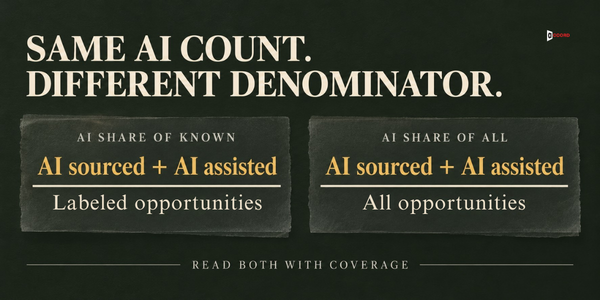
AI share of labeled = opportunities labeled AI sourced or AI assisted ÷ opportunities not labeled Not known. Of the opportunities we know something about, how many show AI in the record?
AI share of all = the same top number ÷ all opportunities created in the quarter. It is the lowest figure the records support, not a measure of the truth.
A No AI mentioned label set from records adds to label coverage but not to buyer-stated coverage, because the buyer did not state it. As a starting point, read the two shares only when label coverage is at least 70% and buyer-stated coverage is at least 50%. Show both shares, with the AI sourced and AI assisted counts beside them.
Value. The headline is the count of opportunities. Dollar value goes in two separate lines, each split by label: closed-won value and open pipeline value. Closed-won value is the amount in your CRM's amount field on opportunities marked closed-won. It is not earned or recognized revenue, because invoicing, payment, refunds and contract changes can follow. Open pipeline value is the same field on opportunities still open, a forecast that can change. Name the one amount field you use, say whether it holds first-year or total contract value, and keep it every quarter. Never add the two lines together. Lost opportunities carry no value line.
Small numbers. With fewer than about 30 opportunities in a quarter, do not quote the two shares as percentages. List the opportunities, tell the story of each and quote small groups as "3 of 10". Both coverage numbers may be quoted at any size.
How do you run the quarterly review?
The review is the fourth kind of evidence. Its goal is narrow: turn Not known opportunities into labeled ones, using only what is already written.
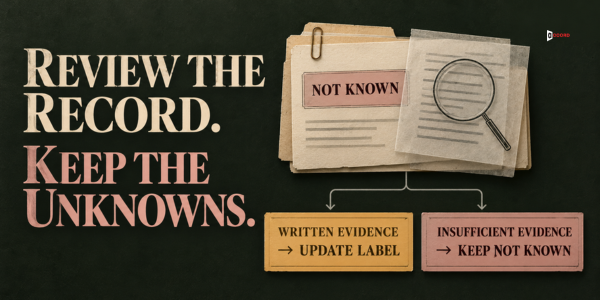
- Choose the opportunities. Run the review before the report closes. Take every opportunity created in the quarter that is closed, won or lost, and labeled Not known. Leave open ones alone, because their labels can still change. Allow about ten minutes each.
- Read the record. Read the form answer, the first emails, the first-call notes and any call transcript your company already records with consent. Do not start recording calls for this. Look for a named AI tool, a question the buyer says they asked an assistant, or a clear other first source.
- Apply the strict test. Change a label only if you can paste a quote or record into the evidence field, with the date. If it is not written down, it does not count, even if a rep remembers it.
- Set the label and the basis. A clear AI statement from the buyer gives AI sourced or AI assisted by the order above, with the basis Buyer-stated. A clear other first source with no mention of AI gives No AI mentioned, basis Inferred, because the buyer was not asked about AI. Anything else stays Not known.
- Repeat the check. Once a year, and after any rule change, repeat the ten-opportunity check from setup step 1.
What can you honestly say, and what can you not say?
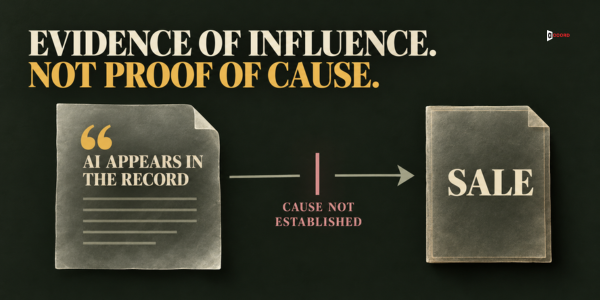
The method gives you a careful count, not proof of cause.
Self-reported answers are biased. Self reported attribution depends on what a person remembers and chooses to type. A buyer who heard your name from a colleague and then checked an AI assistant may name only one of the two. The person filling in the form may also not be the person who asked the assistant. No independent study of how accurate the "how did you hear about us" question is for B2B buyers turned up in our research, so treat the answers as directional.
Google shows only part of the AI step. Google's Search Central page says traffic from its AI features, such as AI Overviews (summaries at the top of results) and AI Mode (chat-style answers), is included in the overall search traffic in Search Console. That is Google's free search reporting tool. The Analytics channel page counts those clicks as Organic Search. So a buyer who clicked from an AI summary may answer "Google" on your form. Google's guidance on AI features in Search has the details.
Search Console also has a separate report, Generative AI performance report (Search), which Google announced in June 2026. Its measure is impressions: how often pages from your site appeared in AI features, shown by page, country, date and device. Google's help page says it may not appear for a site with too few impressions in those features, and it lists no queries, clicks, users or leads. Use it to see which pages AI features show. It cannot identify an opportunity or a buyer who read an answer and never clicked.
People can lean the wrong way. Marketers may want more AI labels, and sales may skip the question; the pasted-quote rule helps. If you change the answer list, the window or the wording, mark that quarter and compare quarters only when both coverage numbers are similar.
You can say that, among opportunities created this quarter, you hold written evidence that an AI answer played a part, and give the counts, both coverage numbers and the value lines. You cannot say that AI produced any revenue, that these opportunities would have been lost without AI answers, or that your share is high or low compared with other companies. Use the counts for small decisions, such as which questions to answer on your site, not to move a channel budget.
Imagine: 50 opportunities in one quarter
This example is invented, with simple numbers. Imagine a ten-person company that sells payroll software to restaurants. In the third quarter (July to September) it creates 50 opportunities, follows the rules above and closes the report on 30 October, 30 days after the quarter ends. Two of the 50 come from one restaurant group, for payroll at a new location and for a separate time-tracking purchase. They hold two opportunity IDs, so they count twice, each labeled from its own evidence.
At the end of September the labels come from the form answer, the first-call question and the stored first visit: 4 AI sourced, 6 AI assisted, 25 No AI mentioned and 15 Not known. Of the 35 labeled opportunities, 34 rest on the buyer's own words. The other one is a conflict case. A tracked first visit from an AI assistant came 20 days before the opportunity was created, inside the 90-day window, but the buyer wrote "a colleague told me" on the form. By the label order it is AI assisted, and because the label rests on the tracked visit, its basis is Inferred. Label coverage is 35 divided by 50, which is 70%. Buyer-stated coverage is 34 divided by 50, which is 68%. The AI share of labeled is 10 divided by 35, about 29%. The AI share of all is 10 divided by 50, which is 20%.
In October the team runs the review on the 15 Not known opportunities, of which 12 are closed and 3 are open. It takes about two hours. One becomes AI sourced because a first email from the buyer says "ChatGPT suggested your firm". Two become AI assisted because call notes record the buyer saying they asked an assistant to compare vendors. These three are Buyer-stated. Four become No AI mentioned, because a partner's introduction email names another first source and nothing mentions AI; these four are Inferred. Five stay Not known. The check is 1 plus 2 plus 4 plus 5, which is 12.
The table shows the result on 30 October. Values are samples taken from one amount field, and open means still open that day.
| Label | End of September | 30 October | Won | Closed-won value | Open | Open pipeline value | Lost |
|---|---|---|---|---|---|---|---|
| AI sourced | 4 | 5 | 1 | $24,000 | 2 | $34,000 | 2 |
| AI assisted | 6 | 8 | 2 | $36,000 | 3 | $52,000 | 3 |
| No AI mentioned | 25 | 29 | 6 | $108,000 | 6 | $96,000 | 17 |
| Not known | 15 | 8 | 1 | $12,000 | 3 | $38,000 | 4 |
| Total | 50 | 50 | 10 | $180,000 | 14 | $220,000 | 26 |
Label coverage is now 42 divided by 50, which is 84%. Buyer-stated coverage is 37 divided by 50, which is 74%: the 34 from September plus the 3 Buyer-stated labels from the review. Label coverage rose 14 points but buyer-stated coverage only 6, because 4 of the 7 new labels are Inferred and say nothing about whether the buyer used AI. The AI share of labeled is 13 divided by 42, about 31%. The AI share of all is 13 divided by 50, which is 26%. It rose from 20% because the review read more records, not because buyers used AI more.
Now the value lines. Of the 10 won opportunities, 3 show AI in the record, worth $60,000 of $180,000 closed-won value (the AI sourced $24,000 plus the AI assisted $15,000 and $21,000). Of the 14 open opportunities, 5 show AI in the record, worth $86,000 of $220,000 open pipeline value ($34,000 plus $52,000). The two lines are never added together. With only 13 opportunities showing AI, the team does not compare win rates between labels. It reads the quotes and updates the page that answers the buyers' question.
Frequently asked questions
What is AI influenced pipeline, and what makes it AI influenced?
In this guide the counted set is AI-influenced opportunities: those labeled AI sourced or AI assisted, whether open, won or lost. Pipeline stays the dollar value of the open ones. Neither label proves that AI caused the sale.
Can Google Analytics or Search Console show which opportunities came from AI answers?
Only in part. The Analytics AI Assistant channel records visits from listed AI assistants but excludes AI Overviews and AI Mode. Search Console's Generative AI performance report shows how often your pages appeared in AI features: visibility, not buyers. Neither can see a buyer who typed your name, and neither labels an opportunity unless your form stores the first-visit source.
How is this different from an attribution model?
An attribution model splits credit among recorded touches using a weighting rule. This method splits nothing: each opportunity gets one label and one basis. Use it beside a model, not instead of one.
What if the buyer says "Google" but saw an AI summary first?
It happens, because those clicks look like ordinary search. Name the Google AI summary as an answer choice on the form, and ask on the call too.
How do I count a company that starts a second project?
Count by CRM opportunity ID. A separate project or purchase that your CRM holds as its own opportunity counts on its own, with its own label.
Does a high count of AI sourced and AI assisted opportunities mean AI answers are working?
No. It means AI answers appear in the written story of those opportunities, and another source may have done most of the persuading.
Next step
If you would like a second pair of eyes on your counting rules, book a 30-minute working session with the Accord team. Bring your form questions and notes from ten closed opportunities. Accord's services include lead generation, email marketing, SEO and answer-engine optimization, so we have an interest in AI search work, but this method needs none of them.