
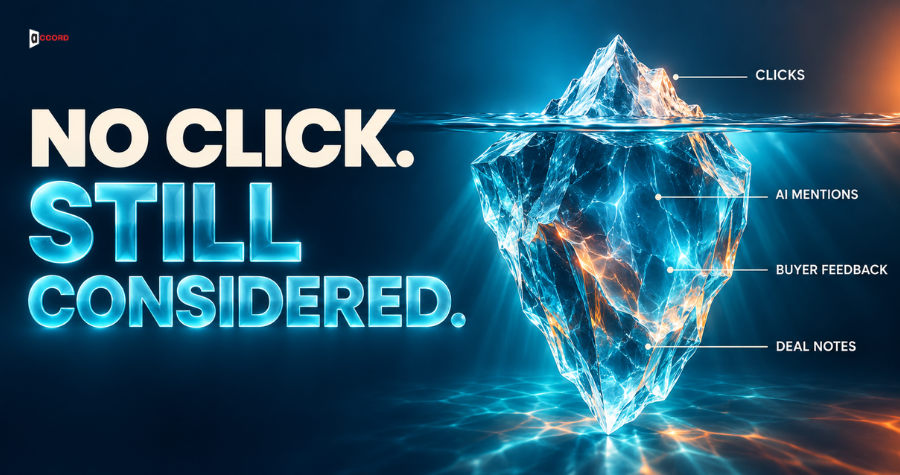
To measure AI search citations, you need three things: a record of when AI answers mention your brand, a way to ask new buyers how they found you, and a CRM field that shows which deals had AI research in them. Standard web analytics will not show most of this. An AI answer can shape a buyer's shortlist without sending a single click to your site, so a traffic report can look flat while pipeline quietly changes. This guide sets out five tracking points, a setup table, a short list of metrics to stop tracking, and a one-page monthly report that a small team can run without a data specialist.
Why does normal analytics miss AI search influence?
Most marketing dashboards count visits. A visit requires a click, and many AI answers are built to resolve the question on the screen. A buyer may ask an AI assistant for a short list of vendors, read a summary that names your firm, and then search for your brand a week later. In your analytics, that path may appear as direct traffic, branded search, or nothing at all.
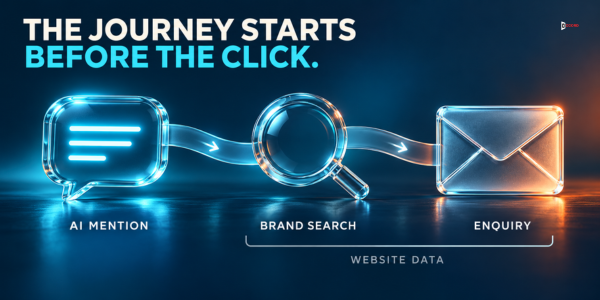
This does not mean AI search has no effect. It means the effect shows up somewhere else: in brand searches, in the words prospects use on discovery calls, in form fills that mention a comparison they read, and in deals that take longer to start. Measuring it well means looking at those places on purpose.
Start by writing down the decision you want the data to support. For most teams, that decision is whether to update a service page, which questions to answer in new content, or what sales material to prepare for the next call. If the data cannot change one of those decisions, it probably does not belong in the report yet. This keeps the tracking program small and useful instead of crowded with numbers nobody reads.
Google's guidance on AI features in Search describes how these features appear and what site owners can see about them. Read it before you set targets, because the reporting you can get directly from search tools is narrower than the influence you care about. Background on how click patterns are shifting in results pages is covered in zero-click search and featured snippets: how to still get traffic, which is useful context before you decide what success looks like for your site.
What should you track to measure AI search citations?
Five tracking points cover most B2B cases. None of them requires a new tool. Each one gives a different angle. Together they show whether AI answers are mentioning you, whether buyers remember those mentions, and whether the mentions connect to pipeline.
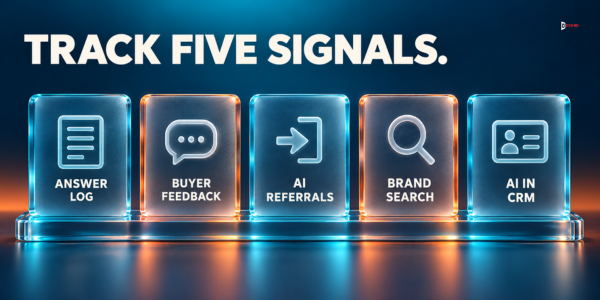
- A citation answer log. Once a month, ask a fixed set of buyer questions in the AI tools your prospects use, and record whether your brand, your site, or your named expertise appears in the answer. Keep the questions identical from month to month so the log shows change rather than wording differences. Save the date, the exact question, the tool, a short summary of the answer, and whether you were named, linked, or absent. Do not rely on a single run, because answers vary with phrasing and account settings.
- A "how did you hear about us" field. Add a free-text field to every demo and contact form, and keep it optional. Free text catches answers that a dropdown will miss, such as "I asked an AI tool which firms do this work." Read the answers each week and tag them in a spreadsheet so patterns are easy to spot.
- An AI referral channel in analytics. Some AI tools send visitors with identifiable referrer addresses. Create a channel group in your analytics tool that catches those referrers, so their visits stop hiding inside general referral or direct traffic. Treat this as a small signal. Many AI answers never send a visit, so a low number here does not prove low influence.
- A branded search trend. When AI answers name your firm, some buyers search for it next. Track branded queries in your search console each month, using the same date range every time. Compare that trend with your citation log. A rise in branded searches that follows a month of new citations is a useful pattern, although it is not proof on its own.
- A CRM field for AI-influenced deals. Add a single-select field to opportunities called "AI research involved," with values such as Yes, No, and Unknown. Sales reps set it at the first call, based on what the buyer says. This field is the bridge between marketing observation and revenue. Keep the definition written down so every rep applies it the same way.

Fictional example. Imagine a fictional software company that sells scheduling tools to clinics. Its marketing lead runs the same question list each month and notices that new prospects keep mentioning an AI tool in their first call. The sales rep marks those deals Yes in the CRM field. Two months later, the team compares those notes with the branded search trend and decides which service pages need clearer wording. The example is invented, but the steps are the ones any team can follow. The point is the habit: a fixed question list, one shared field definition, and a monthly comparison that leads to a specific change on a page or in a sales script.
How do you set up each tracking point?
The table below shows the setup for each point, where the data lives, who owns it, and how often to review it. Keep the setup simple enough that someone can run it during a busy week.
| Tracking point | What to set up | Where the data lives | Owner | Review cadence |
|---|---|---|---|---|
| Citation answer log | A fixed question list, one row per question per tool | Shared spreadsheet | SEO lead | Monthly |
| Open-text attribution | Optional free-text field on forms and booking pages | Form tool and CRM | Marketing operations | Weekly |
| AI referral channel | Channel group covering the referrer sources you can identify | Web analytics | Analytics owner | Monthly |
| Branded search trend | Saved query group for brand terms, same date range each month | Search console | SEO lead | Monthly |
| AI-influenced deal field | Single-select field with a written definition for reps | CRM | Sales operations | Monthly, at pipeline review |
Set up the citation log first, because it gives you a fixed baseline. Add the form field second, since it starts collecting answers right away. Build the analytics channel and the CRM field in the same week, and agree on the written definition before the first sales call.
Plan on a few working hours for the first version. The citation log usually takes longest on the first run, because the question list needs careful choosing. After that, the monthly run should be a short task with the same steps each time, plus a note of anything that changed in the tools you check.
Two related topics need their own posts. If you already report revenue by source, how to prove marketing ROI with pipeline data explains how to connect new fields to the pipeline reports you already use. How to credit a deal to a channel is a separate question. That is the attribution method, and it needs its own rules. Read B2B marketing attribution models for better decisions before you assign credit for any AI-influenced deal. This post covers only what to collect, so that the attribution work has good inputs.
Which AI search metrics are not worth tracking?
Some numbers look useful and waste time. Stop tracking these unless a specific decision depends on them:
- Daily checks of a single AI answer. One run tells you little, because answers change with wording, location, and account history.
- Impression counts from AI tools that do not report them to you. If a figure cannot be verified from a source you trust, do not estimate it.
- Total AI referral visits as a headline KPI. Most influence happens without a visit, so this number undercounts the effect.
- Share-of-voice scores from third-party tools with unclear methods. Ask how the score is built before you put it in a report.
- Rankings across every AI product. Pick the two or three tools your buyers actually use in your sector and track those.
- Sentiment labels on every mention, unless a person reviews them. Automatic labels often misread short answers.
Dropping a metric is not a judgment that it has no value. It means the metric does not help you decide anything this quarter. Review the list each quarter, and add a metric back only when a specific question needs it.
What should a monthly AI search report include?
Use a one-page report with the same layout every month. Keep the same questions in the citation log and the same date windows for search data, so each month compares fairly with the last. The format below is simple enough to copy into a document or a slide.
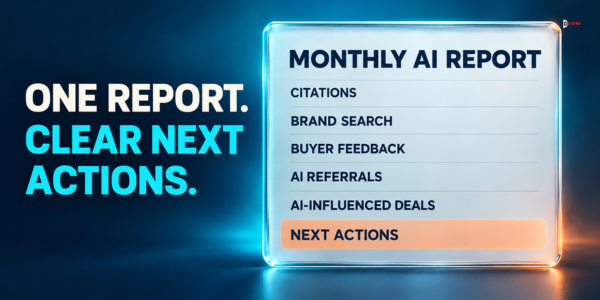
Monthly AI search report (one page)
- Citation summary. How many of the fixed buyer questions named your brand, linked to your site, or left you out, compared with last month.
- Branded search. The direction of branded query volume over the same date range, and any notable change in the pattern.
- Self-reported mentions. Three to five quoted answers from the open-text field, with the buyer role and deal stage where known. Remove personal details before sharing.
- Referral channel. The AI referral visits for the month, with a note that they are a partial signal.
- AI-influenced deals. How many open and closed opportunities have the field set to Yes, and the stage each one has reached.
- Actions for next month. Two or three specific changes, such as a page to update, a question to add to the log, or a note for the sales team.
Assign one owner for the report, usually the SEO lead or the marketing operations manager, and ask a second person from sales to check the deal field each month. Two owners prevent the report from becoming a marketing-only view. Send it to the leadership team on the same day each month, so people expect it and read it.
The report should answer one question: is AI search changing which firms buyers consider, and is that showing up in conversations and deals? If the answer is still unclear after several months, the problem is usually the questions in the log or the wording of the CRM definition, not the choice of tool.
What mistakes make AI search tracking fail?
Most failed programs break in the same few places. Watch for these:
- Changing the question list every month, which makes the citation log impossible to compare.
- Treating a single AI answer as a trend.
- Making the open-text field required, which pushes people to type filler or pick an unrelated option.
- Letting each sales rep define "AI research involved" in a different way.
- Reporting AI referral visits as the whole story.
- Presenting a revenue claim before the CRM field has collected data across a full sales cycle.
- Skipping the written definitions, so the data cannot be trusted six months later.
Each mistake on this list has a simple fix. Lock the question list in a document and date every change to it. Write the field definition once and share it in the sales onboarding material. Keep the open-text field optional. Treat each source as one part of the picture rather than the final answer.
Frequently asked questions
Can I measure AI search citations without paid tools?
Yes. The citation log, the form field, a channel group in your existing analytics tool, a saved branded-search group, and a CRM field need no paid product. Paid tools can speed up the work, but check their method before you rely on their figures.
How often should I run the citation log?
Once a month is enough for most B2B teams. Run it on the same day each month, with the same questions and the same tools, and record the date and any setting that changed.
Does AI referral traffic show the full impact of AI search?
No. Many AI answers mention a brand without sending a visit, so referral traffic is only a partial signal. Use it alongside the citation log, the branded search trend, and the CRM field.
Where should I read about crediting deals to channels?
Read the attribution guide linked earlier in this post. That topic covers how to split credit between touchpoints. This post covers what to collect, so that the attribution work starts from reliable inputs.
If you want to talk through these five tracking points for your team, book a 30-minute working session with the Accord team.