
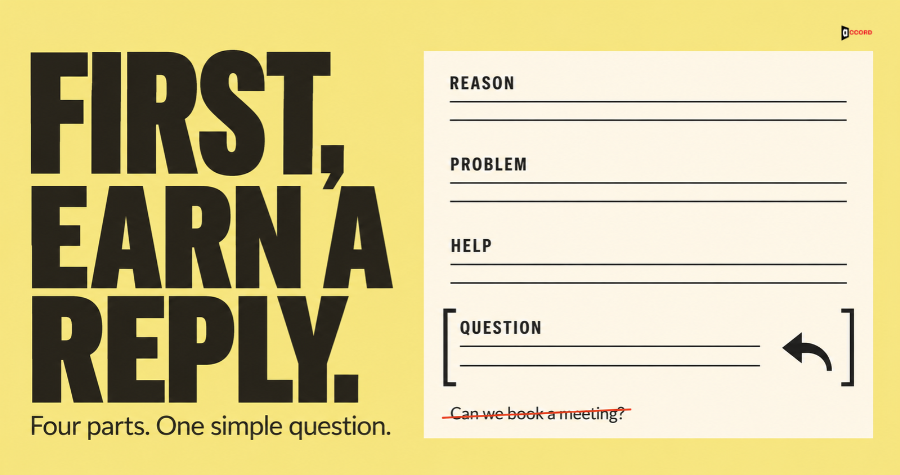
A common way to end a first cold email is "Do you have 15 minutes this week?" To the reader, you are a stranger asking for time before giving a single reason to spend it, and the easy answer is no reply at all. The B2B cold email template below fixes that with four short parts: why you are writing, the problem, what you do and what you can show, and one question that is easy to answer. The meeting comes later, in the second message, after the reader has shown some interest.
Below you get a size limit and a test for each part, three filled examples, the lines to leave out and the footer that US law asks for. The limits and tests are Accord's own starting points, not industry rules. The outside facts, from Gong and the US Federal Trade Commission, are linked where they appear.
Why does a meeting ask fail in the first cold email?
A meeting ask is any line that asks the reader to talk, meet or get on a call, whether or not it names a time. "Do you have 15 minutes on Thursday?" is one. So are "Open to a quick chat?" and "Here is my calendar." The soft versions count too, because they still ask for the reader's time before the reader has a reason to give it.
In our view, a yes to that line means four decisions at once. The reader must decide that you are a real person, that your problem is also theirs, that your offer might fit, and that the answer is worth a slot in the week. A stranger's email lands in a full inbox, and the reader makes those four decisions in seconds. A short question about interest asks for one small decision instead.
Outside data points the same way. Gong, a sales software company, studied 304,174 sales emails and counted a success when a meeting was booked within 10 days. In its write-up, an interest-style ask, one that checks interest before asking for a meeting, was the best-performing ask for cold emails. You can read the details on Gong's cold email call-to-action page. It is one software vendor's analysis of its own data, so treat it as a hint, not as proof for your list.
The first message earns a reply. The second message, sent after a yes, asks for the meeting.
What is the B2B cold email template for the first message?
The first message has four parts in a fixed order. Each part has one job, a size limit and a plain test. The sizes are maximums, not targets.
| Part | Its one job | Size | Test |
|---|---|---|---|
| 1. Reason | Say why this person gets this email | One sentence, up to 25 words | Could you send the sentence unchanged to a different company? If yes, rewrite it. |
| 2. Problem | Name one problem that people in this role run into | One or two sentences, up to 30 words | Would the reader say "yes, that happens here", or at least "I have seen that"? |
| 3. Help | Say what you do and name one thing you can show | One or two sentences, up to 35 words | Could you send the thing within a day if asked? |
| 4. Question | Ask one question that can be answered in a few words | One sentence, up to 15 words | Is it free of any ask to talk or meet, and of any time, day or calendar link? |
The limits add up to 105 words (25 plus 30 plus 35 plus 15), and a greeting and a sign-off add about 10. Aim for 60 to 120 words from the greeting to the sign-off. That stays inside the limits in our cold email deliverability guide: around 120 words or fewer, at most one link and no attachments. The footer comes after the sign-off and is not counted. The real test is whether the reader can say within ten seconds who wrote, why, and what is being asked.
Here is the template, ready to copy. Square brackets show what you replace. After the greeting, the four lines are the four parts, in order.
Subject: [Plain words about the fact in the first line, up to 6 words]
Hi [first name],
[A true, checkable reason you are writing: a fact about their company, their role or their group.]
[One sentence about a problem that people in that role run into.]
[What you do, in one plain sentence, and one thing you can show them if they say yes.]
[One question that can be answered in a few words.]
[Your name, job title and business name]
[Your postal address, and one line telling the reader how to stop getting your emails]
Part 1: Why are you writing to this person?
The reason must be true, easy to check and about the reader or their group. Three kinds work.
A fact about their company. A new office, a product launch, a hiring post, a page they published. For example, "I saw that Brightlane moved its help center to a new site this month."
A fact about their role. For example, "You manage the support team at Brightlane, so the help center is probably yours."
A fact about their group. When you have no personal fact, say so honestly: "I write to heads of support at software companies with 30 to 100 people." An honest group reason is better than a fake compliment. A line such as "I loved your recent post" is a small lie in the first sentence when you did not read the post, and many readers will notice.
You can find a company fact in about two minutes. Look at the company's news or blog page, its product update page and its public job posts. Our live guide on cold email personalization at scale goes deeper on finding and storing these facts.
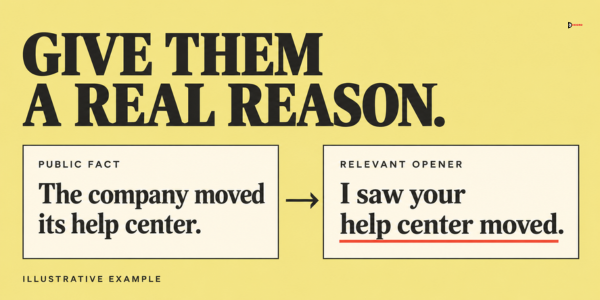
Keep to business facts from public pages, and leave out family and photos. Also leave out "I hope this email finds you well". It is polite, but it is not a reason. The test is the swap test: if the sentence still works after you replace the company name with another, it is not yet a reason.
Part 2: What problem does this person have?
Name one problem, in the reader's own words. Do not name your product, your industry or a trend. Name a problem that a person in this role would recognize on a normal Tuesday.
Here are two samples, both invented. For a head of support: "After a move, it is easy to miss articles that still describe the old screens." For a finance manager at a freight company: "Invoices that arrive by email and need typing into the accounting system pile up at month end."
Four rules keep this part honest. Name one problem only, because two problems split the reader's attention. Skip openers like "Are you struggling with", which sound like a template and assume pain the reader may not feel. Do not exaggerate the cost. And do not add a number unless you can name where it came from and what it measures.
What if you do not know the problem for this group? That is a research gap, not a writing problem. Ask three customers or contacts in that role which problem comes first, or use the one you hear most on sales calls, and write it down once per group.
Part 3: What do you do, and what can you show?
Say what you do in one plain sentence, then name one thing you can show if the reader says yes. The thing can be a sample of your work, a one-page summary, a short example or a public page. It should be something you can send within a day.
For example: "I write help-center articles for B2B software teams, and I can show two I wrote for similar teams."
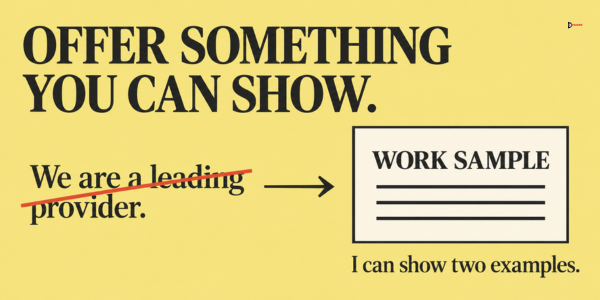
Do not write "We are a leading provider with years of experience". The reader cannot check it. Do not name a client without their permission. Use a result or a number only if you can show where it came from, and say what it measures. If you have no result you can show, offer a sample instead of a claim. A sample is a fact. A claim is a promise.
Leave the link out of this part. The offer sets up the question in part 4, and you send the sample after the reader says yes.
Part 4: What is the one question to end with?
End with one question that can be answered in a few words and needs no meeting. Three kinds work, and you should pick one.
An interest question. "Would it be useful if I sent them over?"
A fit question. "Is this a problem for your team right now?"
A who-handles-this question. "Are you the right person for this, or should I ask someone else?"
Each of these answers tells you what to do next. A yes lets you send the sample. A no tells you to stop. A name lets you write a new first message to the right person. Do not end with "Let me know your thoughts", because the answer is a paragraph. Do not end with "Looking forward to hearing from you", because it is not a question.
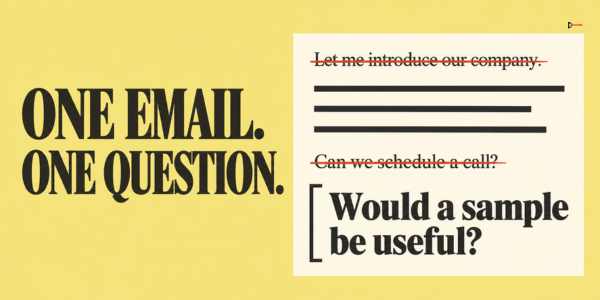
Before you send, search your draft for these words: minutes, week, call, chat, talk, connect, quick, catch up, calendar, schedule, book, demo, "open to" and any day of the week. If one appears, you may have a meeting ask, and part 4 fails its test.
What about the subject line, greeting and sign-off?
These are not among the four parts, but they must match them. Write the subject line last. Say in plain words what the email is about, using the same fact as part 1, such as "Help center move at Brightlane". The FTC's CAN-SPAM compliance guide says a subject line must not be deceptive. So do not use "Re:" or "Fwd:" for a conversation that never happened, and do not promise something the email does not contain.
Use the reader's first name, spelled the way they spell it. Check the name against your list before you send. Sign with your real name and job title, from a real person's mailbox.
What should you leave out of a first cold email?
Many weak first messages have too much in them. Leave out these six:
- Attachments and images, because the first message should be plain text that a person can read in one glance.
- More than one link. Our guide allows at most one, and this template suggests none, because the question in part 4 does not need one.
- Any ask to talk or meet, with or without a time, as described in part 4.
- A long introduction to your company, such as when it was founded or how many offices it has.
- Claims you cannot show, such as "leading", "best" or "proven results", and any promise of an outcome.
- A second question. If you ask two, the reader may answer neither.
What must the footer of a first B2B email include?
In the United States, the CAN-SPAM Act covers commercial email. The same FTC guide says plainly, "The law makes no exception for business-to-business email." It lists eight rules, shown here in short form:
- Do not use false or misleading header information. The sender details must be true.
- Do not use deceptive subject lines.
- Identify the message as an ad. The wording is flexible, but it must be clear and easy to see.
- Include a valid physical postal address.
- Tell recipients how to opt out of future marketing email.
- Remember that subscribers and members can opt out too.
- Honor opt-out requests within 10 business days. The opt-out method must keep working for at least 30 days after you send the message.
- If another company sends emails for you, you are still responsible for what it does.
Rule 3 is the one many senders are unsure about. The FTC leaves the wording flexible, so ask your legal adviser how it applies to your message. That is why the sample footer in this post has no ad label.
In the email itself, rules 4 and 5 show up in the footer: your business name, your postal address and one plain opt-out line, such as "If you would rather not get emails from me, reply "no thanks" and I will stop." Add every stop request to your do-not-email list the same day, even though the law allows up to 10 business days.
The FTC page shows penalties of up to $53,088 for each email in violation. That is the figure as read on 1 November 2026, and it may change. This is a summary of one US law, not legal advice. Canada, the UK and the EU use different rules, so check them before you send there.
How do you adapt the template to one reader in five minutes?
Do the slow work once per group, and the quick work once per reader.
- Choose the group first: readers who share a role and a problem. Write parts 2, 3 and 4 for the group, not for each person. This takes an hour or two, once.
- For each reader, open the company's own site and recent public pages. Look for one fact for part 1. This takes about two minutes. If nothing turns up, use the group reason instead.
- Fill in the name, the company name and the fact. Check the spelling of both. A wrong company name is an easy slip to make and a hard one to recover from.
- Read the email aloud. Mark any sentence you would not say to the person's face.
- Run the four tests from the table and the leave-out list, fix what fails, and send.
Steps 2 to 5 take about five minutes in our starting estimate. If they take much longer, the group is too wide.
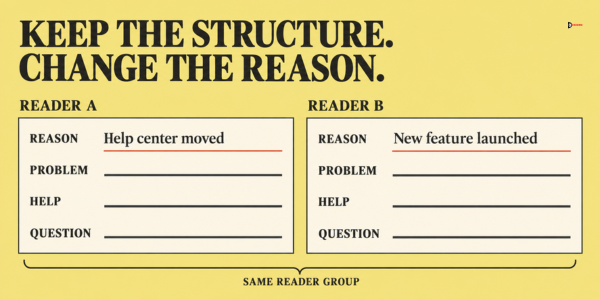
Imagine: one template, one reader, one batch of 40
Imagine a three-person agency, Clearpage Writing, that writes help-center articles for B2B software companies. This example is invented, including every name and number. Dana is writing to Sam, the head of support at a software company called Brightlane. First, the version to avoid:
Subject: Quick call this week?
Hi Sam,
My name is Dana and I work at Clearpage Writing. We are a leading agency with years of experience in help-center content, video tutorials and training material for software companies. We deliver great results for our clients. I would love to schedule a 15-minute call this week to tell you more about our services. Does Tuesday or Thursday work for you?
Best regards, Dana
That version has 66 words, counted from the greeting to the sign-off like the next one, and it asks for a meeting, two times and a call. It has no reason, no problem and nothing the reader can check. Now the same message in four parts:
Subject: Help center move at Brightlane
Hi Sam,
I saw that Brightlane moved its help center to a new site this month.
After a move, it is easy to miss articles that still describe the old screens.
I write help-center articles for B2B software teams, and I can show two I wrote for similar teams.
Would it be useful if I sent them over?
Dana Reyes, Founder, Clearpage Writing
Clearpage Writing, 100 Sample Street, Springfield. If you would rather not get emails from me, reply "no thanks" and I will stop.
The body has 14, 15, 18 and 9 words in its four parts. With the greeting and sign-off it has 63 words, and the footer is extra. Every part passes its test, and no word in part 4 names a time or a day.
For the next reader, Dana changes the name, the company and part 1. Parts 2, 3 and 4 stay the same, because they belong to the group, not to the person.
Two more samples show how the same four parts fit other sellers. Both are invented. A seller of shipment tracking software might write: "Hi Priya, I saw that Northgate Freight opened a second warehouse in Ohio this spring. With two sites, it is easy to lose track of which truck holds which order. I run a shipment tracking tool for mid-sized freight firms, and I can show a one-page view of how a two-site firm uses it. Would it be useful if I sent it?" A consultant who writes billing checklists might write: "Hi Marcus, I saw that Alder Park Dental Group posted three open roles for office managers this month. When several managers start close together, it is easy for billing routines to drift from clinic to clinic. I help dental groups write one billing checklist for all clinics, and I can show a sample with the clinic names removed. Is this a problem for your group right now?"
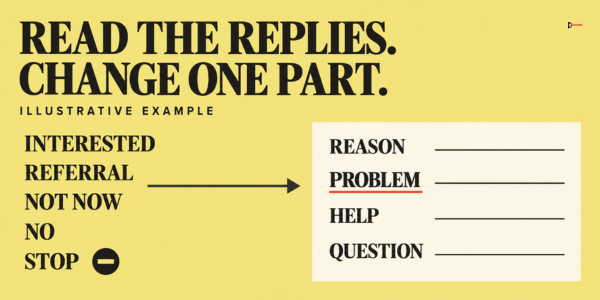
Dana sends the message to 40 heads of support at software companies with 30 to 100 employees. Two addresses do not exist, so those two emails come back undelivered, and 38 are delivered. Dana uses one rule for every rate in this review: the number of replies divided by the 38 delivered emails. Seven replies arrive. Three say yes, please send them. One says wrong person and names a colleague. One says not now. One says no thanks. One asks to stop, and that address goes on the do-not-email list the same day.
Dana counts a positive reply as a yes or a right-person name. That is 4 of 38 delivered emails, or 10.5%. These sample numbers are not a benchmark, so compare them only with your own next batch. They are also small. One more yes would make it 5 of 38, or 13.2%, so a single reply moves the rate by about 2.6 points. Dana reads direction, not proof. For the next 40 sends, Dana changes one part only, say part 2, and compares the kinds of replies as well as the rate. Changing two parts at once would hide which change mattered.
What happens after someone says yes?
A yes to part 4 is permission to send what you offered, and now the meeting ask has its place. Reply in the same thread, send the two samples and offer two specific times. Our guide on how to respond to a positive cold email reply and book the call gives a 24-hour checklist and wording for each kind of yes.
A "wrong person" reply with a name gets a new first message to the named person. If the first reader agrees to be named, say so in part 1. If not, use a group reason. If nobody replies, the next step is a follow-up. That is a separate message with its own job and its own timing, so it is not covered here.
Frequently asked questions
How long should the first B2B cold email be?
Aim for 60 to 120 words from the greeting to the sign-off, with the footer extra. The four part limits are maximums that add up to 105, and the invented example in this post has 63 words. These are Accord's starting points. No outside study cited here proves one best length, so judge by the replies from your own list.
Should a first cold email ever ask for a meeting?
Yes, in a few cases. The reader asked to meet, or a mutual contact introduced you and asked you to write. Otherwise wait for a reply first. Gong's analysis of 304,174 sales emails reports that a specific meeting ask more than doubles meetings booked once a deal is under way, from 15% at the cold stage to 37%. So the meeting ask has its place, later.
Can I use the same template for every reader?
Use the same parts 2, 3 and 4 for one group of readers who share a role and a problem. Change the name, the company and part 1 for each person. If only the name changes, the email is a mass email, and many readers will notice.
What should I write in part 3 if I have no case study?
Offer a sample of your work, a one-page summary or a public page, and say what you do in plain words. Never invent a result, a client or a quote.
Does a first B2B cold email need an unsubscribe line?
In the United States, yes. The FTC's CAN-SPAM compliance guide says the law makes no exception for business-to-business email, and it requires a valid postal address and a clear way to opt out. Honor each request promptly, and within 10 business days at the latest.
Will a good template get my email into the inbox?
No. The template covers what the message says. Whether it reaches the inbox also depends on your domain setup, how much you send and how clean your list is. Our cold email deliverability guide covers those checks in order. Fix them first if your messages land in spam.
How do I know whether the template is working?
Count replies divided by delivered emails, and note the kinds of replies: yes, right person, not now, no and stop. Change one part at a time, then send the next batch and compare.
What if nobody replies to the first message?
Send a follow-up as a separate message with its own job. Send it only to people who did not reply, never to anyone who asked to stop, and keep the same opt-out line. This post gives no number of follow-ups or days between them, because no source cited here supports one.
Next step
If you would like a second pair of eyes on your own first message, book a 30-minute working session with the Accord team. Bring the email you send today and the group of readers it goes to, and we will run the four tests together. There is no obligation, and you can use everything in this post without us. Accord sells outbound and email services, so we have an interest in this subject.