

Many small teams plan a month of content by listing topics: one post on email, one on the website, one on a trend, one photo of the team. Together they tell no single story. In a B2B growth engine, that is a break between parts. Someone who replies to an email and then checks your website and your social page finds a different story in each.
The B2B content calendar below works the other way. It picks one buyer problem for the whole month, looks at it from four angles, one per week, and puts each piece where that buyer will see it. The hours, limits and rules in this post are starting points we chose, not industry standards. Replace them with your own numbers after the first month.
Why does a calendar of mixed topics fail a small B2B team?
A content calendar is a dated plan of what you will publish, on which channel, and who makes it. A post on Monday and an email on Thursday reinforce each other only when they are about the same problem. Otherwise the buyer starts again each time.
Where does a content calendar fit in a B2B growth engine?
A B2B growth engine is a connected system that helps the right buyers find, trust and respond, made of five services: SEO and AEO (being found in search and in AI answers), lead generation, email, web development and social media. The live guide names the same five by their jobs: search visibility, account data, outbound outreach, website conversion and social proof.
A content calendar touches all five. We place its plan in social media, the service that builds trust over time; in your company, give it to whoever owns the buyer's first impression. Its main assets sit on your website (web development), and its small assets go out by email and social posts.
What it receives. Lead generation, which decides who to reach, gives the calendar its buyer role. Sales calls and email replies give it the problem, in the buyer's own words. Each is a signal, meaning a sign from a buyer about what matters to them.
What it hands on. In the full plan, email gets three small assets to send, the website gets a main asset every week, and SEO and AEO gets those assets as pages to find. The sales team, which sits outside the five services but hears buyers first, gets a note to use on calls. Each carries the same problem in the same words.
A ten-minute check. Open the last email your team sent, the page it linked to and your latest social post. Write one line for each: the buyer problem it is about. If all three name the same problem, your parts are connected. If they differ, or you cannot tell, choose the month's problem first. If one of the three does not exist yet, check the other two.
How do you choose one buyer problem for the month?
A buyer problem is a sentence that a person in a named job would say about their own work, that costs them time or money, and that you can help with. Four tests keep the sentence honest.
The role test. You can name the job title of the person who has the problem. "Operations managers at regional freight brokers" passes. "Businesses" does not.
The own-words test. The buyer could say the sentence in a meeting without using your product's words. "Our dispatchers type the same load details into three screens" passes. "Lack of workflow automation" does not.
The one-problem test. The sentence names one problem, so one fix would solve it. "Our dispatchers type the same load details and the same addresses into three screens" passes, because the "and" joins two parts of one problem: retyping. "Our dispatchers retype load details and our customers cannot track their loads" fails, because it needs two different fixes. Words like "and" and "or" are a warning sign, not a ban: ask whether you would need one fix or two.
The not-a-topic test. "Email marketing", "SEO" and "lead quality" are topics, things you want to write about. A problem is something the buyer wants to stop.
Where do you find the problem? Start with the signals your team already holds: your last 10 sales call notes, the replies to your emails and the questions customers sent to support. Write each problem on its own line, add a tally mark for each repeat, and pick the line with the most marks. If you keep a message sheet, as in our guide on writing a message sheet, the month's problem should match it.
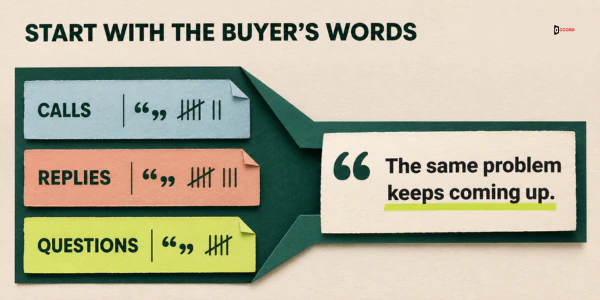
What if you have fewer than 10 notes? Ask three contacts in the role what the most annoying part of their week is, write down their words exactly, and use the one you hear twice. If the tally is a tie, pick the problem you can back with something you already have, such as a sample or a checklist.
What does a B2B content calendar for one problem look like?
The plan has four weeks. Each week has one angle, the way you look at the same problem that week. Each angle gets one main asset, a longer piece that lives on your website, and two small assets, short pieces cut from the main one in under an hour. The angles come in the order of this table, which you can copy. If your team cannot fill all four weeks, the capacity rule further on says which angles to keep.
| Week | Angle | Main asset (on your website) | Two small assets (channel) | Maker and reviewer |
|---|---|---|---|---|
| 1 | Name it: show the problem on an ordinary day, in the buyer's words | A short post that describes the problem day to day | One social post with the problem sentence (points); one email to people who agreed to hear from you (points) | [name] and [name] |
| 2 | Explain why: show where the problem comes from | A post on the cause, with one simple picture | One social question about the cause (asks); one note for your sales team to use on calls (points) | [name] and [name] |
| 3 | Fix it: give steps the buyer can take alone | A checklist or step-by-step guide | One social post with the first three steps (points); one email with the checklist (points) | [name] and [name] |
| 4 | Show it: give an example and ask one easy question | A worked example or a sample the buyer can copy | One social post with the example (points); one email asking people who responded one easy question (asks) | [name] and [name] |
Fill in a header for the month before you write anything else. Month: [month and year]. Buyer role and company type: [one job title, in one kind of company, with a size range]. Problem sentence: [one sentence that passes the four tests]. Hours and sets: [hours per week × 4, then the number of sets from the capacity rule below]. Keep rule: [what must happen for you to keep this problem for a second month].
Write the keep rule before any result arrives, so the month-end review checks a rule and not an opinion. A suggested rule is at least 2 different fitting companies and at least 1 question from any responder over the month. A long sales cycle may need two months of the same problem.
Which asset goes on which channel?
The main asset goes on your website, the one place you control. Before you send anyone there, run the page through our website conversion checklist. The small assets go where your buyer already pays attention: in the first month, email and one social network, plus a note for your sales team. Each small asset opens with a line that names the month's problem in the buyer's words, so the email, the page and the post tell one story.

To choose the social network, ask where your last five customers first heard of you. If you do not know, pick the network where people in that job spend time.
Every small asset either asks one easy question or points to the main asset, as marked in the table. It never does both and never asks for a meeting, which comes later.
Send the emails to customers and to people who agreed to hear from you. Cold outreach has its own rules, but sales can open it with the same problem sentence.
How many assets can a small team really make?
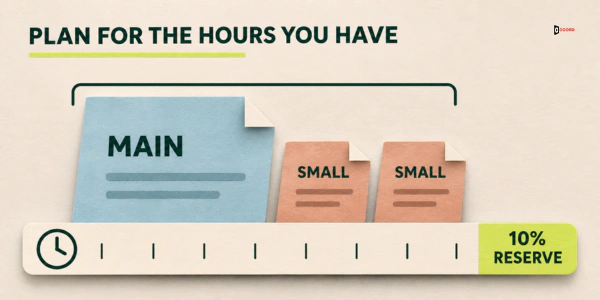
A main asset takes about 5 hours. That is 1 hour to gather real buyer questions, 2 hours to draft a post of 800 to 1,200 words, 1 hour for someone else to review it and 1 hour to publish it.
A small asset takes about 45 minutes when you cut it from a finished main asset. A set is one main asset plus two small assets, so a set takes 5 hours plus 1.5 hours, or 6.5 hours.
Fixed monthly work is 3.5 hours. Planning the month takes 90 minutes, four weekly review lines take 15 minutes each, which is 1 hour, and the month-end review takes 1 hour.
Keep 10% of your hours free for late work, replies to comments and one-to-one sends.
The rule is: number of sets = (hours per month × 0.9 − 3.5) ÷ 6.5, rounded down, where hours per month is weekly hours × 4. Here are four common cases.
| Content hours per week | Hours per month | Sets you can make | Angles to publish |
|---|---|---|---|
| 4 | 16 | 1 | Fix it |
| 6 | 24 | 2 | Name it, Fix it |
| 8 | 32 | 3 | Name it, Explain why, Fix it |
| 9 | 36 | 4 | Name it, Explain why, Fix it, Show it |
When you make fewer than four sets, rank the angles Fix it, Name it, Explain why, Show it, keep the top ones, and publish them in the table's order, starting in week 1. The weeks that remain are response weeks: you create nothing new, answer every comment and reply, and send the main asset to each person who asked a question.
Here is how that reads against the plan table. With one set (4 hours a week), you keep only Fix it, so week 1 is the week 3 row: the checklist, its social post and its email. No Name it post came first, so open the checklist with two lines that name the problem. With two sets (6 hours a week), you keep Name it and Fix it: week 1 is the week 1 row, week 2 is the week 3 row, and weeks 3 and 4 are response weeks.
Below about 11.1 hours a month the rule gives zero sets, so use the time to choose the problem and talk to buyers, and start next month. With more than 9 hours a week, still run only four sets, one per angle, and use the extra hours for sales follow-up.
What is the weekly review line?
Once a week, on the same weekday, the owner writes this line and reads it to whoever decides.
Week [n], [angle]. Published as planned: [yes or no]. Responses: [count]. Responses from fitting companies: [count, then the company names in brackets]. Questions heard: [list, or none]. Next week: [keep, or change what]. Notes for next month: [text, or none].
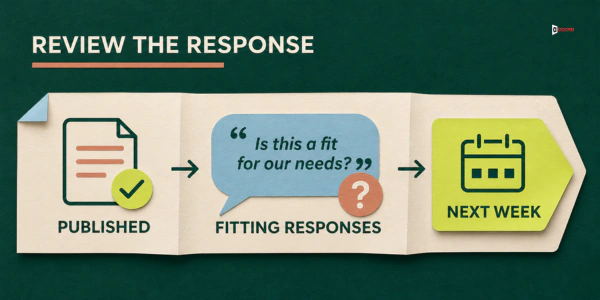
Two definitions keep the counts consistent. A response is any action by a real person outside your team that shows they read the piece: a reply, a comment with words in it, a direct message, a forward, a form fill on the page, or a mention on a sales call that the person links to the piece. A like or a view is not a response, because it costs the person almost nothing.
Count each person once per week, so three messages from one person are one response. Count a late response in the week the piece was published, and update that week's line for up to 7 days after the month ends. Review the month after those 7 days; later responses go in next month's notes. A fitting company matches the buyer role and company type in your plan. Count fitting responses the same way, one per person per week, and write a company name once for each person from it, so (A, A) means two people from A. The fitting count can never be higher than the response count.
Each part has a check and a fix.
Published as planned. The check is a plain yes. If not, move the asset to the next free slot and drop one small asset.
Responses from fitting companies. If there is at least one, keep the plan. If there are none, even when other responses came, use the no-response steps near the end of this post.
Questions heard. Write the buyer's words, not your summary. Pass each one to the website, the email writer or the sales team, whichever can answer it.
If you already hold a weekly meeting such as the one in our weekly marketing and sales meeting guide, read the line where the group makes its one decision, outside its six-number scorecard. Without one, send it to whoever owns the sales number.
Imagine: a two-person team plans November around one problem
This example is invented, including every name and number, and the sample numbers are not a benchmark. Imagine Quillfeather Freight Software, which sells load-entry software to regional freight brokers. Its marketing manager has 6 hours a week for content and the founder has 3, so the team has 9 hours a week, or 36 a month.
The capacity rule gives (36 × 0.9 − 3.5) ÷ 6.5 = 4.45, so the team makes 4 sets. Four sets take 26 hours, or 29.5 with the fixed work, so 6.5 hours stay free, more than the 10% reserve of 3.6.
Next comes the ten-minute check. The team's last email was about faster quotes, its page about a dashboard and its latest post about a trade show. Three lines, three problems, so the check fails. The team tallies its sales notes and email replies, and the top line reads: "Our dispatchers type the same load details into three screens." It passes all four tests. The buyer role is an operations manager at a regional freight broker with 20 to 100 employees, and the team uses the suggested keep rule.
The four weeks follow the table, ending with a sample load sheet in week 4. Here are the four review lines.
Week 1, Name it. Published as planned: yes. Responses: 3. Responses from fitting companies: 2 (A, B). Questions heard: "Does this work with the spreadsheet we use now?" Next week: keep. Notes for next month: none.
Week 2, Explain why. Published as planned: yes. Responses: 1. Responses from fitting companies: 1 (C). Questions heard: none. Next week: keep. Notes for next month: change the first line of the social question.
Week 3, Fix it. Published as planned: yes. Responses: 4. Responses from fitting companies: 3 (A, D, E). Questions heard: "Can you share the checklist as a spreadsheet?" and "How long does step 2 take?" Next week: keep, and add step times to the week 4 sample. Notes for next month: none.
Week 4, Show it. Published as planned: yes. Responses: 2. Responses from fitting companies: 2 (B, C). Questions heard: none. Next week: not applicable, month ends. Notes for next month: none.
Week 3's four responses were two email replies, one social comment and one sales-call mention, all in one count. The spreadsheet question went to the website, and the step 2 question went into week 4, where the sample shows the minutes each step takes.
At the month-end review, the team adds up the lines. Responses: 3 + 1 + 4 + 2 = 10. Responses from fitting companies: 2 + 1 + 3 + 2 = 8. Questions heard: 1 + 0 + 2 + 0 = 3. The names A to E show 5 different fitting companies. The rule asks for at least 2 companies and 1 question, so the team keeps the problem for a second month. Ten responses is a small base, so the team reads direction, not proof. Week 2 drew the fewest fitting responses, 1, so it gets the one change for month 2: a new first line for the social question.
Had only A and B responded and nobody asked a question, the rule would fail on questions, and the team would start at check 3.
What should you do when a post gets no response?
Here, no response means no response from a fitting company. Work through these five checks in order. Fix the first one that fails, then check again a week later.
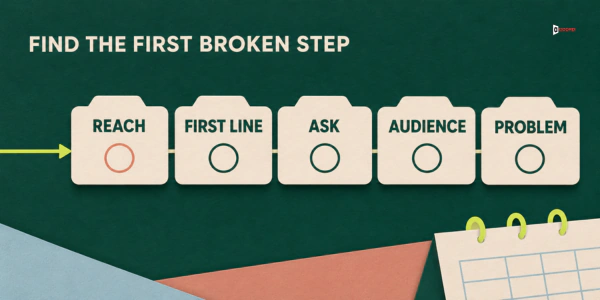
- Did it reach anyone? Confirm it went to the right list or channel. Fix: send it again.
- Could a stranger tell in five seconds what problem it is about? If its first line opens with your company name or a general claim, rewrite it as the problem sentence. Fix: post the small asset again a week later.
- Is the ask small enough? An ask for an opinion, a story or a meeting is heavy. Fix: if the asset was marked "points", switch it to "asks" for the repeat. Drop the link and end with a question a few words can answer, such as "Is this a problem for your team right now?"
- Are the right people seeing it? If your followers are mostly colleagues and other marketers, silence from buyers is common. Fix: send the main asset one to one to five fitting contacts.
- Is it the right problem? If two weeks in a row bring no response from fitting companies, the problem sentence may be wrong. Fix: ask five buyers, "Which of these three problems costs you the most?" If none picks yours, replace the sentence and redo only the weeks that remain. If some do, keep it and change the channel or the list.
What if you cannot tell which check failed? Write "unknown" under Notes for next month and keep the plan for one more week.
How do you review the month and choose the next problem?
At month end, spend an hour on four questions and write the answers in the same sheet.
Did we publish what we planned? If more than one weekly line says no, lower the number of sets for next month instead of working harder.
Which angle drew the fewest fitting responses? That angle gets next month's one change, and the best angle keeps its slot. If two angles tie, use total responses.
What did buyers ask that we did not answer? Those questions are the next problem, or the next main asset on the same problem. Send them to your sales team and to whoever writes your emails.
Did we meet the keep rule? Check the rule you wrote on the first day against the company names and questions in your four lines.
If the rule is met, keep the problem and change one thing, such as the weakest angle or the channel. If it is missed, run the five checks on the weakest week and change one thing the same way. If it is missed two months running, repeat check 5 with five buyers and act on the answer.
Frequently asked questions
Next step
A working session is the quickest way to apply this to your own company: we work through your problem choice, fill in the first month and map which part of your growth engine the calendar feeds and which part is weakest. You can book a 30-minute working session with the Accord team. Bring your problem tally and your weekly hours. Accord sells these five services as one connected growth engine, so we have an interest in this subject.