
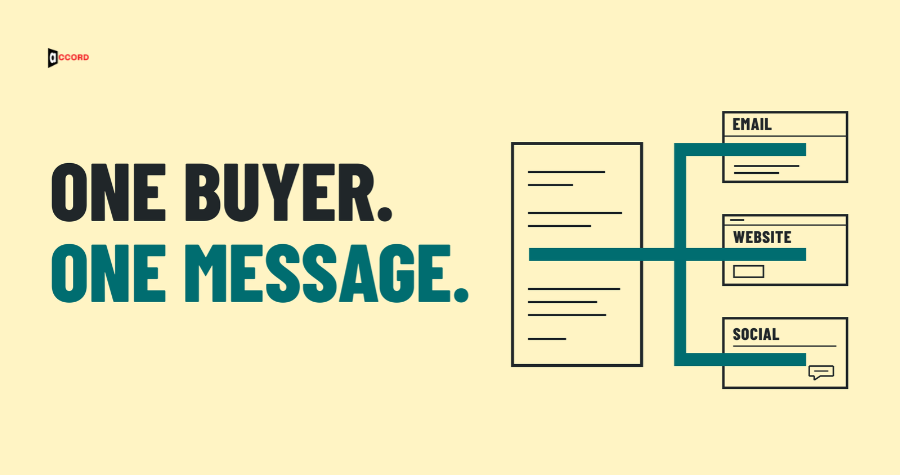
A buyer reads your cold email on Monday, visits your website on Tuesday and sees your social post on Wednesday. If the three name different problems and ask for different next steps, the buyer has to guess what you do. A message sheet is one page that says who you are talking to, what problem they have, what you offer, what you can show and what they should do next.
This mismatch sits where lead generation, email, web development and social media meet, the parts of a B2B growth engine. A good reply can go quiet after the buyer visits a site that describes a different problem.
The mismatch often comes from where each piece starts: the email from a sales call, the web page from a product list and the social post from an empty calendar slot. Each can end up describing a different company. A full B2B messaging framework covers more ground. The message sheet is the small part to start with, one page that a small team can write in an afternoon. The limits, tests and afternoon estimate are Accord's own starting points, not industry rules.
What is a message sheet, and how is it different from a B2B messaging framework?
A message sheet is a single page with seven fields for one buyer. It holds only what every email, page and post must agree on. A longer B2B messaging framework can add a market category and a plan for every channel. It can also write separate messages for each person on a buying committee, the group that signs off on a purchase. Those parts can be useful later, but in our view a one-page sheet is easier to keep in use than a longer document.
One sheet covers one buyer: one role at one kind of company, in one situation.
What goes on the message sheet?
The sheet has seven fields in a fixed order. Each field has one job, a size limit and a test. The limits are maximums, not targets.
| Field | Size limit | Test |
|---|---|---|
| 1. Buyer | Up to 30 words | Can you name one real person who fits? |
| 2. Problem, in the buyer's words | One sentence up to 25 words, plus up to 3 phrases of up to 8 words | Does a real quote, reply or call note use these words? |
| 3. Promise | One sentence up to 25 words | Is it something you control, and could a stranger tell what they would get in the first week? |
| 4. Proof | Up to 3 items, up to 15 words each | Can you send each item within one working day? |
| 5. Objections, with a short answer to each | Up to 3, each reason up to 12 words and each answer up to 25 | Did a real buyer say it, and can the answer be checked? |
| 6. Next step | One sentence up to 15 words | Can a stranger do it in a few words or one click, and does it hold only one action? |
| 7. Words to avoid | Up to 10 words or phrases, 20 words in all | Is each word vague praise, your own inside term or a result you do not control? |
The limits add up to 295 words, not counting the field names (30, then 25 plus 24, 25, 45, 111, 15 and 20). Here is the template to copy, with square brackets where you fill in.
Message sheet for: [buyer, in a few words]
Buyer: [Role, kind of company and situation.]
Problem: [One sentence in the buyer's words.]
Phrases the buyer uses: [Up to three short phrases taken from real notes.]
Promise: [One sentence: a verb, an object and a time or a size.]
Proof: [Up to three things you can send within one working day.]
Objection 1 and answer: [What the buyer says, then your short answer.]
Objection 2 and answer: [What the buyer says, then your short answer.]
Objection 3 and answer: [What the buyer says, then your short answer.]
Next step: [The one action you ask for.]
Words to avoid: [Up to ten words or phrases.]
Where does a message sheet fit in a B2B growth engine?
A B2B growth engine is a connected system that helps the right buyers find, trust and respond, as Accord's guide to the B2B growth engine describes it. It has five parts, which are Accord's five services. Search engine optimization (SEO) and answer engine optimization (AEO) help buyers find you, including in answers from AI tools. Lead generation says who to reach. Email, both first outreach and follow-up messages, starts and keeps conversations. Web development builds the pages that turn attention into a booked call. Social media builds familiarity and trust before and after contact. The guide uses different names for the same parts: search visibility (SEO and AEO), account data (lead generation), outbound outreach (email), website conversion (web development) and social proof (social media).
Everything feeds one pipeline, the path from a first signal to a qualified conversation. A signal is anything a buyer says or does, such as a reply, a form message, a comment or a direct message.
The message sheet sits between lead generation, which names the buyer, and the three parts that speak to the buyer: email, web development and social media. It receives the buyer from lead generation, and the buyer's own words from replies, form messages, comments and direct messages. It hands on the problem, the promise, the proof and one next step to those three parts.
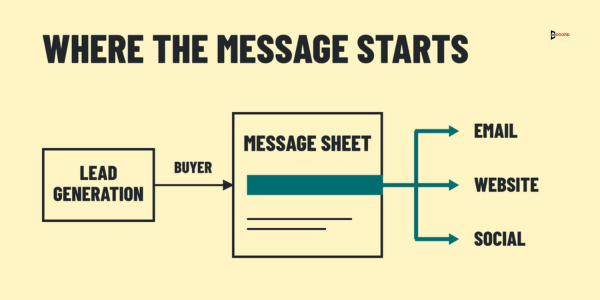
When the sheet is weak, the other parts fail in ways that look like their own faults. Email can earn a reply, then the buyer opens the site, finds a different problem and leaves. The email report shows a good reply, the web report shows a visitor who did nothing, and nobody sees the mismatch between them.
Here is a ten-minute check. Put your latest cold email, the top of your home page and your latest social post side by side. Underline the problem and the action in each. If you cannot find one problem and one action in a piece, or you find different problems or actions across the three, the parts are not connected yet. The same problem in different words counts as one.
Who is the buyer?
Write one role, one kind of company and one situation. "Operations managers at property management companies with 20 to 80 buildings, who send owner statements each month" is a buyer. "Mid-market decision makers" is not, because you cannot name a person who fits it.
The test: name one real person. If you cannot, the field is still a guess. At your last five good customers, check the role of the person who said yes and pick the most common. If you have fewer than five, use all you have. If two roles tie, pick the one you meet more often.
If your team has an ideal customer profile, or ICP (the kinds of companies you can help), copy the buyer from it. If you do not know your best buyer, mark the field "to confirm" and write for the person you reach most often. Accord's ICP scorecard guide shows how to prioritize companies when you have several candidates.
What is the problem, in the buyer's own words?
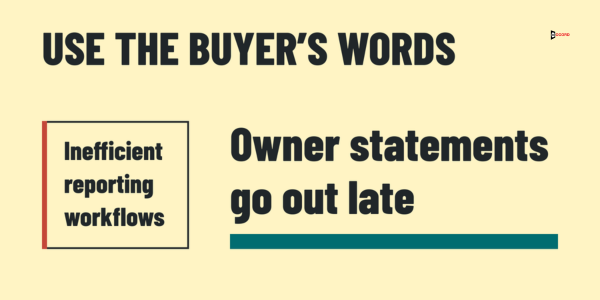
Write the problem as the buyer would say it to a colleague. "Owner statements go out late, and building owners ask the same questions" is a buyer's sentence. "Inefficient reporting workflows" is not. Then add up to three short phrases the buyer actually uses. You copy these into headlines, subject lines and first lines. Take them from sales calls, email replies, form messages and support messages.
Name one problem, the one buyers raise first. If you have no notes, ask three people in the buyer's role what the most annoying part of the task is, and write their words exactly. Do not add a number to this field unless you can name where it came from and what it measures.
What is the promise?
The promise is one sentence with a verb, an object and a time or a size. It is a promise about your own work, not about the buyer's results. "We build your monthly owner statement from your accounting export and send a draft in two working days" is a promise you control. "Your building owners will never ask a question again" is not, because you cannot control it.
Leave out outcome words that depend on the market, such as growth or more leads. If a stranger cannot tell what they would get in the first week, it is still a topic, not a promise.
What proof can you show?
Proof is anything you can send on the day a buyer asks. It can be a sample of your work, a one-page description of how you work, a public page or a result you can trace to its source. Pick up to three. A client name you do not have permission to use is not proof. If you have no case study, offer a sample of the work. Never invent a client, a quote or a number to fill the field.
Accord's guide to the B2B social proof system lists approval rules for client stories and reviews. Follow them before a proof item goes on the sheet.
Which objections come up, and what do you say?
An objection is a reason a buyer gives for not going ahead. Write the three you hear most, each in the buyer's words, with a short answer of 25 words or fewer.
A good answer says what stays the same and what the buyer can check, such as "Keep your spreadsheets. We start from your export and return a draft for you to check." The website can answer objections in a short question-and-answer block.
Do not invent objections to fill the slots. If you have heard none, ask your sales colleagues or read your contact form messages. Until you have one real objection, leave the field empty.
What is the one next step?
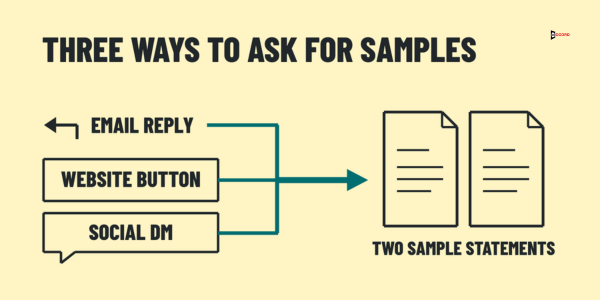
Choose the smallest action a stranger will take, and use it on every channel. The way in can change, such as a reply, a button or a direct message. The action does not.
The smallest useful action is usually to ask for something already listed as proof. "Ask for the two sample statements" is one action. "Get in touch" is not an action, and "Book a call, download our guide or follow us" is three. Accord's post on the first cold email explains why a meeting ask often comes too early. If the buyer has already asked to meet, the next step can be the meeting.
The test: can a stranger do it with a few words or one click, and does the field hold exactly one action? Search the field for the word "or". If it appears, you probably have two actions. If nobody takes the step, change the next step or the proof item behind it, not the whole sheet, and watch the next 20 emails or two weeks of replies.
Which words should the sheet ban?
Three kinds of words belong on this list. One is vague praise that a buyer cannot check, such as "world-class" or "full-service". Another is your own inside terms, such as the name of an internal process. The third is words that promise a result you do not control. Build the list from three old emails, the home page and five posts: note the words you would not say to a buyer's face. Then search each new piece for them before it goes out. A piece can avoid every banned word and still say nothing.
How do you check for consistent messaging across channels?
Take one email, one web page and one social post, all written from the sheet, and run the same five checks on each. The first three need a cold reader, someone who has not seen the sheet. Ask that person to say in their own words who the piece is for, what problem it describes and what they would do next. You do checks 4 and 5 yourself by looking.
- Buyer: the cold reader names the same kind of buyer as field 1.
- Problem: the cold reader describes the same problem as field 2.
- Next step: the cold reader names the sheet's action as the main thing to do, and the piece asks for no competing action. Menus and footer links do not count.
- Words: none of the words to avoid appear.
- No conflict: any promise, proof item or objection answer in the piece matches the sheet. A piece that states none passes.
That is 5 checks on 3 pieces, or 15 in all.
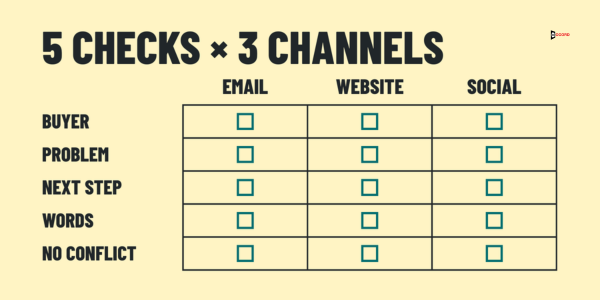
The pass line is all 15. If a check fails, fix the piece, not the sheet. Change the sheet only when two pieces disagree and the sheet does not say which is right. If the cold reader answers "I do not know", that is a fail, and a useful one: add the missing fact near the top of the piece. If you have no outside reader, wait a day and answer the three questions yourself with the sheet closed.
How do you keep the message sheet current?
Three events call for a change. Your offer changes, three or more buyers use a different word for the problem, or the same objection comes up twice in a month with no answer on the sheet. Count buyers across email replies, form messages, social comments and direct messages, because each part hears a different slice. Change one field at a time and write the date and the reason beside it. Then rerun the checks on the pieces that use that field.
Imagine: one sheet, three pieces, one check
Imagine a three-person firm, Pinewell Reports, that prepares monthly owner statements for property management companies. An owner statement is the monthly report a property manager sends to a building owner. This example is invented, including every name, number and quote, and it is not a benchmark. Tom Hale, the founder, writes the sheet first.
Message sheet for: operations managers at property management companies
Buyer: Operations managers at property management companies with 20 to 80 buildings, who send owner statements each month.
Problem: Owner statements go out late, and building owners ask the same questions.
Phrases the buyer uses: month-end crunch; chasing the numbers; answering the same questions.
Promise: We build your monthly owner statement from your accounting export and send a draft in two working days.
Proof: Two sample owner statements with names removed. A list of the accounting systems we read exports from. A one-page list of what we need from you each month.
Objection 1 and answer: We already do this in spreadsheets. Keep your spreadsheets. We start from your export and return a draft for you to check.
Objection 2 and answer: Building owners will notice a new layout. Send one old statement and we match its layout in the first draft.
Objection 3 and answer: Our data is messy. We list every gap in the draft, so nothing is guessed.
Next step: Ask for the two sample statements.
Words to avoid: full-service; world-class; tailored; one-stop; turnkey; hassle-free.
Counted by hand, the sheet is 153 words without the field names, counting a hyphenated word as one. Tom writes three pieces from it. First, the email to Ruth, an operations manager at Cedarline, which follows the four-part shape from the first-email post.
Subject: Owner statements at Cedarline
Hi Ruth,
I saw that Cedarline now lists 41 buildings on its website.
At that size, property managers often send owner statements late, and building owners ask the same questions.
I build monthly owner statements from your accounting export and send you a draft in two working days. I can show two sample statements with the names removed.
Would you like to see the two sample statements?
Tom Hale, Founder, Pinewell Reports
Second, the top of the home page. The headline reads "Monthly owner statements, built from your accounting export." The line under it names property managers, the problem and the two-day draft. A button reads "Get the two sample statements," and a short question-and-answer block answers the three objections. The footer reads "Pinewell Reports offers world-class reporting for property managers."
Third, the social post: "Operations managers: owner statements go out late, and building owners ask the same questions. Follow us for more property tips."
A friend who has never seen the sheet does checks 1 to 3 on each piece. For the email and the web page, the friend names the right buyer, the late statements and the samples as the next step. For the post, the friend names the right buyer and problem but says the next step is to follow the page.
Tom does checks 4 and 5 by looking. The email passes all 5 checks. The web page passes 4 of 5, because the footer uses "world-class", which is on the avoid list. The social post passes 4 of 5, because its next step is "follow us". That gives 5 plus 4 plus 4, or 13 of 15 checks.
Tom fixes the pieces, not the sheet. He replaces the footer with "Pinewell Reports prepares monthly owner statements for property managers." He replaces the last line of the post with "Message us the word SAMPLES to ask for the two sample statements." The same action now has three ways in: a reply, a button and a direct message. A second friend, who has not seen either piece, does checks 1 to 3 on the two fixed pieces, and Tom redoes checks 4 and 5 by looking. Both now pass 5 of 5, so the total is 15 of 15.
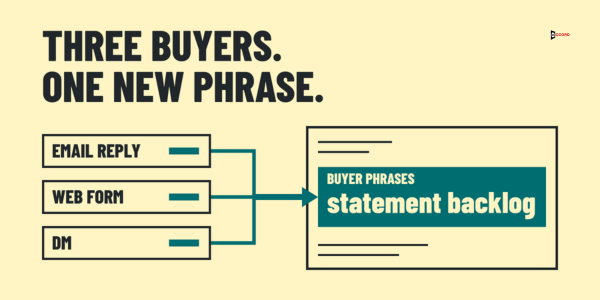
Now a signal travels through the growth engine. In the next month, Ruth answers the email with "Yes, send them. Our statement backlog gets worse every month." A prospect writes "We have a statement backlog" in the web form. A third person sends the same two words in a direct message after the SAMPLES post. Three buyers across email, web and social now use a phrase for the problem that is not on the sheet, which meets the rule of three or more buyers.
Tom also checks field 1 against his lead list. All three people are operations managers, which matches the buyer. Then he changes one field. In the phrases line, he replaces "chasing the numbers" with "statement backlog", so the line still holds three phrases, and writes the date and the reason beside it.
He uses the new phrase in the next email subject and the next post. He reruns the 5 checks on the email and the 5 on the post with a colleague who has not seen them, and all 10 pass. The web page does not use the phrase, so it needs no change and its 5 stay at 5. The total remains 15 of 15.
Frequently asked questions
What is a message sheet in B2B marketing?
A message sheet is a one-page document for one buyer. It holds seven fields: the buyer, the problem in the buyer's words, the promise, the proof you can show, the top objections, one next step and the words to avoid.
How long should a message sheet be?
Accord's starting point is 295 words or fewer, the total of the seven size limits, not counting the field names. A sheet can be much shorter.
Is a message sheet the same as a B2B value proposition?
No. A message sheet is not the same as a B2B value proposition, which is a short statement of why a buyer should choose you. On the message sheet, the problem and promise fields together play that role. The sheet adds the proof, the objections, the next step and the banned words.
How does a message sheet help the parts of a B2B growth engine work together?
In a B2B growth engine, a message sheet sits between lead generation, which names the buyer, and the email, web and social parts that speak to the buyer. Those parts read the sheet, and the replies and messages they receive feed back into it.
How many message sheets does a company need?
A company needs one message sheet for each kind of buyer it sells to, and no more than it can keep current. Add a second sheet only when the second buyer has a different problem, not just a different job title.
What should I do if the email and the web page disagree?
If an email and a web page disagree, check both against the message sheet and fix the piece that departs from it. If the sheet does not say which is right, settle that on the sheet first.
Next step
In a working session we map which part of your growth engine your message sheet feeds and which part is weakest. If you would like that, book a 30-minute working session with the Accord team. Bring your draft sheet and one email, one web page and one social post, and we will run the cold read together. There is no obligation, and you can use everything here without us. Accord sells these five services together as one connected growth engine, so we have an interest in this subject.