
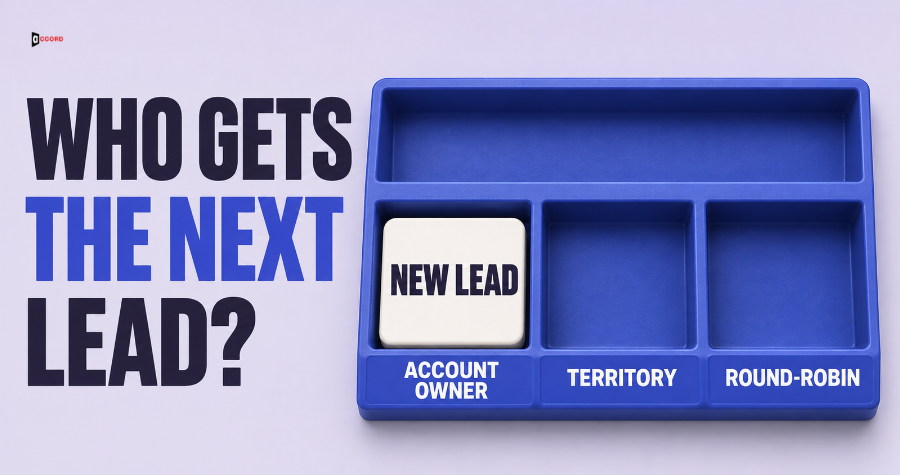
A new request comes in at 10:12 on a Tuesday. One rep sees it and thinks a colleague has it. The colleague is in a meeting. By Thursday the buyer has talked to a competitor. The cause is often not a lazy team but that nobody wrote down which person gets which lead. This post compares the three ways a small team can settle that: round-robin, territory and account owner. It gives you a table to compare them, a rule for choosing by team size and deal type, and a worked example.
B2B lead routing is the set of rules that decides which person receives each new lead. Lead means a person or company that may buy what you sell. The team size limits and tests below are Accord's own starting points, not industry rules. The one outside fact, about HubSpot, is linked where it appears. Accord does not sell routing software, so this comparison has no product to push.
What are the three methods of lead routing?
Each method answers the same question, which rep gets this lead, in a different way.
Round-robin sends leads to reps in turn. Rep A gets the first lead, rep B the second, rep C the third, and then it starts again with rep A. It is sometimes called round robin lead distribution. The idea is fairness: everyone gets the same number of chances.
Territory routing sends a lead to the rep who covers a defined slice of the market. The slice can be a region, an industry, a company size or a product. It is also called territory based routing. The idea is fit: the rep who knows that slice gets the lead.
Account-owner routing sends a lead to the rep who already owns the company the lead works for. A company counts as owned when it is a customer, when it has an open deal, or when a rep is in active conversation with it. The idea is continuity: a buyer should not have to explain the history twice.
Together these are three common lead assignment methods for a small team. You do not have to pick only one. Many small teams use two or three in a fixed order, and the section on choosing shows which.
Two words need a short explanation. A CRM, short for customer relationship management tool, is the software where you store leads, companies and deals. A fallback is the rule that applies when no other rule matches.
How does round-robin work, and where does it break?
Round-robin is the simplest method to explain, and many CRMs can do it. Each new lead goes to the next rep in the pool.
Where it works. Round-robin suits a team that sells one product to one kind of buyer, where deals are similar in size and any rep can handle any lead. It also suits many small, fast deals.
Where it breaks. It ignores everything about the lead. A returning customer can land with a rep who has never met them, and a large deal can land with a rep who is still learning the product. It also treats a rep on holiday like any other name unless the system knows about absences.
What a CRM may do: HubSpot as an example. On 1 November 2026, HubSpot's help page on assigning and rotating record owners described round-robin lead assignment as a beta (test) feature on Sales Hub Professional or Enterprise. Users set to Away can be skipped, and if no eligible user exists, no owner is assigned. The page covers rotation, not territory routing. Plans and beta status may have changed, so check your own account.
How does territory-based routing work, and where does it break?
In territory routing, you divide your market into slices and give each slice to one rep. A lead goes to the rep whose slice it matches.
Where it works. Territory routing fits teams where buyers really differ. Examples are reps who speak different languages, who sell to different industries, or who cover regions where a visit or a local time zone matters. It also fits longer sales where the rep builds a relationship over months.
Where it breaks. The first problem is gaps and overlaps. If one rep covers "the West" and another covers "technology companies," where does a technology company in California go? The second is missing data: a territory rule needs a field, such as state or industry, and a form that does not ask for it sends every lead to the leftover slice. The third is uneven volume, because a territory that looked equal on a map can produce three times the leads of its neighbor.
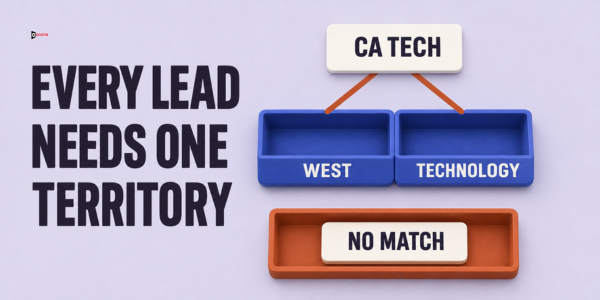
The test for a good territory map. Take the last 20 leads you received. Each one must fit exactly one territory. If any lead fits two, you have an overlap, so write a tie-break such as "industry beats region." If any lead fits none, you have a gap, and you can close it in one of two ways. Either add an "Other" territory with one named owner, so those leads are assigned at step 2. Or leave the gap, and those leads fall through to the round-robin pool at step 3. Pick one and write it down; the rules must not say both. The target is 20 of 20 leads in exactly one slice, or in "Other" if you use it.
How does account-owner routing work, and where does it break?
Account-owner routing starts by asking whether the lead's company is already known. If the company has an owner, the lead goes to that owner. If not, a different rule decides.
Where it works. It fits any business with repeat buyers, long sales and several contacts at one company. A colleague who fills in a contact form on a Monday should reach the person already working with that company. It also fits renewals and expansion.
Where it breaks. It depends on matching the lead to the company. A personal email address has no company domain to match, a subsidiary may have a different website than its parent, and a company may be spelled three ways in the CRM. If matching fails, the lead looks like a new company, which is the exact mistake this method is meant to prevent. Matching is only as good as the records behind it, and our guide on what dirty CRM data costs a sales team shows how that damage builds up.
How do the three methods compare?
The table puts the three side by side. Read the last two columns first, because they show the work you must do before the method can run.
| Method | Sends the lead to | Works best when | Breaks when | What the CRM must hold |
|---|---|---|---|---|
| Round-robin | The next rep in the list | One product, similar deals, any rep can answer | Reps differ in skill, region or capacity; repeat buyers matter | A list of active reps and their status (present or away) |
| Territory | The rep who covers the lead's slice | Buyers differ by region, industry or size; sales are long | Slices overlap, the field is blank or one slice is far busier | A clean field for the slice (state, industry, size) filled on every lead |
| Account owner | The rep who owns the company | Repeat buyers, several contacts per company, renewals | Company names or domains do not match; owner is away or has left | One named owner per company and a way to match a lead to a company |
No row wins on every line. Round-robin is the cheapest to run, but only when reps are interchangeable and deals are alike; with mixed reps it is the least accurate. Account-owner routing is the most accurate, but only when company matching and owner records are clean; with messy records it misroutes too. Territory routing sits in between, and it is the one most likely to need regular upkeep as the market changes.
Which method should a small team choose?
Do not choose one method. Choose an order for checking them, and end with the method that needs the least data. We suggest this order:
- Check for an owner. If the company is already owned, the lead goes to the owner.
- If there is no owner, check the territory. If a territory rule matches, the lead goes to that territory's rep.
- If nothing matches, use round-robin among the reps in the fallback pool.
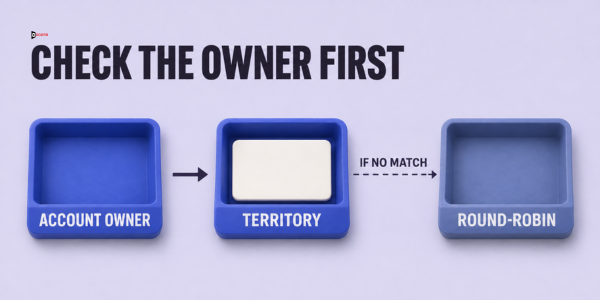
The order puts the most specific rule first and the broadest last. Round-robin comes last because it needs no data about the lead. It has one failure of its own: if every rep in the pool is away, it has nobody to pick. For that case, name one backup person or a manual review queue that a manager checks each morning, and say so in the rules.
You may not need all three steps. Use team size and deal type to decide how many to switch on. These sizes are our starting points, and vendor guides give different limits.
One or two sellers. Skip automatic routing. With one seller, every lead goes to that person, and the only rule you need is a named backup for days off. With two sellers, use steps 1 and 3: the owner first, then alternate.
Three to five sellers, one product, similar deals. Use steps 1 and 3. Account owner first, then round-robin. It is cheap, and it prevents the worst mistake, which is a customer meeting a stranger. The condition is that the reps are alike. If one of them covers a region, language or industry, add step 2, as the example near the end does.
Six to ten sellers, or reps who differ by region, language or industry. Add step 2. At this size, a wrong match costs more, and reps have usually begun to specialize anyway. Add the territory step only if you can fill in the slice field on nearly every lead.
More than ten sellers, or many exceptions. The rules will grow long. At that point it is reasonable to look at routing software or a part-time operations role. That is a bigger decision than this post covers.
Deal type changes the answer too. If deals are small, quick and alike, round-robin carries more of the load. If deals are large and slow, lean on the account owner and territory steps. If a lead comes from an existing customer, step 1 comes first, whatever the team size. A final check: if a new hire cannot predict where a lead would go from your one-page rules, the rules are too complicated.
What counts as "this company already has an owner"?
Step 1 only works if everyone agrees on what an owned company is. We suggest that a company counts as owned when at least one of these is true:
- It is a current customer, with a named account owner.
- It has an open deal, meaning a deal not yet won or lost.
- A rep has had a two-way conversation with it in the last 90 days, such as a reply, a call or a meeting. An email that got no answer does not count.
- It appears on a named-accounts list that a manager has approved.
The 90 days is a starting point. Shorten it for short sales cycles and lengthen it for long ones.
The soft cases need a decision too. A person with a personal email address has no company domain, so ask for the company name in the form. If it is blank, step 1 is skipped for that lead and a person checks the name within one working day. A subsidiary counts as owned if the parent is owned, unless a manager has split the accounts. If two companies share one name, the person checking decides and records the reason. If the owner has left, the account goes to the fallback pool until a manager names a new owner.
When two reps both have a claim on the same company, that is an ownership conflict, not a routing choice. Our post on lead ownership rules and who takes the lead covers those tie-breaks.
What if the rules cannot find an answer?
Every routing rule needs an answer for "I do not know." Here are the four cases that come up most.
No territory matches. Use whichever of the two choices you wrote down. With an "Other" territory and a named owner, the lead goes to that owner at step 2. Without one, the lead goes to the round-robin pool at step 3.
The data is missing. A blank field stops only the rule that depends on it. A blank company name stops step 1, but the state or industry can still match a territory at step 2. A blank state does not stop step 1, because the company match can still find an owner. Skip only the rule that needs the missing field, try the next one, and add a short note such as "missing company name." A lead with no usable company and no usable territory field ends at step 3. Count the notes each week. If more than one in ten routed leads has one, fix the form first, because no routing rule can repair missing data.
The rep is away. Skip absent reps in the pool, and name a backup for owners and territories. If every rep is away, the pool cannot pick anyone, so the lead goes to the named backup or the manual review queue. The simplest return rule is no catch-up, because it is easy to read and easy to check.
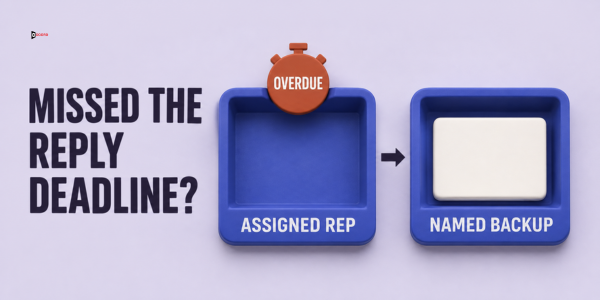
Nobody acts. A lead can be routed perfectly and still sit. Set a time limit for the first human action. If the rep has not acted by then, the lead moves to the backup. Our speed-to-lead guide shows how to set that time limit by type of trigger. Routing decides who should act, and the time limit decides how long you wait for them.
How do you set up B2B lead routing in one afternoon?
You do not need software to begin, only a page of rules, a list of reps and a test.
- Write the order from the section above in three or fewer sentences. Put it where the whole team can read it.
- List the reps in the pool, with a status for each: active, away or excluded. Name a backup for every owner and territory.
- Write the definition of an owned company, the territory list (say whether it has an "Other" slice), the fallback pool and the backup for the case where everyone is away.
- Test with ten real leads from last month. For each one, write down where your rules send it. Then ask the person who actually handled it whether that is the right rep. Fix a rule if any answer is "no."
- Turn the rules on in the CRM, by hand if the tool cannot do it. Hand routing is slow, but it shows you the exceptions first.

Re-run the ten-lead test whenever the team changes, a rep leaves or a territory moves.
How do you know the rules are working?
Track one number every month: the share of routed leads that a person had to move by hand. Divide the leads whose owner a person changed within two working days by all leads routed in that month.
As a starting point, 10% or less means the rules fit your team. A higher figure means a rule is missing or a field is empty. Read the reason for each move before changing anything: "customer already had an owner" points to step 1, and "wrong region" points to step 2.
Imagine: twelve leads, three reps and two ways to route them
This example is invented, including every company name and number, and the numbers are not a benchmark. It uses the territory step, even though the team has only three sellers, because Cole specializes in the West. That is the exception named earlier: with three to five alike sellers, steps 1 and 3 are enough, but a regional specialist calls for step 2. Imagine a software company with three sellers: Ana, Ben and Cole. Cole covers the West. Ana and Ben share everything else. Twelve new leads arrive in one week, numbered L1 to L12.
Three companies in the example are already owned: Alder Tools is Ana's customer, Dunmore Freight has an open deal with Ben, and Hartwell Dental is Cole's customer. Three more leads are in the West and have no owner. The other six are in the East with no owner.
The table shows where each lead goes under pure round-robin, which cycles Ana, Ben, Cole in order, and under the order from this post: owner, then territory, then round-robin. In the second method, only Ana and Ben are in the fallback pool, because Cole already has the West. The fallback turn count moves only when a lead reaches step 3. The example has no "Other" territory, so the unowned East leads go to step 3.
| Lead | Company | Fact | Round-robin only | Owner, territory, then round-robin |
|---|---|---|---|---|
| L1 | Alder Tools | Ana's customer | Ana | Ana (owner) |
| L2 | Birchway Health | West, no owner | Ben | Cole (territory) |
| L3 | Cobalt Foods | East, no owner | Cole | Ana (fallback) |
| L4 | Dunmore Freight | Open deal with Ben | Ana | Ben (owner) |
| L5 | Elmstead Labs | West, no owner | Ben | Cole (territory) |
| L6 | Fairhaven Print | East, no owner | Cole | Ben (fallback) |
| L7 | Glenrock Supply | East, no owner | Ana | Ana (fallback) |
| L8 | Hartwell Dental | Cole's customer | Ben | Cole (owner) |
| L9 | Ironvale Metals | East, no owner | Cole | Ben (fallback) |
| L10 | Juniper Labs | West, no owner | Ana | Cole (territory) |
| L11 | Kestrel Tools | East, no owner | Ben | Ana (fallback) |
| L12 | Lindqvist Group | East, no owner | Cole | Ben (fallback) |
Pure round-robin splits the leads 4, 4 and 4, and the split looks fair. But it sends only L1 to the right rep. Five leads (L2, L4, L5, L8 and L10) would be moved by hand, which is 5 of 12, or 41.7%, far above the 10% starting point.
The three-step order also splits the leads 4, 4 and 4. No lead needs to be moved: 0 of 12, or 0%. The split is just as even, and every lead with a named rep reaches that rep.
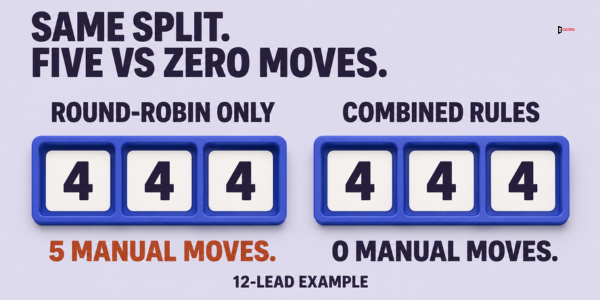
The example is neat because it was built to be; real territories give uneven totals.
Frequently asked questions
What is the difference between round-robin and territory routing?
Round-robin sends each new lead to the next rep in a list, so every rep gets the same number of leads over time. Territory routing sends each lead to the rep who covers its region, industry or company size, whatever the rep's current load. Round-robin aims for fairness, territory routing for fit.
Which lead routing method is best for a small B2B team?
For three to five alike sellers who sell one product, we suggest account owner first and round-robin second. Add territory routing as soon as one rep specializes by region, language or industry. The sizes in this post are Accord's starting points, and vendor guides give different ones.
Do I need lead routing software?
Not at the start. A written rule, a list of reps and a CRM that can rotate owners are enough for a small team. Routing software becomes worth a look when the rules grow long or matching leads to companies is hard. Accord does not sell routing software.
What should happen when a lead does not match any territory?
It should go to a named place, and you decide which in advance: an "Other" territory with an owner (step 2), or the round-robin pool (step 3). A lead that matches no territory and has no written fallback is the lead most likely to sit untouched.
What if every rep is away?
Round-robin cannot pick anyone, so name one backup person or a manual review queue in the rules. Without that, the lead sits until a rep returns.
What if a field is blank on the form?
Skip only the rule that needs that field and try the next one. A blank state still allows a company match, and a blank company name still allows a territory match by industry.
Next step
If you would like a second pair of eyes on your own rules, book a 30-minute working session with the Accord team. Bring your last ten leads and the rep who handled each one, and we will test your routing order against them together. You can use everything in this post without us. Accord sells outbound, email and lead-generation services, so we have an interest in this subject.