
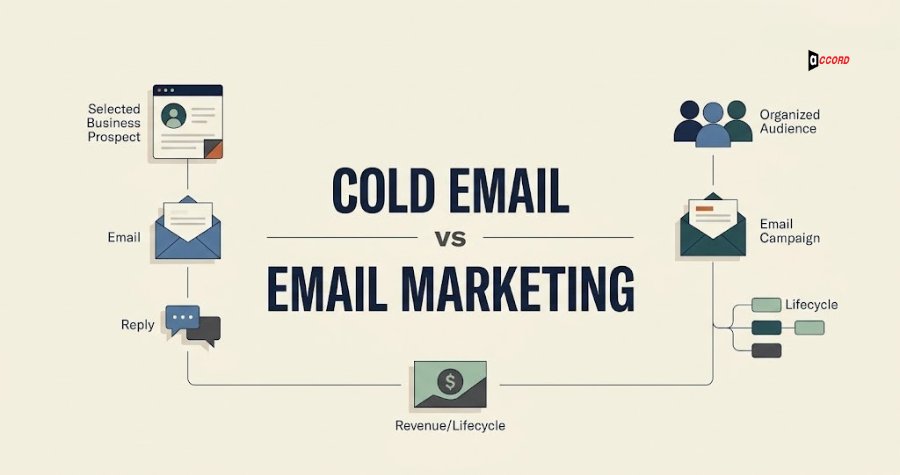
Quick answer: Use cold email to begin relevant, one-to-one B2B conversations with carefully researched prospects. Use email marketing to educate, nurture, retain, or activate people who already have an established or permission-based relationship with your brand. Many B2B companies need both, but the audiences, expectations, compliance workflows, technology, copy, and metrics should remain distinct.
Cold email and email marketing both arrive in an inbox. That surface similarity causes teams to treat them as one channel: one database, one platform, one writing style, and one performance dashboard.
The result is often disappointing. A prospect receives a newsletter they never requested. A subscriber receives a cold pitch that ignores their existing relationship. Sales imports a broad list into a marketing automation platform. Marketing judges prospecting by open rate. Opt-outs do not synchronize across systems.
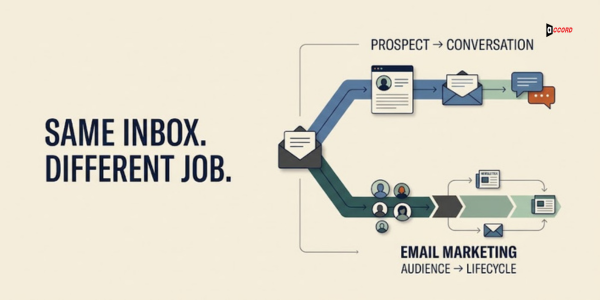
The two practices can support the same revenue strategy, but they have different jobs.
Cold email is usually designed to start a conversation with a specific business person based on fit and relevance. Email marketing is usually designed to communicate at scale with subscribers, customers, leads, or another audience that has an established basis for receiving the message. Understanding that difference makes strategy, operations, measurement, and recipient experience much clearer.
What is cold email?
Cold email is targeted outreach to a person who does not have an active relationship with the sender but appears relevant to a legitimate business offer. In B2B contexts, the sender researches the account and role, explains the reason for contact, proposes a useful next step, and provides a clear way to decline future communication.
Cold email should feel like the beginning of a business conversation, not a compressed advertisement. Its core inputs are:
- A defined ideal customer profile.
- Verified and relevant account and contact data.
- A defensible reason to contact the person.
- A clear problem and value hypothesis.
- Responsible sending infrastructure and monitoring.
- Reply handling, suppression, and sales follow-up.
Because the recipient did not ask for the message, relevance and restraint are critical. Cold email is not permission to send a generic sequence to every address a database can produce.
What is email marketing?
Email marketing is planned communication to an audience with an existing relationship or appropriate permission, such as subscribers, leads, trial users, customers, members, or event registrants. It can educate, nurture, announce, onboard, retain, reactivate, and support purchases across the customer lifecycle.
Email marketing programs may include:
- Newsletters and educational updates.
- Lead-nurture sequences.
- Product or service announcements.
- Event invitations and follow-ups.
- Onboarding and lifecycle automation.
- Customer education and retention campaigns.
- Re-engagement and preference management.
The audience expects some form of ongoing communication, but that does not mean every message is automatically welcome. Frequency, relevance, preferences, and consent still require active management.
Cold email vs email marketing: the main differences
The central difference is the relationship with the recipient and the job the message must perform. Cold email must establish relevance and earn a reply from a researched prospect. Email marketing develops an existing audience relationship through useful, expected communication at a broader scale.
| Dimension | Cold email | Email marketing |
|---|---|---|
| Primary purpose | Start a qualified sales conversation | Educate, nurture, activate, or retain |
| Audience | Researched prospects without an active relationship | Subscribers, leads, customers, or permissioned contacts |
| Typical style | Brief, personal, one-to-one | Branded, segmented, one-to-many or automated |
| Core data | ICP, role, account context, signal | Consent or relationship, preferences, lifecycle, behavior |
| Main action | Reply or short meeting | Click, register, read, purchase, renew, or reply |
| Core metrics | Reply quality, meetings held, opportunities | Clicks, conversions, engagement, retention, revenue influence |
| Operational risk | Poor targeting and sender reputation | Fatigue, weak segmentation, consent and lifecycle errors |
These are typical patterns, not universal definitions. A customer success manager may send a personal lifecycle message. A small newsletter may look plain and conversational. The audience relationship and operational purpose matter more than the visual format.
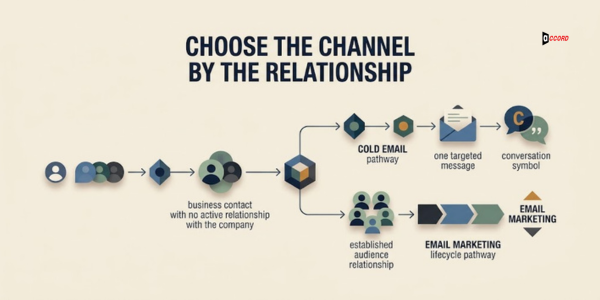
Choose cold email when you need targeted market entry
Cold email is appropriate when your B2B company knows which accounts it can help but lacks an existing path to the relevant buyers. It can support a new market, a focused account list, a specific service, event follow-up where the relationship permits, or research into whether a problem is active.
Cold outreach is a better fit when:
- The total addressable market can be defined clearly.
- Account value justifies research and responsible personalization.
- Sales can handle replies quickly and competently.
- The offer solves a specific business problem.
- The organization can operate compliant, monitored sending systems.
- Success is measured by qualified conversation, not raw send volume.
It is a poor fit when the offer is vague, the audience is enormous and undifferentiated, data quality is unknown, or the sales team cannot follow up. More automation will amplify those gaps.
Choose email marketing when you need lifecycle communication
Email marketing is appropriate when your company needs to build value over time with people who already know the brand or have an appropriate relationship with it. It is especially useful when buying cycles are long, products require education, customers need onboarding, or the audience benefits from recurring expertise.
Email marketing is a better fit when:
- People can knowingly subscribe or set preferences.
- The business has useful recurring content or lifecycle information.
- CRM and product data can support responsible segmentation.
- The team can manage frequency, consent, bounces, and inactivity.
- Conversion may occur across several messages rather than one reply.
Do not send the same newsletter to the entire database because it is easier. Segment by relationship, interest, product, lifecycle, role, or another meaningful dimension. A customer and a new subscriber should not receive identical calls to action by default.
Understand the compliance difference without oversimplifying it
Cold email and email marketing are governed by laws, regulations, provider policies, and contractual requirements that vary by location, audience, and data practice. A business context does not automatically remove privacy or electronic marketing obligations, and consent is not the only consideration.
Teams should document:
- Where the organization and recipients are located.
- How contact data was obtained.
- The purpose and lawful basis relied upon where applicable.
- What notice and identity information the message provides.
- How opt-outs are captured and honored.
- How suppression data is shared across sending systems.
- How long data is retained and who can access it.
The United States CAN-SPAM Act, Canada's CASL, the EU's GDPR and ePrivacy rules, UK privacy and electronic communication rules, and other national requirements can apply differently. Provider acceptable-use policies may be stricter than law. Obtain qualified legal guidance for your actual operation.
Use different copy for different relationships
Cold email copy establishes context quickly, while email marketing copy develops an existing relationship and can draw on known preferences or lifecycle events. Reusing one format for both ignores what the recipient knows and expects.
A cold message usually needs:
- A credible reason the specific person was selected.
- One relevant problem hypothesis.
- A concise description of help.
- A low-friction question.
- Clear sender identity and opt-out handling.
An email marketing message can usually assume some recognition and may include:
- The reason the audience receives the email.
- Useful content or lifecycle information.
- More developed brand design where appropriate.
- Several related resources with a clear priority.
- Preference and unsubscribe controls.
In both cases, write for the reader's job. A message that is technically personalized but does not help the recipient decide anything is still generic.
Keep the technology and reputation systems controlled
Cold outreach and marketing automation may use different platforms and sending configurations, but they should share governance for identity, data quality, suppression, security, and reporting. A problem in one program can affect brand reputation and recipient trust across the business.
For both programs:
- Authenticate sending domains with appropriate SPF, DKIM, and DMARC configuration.
- Use secure mailbox and platform access.
- Validate and monitor data inputs.
- Process bounces and complaints.
- Honor opt-outs reliably.
- Review provider requirements.
- Monitor domain and campaign health.
Do not connect systems in a way that overwrites consent or suppression fields. Define which platform is the source of truth and test synchronization before launch.
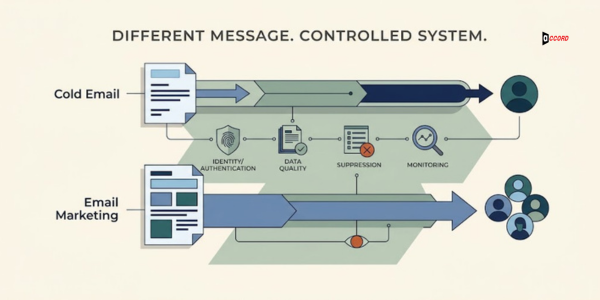
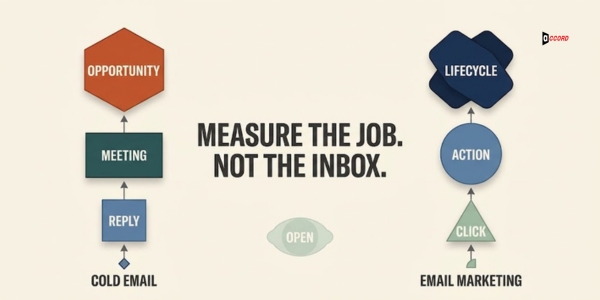
Measure each channel by its actual job
Cold email should be judged by conversation and pipeline quality, while email marketing should be judged by audience engagement and lifecycle outcomes. Both can influence revenue, but the path and useful leading indicators differ.
For cold email, prioritize:
- Bounce and block behavior.
- Positive, negative, and unsubscribe replies.
- Qualified conversations.
- Meetings booked and held.
- Opportunities created or influenced by segment.
For email marketing, prioritize:
- Delivery and complaint health.
- Clicks and content engagement.
- Form, event, trial, purchase, or renewal actions.
- Lifecycle progression and retention where relevant.
- Qualified pipeline or revenue influence.
Open data can be incomplete because of privacy features and automated image loading. Use it as a directional diagnostic where appropriate, not as the primary proof of business value.
How cold email and email marketing can work together
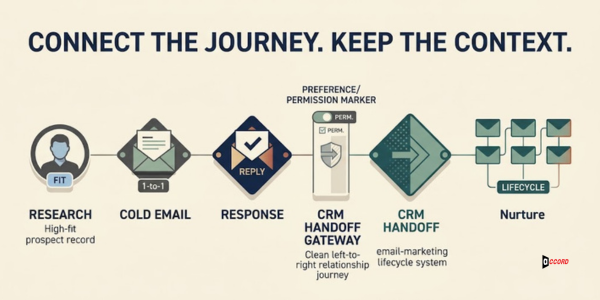
The two channels work together when cold outreach creates a legitimate relationship and email marketing continues it with appropriate expectations and permission. The handoff should be explicit, recorded, and relevant, not an automatic move from every prospect list into a newsletter.
A connected journey can look like this:
- Research identifies a high-fit account and contact.
- A cold email begins a relevant conversation.
- The contact requests a resource, meeting, or future update.
- CRM records the relationship, source, preference, and next step.
- Appropriate nurture or customer communication begins.
- Sales and marketing share engagement context without duplicate outreach.
The reverse can happen too. A subscriber may show strong interest and become appropriate for sales follow-up. Define thresholds and make the transition feel like a continuation of the person's behavior, not a surprise escalation.
Common mistakes when companies run both
The biggest mistakes come from mixing audiences and losing context at the system boundary. A documented operating model prevents a useful multichannel program from becoming a confusing inbox experience.
Watch for:
- Importing cold prospects into a subscriber newsletter.
- Sending prospecting sequences to customers or active opportunities.
- Keeping opt-outs in only one platform.
- Using one generic lifecycle stage for every contact.
- Allowing sales and marketing to email the same person without coordination.
- Comparing cold reply rates with newsletter click rates as if they measure the same job.
- Claiming personalization based on data that is stale or inappropriate.
Create a contact policy that defines audience states, allowable messages, owners, frequency rules, and suppression logic. Then test the actual workflow across CRM and sending tools.
How Accord Tech Solutions designs connected email programs
Accord Tech Solutions treats cold outreach and email marketing as distinct programs connected by data, strategy, and lifecycle logic. Work can include ICP and contact research, validation, deliverability controls, campaign strategy, segmentation, copy, automation, A/B testing, performance analysis, and reputation management.
Our email marketing services can support campaign and automation needs, while our B2B lead generation services support targeted prospect research and enrichment. The scope should reflect the audience relationship, market, platform, compliance requirements, and sales capacity.
We do not promise a fixed reply rate, inbox placement, number of meetings, or revenue result. The goal is to build a responsible system that gives the right message a better chance to reach the right audience at the right stage.
Frequently asked questions
Is cold email considered email marketing?
The terms sometimes overlap in casual use, but operationally they are best treated as distinct. Cold email initiates contact with researched prospects who lack an active relationship. Email marketing usually serves an existing or permission-based audience through newsletters, nurture, lifecycle, and promotional communication.
Can I add cold email prospects to my newsletter?
Do not assume a cold outreach record has agreed to ongoing marketing. The appropriate action depends on applicable law, the stated purpose, the person's response, and your consent and preference process. Create an explicit, documented transition before adding people to recurring campaigns.
Which channel is better for a new B2B company?
Cold email may help a new company reach a small, defined market before it has a large audience. Email marketing becomes valuable as the company earns subscribers, leads, and customers. The right starting point depends on offer clarity, audience access, content capability, and sales follow-up.
Can the same domain send cold email and newsletters?
It may be technically possible, but the architecture should be evaluated carefully. Different sending patterns, platforms, reputational risks, and provider requirements can affect the decision. Use appropriate authentication, clear ownership, monitoring, and technical guidance rather than a universal configuration rule.
Should we track open rates?
Open rates can provide limited directional information but are affected by privacy protection, image blocking, automated scanning, and other behavior. Use clicks, replies, conversions, qualified meetings, and downstream outcomes as stronger evidence, depending on the program's purpose.
Choose the relationship before choosing the tool
The most important difference between cold email and email marketing is not the software or template. It is the relationship with the recipient. That relationship determines what the message needs to explain, what data is appropriate, which rules apply, and how success should be judged.
Use cold email to begin carefully researched conversations. Use email marketing to develop value across an established audience lifecycle. Connect them through trustworthy CRM data and explicit handoff rules, but do not erase the distinction.
If your business needs help designing the right program, or both programs as one coordinated system, contact Accord Tech Solutions to discuss the audience, infrastructure, content, and measurement required.
Methodology and sources
This comparison reflects Accord Tech Solutions' email marketing, cold outreach, and lead research positioning. It is educational and not legal advice. References include Google's email sender guidelines, the FTC CAN-SPAM compliance guide, and the ICO PECR direct marketing guidance.
Last reviewed: August 23, 2026.