
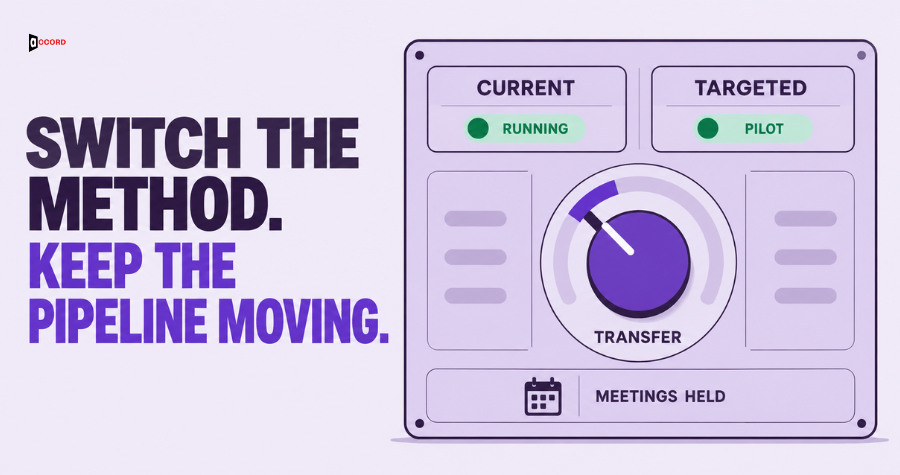
The alternative to spray-and-pray outbound is targeted outreach: a smaller list chosen by fit and by a recent, verifiable reason to write, with a message that names that reason. You do not have to switch overnight, and you should not. Run the targeted method next to your current one for four weeks and move volume only when the new method earns it. The measure that decides every step is meetings held per 100 people contacted. If the targeted method produces more of them, you may be able to send less and still keep your pipeline, as long as enough accounts have a fresh reason to write. Four weeks is enough to run a pilot and make a first, limited decision. Meetings held arrive later than replies, so the full decision may need a few more weeks.
The four weeks at a glance:
| Week | What you do | What you have at the end |
|---|---|---|
| Week 1: measure and choose | Write down a 90-day baseline, pick one segment, score its accounts A, B or C and set three stop rules. No sending. | Baseline numbers, one segment, a list of A accounts and the stop rules |
| Week 2: build and send | Build a list of 100 to 200 people with a fresh signal, check the data, write a three-line message and send the pilot. | A pilot in the market and a named owner for positive replies |
| Week 3: compare and fix | Compare positive replies and meetings booked with the control, read every reply and send a second batch with one change. | A list of fixes and a short note of what changed in each batch |
| Week 4: shift by rule | Apply the rule you wrote down. Early signs allow a small, temporary increase. The full decision uses meetings held. | A volume decision, and a supply check on fresh-signal accounts |
What does "spray and pray" mean in outbound?
Spray and pray means sending the same cold message to a very large, loosely chosen list in the hope that a small share will answer. Volume is the plan.
You are probably doing it if most of this sounds familiar. The list comes from a title filter, so everyone with "Director" and "marketing" in the title is on it, whatever the company does. One message goes to everyone, and the only difference between emails is the first name and the company name. Nobody can say why this person was chosen this week, because the list has no reason to write today. Weekly targets count emails and not conversations, and the reports end at opens and replies, so no one counts the meetings held from each list.
Why does it stop working, and what does it cost?
It can still produce meetings, which is why teams keep it. The trouble is the cost of each meeting and the risk that comes with the volume.
Sender reputation. Mailbox providers watch how recipients react. Google tells senders to keep the spam rate reported in Postmaster Tools below 0.10% and to avoid ever reaching 0.30% or higher, in its email sender guidelines. A loosely chosen list sends messages to people who never wanted them, and those people are the ones who report them. Since February 1, 2024, Google also requires senders of more than 5,000 messages a day to Gmail accounts to authenticate their mail and offer one-click unsubscribe. Once reputation drops, even good messages to good prospects land in spam.
A small market burns fast. If your market holds a few thousand companies, a mass message to all of them uses up the contacts you cannot get back. Someone who gets several generic emails from you in one quarter may be harder to win with a good one later.
Weak learning. When one message goes to everyone, a poor result teaches nothing, because you cannot tell whether the list, the timing or the words failed.
Look at the cost per meeting, not only the count. Twelve meetings from 2,400 contacts is not the same result as 12 from 800.
What does targeted outreach look like instead?
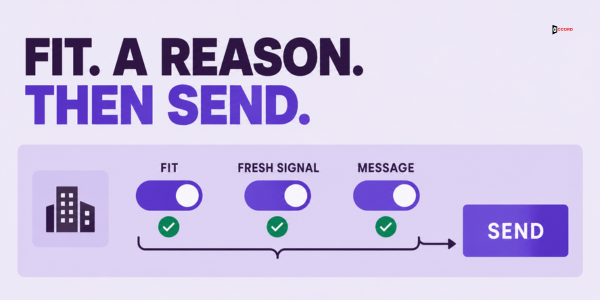
Targeted outreach rests on three ingredients, and each one is a simple test. The first is fit: the company matches a written description of your ideal customer, covering size, industry, country and the problem you solve. If you cannot write that description in three lines, it is not ready. A scorecard helps; see how to build a B2B ideal customer profile scorecard. The second is a reason to write now, meaning a recent, public event that suggests the problem is live, such as a new leader, a hiring push in the relevant team, a funding round, a product launch or a technology change. For the types of signals and where to find them, read signal-based lead generation for B2B sales. The third is a message that names the reason. Its first line says what you noticed, its second says why that matters to a company like theirs, and its third asks one easy question.
Side by side, the two methods differ on almost every line:
| Spray and pray | Targeted outreach | |
|---|---|---|
| List | Large, chosen by title | Smaller, chosen by fit and a recent reason |
| Reason to write | No reason recorded for this person this week | The signal and its date are recorded |
| Message | One version goes to everyone | The opening line names the reason |
| Volume | Volume is the plan | Volume is a result: it depends on how many accounts qualify |
| Main measure | Emails sent, opens and replies | Meetings held per 100 people contacted |
| Review | Monthly, if at all | Weekly, with someone reading the real replies |
Targeted does not mean one-to-one writing. It means that each message can answer "why me, and why now?" in a single sentence.
Which signals should you use first?
Start with signals that are close to the problem you solve, recent (for example within 30 days) and checkable from a public source. Hiring for the team your service supports and a new leader in the relevant function are the best places to begin, because both tend to sit close to a live problem. A product launch, a new market entry or a funding round is sometimes relevant, so test those first. An award or a general news story is rarely a good reason to write, so skip it. The guide linked above covers the full ranking method.
Rank the signals for your own service: a funding round that matters to a recruiting firm may mean little to a data-cleaning service.
Why not switch all at once?
Because your current method, flaws and all, produces some of your pipeline today. Cut it on Monday while the new method needs a month to learn, and you have a hole in the calendar in the middle of the quarter. The new method also needs time to find its own faults, such as a weak signal, a list that is too small or a first line that sounds odd.
Running both side by side keeps the old pipeline alive and gives you a fair comparison. The old method becomes your control, and the new one has to beat it on one number before it gets more volume.
What should you write down before you start?
Collect one baseline for the last 90 days of your current outbound, by segment if you have segments. Count unique people, not emails, so if you sent one person four emails, that is one person. You need six numbers. People contacted is the count of unique people who received a first email. Human replies are the people who sent a reply written by a person, which leaves out out-of-office and automatic messages. Positive replies are the people who asked for times, details, price or a call. Meetings booked are the calendar events created from the list, and meetings held are the meetings that actually took place, with a buyer who fits your description. The sixth number is complaints and unsubscribes, counted per 100 people contacted.
Divide each number by people contacted and multiply by 100 to get your baseline per 100. Meetings held per 100 people contacted is the number that decides the switch. If your data does not allow this count, take a smaller window and count by hand from the inbox and the calendar. It is slow but revealing.
Week 1: What do you measure and choose?
Week 1 has no sending, and it produces four things. The first is the baseline from the section above, written down in one place. The second is one segment to test. Choose a segment where you already know the buyer and can recognize a signal, for example "software companies with 50 to 200 employees that hire a head of sales". The third is the ideal customer in three lines, plus a score for each account on a simple A, B or C scale (A is a clear fit, B a partial fit, C a poor fit). Only A accounts go into the pilot. The fourth is a set of three stop rules, written before anything is sent. For example, you might stop the pilot if the spam rate in Google Postmaster Tools climbs toward 0.10% (the level Google asks senders to stay under, and it applies only to that reported rate), if your own count of complaints passes a limit you set, if replies show the signal was wrong, or if sales finds that the accounts are already in conversation with you. Keep the two measures apart. Postmaster Tools reports Gmail users who mark your mail as spam, and it may show no data at pilot volume. Your own complaint count is the number of people who write to say they object, per 100 people contacted. Google's 0.10% is not a limit for that count, so choose your own, such as 1 per 100 as a starting point.
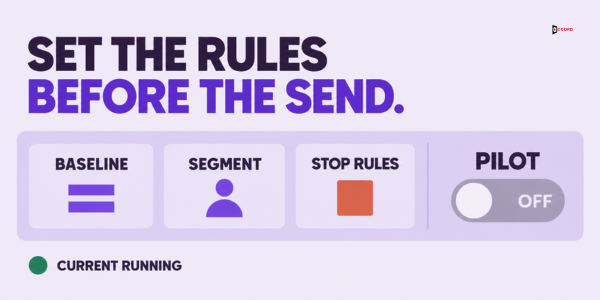
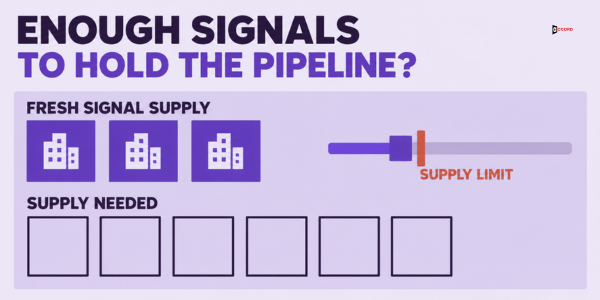
Leave the current sequences alone. They are the control, meaning the current method that you keep running as the comparison, and changing them during the test makes the comparison unfair. Also count how many A accounts show a fresh signal in a typical month. That supply sets how much of your old volume the new method can replace, as the break-even math in week 4 shows.
Week 2: How do you build and send the pilot?
The pilot is small on purpose. A pilot of 100 to 200 people is enough to learn how the method behaves, though not enough to prove a rate with confidence, and you should say so when you report it.
Build the list. Start from your A accounts and keep only those with a signal in the last 30 days, writing the signal, the source link and the date next to each one. Then pick one or two people per account whose roles match the problem the signal points to. Stay with public company information, and leave personal social accounts alone.
Check the data. Before anything goes out, pull a random sample of 100 records and look for a valid email, a person still in the role, no existing customers, nobody on a do-not-send list, no duplicates and no empty message fields.
Write the message. Keep it to three lines. Start with what you noticed (the signal), in plain words and without flattery. Follow with why it matters for a company like theirs, in a single sentence. Finish with one easy question, such as whether the topic is on their list this quarter.
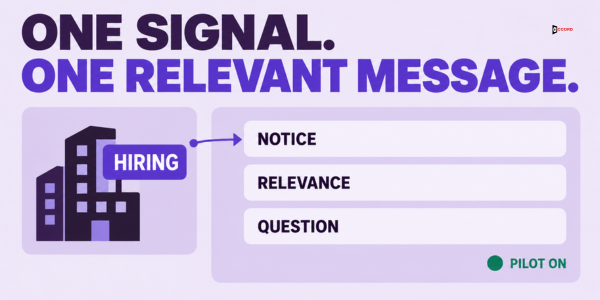
To see the difference, compare an invented spray-style opening with an invented targeted one. Spray style: "Hi Dana, I help companies like Northfield Freight grow with better outbound." Targeted: "Hi Dana, I saw Northfield Freight is hiring an operations manager for the new Dallas warehouse. A new site usually adds customers to look after. Is customer follow-up on your list this quarter?" The second names a public fact, makes one plain point and asks one easy question. It takes a few minutes to write, which a small list can afford. Try two or three versions of the first line to see which reason gets answered.
Keep the follow-ups short. A reasonable starting point is three messages over about two weeks (our proposal), each adding something new, such as a related fact, a short checklist or a different question, and never repeating the first. Stop the moment the person replies, and never follow up more than once a week.
Prepare the reply path. Decide before sending who answers a positive reply, and how fast, because a slow answer wastes a good reply. The method in handling cold email replies covers this step.
Week 3: How do you compare and fix?
Compare the pilot with the control on the same measures per 100 people contacted. Meetings held lag behind replies by one to three weeks, so in week 3 compare positive replies and meetings booked, and check meetings held again in weeks 6 to 8. With a pilot this small, one meeting more or less moves the rate a lot, so read the numbers as a direction and not as proof.
Then read every reply, because replies are the best data you have in week 3.
- "Wrong person" replies point to a list problem. Fix the role filter.
- "Not relevant" replies point to a signal that did not mean what you thought. Remove that signal type.
- "Interesting, but not now" replies point to good fit with poor timing. Put those people in a follow-up list with a date.
- Positive replies show which first line works. Use it for the next batch.
- Silence is weak data. It could be the list, the line or the timing, so change only one of them in the next batch.
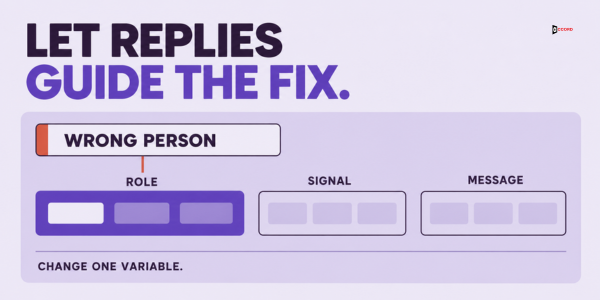
Send a second batch with the fixes, and keep a short note of what changed in each batch, so that a later improvement or drop can be traced to a cause and not guessed at. By the end of week 3 you should know which signal types produce replies, which roles answer, and which first line to keep.
Week 4: How do you shift volume by rule?
Write the rule down before you look at the numbers, so the result does not argue for itself. Meetings held per 100 is the number that decides the switch. Ten positive replies are only an early sign: they allow a small, temporary increase, but they do not justify cutting the control. The full decision waits for mature meeting data, because meetings held arrive one to three weeks after replies. A simple version looks like this.
| Result so far | What it allows |
|---|---|
| Meetings held per 100 are higher than the control, with at least 5 meetings held from people contacted at least three weeks ago | Full decision: move a quarter of the control's volume to targeted, and review again in a week |
| Meetings held are still coming in, but there are at least 10 positive replies and the positive-reply rate beats the control | Temporary expansion only: add targeted sends from accounts that still have a fresh signal, leave the control as it is, and decide when meetings held have matured |
| Fewer than that, or about the same as the control | Keep both for another week or two and run a second signal type in the pilot |
| Lower, but positive replies are close | Fix the message or the reply path, run one more batch, then decide |
| Clearly lower | Keep the control, find the cause in the replies and restart the pilot with one change |
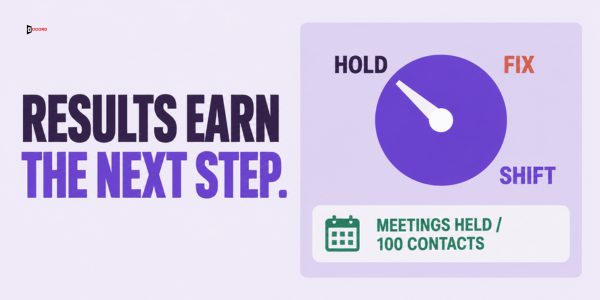
Targeted outreach is limited by how many accounts have a fresh signal, so total sends will probably fall. A simple break-even calculation shows whether pipeline holds:
Contacts needed = meetings held you want ÷ meetings held per 100 contacted × 100.
If your control makes 12 meetings held from 2,400 contacts, that is 0.5 per 100. If the targeted method makes 1.5 per 100, you need 800 contacts to get the same 12 meetings. Be careful with this math, because the first accounts you pick are the best ones and the rate may fall as you widen the list. Recalculate each week with the new rate instead of locking in a number from week 3.
Do not read this as a need to fill the control's slots one for one. The goal is to hold meetings held, not sending volume. A quarter of the control (600 of 2,400 contacts) produces about 3 meetings held at 0.5 per 100. At 2.4 per 100, about 125 targeted contacts produce the same 3. Sending volume falls while the meeting contribution can stay level.
Reduce the control gradually, and keep a tenth of it running for a month as a reference, so that if results change you can tell whether the method or the market moved.
When is volume still the right choice?
Targeted outreach is not always better. Volume can be reasonable when your market is large, the buyers are easy to identify from company facts alone, the offer is simple and low-priced, and you have already tested the message on a small group. Even then, volume needs a clean, verified list, working authentication and a way to stop when complaints rise. Volume is a poor choice when your market holds a few thousand companies, when each deal is large, when the sales cycle is long, or when one bad impression can close a door for years. Most B2B services firms fall into this second group, so this guide treats volume as the exception to prove and not the default.
What can go wrong during the switch?
Four problems are common, and each has a simple response.
- The targeted list is too small. Not enough accounts have a fresh signal. Widen the signal window from 30 to 60 days, or add a second signal type, but keep fit as the first filter.
- The signals are old or wrong. A role posted six months ago is not a reason to write today, so date every signal and drop any that falls outside your window.
- The message sounds like surveillance. A message that lists five things you know about a person feels intrusive. Mention one public fact in a natural way; one reason is enough.
- Sales is not ready for better replies. If replies wait two days, the improvement is wasted. Set the reply owner and time before the pilot starts.
Do not judge the new method by opens and replies, the old method's numbers. Keep meetings held per 100 as the measure.
Imagine: a four-week switch at a fictional company
The details of this example are invented. Imagine a 35-person IT services company that sends first cold emails to 2,400 operations leaders a month. Its baseline, over the last 90 days, is 1.5 positive replies per 100 people contacted and 0.5 meetings held per 100, which is 12 meetings a month. The spam rate in Postmaster Tools runs at about 0.12%, just above the 0.10% level Google asks senders to stay under.
In week 1 the team picks one segment, mid-sized logistics companies, and scores 400 accounts. Ninety-six score A, and 61 of those hired an operations manager or announced a new warehouse in the last 30 days. In week 2 the team sends a pilot to 120 people at those 61 accounts, each message opening with the hiring or the warehouse news.
The pilot is small, so the numbers are a direction only. In week 3, 8 of the 120 people give positive replies (about 6.7 per 100, against 1.5 for the control) and 3 meetings are booked. Three replies say "wrong person," so the team moves the role filter from "operations director" to "head of supply chain" for a second batch of 90 people. By the end of week 4, the 210 people have produced 13 positive replies and 5 meetings held, or 2.4 meetings held per 100, against 0.5 for the control. The second batch is only a week old, so the team reads this as an early sign. It adds targeted sends from the accounts that still have a fresh signal, leaves the control alone and waits two more weeks. If the rate stays near 2.4 per 100 on mature data, it then moves a quarter of the control volume and keeps a tenth of the old method running as a reference. The supply check separates two things, sending volume and meeting contribution. A quarter of the control is 600 contacts, which gives up about 3 meetings held at 0.5 per 100. The 61 accounts with a fresh signal give about 120 people a month, which at 2.4 per 100 is also about 3 meetings. Sending volume falls from 2,400 to about 1,920 a month, and meetings held stay near 12. Moving more than a quarter would outrun the supply, so the team sets a new break-even number for the following month.
Frequently asked questions
Is cold email still worth it?
Yes, for many B2B teams, when it is aimed at the right people with a reason to write. The point of this guide is not to abandon cold email but to stop sending to people who have no reason to care, and to measure the result by meetings held.
How many people should the pilot include?
A range of 100 to 200 is enough to see how the method behaves and small enough to fix quickly. It is not enough to prove a rate, so run two or three batches before you decide.
What if our market has no useful public signals?
Then fit and role become the main filters, and the reason to write has to come from something else, such as a relevant industry event, a question from your own content or a mutual connection. Write that reason in each record. If you cannot name one for a group of people, ask whether that group belongs on the list at all.
Next step
If you want help choosing a first segment and setting the stop rules, book a 30-minute working session with the Accord team: book a 30-minute working session. Bring your last 90 days of outbound numbers, and use the time to pick one segment and write the week 4 rule.