
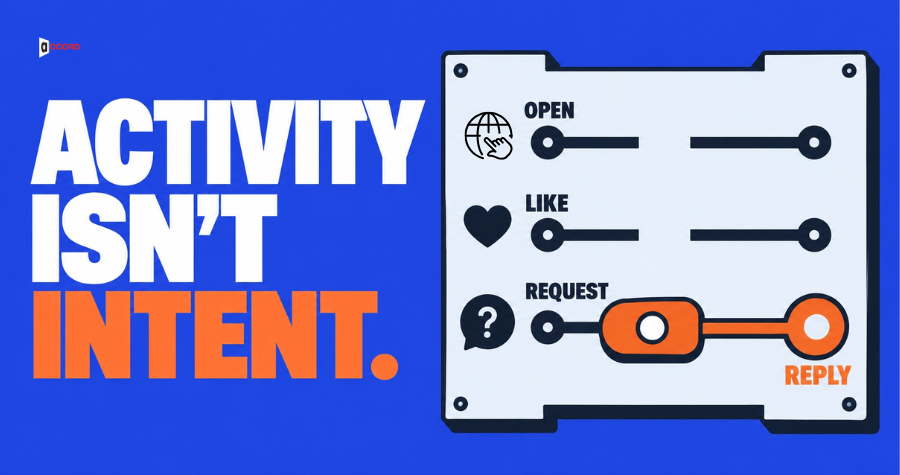
Seven buying signals, also called intent signals, deserve a fast, personal reply. Three usually deserve no human time: an email open, a single blog visit or like, and general company news such as an award. A signal is worth acting on when it is close to the problem you solve, recent, and checkable from a source you can open. Every signal suggests timing. None of them proves that a company wants to buy.
The seven signals at a glance:
- Direct request: a demo request, a quote request, a booked call or a message that asks to talk.
- Question: a question in a reply or message.
- Repeat visits: a named account returning to a pricing or service page.
- Hiring post: an open role for the team your service supports.
- New leader: a new head of the function you serve.
- Technology change: a move to a new CRM, email, analytics or website platform.
- Several people: multiple people from one account engaging within a short time.
Below, each signal shows what it looks like, how it misleads, how fast to act and what to say. For the full background on signals, read the signal-based lead generation guide.
What is the difference between buying signals, intent signals and intent data?
The three terms overlap, and vendors use them differently, so define them in your sheet. A buying signal is a specific, dated action or event you can point to, such as a demo request or a new role. An intent signal is the broader term, and it also covers weaker clues, such as research behavior. Intent data usually means a score or topic list that a vendor builds from research activity across many websites. It can be useful for spotting which companies are reading about a topic, but it is probabilistic: it rarely tells you who the person is, whether they have a budget or how far along they are. This guide focuses on signals you can open, read and date yourself.
Why do some signals matter more than others?
Most business buyers do a large part of their research before they talk to any supplier, and when they compare several suppliers they spread the time they do spend with sellers across all of them. Much of the buying work happens where you cannot see it, so the signals you can see are partial. A signal is a clue that a conversation may be timely, not a view into a decision.
Three tests separate a useful signal from noise.
- Is it close to the problem you solve? The event should connect to what your service fixes. A company hiring a head of sales is close to an outreach problem. A company that won a design award is not.
- Is it recent? An event from last week is a reason to write today. An event from last quarter is history. Choose a window, such as 30 days, and keep to it.
- Can you check it? You should be able to open a page and read the date. If you cannot, treat it as a guess.

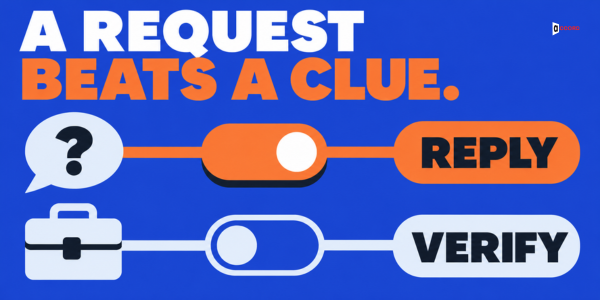
Then add one more question: how strong is it? A person who asked you for something is usually a stronger sign than a company that did something in public. The order of the seven signals below is a general guide to prioritization, not a fixed ranking: several people from one account engaging can outrank a single hiring post or technology change, depending on the account and on what you sell.
Which seven signals are worth acting on?
The response times in this guide are Accord's proposed starting points, not industry standards. Adjust them to your team.
1. A direct request for contact
This one is as clear as signals get: a demo request, a quote request, a booked call, or a message that simply says "can we talk?" The person has asked, and nothing else on this list is as direct. Reply within 15 minutes during business hours, and aim for 5 (our proposal; adjust to your team).
Some requests come from students, job seekers, competitors or vendors. A request from a company far outside your ideal customer still deserves a polite answer, just not a rushed one.
Your first message should answer what was asked, propose one time and add one question about their situation. Leave the brochure out. Something plain like "Yes, we can help with that. Would Thursday at 10 work, and what is prompting the question right now?" does the job.
2. A question in a reply or message
Picture a reply to a cold email, newsletter or social post that asks something: what it costs, how it works, whether you work with a certain type of company. It means the person is weighing whether your service applies to them, which is far more useful than a polite "thanks." Plan on one to two business hours.
Watch the tone, because a question can also be a way of ending the conversation. "How did you get my address?" is not interest. Answer that kind plainly and briefly.
For the real ones, answer first and add one question back. If someone asks about price, give the range or the honest "it depends on these two things" before you suggest a call.
3. Repeat visits to a pricing or service page by a named account
Your website analytics or marketing tool may show that a known account looked at your pricing, service or case study pages and came back within a week. A second visit counts for more than a first. If the account fits your ideal customer, write within one business day.
Treat the data with suspicion, though. Company-level tracking is a guess: it can mix up people who share an office network, miss people working from home and confuse companies with similar names. It cannot tell you who the visitor was or whether that person has any say in a decision.
Build the message around the topic, not the visit. A line such as "I noticed you were on our pricing page" can feel intrusive. Try "Teams often ask us how this is priced, and I can share the short version" instead.
4. A hiring post for the team your service supports
Companies hire where they invest, so an open role on the company's own careers page can point to a new project, a gap or a plan to build a team. The roles that matter are those tied to your service: a sales development role for an outreach service, a marketing operations role for a CRM service, a web developer for a website service. For a post under 30 days old at an account that fits, aim for three business days.
Postings can be old, reposted, or for a role already filled. A hiring post may also mean the company plans to do the work in-house, which makes it a poor prospect for an outside service. Read the description, not only the title, and check the post date.
When you do write, mention the role as context and ask one question about the goal. "I saw the open customer success role. Is improving onboarding a priority this quarter?" is enough.
5. A new leader in the function you serve
A new head of sales, marketing, operations or technology, announced on the company page or a professional network, often reviews tools, vendors and plans in the first months. That window is short, so this signal is time-sensitive. Reach out within three to five business days, and again around day 60 to 90 of their time in role (our proposal).
A new leader does not mean unhappiness with the current setup or a budget to spend. Many changes are routine, and some leaders arrive without the authority to change vendors yet.
Keep the first note short and respectful, and do not assume a problem. Congratulate only if it is natural, and share one relevant observation about the function. A former user or champion of yours who moves to a new company is an even stronger version of this signal, because that person already knows what you do.
6. A technology change
When a company moves to a new CRM, email platform, analytics tool or website platform, work usually follows: data to move, reports to rebuild, pages to redirect, processes to rewrite. You may spot the change in job posts, a public announcement or a technology lookup tool. Once confirmed, give yourself about one week.
The confirmation matters. Technology detection is imperfect, and tools can run side by side for months. A tool seen on a page may be an old script. Check a second source before you mention it to anyone.
Then ask what is changing and what they would like to keep, rather than claiming to know. A short checklist related to the change makes a useful offer.
7. Several people from one account engaging within a short time
Business purchases usually involve more than one person, so two or three people from one company reading your content, replying or attending your event within a few weeks suggests a shared project more strongly than one person does. Contact the person who asked the question or who owns the work the topic relates to, within one to two business days, and refer to the topic. Seniority alone does not make someone the right contact.
Check before you count. Colleagues sometimes forward a link without any project behind it, and one person may be using several devices or addresses. Make sure they are different people. To work out who usually sits in a buying group, read how to map a B2B buying committee. In the message, do not mention that you noticed several people. Write to one person about one topic.
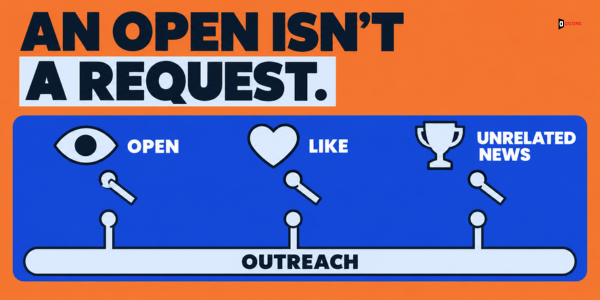
Which three signals should you ignore?
Ignoring a signal means not spending human time on it. You can still log it.
1. Email opens
An open count used to show that someone looked at your message. Since 2021, Apple's Mail Privacy Protection has downloaded remote content in the background, including tracking images, regardless of whether the person engages with the email, as Apple describes on its Mail Privacy Protection page. That registers an open whether or not anyone read the message, and some security tools do the same. Vendors report that a large share of opens in some programs are now machine-generated, though the numbers differ by source and by audience. Treat an open as a weak hint at most. Replies and clicks that follow a real action are more reliable.
2. A single blog visit, like or follow
One visit to one blog post shows curiosity about a topic, not an intention to buy. A follow or a like costs the person a second and says even less. Nurture these people with useful content, not a personal sales message. Pitching everyone who liked a post would reach many people with no need.
3. General company news
Awards, anniversaries, and press mentions that have no link to the problem you solve do not make a company more likely to need your service. They are a reason to congratulate someone, not a reason to pitch. A news item is worth acting on only when you can explain in one sentence how it connects to your service.
Ignored signals are not wasted. An email open on its own is noise, but an open from an account that also posted a relevant role last week is a small extra reason to prioritize that account. Let the weak signal support a stronger one, and never let it start a message on its own.
Which signals matter most for your own service?
The seven signals above are general. The order changes with what you sell, so rank them for your own service before you build any routine. Ask which events usually appear shortly before a customer needs you. Direct requests and questions in replies stay at the top whatever you sell, so these three invented examples rank the signals you spot in public.
If you sell an outreach or lead research service, a hiring post for sales development and a new head of sales will probably rank highest among publicly observed signals, because the company is building or changing its sales motion. If you sell a website or SEO service, a technology change to the website platform and a new head of marketing come first, since a rebuild or review is likely to start soon. If you sell CRM cleanup or data work, a CRM change and a hiring post for sales or marketing operations lead the list, because data work follows a system change.
To test your own ranking, list your last ten customers and write down what happened at each company in the 60 days before the first conversation. The pattern is better evidence than a general list, though ten is a small sample, so treat it as a starting guess.
How do you combine signals?
One signal is a hint. Two or three different signals at one account within a short window are stronger. A hiring post and a new leader in the same function, or a pricing-page visit and a question in a reply, point the same way.
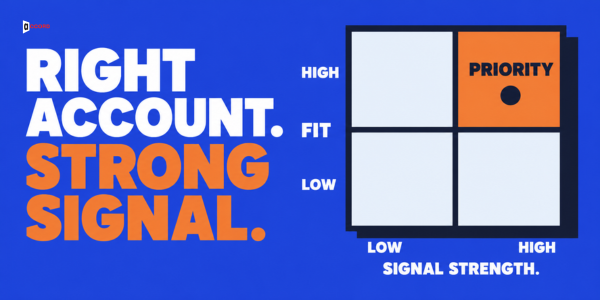
Keep two scores per account and do not add them: fit, which says whether the company is the right kind of company, and signal strength, which says how strong and recent the evidence is. Act first on high fit with a strong signal. A strong signal at a poor-fit account is a polite reply, not a priority.
Contact an account once, and open with the strongest signal. Five messages to five people because five signals appeared is the same spray problem in a new form.
Who owns each signal, and how fast do they act?
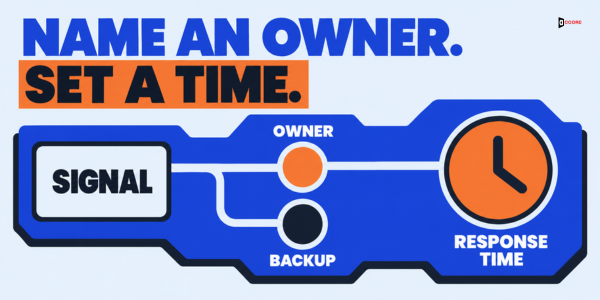
Give each of the seven signals one owner and one backup, and write the response time next to it. A short table in your sheet is enough.
| Signal | Owner | Backup | Response time (proposal) |
|---|---|---|---|
| Direct request | Sales rep on rotation | Sales manager | 15 minutes (aim for 5) |
| Question in a reply | Whoever sent the original message | Sales rep on rotation | 1 to 2 business hours |
| Repeat page visits | Account owner | Marketing lead | 1 business day |
| Hiring post | Researcher or SDR | Marketing lead | 3 business days |
| New leader | Account owner | Sales manager | 3 to 5 business days |
| Technology change | Researcher | Marketing lead | 1 week |
| Several people engaged | Account owner | Sales manager | 1 to 2 business days |
Without a named owner, the signal is seen by everyone and acted on by no one. Without a response time, "soon" means whenever someone has a free hour.
How do you know a signal is worth acting on in your market?
Do not trust any ranking, including this one, until your own numbers support it. For each signal type, keep four counts in your log: messages sent, positive replies, meetings held, and "not relevant" replies. After about 20 messages for one signal type you have enough to see a rough pattern, though not enough to prove one. Compare the types with each other. A signal that produces positive replies at a higher rate than the others deserves more of your time. A signal that produces mostly "not relevant" replies has a definition problem: tighten the rule for what counts, or retire it.
How do you check a signal before you write?
The three tests above cover relevance, recency and source. Before you write, add a two-minute check on every signal.
- Confirm it is the right company. Similar names and subsidiaries cause mistakes.
- Check the account is not a customer or already in conversation with you.
- Write the reason in one sentence. If you cannot explain why this event matters to this company, do not send.
- Check your information sources. Use only inquiries and engagement that came to you directly, such as replies, demo requests and visits to your own site, plus relevant public business information. Do not use private personal information.
Imagine: ten signals on a Monday
The details of this example are invented. Imagine a 30-person data services company with one person checking signals on Monday morning. The sheet shows ten new rows, each graded A, B or C for fit.
Row one is a demo request from a 120-person firm, an A, so it gets a reply within 15 minutes. Row two is a pricing question in a newsletter reply, also an A, answered within the hour. Row three is a second pricing-page visit this week from a named account, another A, which earns a short message the same day. Row four is an open role for a marketing operations manager, posted 8 days ago at an A account, so a message goes out within three days.
Row five is a new head of sales at a 60-person firm, graded B, so it gets a light note within five business days. Row eight is a company that won a regional award. It is an A for fit, but the award has nothing to do with the service, so congratulate if that feels natural and skip the pitch. Row nine shows two people from one account reading the same guide, another A, so a short message goes to the reader whose role is closest to the topic.
Row six is an email opened 11 times, a B, and it is ignored. Row seven is a liked post from a C account, also ignored. Row ten is a role posted 5 months ago and reposted, which looks fresh but is stale, so it is skipped.
Three rows get a fast, personal reply, three get a message within a set time, and four get no sales outreach. The person spends about 40 minutes on Monday and reaches the six accounts that matter while the signals are fresh.
Frequently asked questions
What are buying signals in sales?
Buying signals are observable actions or events that suggest a person or company may be ready to talk about a purchase: a request for contact, a question, repeated visits to a pricing page, a relevant hiring post. They suggest timing. They do not prove that a company has a budget or a decision.
How fast should we act on an intent signal?
For a direct request, within 15 minutes during business hours, and for a question, within one or two business hours. For a signal you noticed on your own, such as a hiring post, within a few business days while it is still fresh. These times are Accord's proposed starting points, not industry standards, and your own review will show where speed changes the result.
Is it creepy to contact someone because of a signal?
It can be, if the message shows how closely you watch them. Mention one public fact connected to their work, explain why it matters in one sentence and ask a question. If a message would feel odd to read aloud to the person, rewrite it.
Next step
If you want to check which of these signals fit your own sales process, book a 30-minute working session with the Accord team. Bring a list of the signals you see today and the last ten leads you worked, and use the time to rank them.