How do I actually prove that our AI-driven search strategy is paying off? This is the question haunting every boardroom in 2026. For decades, we chased blue links and raw click counts.
But today, with search engines morphing into "answer engines," the old playbook feels like measuring a jet engine with a yardstick. If your brand is the primary source for a Google AI Overview but nobody clicks because the answer was "too good," did you still win?
The short answer is yes, but only if you know how to track it. I recently worked with a mid-sized tech firm that saw their traditional organic traffic dip by 15%. Panic set in until we looked at their AI SEO performance measurement.
It turned out they were being cited in 60% of all AI-generated responses for their core product category. Their conversion rate from SEO hadn't just stayed steady; it had jumped because the visitors they did get were already pre-sold by the AI's recommendation.
This guide is for the marketing leaders, IT directors, and digital strategists who need to move beyond vanity metrics and embrace data-backed SEO growth. If you want the bigger picture on where SEO is headed in 2026, that context sets the stage perfectly for everything below.
What Is AI SEO Performance Measurement?
At its core, AI SEO performance measurement is the process of tracking your brand’s "Share of Model." It’s no longer just about where you rank on a list; it’s about how often Large Language Models (LLMs) and Search Generative Experiences (SGE) choose your content to synthesize an answer.
In the past, SEO was a game of visibility. In 2026, it is a game of "Entity Authority."
Why does this exist? "Entity Authority" is the name of the game in 2026. Why is this here?
Because people now use natural language to search.
Measuring SEO with AI requires us to understand if we are an "authoritative source" that the AI trusts enough to repeat. This shift is why AI-driven SEO reporting has become the cornerstone of any performance driven SEO strategy. To understand how AI ranking factors are changing how people search, it helps to first understand what signals these models are actually evaluating. If the AI doesn't know you exist, for most users, you don't.
How It Works: The Tech Behind the Tracking
Technically, AI SEO analytics has moved from simple keyword tracking to sophisticated NLP (Natural Language Processing) auditing. Modern tools now "scrape" AI responses to see which domains are being linked in the citation carousels.
When an AI agent builds a response, it looks for structured, high-quality data. Measuring SEO with AI involves checking your citation share, the percentage of time your site is the footnote for a specific topic.
Accord Tech Solutions, we treat these citations as the new "Position Zero." This isn't just about bots; it's about how those bots influence the conversion-focused SEO funnel by building trust before the user even lands on your site.
The New Key Performance Indicators for 2026
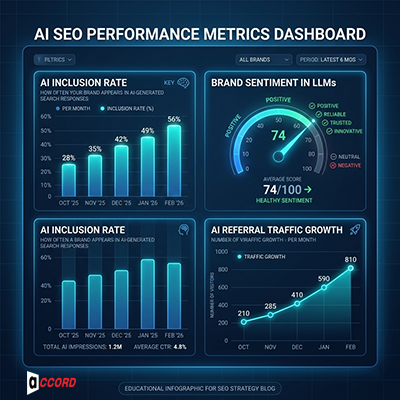
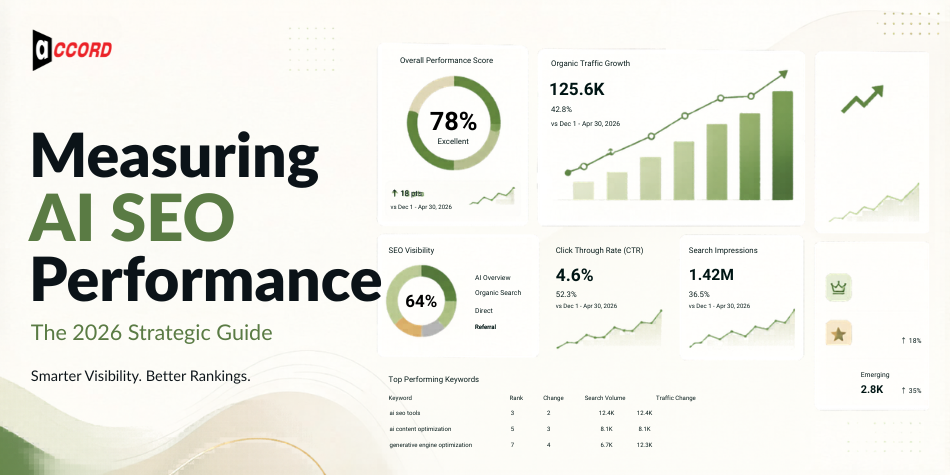
• A look at AI Inclusion Rate: How often your site shows up as a reference in Google's generative results.
• Brand Sentiment in LLMs: Using AI SEO analytics to see if ChatGPT or Gemini calls your product "reliable," "affordable," or "innovative."
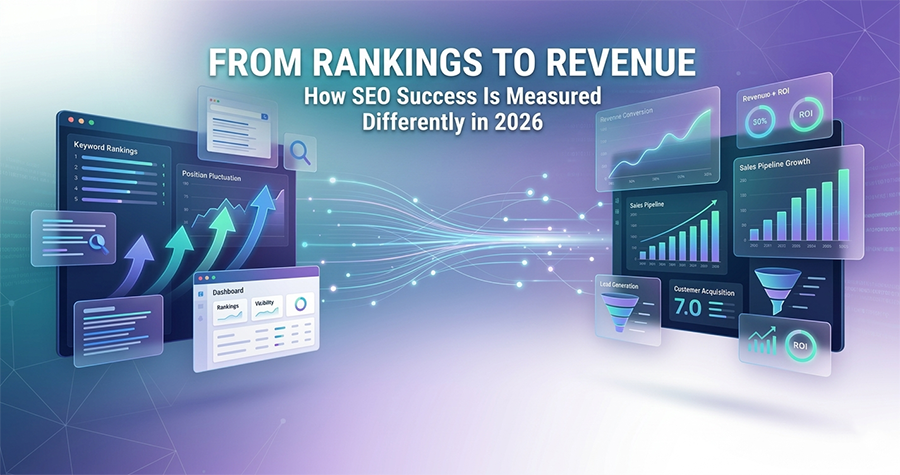
• Organic traffic growth tracking: This means looking at the "Referral Traffic" that comes from AI summaries with a high intent. For a deeper breakdown of how SEO success is measured differently in 2026, these new KPIs are explored in full detail alongside revenue attribution models.
Why It Matters: The Danger of Digital Silence
"Zero-click" is now the most common type of threat in digital marketing. If you don't pay attention to AI-driven SEO reporting, you could end up in digital silence.
In late 2025, real-world data showed that brands that didn't have an AI search optimization strategy lost a lot of market share to smaller, more flexible competitors that optimized for "extractability." You can read more about advertising on AI search engines to understand how paid and organic visibility are converging in this new environment.
An ROI focused SEO approach must account for the fact that being the "featured" expert in an AI response builds a mental bridge, even if the user doesn't click today. This makes "Branded Search" go up, which means that people will eventually look for you by name. It is very important to keep an eye on this "halo effect" as part of SEO performance tracking 2026.
Common Misconceptions
One major myth is that AI content optimization metrics are only about technical code. While schema helps, the AI actually cares more about the "expertise" shown in the writing.
Another common mistake is thinking that Core Web Vitals tracking is dead. Actually, speed is more important than ever because AI crawlers are expensive to run; they will prioritize sites that load and "parse" instantly.
Many people also confuse AI search optimization with keyword stuffing for bots. In reality, modern AI is smart enough to ignore fluff; it wants "information density."
How to Track SEO Performance
To stay ahead, you need a multi-layered approach to how to track SEO performance. It’s about merging the old world of clicks with the new world of citations.
1. Mastering AI Content Optimization Metrics
You need to analyze the "summarizability" of your content. If you ask an AI to summarize your service page and it misses your USP (Unique Selling Proposition), your AI content optimization metrics are failing. This is a core part of running AI-optimized SEO campaigns. Your content must be crystal clear so the machine doesn't misinterpret your value.
2. Search Ranking Improvement Tracking 2.0
Traditional search ranking improvement tracking still has a place, but you must now track "Pixel Height." Since AI Overviews take up the top of the screen, being #1 in blue links might actually be "below the fold." You need to measure how much "real estate" you own in the total AI result window.
3. SEO ROI Measurement in a Click less World
The million-dollar question: How to calculate SEO ROI when the AI gives the answer away? Look at your lead quality. Users who come from AI citations are usually further down the funnel. SEO KPIs for B2B companies should focus on assisted conversions, where the AI was the first touchpoint in a multi-week buying journey. This directly connects to the broader topic of B2B digital marketing trends in 2026, where AI-assisted conversion paths are reshaping how revenue is attributed.
Even though we are talking about measuring SEO with AI, the "Source of Truth" is still human expertise. AI models are trained to look for signals of real-world experience. This is why Accord Tech Solutions advocates for "Expert-Verified" content.
What metrics matter in SEO? In 2026, it’s the "Trust Score." If users see your brand cited by an AI and then see your experts quoted on LinkedIn or in industry journals, the conversion rate from SEO skyrockets.
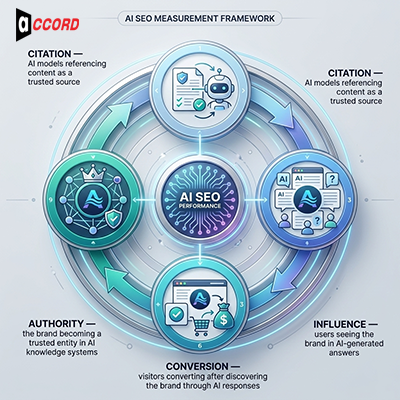
AI SEO Performance Measurement Framework: From Citation to Revenue
Score for AI Visibility
First, see how often AI-generated answers actually mention your brand. If tools like Google AI Overviews or ChatGPT keep bringing up your content, it's a good sign that people in your field trust your brand.
AI Rate of Influence
Next, see what happens after that visibility. Are more people looking for your brand name? Are visitors converting faster because they trust you more after seeing an AI mention? That change in behavior is real power.
Attribution for Assisted Conversion
Keep in mind that AI is often the first step, not the last one. A lot of people find you through an AI summary and then come back later to buy something. Keep an eye on those trips to get the big picture.
Signals of Trust and Authority
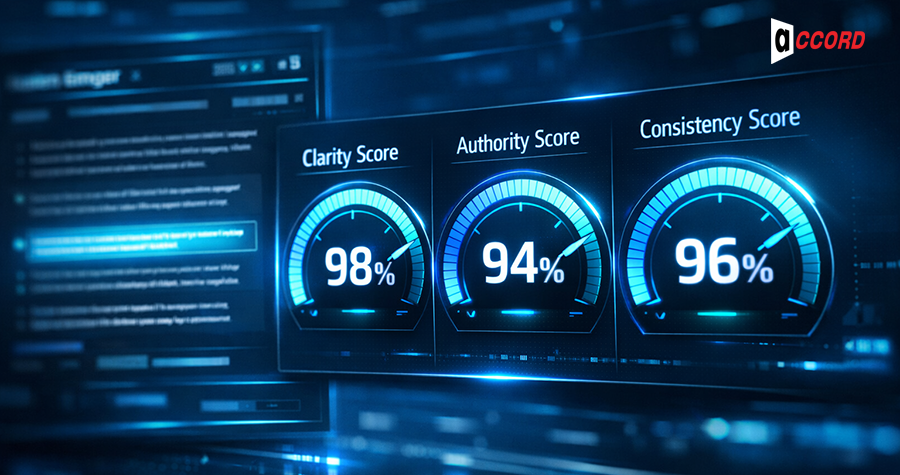
Last but not least, pay attention to how AI talks about your brand. If it always makes you look trustworthy, knowledgeable, or creative, you are building long-term authority.
When you put all four together, you go beyond rankings and start to see something more important: real influence that makes money.
Accord Tech Solutions Insight Box:
Don't just optimize for the bot; optimize for the referral. When an AI cites you, it usually provides a small link. To win the click, your metadata needs to be more compelling than ever. We recommend a "double-hook" strategy: one for the AI to scrape and one for the human to click.
Future Implications: Toward Agentic Search
As we look toward 2027, searches will be performed by "agents" (like Siri or specialized AI assistants) rather than humans. Success in AI SEO performance measurement will eventually mean being the "Preferred Provider" for these agents.
If you want to be known as the Best SEO Services Agency or the top software provider, you must ensure your data is clean, accessible, and consistently authoritative. For a real-world look at how AI agents are already changing workflows, this case study on AI agents rewriting software rules is worth reading before this shift accelerates further.
Summary of Modern Metrics

Frequently Asked Questions
Final Thoughts
The transition to AI SEO performance measurement is perhaps the biggest shift in digital marketing history. It requires a move from "counting hits" to "measuring influence." Your brand can do well in this new era by focusing on conversion-focused SEO and making sure that there is a high AI Overview inclusion rate.
In 2026, the people who win will not have the most keywords but the most "machine-reliable" authority.
Ready to see how your brand ranks in the AI era? Accord Tech Solutions provides the specialized tools and expertise needed to launch AI optimized SEO campaigns that turn citations into customers.