
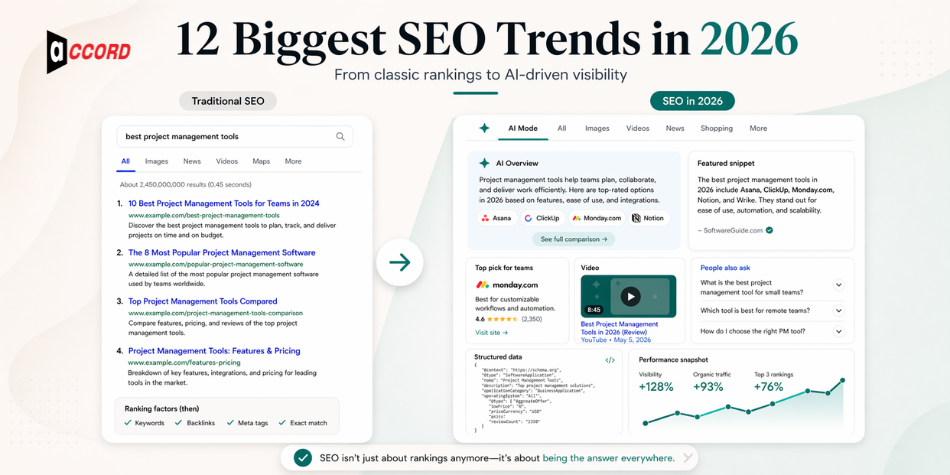
Are the biggest SEO trends of 2026 basically "rank less, get fewer clicks," or is there still a real way to grow?
As of 2026, the honest answer is: you can still grow — but growth now comes from being cited, trusted, and chosen inside AI answers, not only from traditional blue-link clicks. Google's AI Overviews, plus the wider shift toward "answer-first" search, are pushing more users into zero-click search strategies, where visibility matters even when traffic does not show up the way it used to.
Search has started to behave like a helpful coworker who answers your question before you finish asking it. That's great for users. For websites, it is a new kind of pressure.
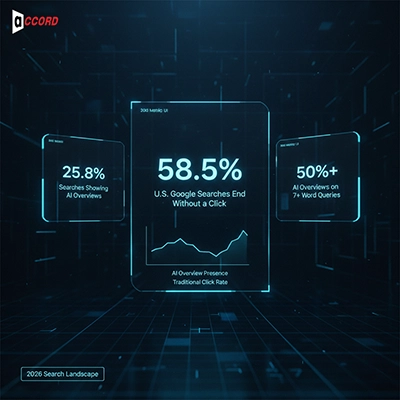
Here's the hard data behind the mood change:
- A large U.S. keyword study (2.37 million queries) found AI Overviews appear in 25.8% of searches and rise above 50% on longer, seven-word queries.
- SparkToro's 2024 study found 58.5% of U.S. Google searches ended with zero clicks.
- Google has recently pushed AI Overviews even deeper into the search flow — letting people ask follow-up questions and jump into AI Mode from the results page.
- Gartner has warned that traditional search volume could drop meaningfully as chat-style "answer engines" replace some searches.
That is the landscape we are walking into. This guide breaks the chaos into the 12 biggest trends that matter in 2026.
📖 Related: SEO Isn't Dead in 2026 — But This Is What's Actually Ranking in Google & AI Search | Are AI Ranking Factors 2026 Changing How People Search?
1) SEO Trends 2026 Are Being Rewritten by "Answer-First" Search
The first big shift in SEO trends in 2026 is psychological. People do not "browse" search results the same way anymore. They ask. They receive an answer. They move on.
That sounds small until you watch it happen in real life.
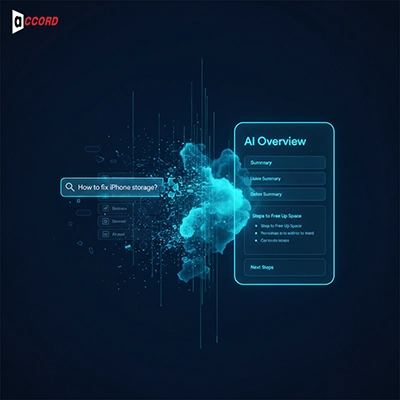
A friend texts you, "What's the best way to fix iPhone storage?" You open Google to help, and boom — an AI summary is already there. You skim it. You do not click. You feel done.
Search results are turning into destination pages. AI Overviews summarize and recommend next steps. It reduces friction. Google is competing with chat tools that answer instantly, so it is redesigning search to behave more like a conversation.
💡 What to do: Treat SEO as visibility engineering, not just traffic engineering. Structure content so it can be summarized accurately, and make your brand the "safe source" AI wants to quote.
Example: Accord Tech Solutions reviewed a service page that ranked well but got fewer leads. The fix was not "more keywords." It was adding a short comparison section and a clear checklist that AI could lift into summaries, while the page still offered depth for people who wanted details.
Impressions can rise while clicks fall. That is not a mistake. That is the new normal. You will measure influence more — not only sessions.
2) Search Generative Experience (SGE) Optimization Is Now Basically "Earn Citations"
Let's talk plainly about Search Generative Experience (SGE) optimization. The old goal was "rank #1." The new goal is often "be one of the sources the AI trusts."
AI Overviews appear in about one in four U.S. searches in a large study, and they trigger even more on longer queries. SGE-style results summarize information and cite a few sources — because users ask messy questions, and Google wants to answer them cleanly.
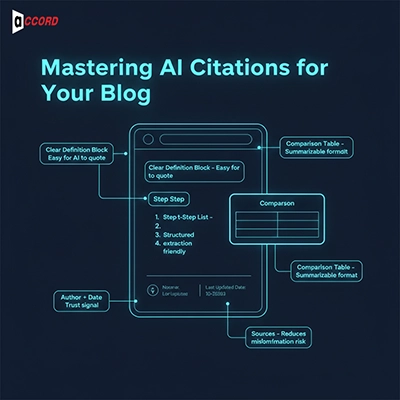
Write "citation-friendly" sections:
- Clear mini-definitions near the top
- Step-by-step lists
- Tables for comparisons
- Short "answer nuggets" that are easy to quote
You can earn brand visibility even when users do not click. Citation share-of-voice becomes the new ranking game.
3) Zero-Click Search SEO Strategy Becomes a Survival Skill, Not a Nice-to-Have
The number that makes marketers sit up straight: SparkToro found 58.5% of U.S. Google searches ended without a click.
This does not mean "SEO is dead." It means SEO is now partly about winning attention where the click never happens. AI Overviews, featured snippets, People Also Ask, local packs, and knowledge panels soak up the attention.
⚡ 58.5% of U.S. Google searches end with zero clicks. Visibility without clicks is now the new normal.
Build a zero-click search SEO strategy that does two things at once:
- Provide the best short answer on the page.
- Give a reason to click for the "next layer" of value.
That "next layer" can be a real checklist, a template, a calculator, a deeper comparison, or real examples and edge cases.
Example: A client's FAQ content got pulled into SERP features. Instead of resisting, they added a downloadable audit checklist and a short "common mistakes" section. People clicked when they realized the AI summary did not cover their specific situation. Clicks become fewer but more qualified.
📖 Related: Zero-Click Search & Featured Snippets: How to Still Get Traffic in 2026 | AI Search Optimization (AEO) in 2026: How Brands Get Cited in ChatGPT & Google AI
4) AI-Led Ranking Factors 2026 Are Pushing SEO Toward Trust Signals
Here's the part most people feel but struggle to explain: the web is crowded with content that sounds the same. AI makes that worse. So Google leans harder on signals that suggest "this is real."
That is where AI-led ranking factors for 2026 come in. In practice, they reward proof, clarity, and consistency. Ranking signals increasingly reflect whether content is trustworthy and experience-backed.
Add proof layers to every important page:
- Named authors with credentials
- Updated dates visible on the page
- Sources and citations for key claims
- First-hand experience and real examples
- Transparent limitations where they exist
Example: When a page makes a claim that cannot be confirmed, Accord Tech Solutions uses a line like: "This appears to be unverified or misleading information, and no official sources confirm its authenticity." That kind of honesty protects trust and reduces reputational risk. "Feels real" becomes a ranking advantage. Content that is vague, generic, or unsourced becomes invisible.
5) How AI Is Changing Organic Search Across Platforms, Not Just Google
Search is no longer one box. People ask TikTok for a quick tutorial, Reddit for real experiences, and ChatGPT for explanations. Gartner even predicts traditional search volume could drop as chat tools replace some queries. Search behavior now fragments across multiple platforms.
Each platform "wins" a different intent:
- Video platforms for "show me"
- Forums for "tell me what really happened"
- AI chat for "explain it simply"
- Google for "verify and compare"
Build content that can travel across formats:
- Turn blog sections into short video scripts
- Turn FAQs into social posts
- Turn comparisons into tables people can screenshot and share
Example: A long guide was repurposed into a short checklist post and a video outline. The original page gained more branded searches later because people remembered the name. SEO becomes reputation management across surfaces. Omni-visibility becomes the goal.
📖 Related: AI SEO Performance Measurement: Is Your Brand Fading into the Shadows in 2026? | AI Search Optimization in 2026: Get Cited (Not Ignored) by ChatGPT and Google AI
6) The Importance of E-E-A-T in 2026 Is No Longer Optional
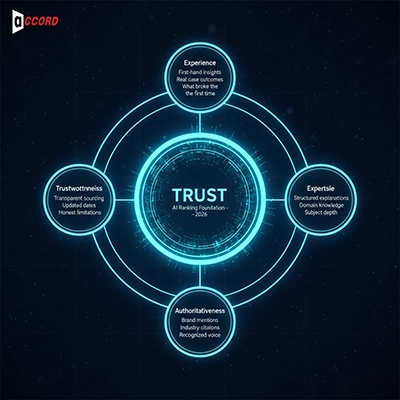
The importance of E-E-A-T in 2026 is not theoretical anymore. If AI systems summarize the internet, they need to decide which sources are safe.
E-E-A-T means Experience, Expertise, Authoritativeness, and Trustworthiness. It is how Google and other systems separate "helpful" from "harmful" content.
Show experience without being cheesy — use honest framing like:
- "Here's what happened when we tried it."
- "Here's what broke the first time."
- "Here's the part most guides skip."
Trust turns into search visibility. Anonymous, faceless content struggles. First-person experience is now a competitive advantage.
7) "Cited Content" Beats "Perfect Content" in AI Overviews
This trend is sneaky. People assume the best page always wins. In AI Overviews, the best quotable page often wins.
A page can be brilliant but messy. AI does not love messy. AI picks chunks that are clean, direct, and structured. Summaries need extractable, low-risk snippets.
Use a simple pattern on every important section:
- One-sentence definition at the top
- Bullet list of steps or key points
- Short comparison table where relevant
- Clear conclusion sentence
Structure becomes a ranking tool. Expect more "snippet engineering" to become standard practice in 2026.
8) Technical SEO for AI Search Engines Turns Into "Make It Easy to Understand"
Traditional technical SEO still matters. But technical SEO for AI search engines is now less about tricks and more about clean communication. AI needs to crawl, parse, and interpret your page correctly. If Google cannot confidently understand your page, it will not cite it in an AI summary.
Prioritize:
- Fast-loading pages across all devices
- Clean internal linking that guides crawlers
- Structured data markup where it fits naturally
- Clear headings and focused topic coverage per page
Better crawl eligibility equals better eligibility for AI features. Technical SEO in 2026 is clarity engineering.
📖 Related: How to Create an Effective SEO Strategy in 2026 | AI-Powered SEO Strategy: How Small Businesses Can Compete in 2026
9) SEO Audit Services for the AI Era Now Check "AI Visibility," Not Only Rankings
Old audits focused on errors and positions. That is still useful — but no longer sufficient.
SEO audit services for the AI era should also examine:
- Where AI Overviews appear for your core topics
- Whether your brand is being cited in AI answers
- Which of your pages are "AI-friendly" in structure
- Which pages are at risk of becoming zero-click results
Add new audit checkpoints to your standard process:
- Snippet readiness — can this section be quoted cleanly?
- Citation readiness — does this page have structured, quotable content?
- E-E-A-T proof — is there authorship, sourcing, and transparency?
- Content freshness — is the information still accurate and up to date?
During audits, tag pages into three buckets: likely to become zero-click, likely to earn citations, and likely to drive clicks. That helps prioritize work efficiently. Audits will increasingly track "answer share" alongside traditional rankings.
10) Forums and First-Hand Experiences Are Being Elevated
This is not a "new" trend, but it is louder now. Google is clearly surfacing more discussion content, and Reddit's visibility has grown in many markets. Forums show up more often for experience-based questions because people want real stories, not marketing copy.
Use forums as research tools:
- Collect common pain points your audience is discussing
- Note the exact language real users use to describe problems
- Build content that answers the real questions — not the assumed ones
Your blog becomes more aligned with real demand. Experience-driven content keeps rising as a visibility driver in 2026.
11) "Best SEO Services" Content Must Educate, Not Sell
When you mention the best SEO services, make it a learning moment. Explain what a reader should actually look for. Treat it like consumer education — not a pitch.
Service keywords are still searched, but buyers want proof. AI tools and zero-click results have made people more skeptical. They want clarity, not promises.
When evaluating the best SEO services, check for:
- Do they measure AI Overviews' impact on visibility?
- Do they track zero-click exposure and impression share?
- Do they show E-E-A-T improvements over time?
- Do they explain strategy in plain, transparent language?
If an agency cannot explain how they adapt to AI answers, they are behind. Educated buyers make better choices. Service pages will need more transparency in 2026 to convert.
12) "Expert SEO Agency in USA" Positioning Shifts Toward AI Search Readiness
Agency selection criteria are changing. Because AI-led SERPs require newer skills: citation strategy, content structuring, and trust building — not just keyword targeting and link building.
If someone is hiring an expert SEO agency in USA, the smart questions in 2026 include:
- "How do you handle a zero-click search SEO strategy?"
- "How do you approach Search Generative Experience (SGE) optimization?"
- "How do you prove AI-led ranking factors 2026 improvements?"
- "Do you track AI Overviews and citations — not just rankings?"
A good agency can show examples of content that earns citations — not just content that ranks. Agencies become search strategists, not keyword stuffers. Procurement becomes more rational and results-focused.
📖 Related: From Rankings to Revenue: How SEO Success Is Measured Differently in 2026 | Which SEO Tactics Still Help Websites Rank Well in Current Search Algorithms?
How to Rank When Clicks Disappear
Step 1: Pick the right query types.
If the query is "what is," expect AI to answer it fully. Instead, write content around:
- Comparisons ("X vs Y")
- "Best for" scenarios with context
- Step-by-step troubleshooting guides
- Decision guides for different situations
This aligns with what tends to trigger deeper engagement and click-through.
Step 2: Create a citation block.
Add a short section designed to be quoted directly by AI systems:
- 40 to 80 words maximum
- Direct, specific answer — no filler
- Simple, clear language
- No vague qualifiers
This is also where your low-competition phrase fits naturally: how to get cited in AI Overviews.
Step 3: Add the click reason.
After the short answer, give something AI cannot fully replace or summarize:
- A real, downloadable checklist
- A customizable template
- Case-based nuance from real experience
- A list of mistakes to avoid with examples
Step 4: Track new signals.
Move beyond sessions and rankings. Track:
- Impressions in Google Search Console
- Branded search volume growth
- Featured snippet ownership for your key topics
- AI Overview presence on your target keywords
SEO Moves That Will Work in 2026
- Make pages that can be safely quoted — definitions, numbered steps, and comparison tables.
- Put "decision" content ahead of "dictionary" content in your page structure.
- Treat zero-click search SEO strategy as both a branding play and a lead-quality play.
- Strengthen E-E-A-T proof with named authorship, visible update dates, and transparent sourcing.
- Run SEO audit services for the AI era quarterly — include AI Overview checks as standard.
- Add one "next layer" asset on every major page: a template, checklist, tool, or real-world examples.
FAQs
Final Takeaway
If you remember one thing, make it this: in 2026, you can still win the search — but winning often looks like being the trusted voice inside the answer.
That is why SEO trends in 2026 are so different. And that is why Search Generative Experience (SGE) optimization, zero-click search SEO strategy, and AI-led ranking factors for 2026 are no longer "advanced topics." They are the basics now.
Continue Reading
- → From Rankings to Revenue: How SEO Success Is Measured Differently in 2026
- → Are AI Ranking Factors 2026 Changing How People Search?
- → How AI-Powered SEO Is Changing the Game for Small Businesses in 2026
- → How to Create an Effective SEO Strategy in 2026
- → Google Drops Support for 7 Schema Types — What Marketers Must Refocus On